
Masked Autoencoders Are Effective Tokenizers for Diffusion Models
Hao Chen$^{*1,2}$ Yujin Han$^{*3}$ Fangyi Chen$^{1}$ Xiang Li$^{1}$ Yidong Wang$^{4}$
Jindong Wang$^{5}$ Ze Wang$^{2}$ Zicheng Liu$^{2}$ Difan Zou$^{3}$ Bhiksha Raj$^{1}$
$^{*}$Equal contribution $^{1}$Carnegie Mellon University $^{2}$AMD $^{3}$The University of Hong Kong $^{4}$Peking University $^{5}$William & Mary.
Correspondence to: Hao Chen [email protected].
Proceedings of the 42nd International Conference on Machine Learning, Vancouver, Canada. PMLR 267, 2025. Copyright 2025 by the author(s).
Abstract
Recent advances in latent diffusion models have demonstrated their effectiveness for high-resolution image synthesis. However, the properties of the latent space from tokenizer for better learning and generation of diffusion models remain under-explored. Theoretically and empirically, we find that improved generation quality is closely tied to the latent distributions with better structure, such as the ones with fewer Gaussian Mixture modes and more discriminative features. Motivated by these insights, we propose MAETok, an autoencoder (AE) leveraging mask modeling to learn semantically rich latent space while maintaining reconstruction fidelity. Extensive experiments validate our analysis, demonstrating that the variational form of autoencoders is not necessary, and a discriminative latent space from AE alone enables state-of-the-art performance on ImageNet generation using only 128 tokens. MAETok achieves significant practical improvements, enabling a gFID of 1.69 with 76× faster training and 31× higher inference throughput for 512×512 generation. Our findings show that the structure of the latent space, rather than variational constraints, is crucial for effective diffusion models. Code and trained models are released^1.
Executive Summary: Diffusion models have revolutionized high-resolution image synthesis, but their efficiency hinges on a compressed latent space learned by tokenizers. Traditional approaches use variational autoencoders (VAEs), which impose constraints to create smooth latent distributions but often sacrifice pixel-level reconstruction accuracy. Plain autoencoders (AEs) offer better fidelity yet produce tangled latent spaces that hinder generative performance. As demand grows for scalable, high-quality image generation in applications like design and media, understanding what makes an effective latent space is critical today, enabling faster training and inference without compromising output quality.
This document evaluates how latent space structure influences diffusion model performance and demonstrates a new tokenizer called MAETok to address key limitations. It aims to show that a discriminative latent space, rather than variational constraints, drives superior results in image generation.
The authors conducted empirical and theoretical analysis on popular tokenizers, including AEs, VAEs, and aligned VAEs, using the ImageNet dataset for 256x256 and 512x512 resolutions. They modeled latent distributions with Gaussian mixture models to quantify complexity via the number of modes. Diffusion models were then trained in these spaces to measure generation quality. Motivated by findings, they developed MAETok: an AE trained with masked image patches (40-60% masking) to encourage semantic richness, aided by auxiliary decoders predicting features like edge histograms or pre-trained embeddings. The encoder was frozen after initial training, and only the decoder was fine-tuned to restore reconstruction fidelity. Experiments involved training tokenizers for 500,000 iterations and diffusion models like SiT (675 million parameters) for up to 4 million steps, evaluating on metrics such as generation Frechet Inception Distance (gFID) and reconstruction FID (rFID).
The analysis revealed three main insights. First, latent spaces with fewer mixture modes—indicating clearer, more separated features—yielded 20-30% lower diffusion training losses and better generation, with gFID dropping to 1.69 on 512x512 images versus 3-5 for less structured spaces. Second, MAETok's plain AE design outperformed VAEs by achieving state-of-the-art gFID (1.69 without guidance, 1.65 with) using just 128 tokens, compared to 256-1024 tokens in prior models requiring billions of parameters. Third, it delivered strong reconstruction (rFID of 0.48, SSIM of 0.763) while enabling 76 times faster training and 31 times higher inference speed (3.12 images per second on a single GPU versus 0.1). Masking with multiple targets proved optimal, as low-level features alone sufficed for basics, but semantic ones like CLIP embeddings boosted results by 15-20% in gFID.
These findings mean that prioritizing latent space organization over variational smoothing can cut computational costs dramatically—reducing training time from weeks to days and inference from seconds to milliseconds per image—while matching or exceeding prior benchmarks on fidelity and diversity. This challenges reliance on VAEs, which add overhead without proportional gains, and highlights how entangled latents increase risks of poor generalization or mode collapse in generation. Surprisingly, MAETok excelled in unconditional generation (gFID 1.67 without class conditioning), suggesting built-in semantics reduce dependence on guidance techniques, potentially simplifying deployment.
Leaders should adopt MAETok for diffusion-based pipelines, integrating it into existing frameworks for immediate efficiency gains in image synthesis tools. For high-stakes uses like creative AI, pair it with SiT or LightningDiT models, starting with 128 tokens to balance quality and speed; if higher fidelity is needed, increase to 256 tokens at a modest 20% compute cost. Further work requires piloting on domain-specific datasets beyond ImageNet and refining guidance methods, as current classifier-free approaches show tuning sensitivity.
While experiments are robust across resolutions and architectures, limitations include reliance on ImageNet (1.3 million images), which may limit transfer to diverse real-world data, and theoretical assumptions like bounded Gaussian modes that simplify complex distributions. Confidence in core claims is high, supported by ablations and visualizations, but caution applies to low-data regimes or non-image tasks where latent entanglement could persist.
1. Introduction
Section Summary: Diffusion models have become a leading way to generate high-quality images by gradually adding and removing noise, and they work even better when operating in a compressed "latent space" rather than directly on pixels, which saves a lot of computing power. However, creating an ideal latent space is tricky: traditional methods like variational autoencoders produce organized but somewhat blurry reconstructions, while simpler autoencoders offer sharper results but less structured spaces that can hinder generation. This paper explores how the structure of latent spaces affects diffusion models, finding through experiments and proofs that spaces with fewer, more distinct features lead to better performance, and proposes a new "masked autoencoder" approach that trains these spaces to be both organized and precise, achieving top results on image generation tasks with fewer resources.
Diffusion models [1, 2, 3, 4] have recently emerged as a powerful class of generative models, achieving state-of-the-art (SOTA) performance on various image synthesis tasks [5, 6].
Although originally formulated in pixel space [2, 7], subsequent research has shown that operating in a latent space – a compressed representation typically learned by a tokenizer – can substantially improve the efficiency and scalability of diffusion models [3]. By avoiding the high-dimensional pixel domain during iterative diffusion and denoising steps, latent diffusion models dramatically reduce computational overhead and have quickly become the de facto paradigm for high-resolution generation [8].
However, a key question remains: What constitutes a "good" latent space for diffusion? Early work primarily employed Variational Autoencoders (VAE) [9] as tokenizers, which ensure that the learned latent codes follow a relatively smooth distribution [10] via a Kullback–Leibler (KL) constraint. While VAEs can empower strong generative results [11, 12, 13], they often struggle to achieve high pixel-level fidelity in reconstructions due to the imposed regularization [14]. In contrast, recent explorations with plain Autoencoders (AE) [15, 16] produce higher-fidelity reconstructions but may yield latent spaces that are insufficiently organized or too entangled for downstream generative tasks [17]. Indeed, more recent studies emphasize that high fidelity to pixels does not necessarily translate into robust or semantically disentangled latent representations [18, 19]; leveraging latent alignment with pre-trained models can often improve generation performance further [20, 21, 22, 23].
In this work, we attempt to answer this question by investigating the interaction between the latent distribution learned by tokenizers, and the training and sampling behavior of diffusion models operating in that latent space. Specifically, we study AE, VAE and the recently emerging representation aligned VAE [20, 21, 23, 19], by fitting a Gaussian mixture model (GMM) into their latent space. Empirically, we show that a latent space with more discriminative features, whose GMM modes are fewer, tends to produce a lower diffusion loss. Theoretically, we prove that a latent distribution with fewer GMM modes indeed leads to a lower loss of diffusion models and thus to better sampling during inference.
Motivated by these insights, we demonstrate that diffusion models trained on AEs with discriminative latent space are enough to achieve SOTA performance. We propose to train AEs as Masked Autoencoders (MAE) [24, 25, 26], a self-supervised paradigm that can discover more generalized and discriminative representations by reconstructing proxy features [27]. More specifically, we adopt the transformer architecture of tokenizers [28, 29, 20, 21] and randomly mask the image tokens at the encoder, whose features need to be reconstructed at the decoder [30]. To maintain a pixel decoder with high reconstruction fidelity, we adopt auxiliary shallow decoders that predict the features of unseen tokens from seen ones to learn the representations, along with the pixel decoder which is normally trained as previous tokenizers. The auxiliary shallow decoders introduce trivial computation overhead during training. This design allows us to extend the MAE objective that reconstructs masked image patches, to simultaneously predict multiple targets, such as HOG [31] features [26], DINOv2 features [32], CLIP embeddings [33, 34], and Byte-Pair Encoding (BPE) indices with text [35].
Furthermore, we reveal an interesting decoupling effect: the capacity to learn a discriminative and semantically rich latent space at the encoder can be separated from the capacity to achieve high reconstruction fidelity at the decoder. In particular, a higher mask ratio (40–60%) in MAE training often degrades immediate pixel-level quality. However, by freezing the AE’s encoder, thus preserving its well-organized latent space, and fine-tuning only the decoder, we can recover strong pixel-level reconstruction fidelity without sacrificing the semantic benefits of the learned representations.
Extensive experiments on ImageNet ([5]) demonstrate the effectiveness of MAETok. It addresses the trade-off between reconstruction fidelity and discriminative latent space by training the plain AEs with mask modeling, showing that the structure of latent space is more crucial for diffusion learning, instead of the variational forms of VAEs. MAETok achieves improved reconstruction FID (rFID) and generation FID (gFID) using only 128 tokens for the 256 $\times$ 256 and 512 $\times$ 512 ImageNet benchmarks.
Our contributions can be summarized as follows:
- Theoretical and Empirical Analysis: We establish a connection between latent space structure and diffusion model performance through both empirical and theoretical analysis. We reveal that structured latent spaces with fewer Gaussian Mixture Model modes enable more effective training and generation of diffusion models.
- MAETok: We train plain AEs using mask modeling and show that simple AEs with more discriminative latent space empower faster learning, better generation, and higher throughput of diffusion models, showing that the variational regularization of VAE is not necessary.
- SOTA Generation Performance: Diffusion models of 675M parameters trained on MAETok with 128 tokens achieve performance comparable to previous best models on 256 ImageNet generation and outperform previous 2B USiT at 512 resolution with 1.69 gFID and 304.2 IS.
2. On the Latent Space and Diffusion Models
Section Summary: Researchers explore how different latent spaces, created by tools like autoencoders and variational autoencoders, influence the performance of diffusion models used for generating images. Their experiments show that latent spaces with simpler structures—measured by fitting them to Gaussian mixtures, where fewer "modes" indicate less complexity—lead to easier training for the models and higher-quality images, as seen in lower losses and better visual results. A supporting theory proves that more complex spaces with many modes demand far more training data to achieve similar outcomes, explaining why simpler designs yield superior generations under typical conditions.
To study the relationship of latent space for diffusion models, we start with popular tokenizers, including AE [15], VAE [9], representation aligned VAE, i.e., VAVAE [19]. We train our own AE and VAE tokenizers under the same training recipe and the same dimension for fair comparison. We train diffusion models on them and establish connections between latent space properties and the quality of the final image generation through empirical and theoretical analysis.
Empirical Analysis. Inspired by existing theoretical work [36, 37, 38], our investigation of the connection between latent space and generation quality starts with a high-level intuition. With optimal diffusion model parameters, such as sufficient total time steps and adequately small discretization steps, and with assumed similar capacity of tokenizer decoders, the generation quality of diffusion models, i.e., the learned latent distribution, is dominated by the denoising network's training loss [36, 37, 38], while the effectiveness of training diffusion model via DDPM [2] heavily depends on the hardness of learning the latent space distribution [39, 40, 41]. Specially, when the training data distribution is too complex and multi-modal, i.e., not discriminative enough, the denoising network may struggle to capture such entangled global structure of latent space, resulting in a degraded generation quality.
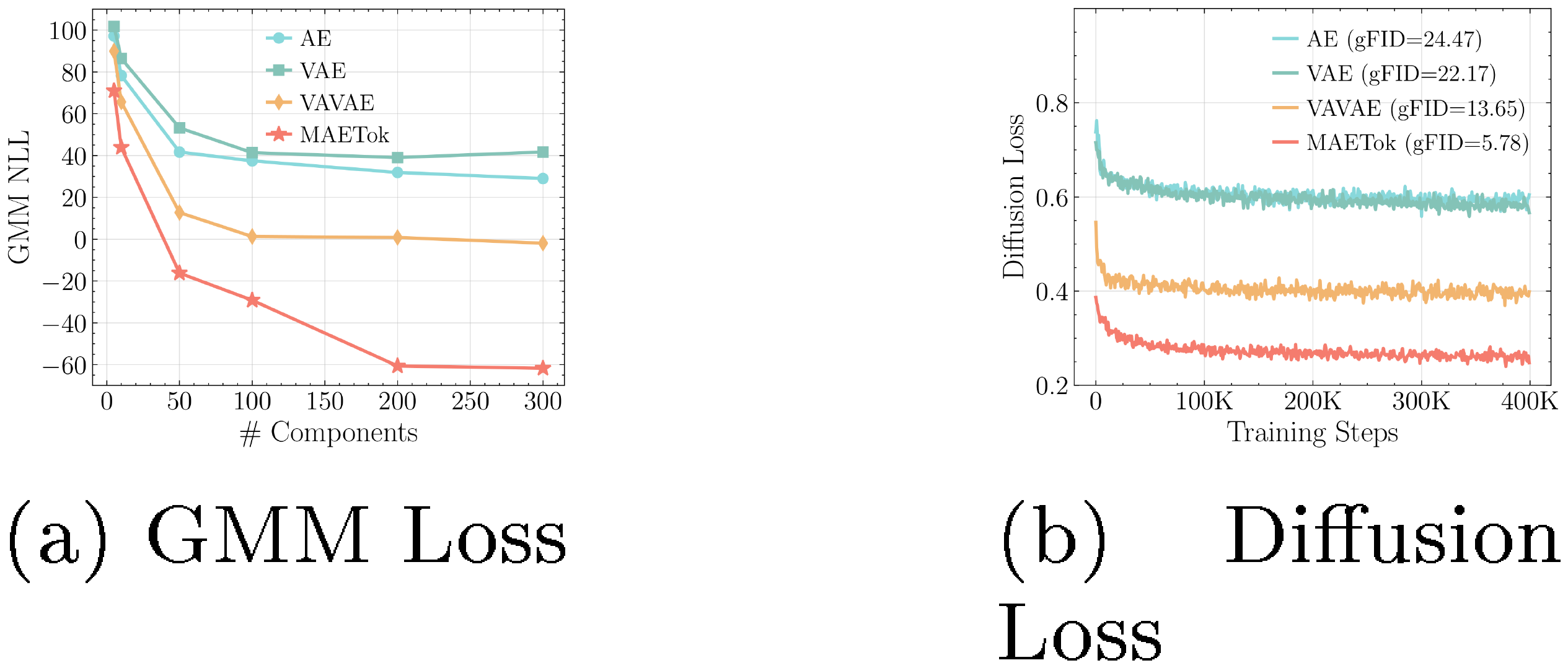
Building upon this intuition, we use the Gaussian Mixture Models (GMM) to evaluate the number of modes in alternative latent space representations, where a higher number of modes indicates a more complex structure. The details of GMM training are included in Appendix B.3. Figure 2a analyzes the GMM fitting by varying the number of Gaussian components and comparing their negative log-likelihood losses (NLL) across different latent spaces, where a lower NLL indicates better fitting quality. We observe that, to achieve comparable fitting quality, i.e., similar GMM losses, VAVAE requires fewer modes compared to VAE and AE. Fewer modes are sufficient to adequately represent the latent space distributions of VAVAE compared to those of AE and VAE, highlighting simpler global structures in its latent space. Correspondingly, Figure 2b reports the training losses of diffusion models with AE, VAE, and VAVAE, which (almost) align with the GMM losses shown in Figure 2a, where fewer modes correspond to lower diffusion losses and better gFID. This alignment validates our intuition, confirming that latent spaces with fewer modes and thus more separated and discriminative features can reduce the learning difficulty and lead to better generation quality of diffusion models.
Theoretical Analysis. After observing experimental phenomena that align with our high-level intuition, we further present a concise theoretical analysis here to justify the rationale behind it, with more details provided in Appendix A.
Following the empirical analysis setup, we first consider a latent data distribution in $d$ dimensions modeled as a GMM with $K$ equally weighted Gaussians:
$ \begin{align} p_0 = \frac{1}{K} \sum_{i=1}^{K} \mathcal{N}(\boldsymbol{{\mu}}^*_i, \mathbf{I}), \end{align}\tag{1} $
Considering the classic diffusion model DDPM [2] and following the training objective as [39], the score matching loss of DDPM at timestep $t$ is
$ \begin{align} \min_{\mathbf w} \mathbb E[|s_{\mathbf w}(\mathbf x, t)-\nabla_{\mathbf x} \log p_t(\mathbf x)|^2], \end{align}\tag{2} $
where $s_{\mathbf w}(\mathbf x, t)$ represents the denoising network and $\nabla_{\mathbf{x}}\log p_t(\mathbf x)$ denotes the oracle score function.
Then, we establish the following theorem to show that more modes typically require larger training sample sizes for diffusion models to achieve comparable generation quality.
Theorem 1
(Informal, see Theorem 7) Let the data distribution be a mixture of $ K $ Gaussians as defined in Equation 1. Then assume the norm of each mode is bounded by some constants, let $d$ be the data dimension, $T$ be the total time steps, and $\epsilon$ be a proper target error parameter. In order to achieve a $O(T\epsilon^2)$ error in KL divergence between data distribution and generation distirbution, the DDPM algorithm may require using $ n \geq n'$ number of samples:
$ \begin{align} n' = \Theta\left(\frac{K^4 d^5 B^6}{\varepsilon^2}\right), \end{align}\tag{3} $
where the upper bound of the mean norm satisfies $\max_i |\boldsymbol{\mu}_i| \leq B $.
Theorem 1 combines Theorem 16 from [39] and Theorem 2.2 from [37], showing that to achieve a comparable generation quality $O(T\epsilon^2)$, latent spaces with more modes ($ K $) require a larger training sample size, scaling as $ \mathcal{O}(K^4) $ .This theoretically help explain why, under a finite number of training samples, latent spaces with more modes (e.g., AE and VAE) produce worse generations with higher gFID. We provide additional experimental results in Appendix A, demonstrating that these latent distributions share comparable upper bounds $B$, thus justifying our focus primarily on the impact of mode number $K$.
3. Method
Section Summary: The researchers introduce MAETok, a simple autoencoder method that replaces more complex variational autoencoders in diffusion models for image generation, showing it can achieve top performance with just 128 tokens by creating clear, discriminative latent spaces through fewer mixture model modes. The model uses a vision transformer-based encoder to process image patches alongside learnable latent tokens, producing compact representations, while a similar decoder reconstructs the image from these representations and additional tokens, incorporating position encodings to preserve spatial details. Training involves standard reconstruction losses plus masked modeling, where 40-60% of patches are hidden during encoding, and auxiliary decoders predict various features like edge detectors or pre-trained embeddings for the masked parts to enhance learning without needing variational components.
Motivated by our analysis, we show that the variational form of VAEs may not be necessary for diffusion models, and simple AEs are enough to achieve SOTA generation performance with 128 tokens, as long as they have discriminative latent spaces, i.e., with fewer GMM modes. We term our method as MAETok, with more details as follows.
3.1 Architecture
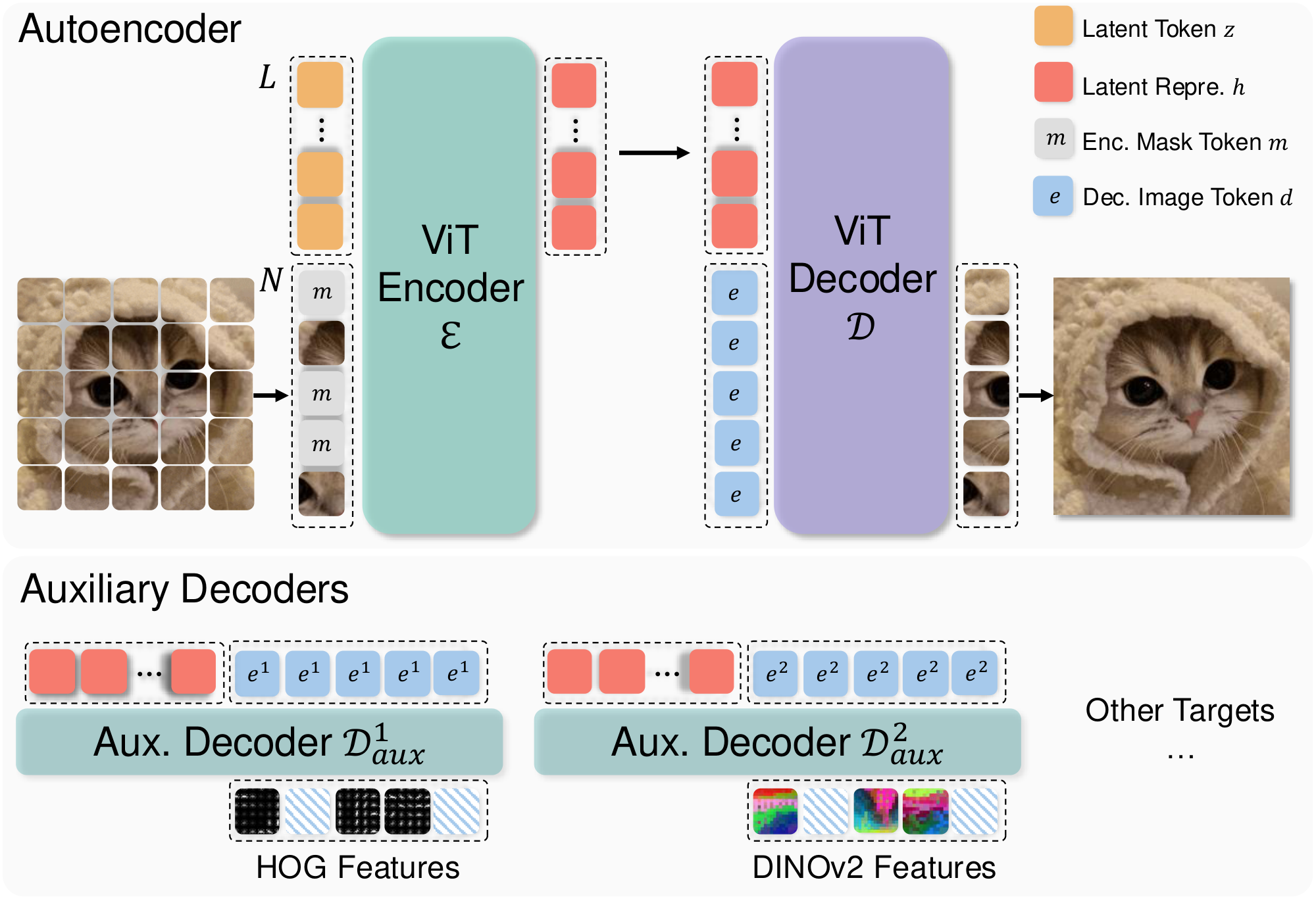
We build MAETok upon the recent 1D tokenizer design with learnable latent tokens [29, 20, 21]. Both the encoder $\mathcal{E}$ and decoder $\mathcal{D}$ adopt the Vision Transformer (ViT) architecture [42, 28], but are adapted to handle both image tokens and latent tokens, as shown in Figure 3.
Encoder. The encoder first divides the input image $I \in \mathbb{R}^{H \times W \times 3}$ into $N$ patches according to a predefined patch size $P$, each mapped to an embedding vector of dimension $D$, resulting in image tokens $\mathbf{x} \in \mathbb{R}^{N \times D}$. In addition, we define a set of $L$ learnable latent tokens $\mathbf{z} \in \mathbb{R}^{L \times D}$. The encoder transformer takes the concatenation of image patch embeddings and latent tokens $\left[\mathbf{x} ; \mathbf{z}\right] \in \mathbb{R}^{(N+L) \times D}$ as its input, and outputs the latent representations $\mathbf{h} \in \mathbb{R}^{L \times H}$ with a dimension of $H$ from only the latent tokens:
$ \mathbf{h}=\mathcal{E}\left(\left[\mathbf{x} ; \mathbf{z} \right] \right). $
Decoder. To reconstruct the image, we use a set of $N$ learnable image tokens $\mathbf{e} \in \mathbb{R}^{N \times H}$. We concatenate these mask tokens with $\mathbf{h}$ as the input to the decoder, and takes only the outputs from mask tokens for reconstruction:
$ \hat{\mathbf{x}} =\mathcal{D}([\mathbf{e} ; \mathbf{h}]]). $
We then use a linear layer on top of $\hat{\mathbf{x}} \in \mathbb{R}^{N \times D}$ to regress the pixel values and obtain the reconstructed image $\hat{I}$.
Position Encoding. To encode spatial information, we apply 2D Rotary Position Embedding (RoPE) to the image patch tokens $\mathbf{x}$ at the encoder and the image tokens $\mathbf{e}$ at the decoder. In contrast, the latent tokens $\mathbf{z}$ (and their encoded counterparts $\mathbf{h}$) use standard 1D absolute position embeddings, since they do not map to specific spatial locations. This design ensures that patch-based tokens retain the notion of 2D layout, while the learned latent tokens are treated as a set of abstract features within the transformer architecture.
Training objectives. We train MAETok using the standard tokenizer losses as in previous work [18]:
$ \mathcal{L} = \mathcal{L}_{\textrm{recon}}
- \lambda_1 \mathcal{L}{\textrm{percep}} + \lambda_2 \mathcal{L}{\textrm{adv}},\tag{4} $
with $\mathcal{L}{\textrm{recon}}$, $\mathcal{L}{\textrm{percep}}$, and $\mathcal{L}_{\textrm{adv}}$ denoting as pixel-wise mean-square-error (MSE) loss, perceptual loss [43, 44, 45, 46], and adversarial loss [47, 48], respectively, and $\lambda_1$ and $\lambda_2$ being hyper-parameters. Note that MAETok is a plain AE architecture, therefore, it does not require any variational loss between the posterior and prior as in VAEs, which simplifies training.
3.2 Mask Modeling
Token Masking at Encoder. A key property of MAETok is that we introduce mask modeling during training, following the principles of MAE [24, 25], to learn a more discriminative latent space in a self-supervised way. Specifically, we randomly select a certain ratio, e.g., 40%-60%, of the image patch tokens according to a binary masking indicator $M \in \mathbb{R}^N$, and replace them with the learnable mask tokens $\mathbf{m} \in \mathbb{R}^D$ before feeding them into the encoder. All the latent tokens are maintained to more heavily aggregate information on the unmasked image tokens and used to reconstruct the masked tokens at the decoder output.
Auxiliary Shallow Decoders. In MAE, a shallow decoder [24] or a linear layer [25, 26] is required to predict the target features, e.g., raw pixel values, HOG features, and features from pre-trained models, of the masked image tokens from the remaining ones. However, since our goal is to train MAE as tokenizers, the pixel decoder $\mathcal{D}$ needs to be able to reconstruct images in high fidelity. Thus, we keep $\mathcal{D}$ as a similar capacity to $\mathcal{E}$, and incorporate auxiliary shallow decoders to predict additional feature targets, which share the same design as the main pixel decoder but with fewer layers. Formally, each auxiliary decoder $\mathcal{D}^j_{\mathrm{aux}}$ takes the latent representations $\mathbf{h}$ and concatenate with their own $\mathbf{d}^j$ as inputs, and output $\hat{\mathbf{y}}^j$ as the reconstruction of their feature target $\mathbf{y}^j \in \mathbb{R}^{N \times D^j}$:
$ \hat{\mathbf{y}}^j =\mathcal{D}^j_{\mathrm{aux}}([\mathbf{e}^j ; \mathbf{h}] ; \theta), $
where $D^j$ denotes the dimension of target features. We train these auxiliary decoders along with our AE using additional MSE losses at only the masked tokens according to the masking indicator $M$, similarly to [25]:
$ \mathcal{L}_{\textrm{mask}} = \sum_j \left| M \otimes \left(\hat{\mathbf{y}}^j -\mathbf{y}^j \right) \right|_2^2. $
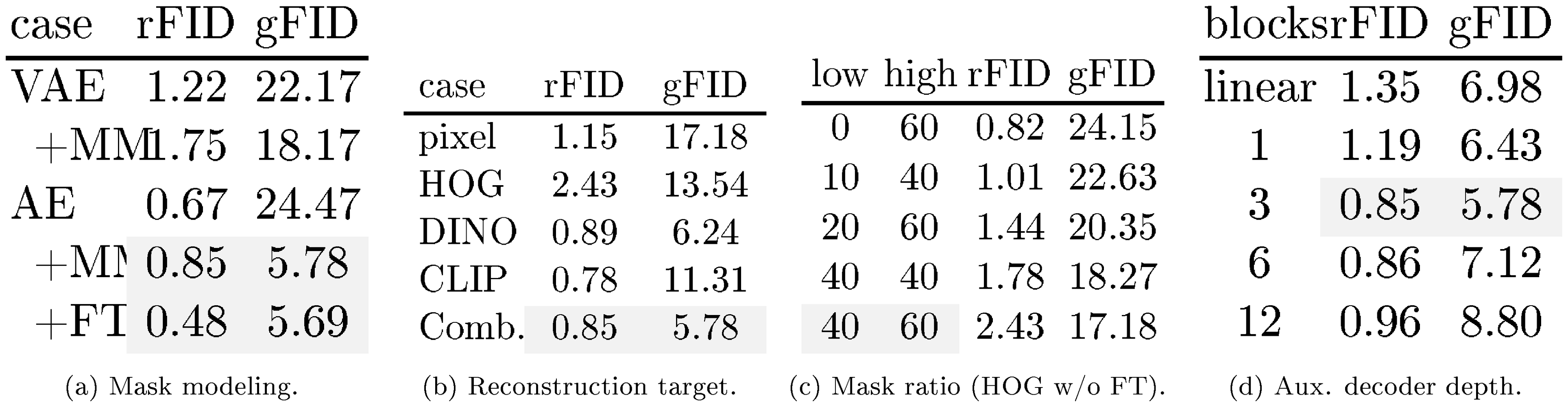
::: {caption="Table 1: Ablations with MAETok on 256 $\times$ 256 ImageNet. We report rFID of tokenizer and gFID of SiT-L trained on latent space of the tokenizer without classifier-free guidance. We train tokenizer of 250K and SiT-L for 400K steps. Default settings are indicated in Grey."}
:::
3.3 Pixel Decoder Fine-Tuning
While mask modeling encourages the encoder to learn a better latent space, high mask ratios can degrade immediate reconstruction. To address this, after training AEs with mask modeling, we freeze the encoder, thus preserving the latent representations, and fine-tune only the pixel decoder for a small number of additional epochs. This process allows the decoder to adapt more closely to frozen latent codes of clean images, recovering the details lost during masked training. We use the same loss as in Equation 4 for pixel decoder fine-tuning and discard all auxiliary decoders in this stage.
4. Experiments
Section Summary: Researchers conducted detailed experiments to test the MAETok model's design, examine its internal representations, and compare its image generation abilities against other methods. They trained the model on datasets like ImageNet using techniques such as masking parts of images during learning and adding helper components to improve how well it reconstructs and generates pictures, with tests showing that balanced masking, semantic features, and decoder adjustments enhance overall performance without losing detail. Visualizations revealed that MAETok creates clearer, more organized internal spaces for image features compared to simpler models, leading to better-separated categories and superior generation results.
We conduct comprehensive experiments to validate the design choices of MAETok, analyze its latent space, and benchmark the generation performance to show its superiority.
4.1 Experiments Setup
Implementation Details of Tokenizer. We use XQ-GAN codebase [49] to train MAETok. We use ViT-Base [42], initialized from scratch, for both the encoder and the pixel decoder, which in total have 176M parameters. We set $L=128$ and $H=32$ for latent space. Three MAETok variants are trained on 256 $\times$ 256 ImageNet [5], and 512 $\times$ 512 ImageNet, and a subset of 512 $\times$ 512 LAION-COCO [50] for 500K iterations, respectively. In the first stage training with mask modeling on ImageNet, we adopt a mask ratio of 40-60%, set by ablation, and 3 auxiliary shallow decoders for multiple targets of HOG [31], DINO-v2-Large [32], and SigCLIP-Large [34] features. We adopt an additional auxiliary decoder for tokenizer trained on LAION-COCO, which predicts the discrete indices of text captions for the image using a BPE tokenizer [51, 35]. Each auxiliary decoder has 3 layers also set by ablation. We set $\lambda_1=1.0$ and $\lambda_2=0.4$. For the pixel decoder fine-tuning, we linearly decrease the mask ratio from 60% to 0% over 50K iterations, with the same training loss. More training details of tokenizers are shown in Appendix B.1.
Implementation Details of Diffusion Models. We use SiT [52] and LightningDiT [19] for diffusion-based image generation tasks after training MAETok. We set the patch size of them to 1 and use a 1D position embedding, and follow their original training setting for other parameters. We use SiT-L of 458M parameters for the analysis and ablation study. For main results, we train SiT-XL of 675M parameters for 4M steps and LightningDiT for 400K steps on ImageNet of resolution 256 and 512. More details are provided in Appendix B.2.
Evaluation. For tokenizer evaluation, we report the reconstruction Frechet Inception Distance (rFID) [53], peak-signal-to-noise ratio (PSNR), and structural similarity index measure (SSIM) on ImageNet and MS-COCO [54] validation set. For the latent space evaluation of the tokenizer, we conduct linear probing (LP) on the flatten latent representations and report accuracy. To evaluate the performance of generation tasks, we report generation FID (gFID), Inception Score (IS) [55], Precision and Recall [56] (in Appendix C.1), with and without classifier-free guidance (CFG) [57], using 250 inference steps.
4.2 Design Choices of MAETok
We first present an extensive ablation study to understand how mask modeling and different designs affect the reconstruction of tokenizer and, more importantly, the generation of diffusion models. We start with an AE and add different components to study both rFID of AE and gFID of SiT-L.
Mask Modeling. In Table 1a, we compare AE and VAE with mask modeling and also study the proposed fine-tuning of the pixel decoder. For AE, mask modeling significantly improves gFID and slightly deteriorates rFID, which can be recovered through the decoder fine-tuning stage without sacrificing generation performance. In contrast, mask modeling only marginally improves the gFID of VAE, since the imposed KL constraint may hinder latent space learning.
Reconstruction Target. In Table 1b, we study how different reconstruction targets affect latent space learning in mask modeling. We show that using the low-level reconstruction features, such as the raw pixel (with only a pixel decoder) and HOG features, can already learn a better latent space, resulting in a lower gFID. Adopting semantic teachers such as DINO-v2 and CLIP instead can significantly improve gFID. Combining different reconstruction targets can achieve a balance in reconstruction fidelity and generation quality.
Mask Ratio. In Table 1, we show the importance of proper mask ratio for learning the latent space using HOG target, as highlighted in previous works [24, 26, 25]. A low mask ratio prevents the AE from learning more discriminative latent space. A high mask ratio imposes a trade-off between reconstruction fidelity and the latent space quality, and thus generation performance.
Auxiliary Decoder Depth. We study the depth of auxiliary decoder in Table 1 with multiple reconstruction targets. We show that a decoder that is too shallow or too deep could hurt both the reconstruction fidelity and generation quality. When the decoder is too shallow, the combined target features may confuse the latent with high-level semantics and low-level details, resulting in a worse reconstruction fidelity. However, a deeper auxiliary decoder may learn a less discriminative latent space of the AE with its strong capacity, and thus also lead to worse generation performance.
We include more ablation study on the number of learnable latent tokens and 2D RoPE in Appendix C.4.
4.3 Latent Space Analysis
We further analyze the relationship between the latent space of the AE variants and the generation performance of SiT-L.
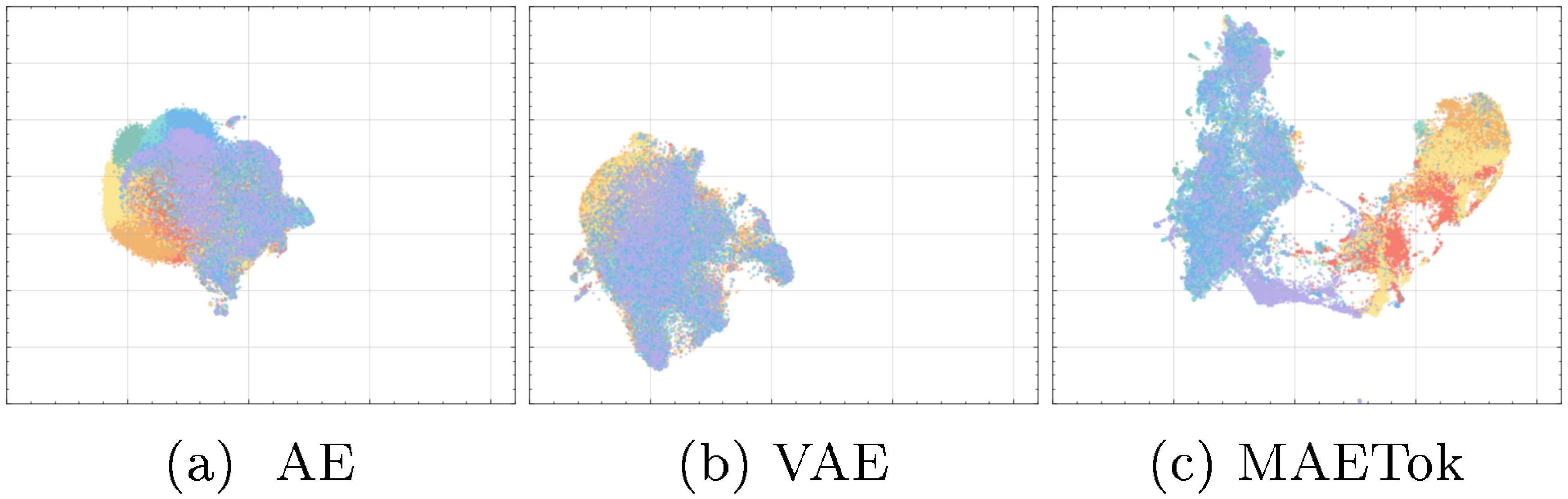
Latent Space Visualization. We provide a UMAP visualization [58] in Figure 4 to intuitively compare the latent space learned by different variants of AE. Notably, both the AE and VAE exhibit more entangled latent embeddings, where samples corresponding to different classes tend to overlap substantially. In contrast, MAETok shows distinctly separated clusters with relatively clear boundaries between classes, suggesting that MAETok learns more discriminative latent representations. In line with our analysis in Equation 5 and Figure 2, a more discriminative and separated latent representation of MAETok results in much fewer GMM modes and improve the generation performance. More visualization is shown in Appendix C.3.
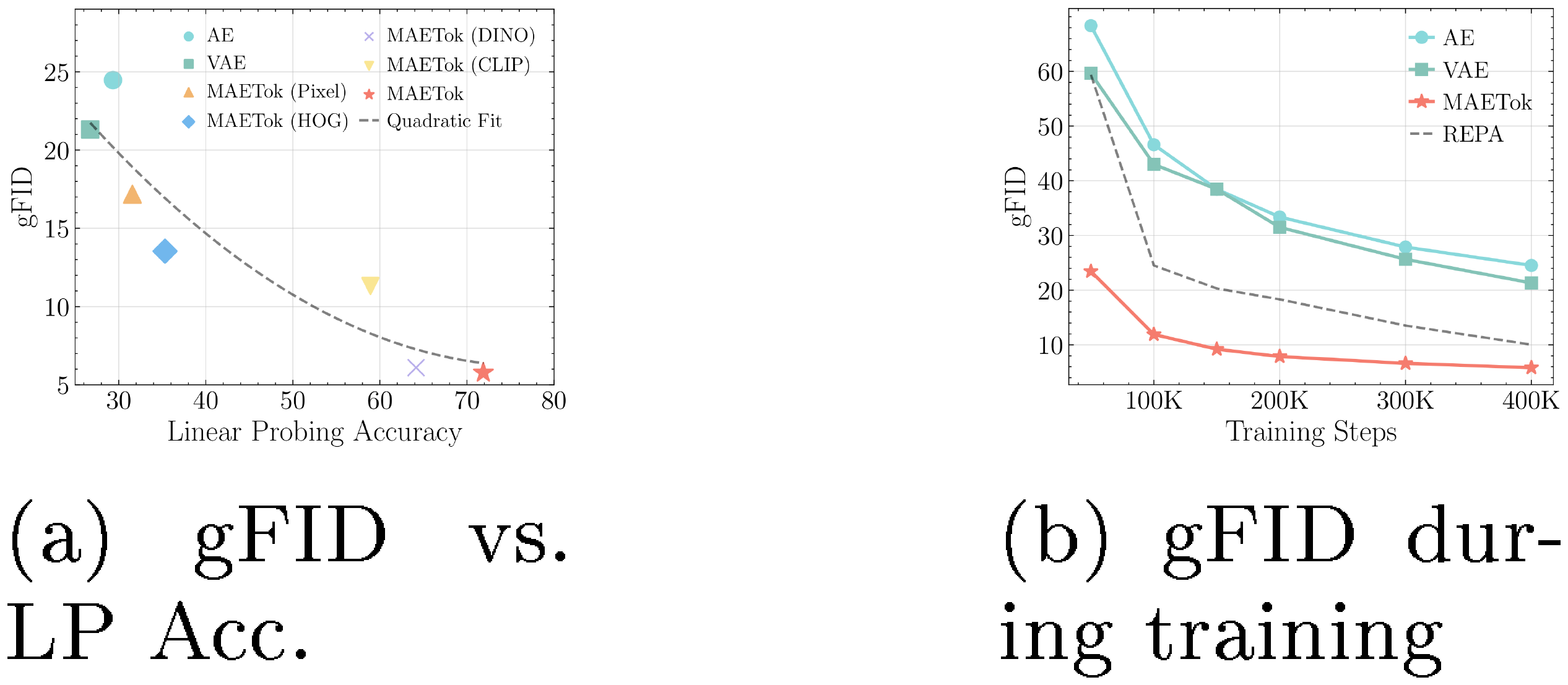
Latent Distribution and Generation Performance. We assess the latent space's quality by studying the relationship between the linear probing (LP) accuracy on the latent space, as a proxy of how well semantic information is preserved in the latent codes, and the gFID for generation performance. In Figure 5a, we observe tokenizers with more discriminative latent distributions, as indicated by higher LP accuracy, correspondingly achieve lower gFID. This finding suggests that when features are well-clustered in latent space, the generator can more easily learn to generate high-fidelity samples. We further verify this intuition by tracking gFID throughout training, shown in Figure 5b, where MAETok enables faster convergence, with gFID rapidly decreasing with lower values than the AE or VAE baselines. A high-quality latent distribution is shown to be a crucial factor in both achieving strong final generation metrics and accelerating training.
4.4 Main Results
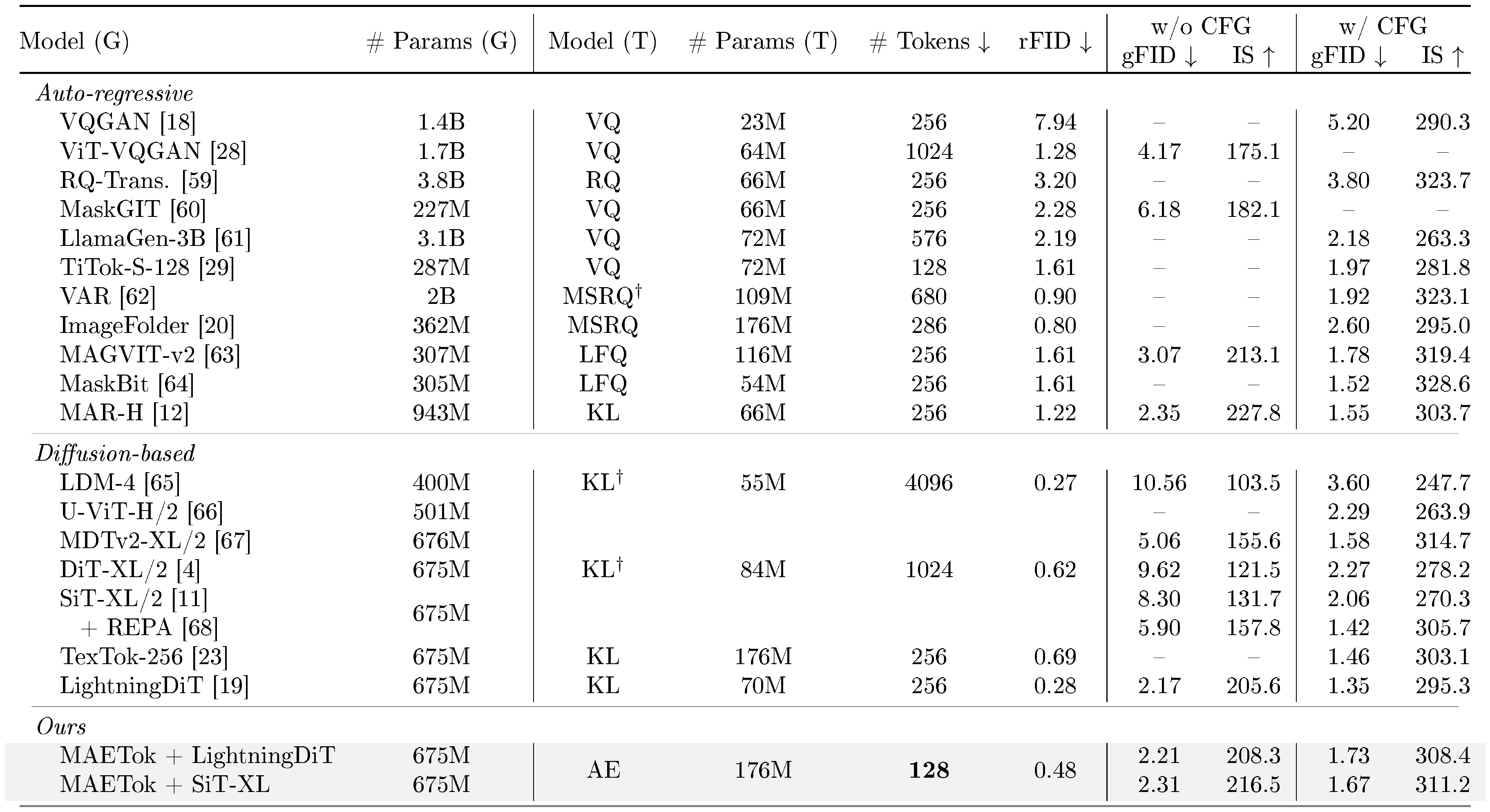
::: {caption="Table 2: System-level comparison on ImageNet 256 $\times$ 256 conditional generation. SiT-XL and LightningDiT trained on MAETok achieves performance comparable to state-of-the-art using plain AE with only 128 tokens. "Model (G)": the generation model. "# Params (G)": the number of generator's parameters. "Model (T)": the tokenizer model. "# Params (T)": the number of tokenizer's parameters. "# Tokens": the number of latent tokens used during generation. $^\dagger$ indicates that the model has been trained on other data than ImageNet."}
:::
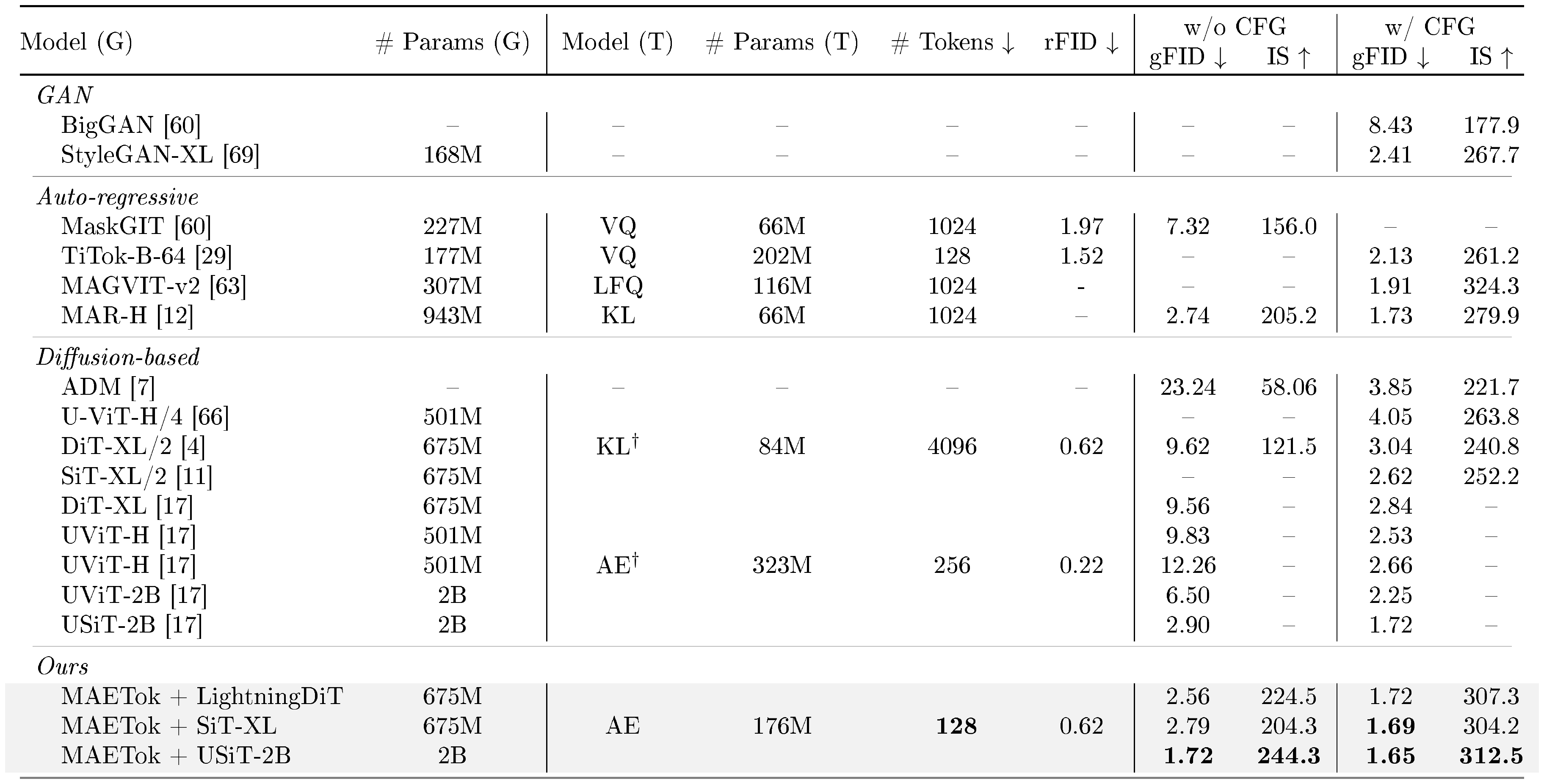
::: {caption="Table 3: System-level comparison on ImageNet 512 $\times$ 512 conditional generation. SiT-XL and LightningDiT trained on MAETok achieve state-of-the-art performance using plain AE with only 128 tokens, outperforming USiT of 2B parameters using only 675M parameters."}
:::
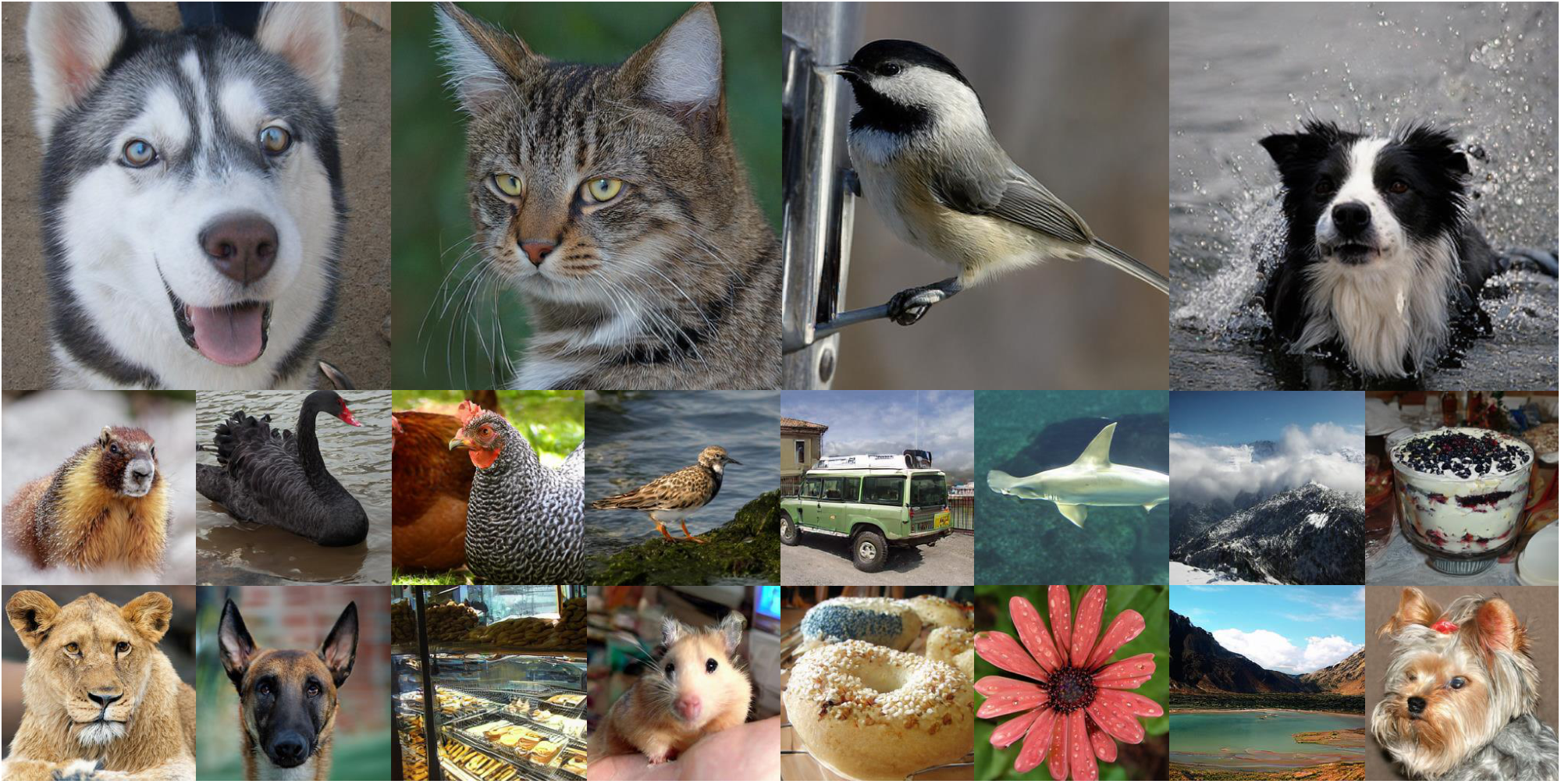
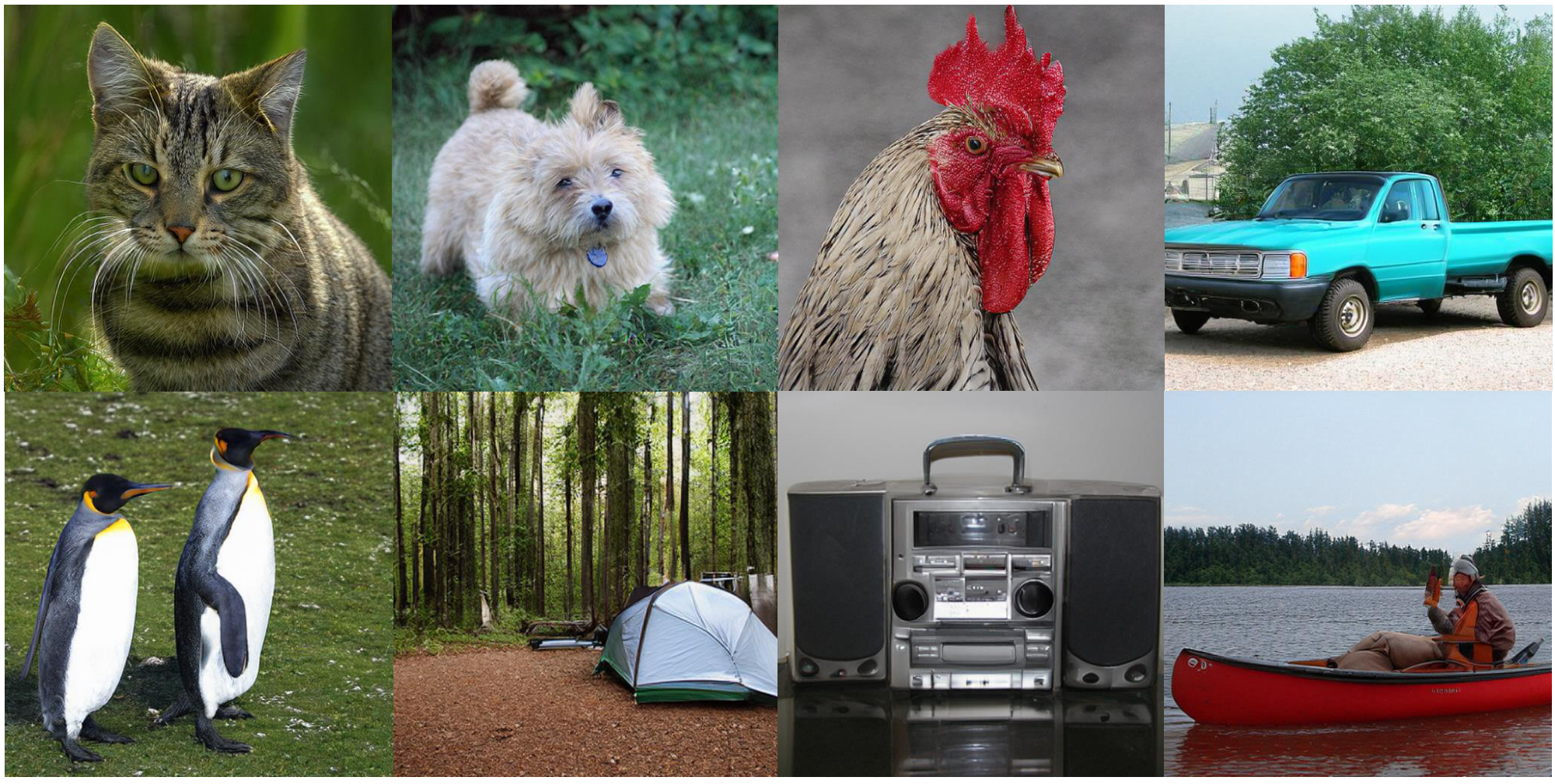
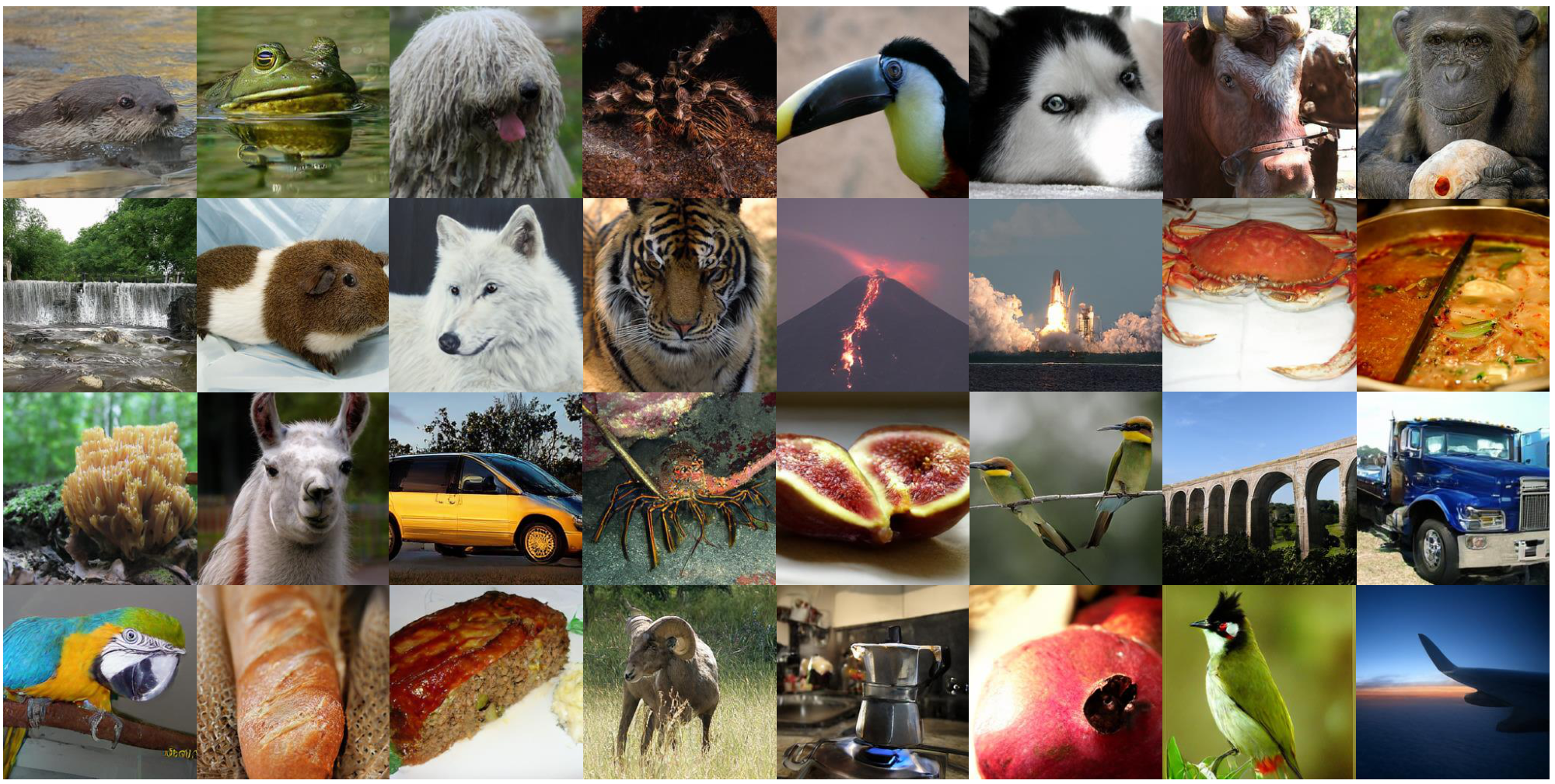
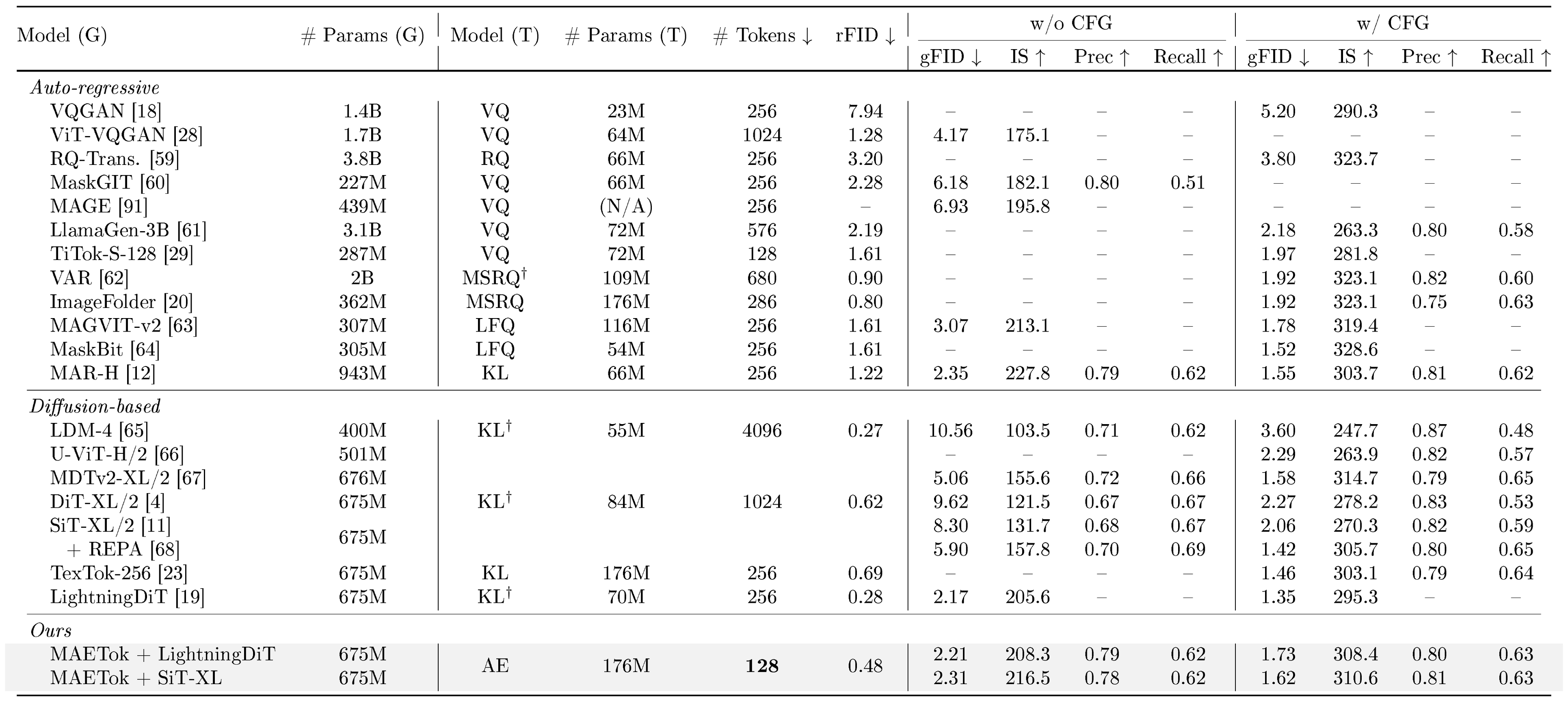
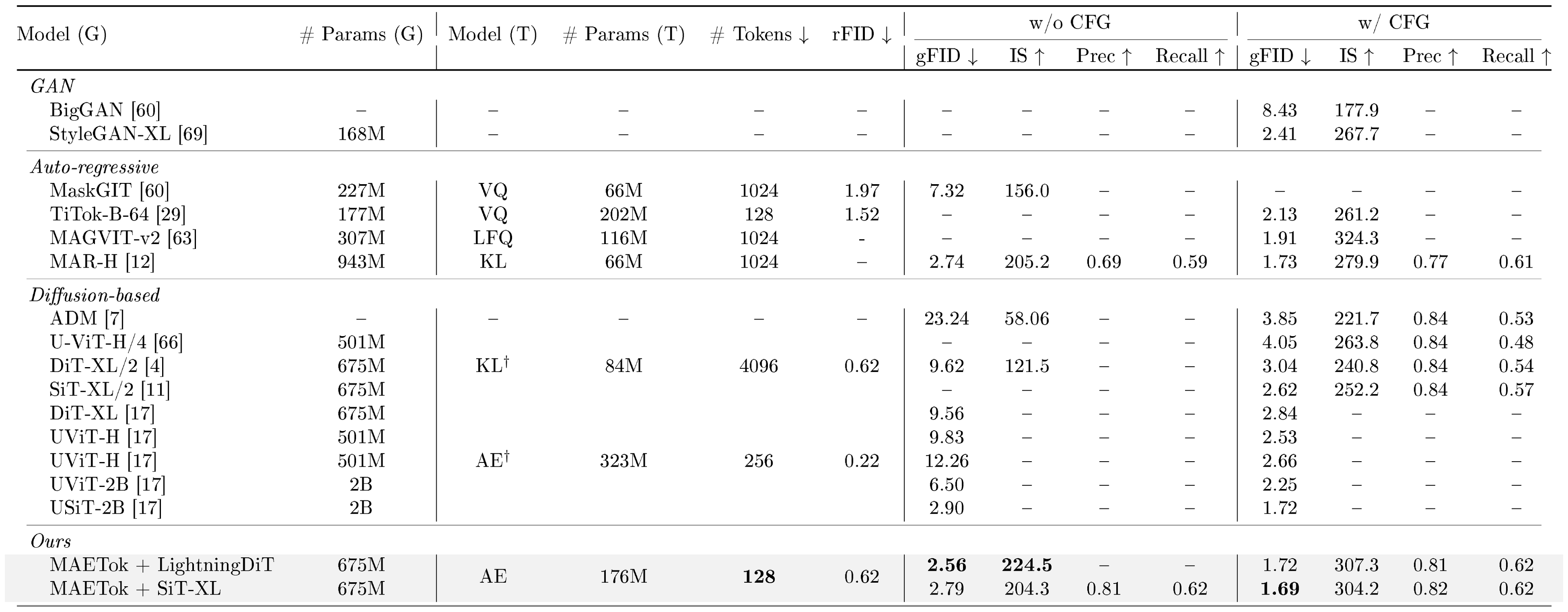
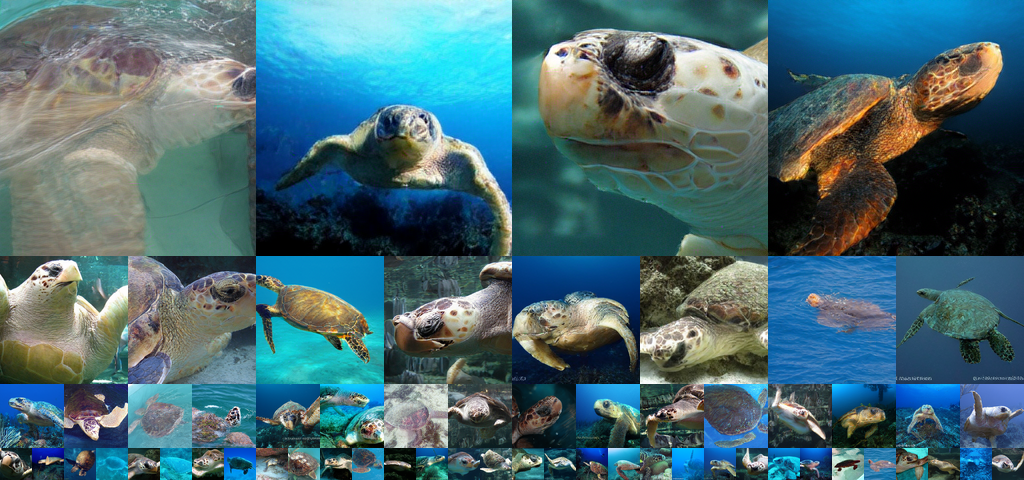
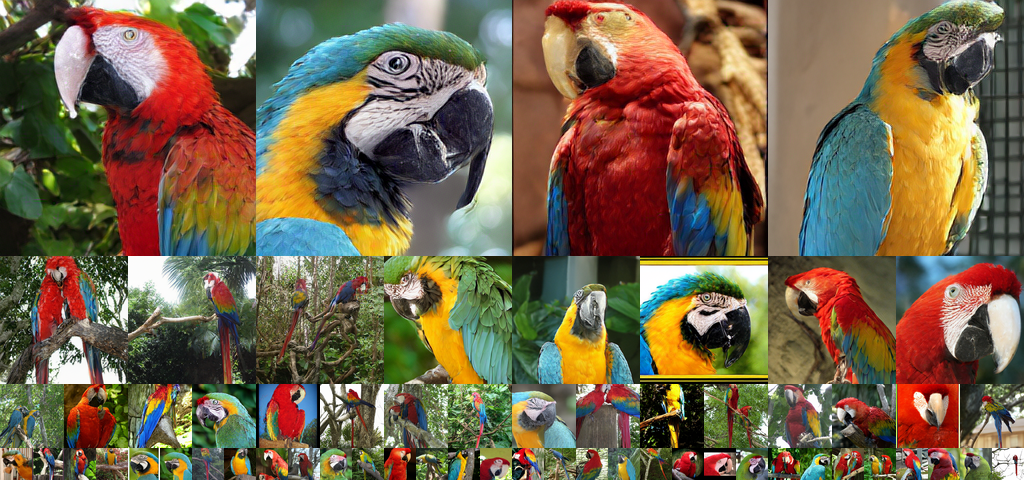
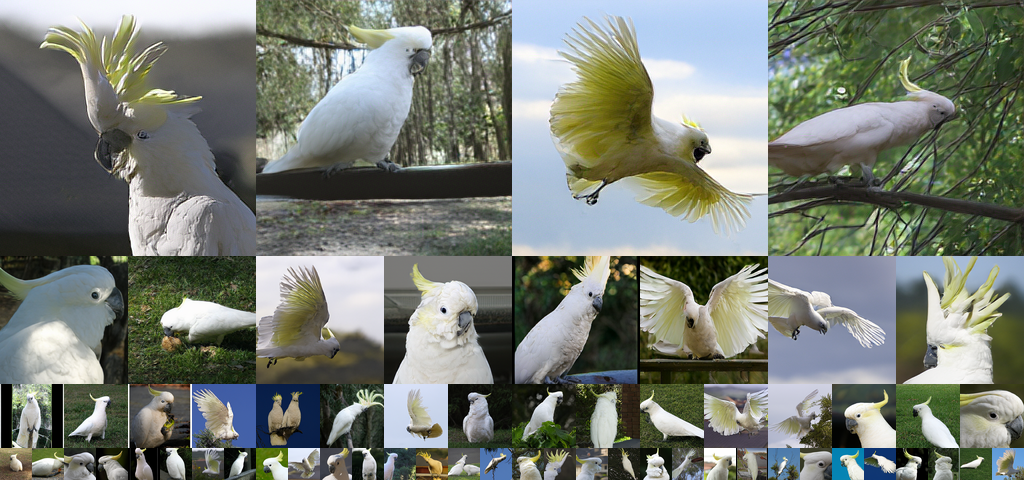
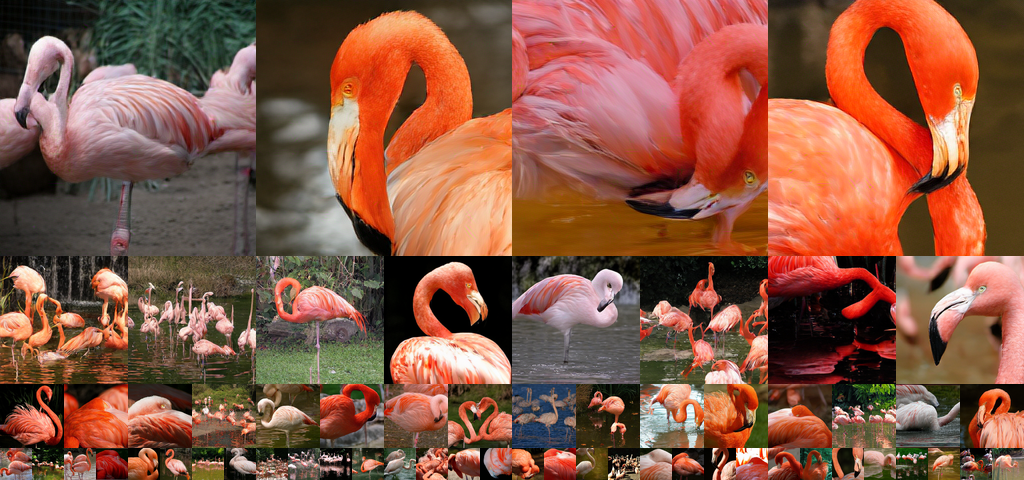
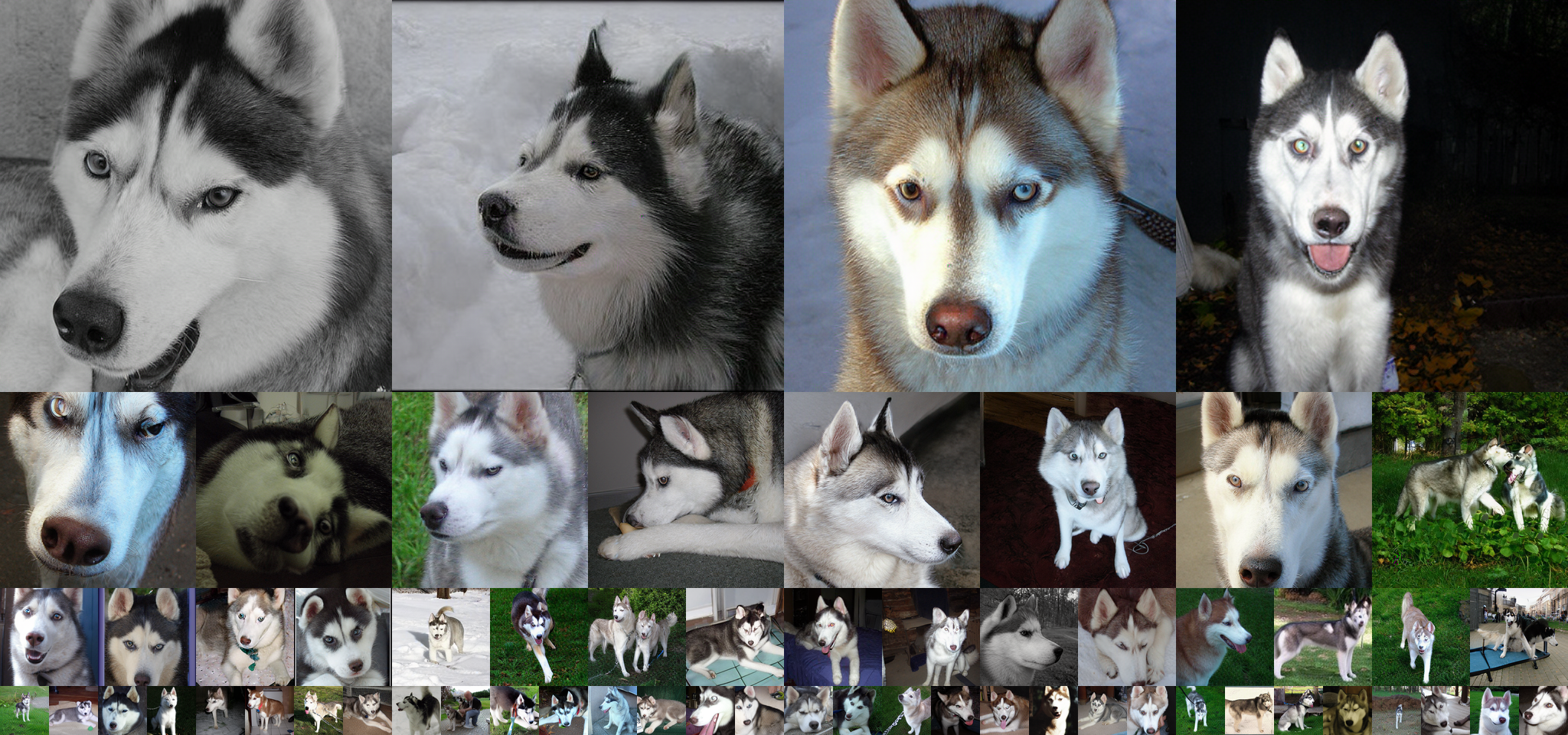
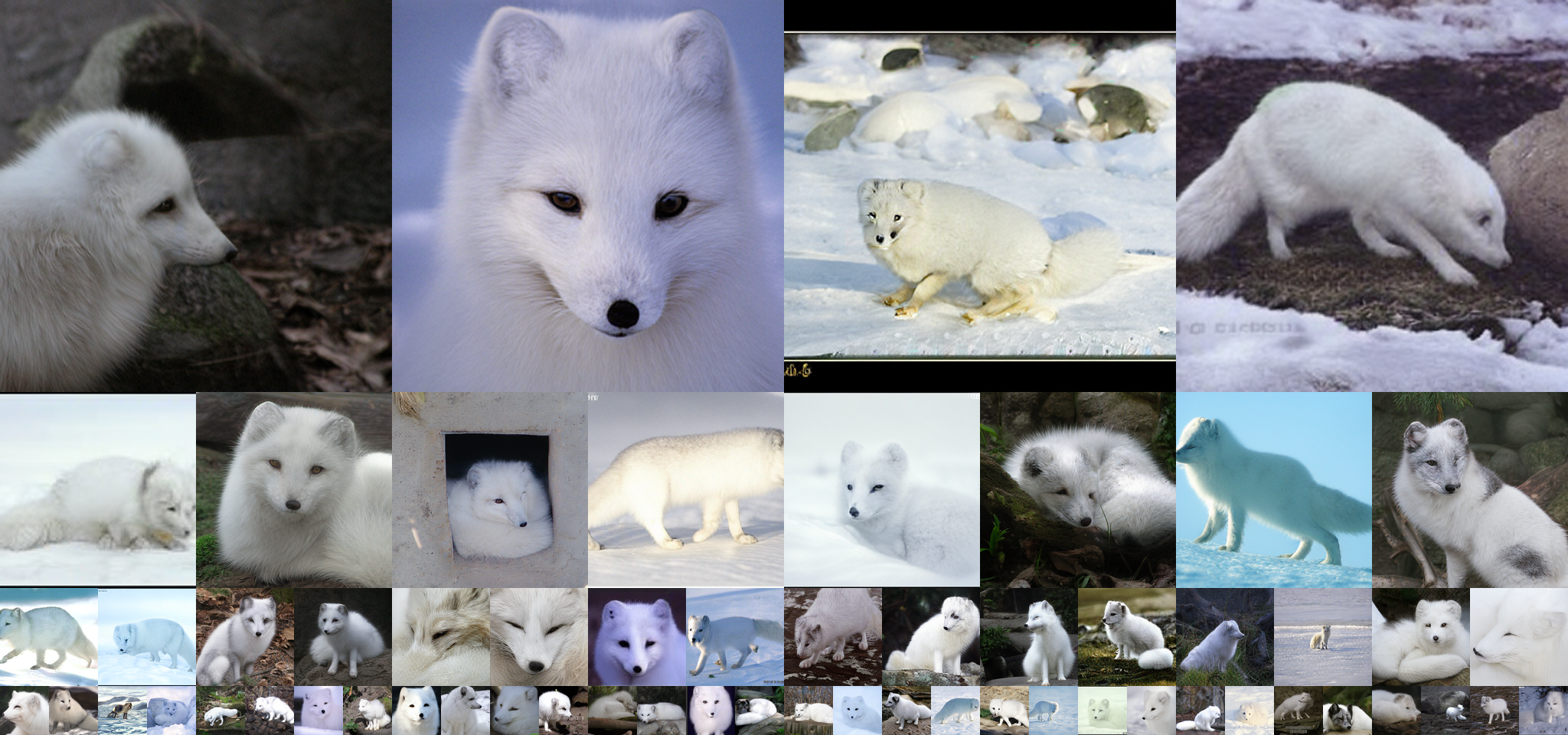
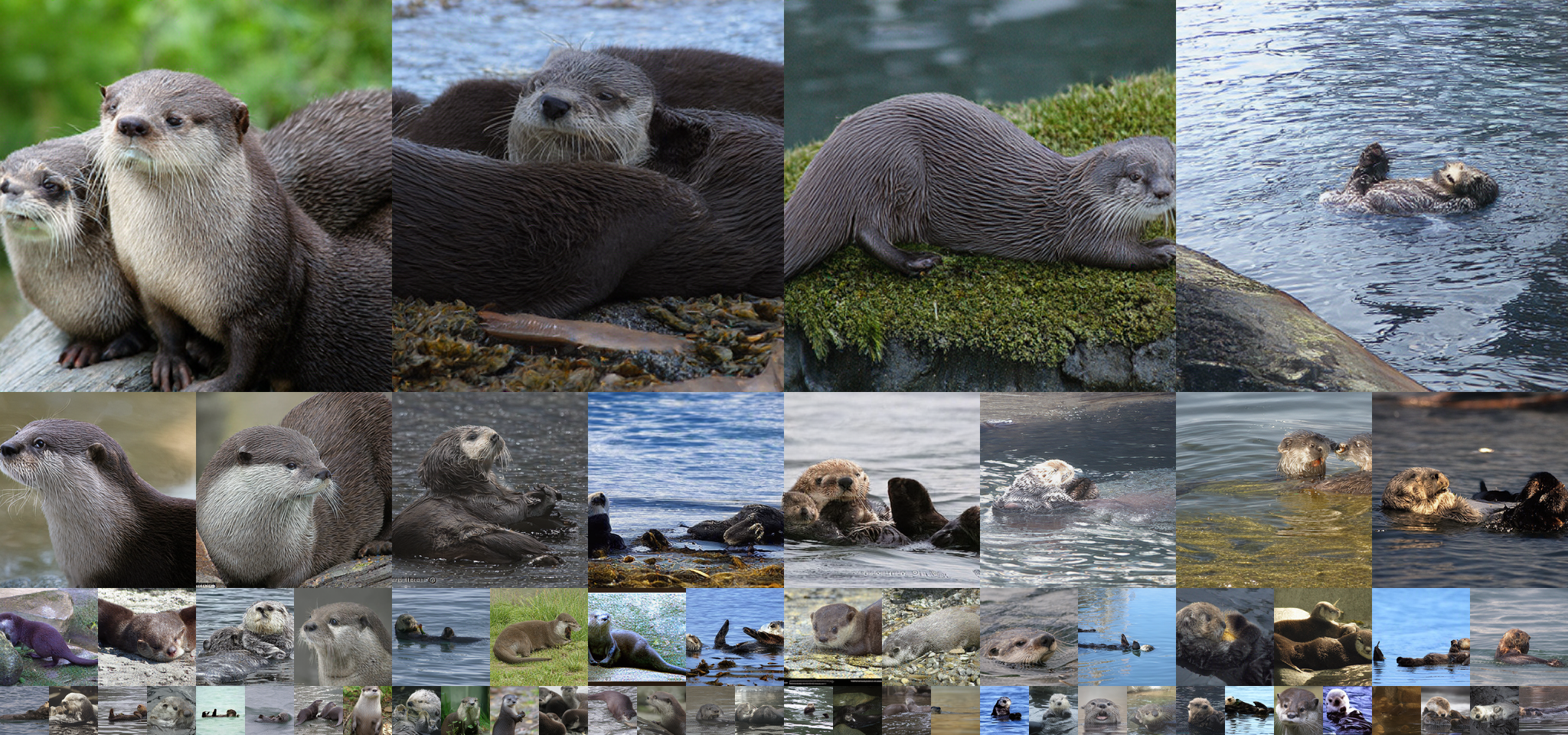
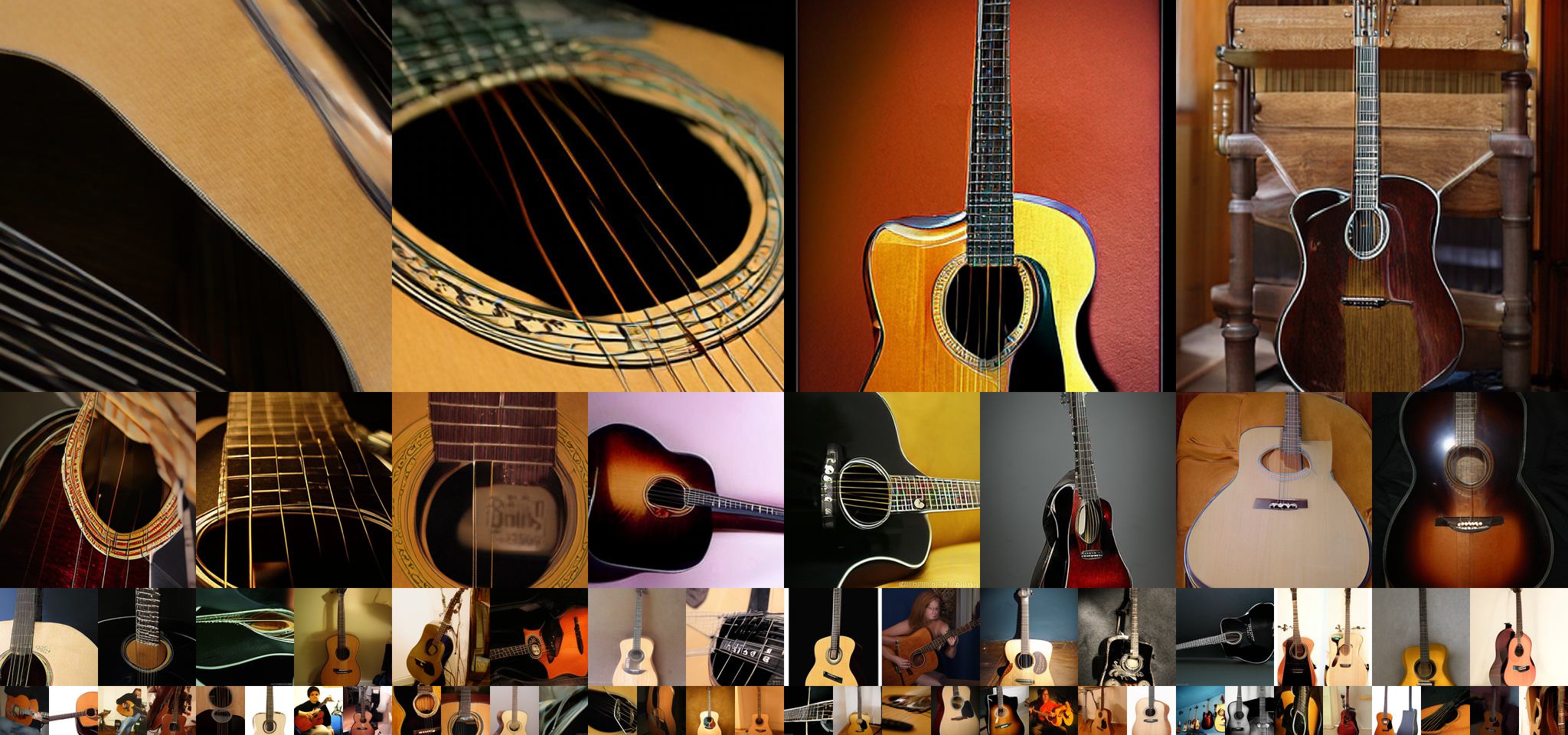
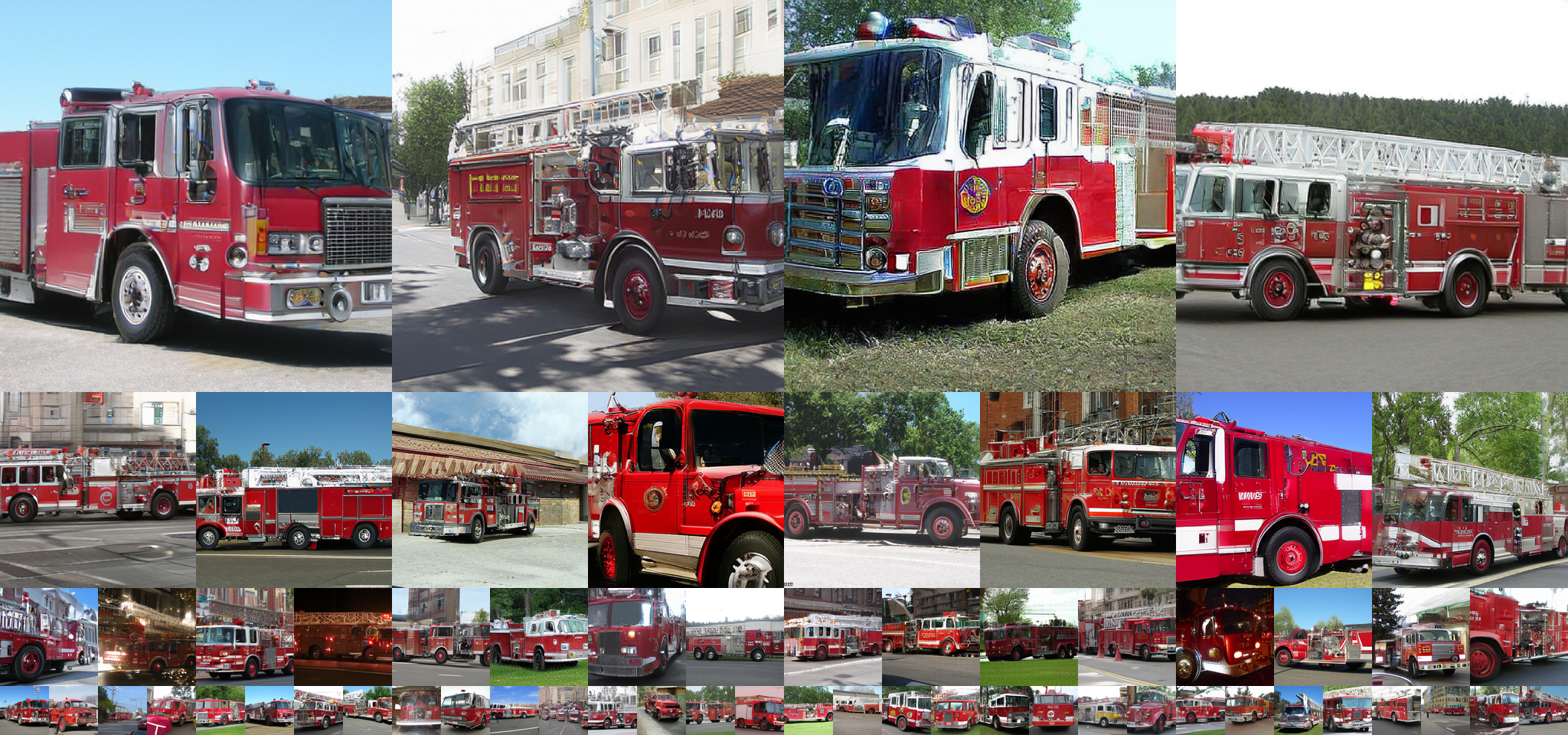
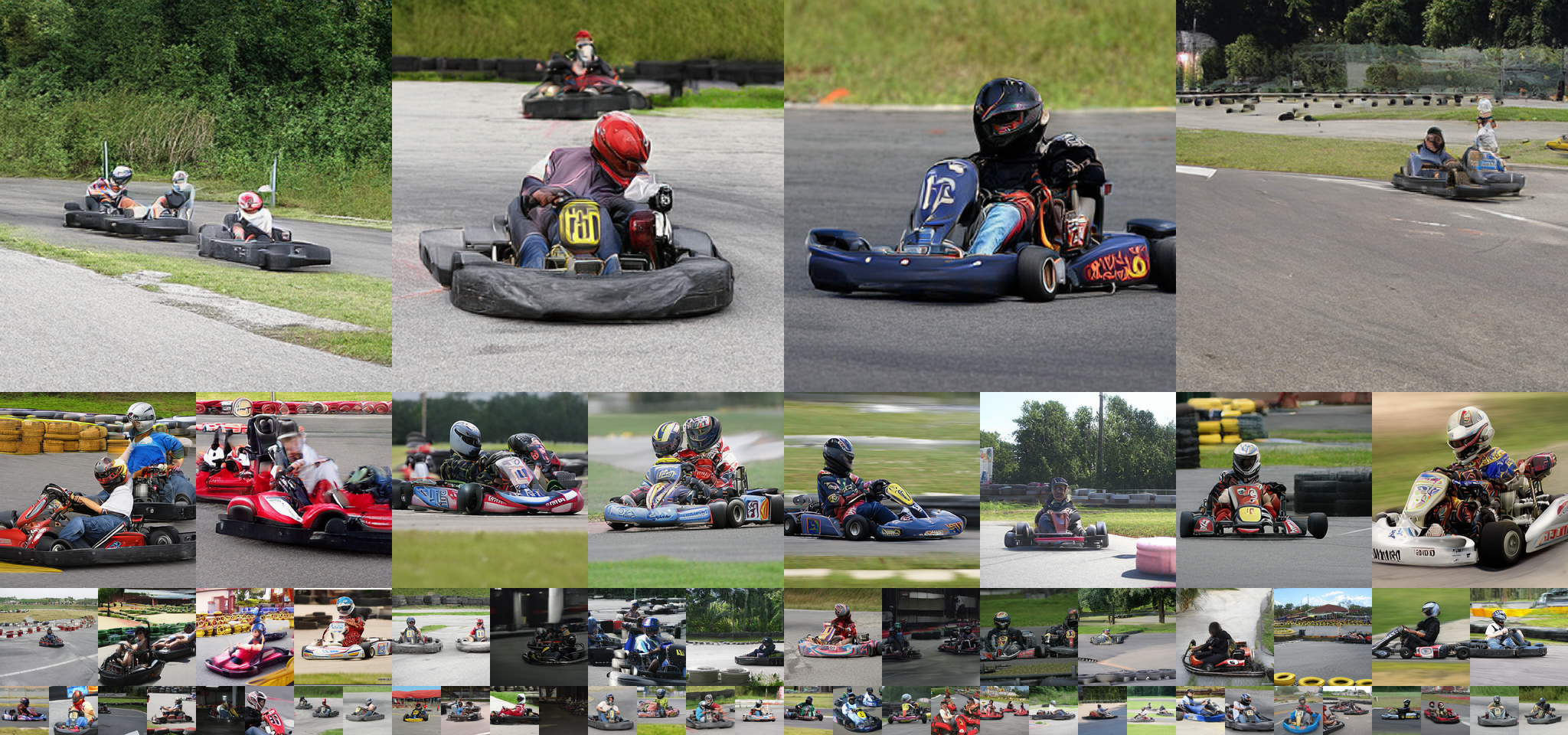
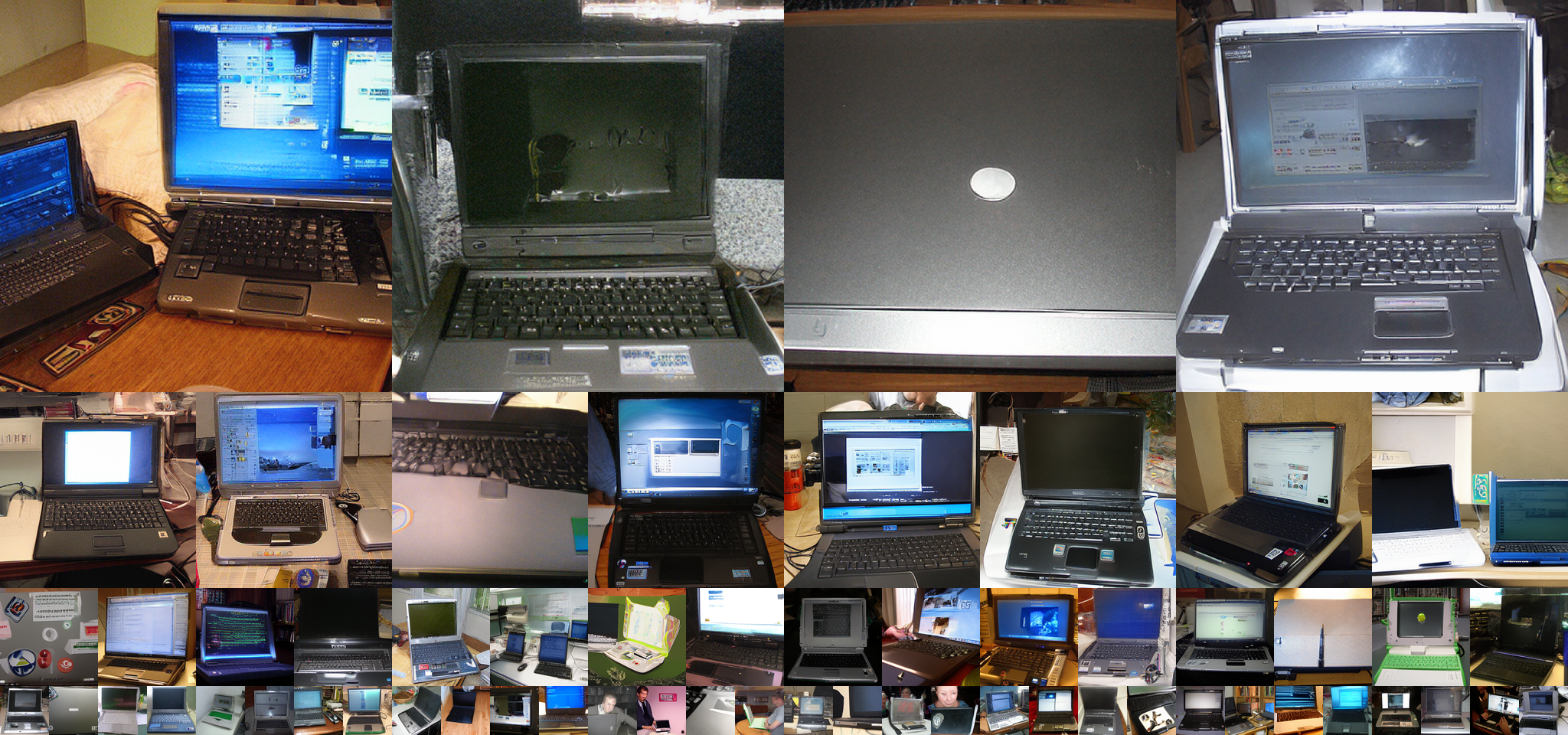
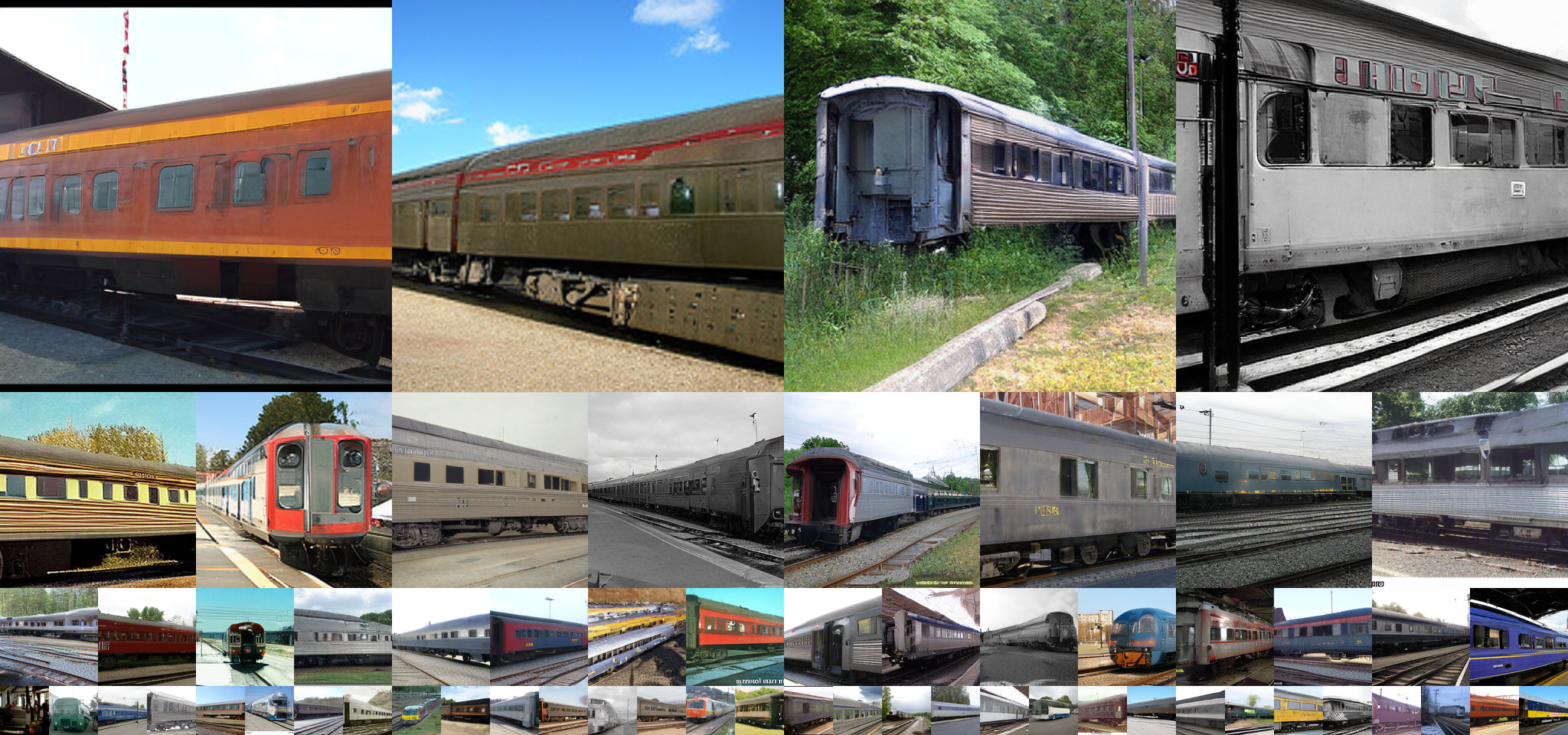
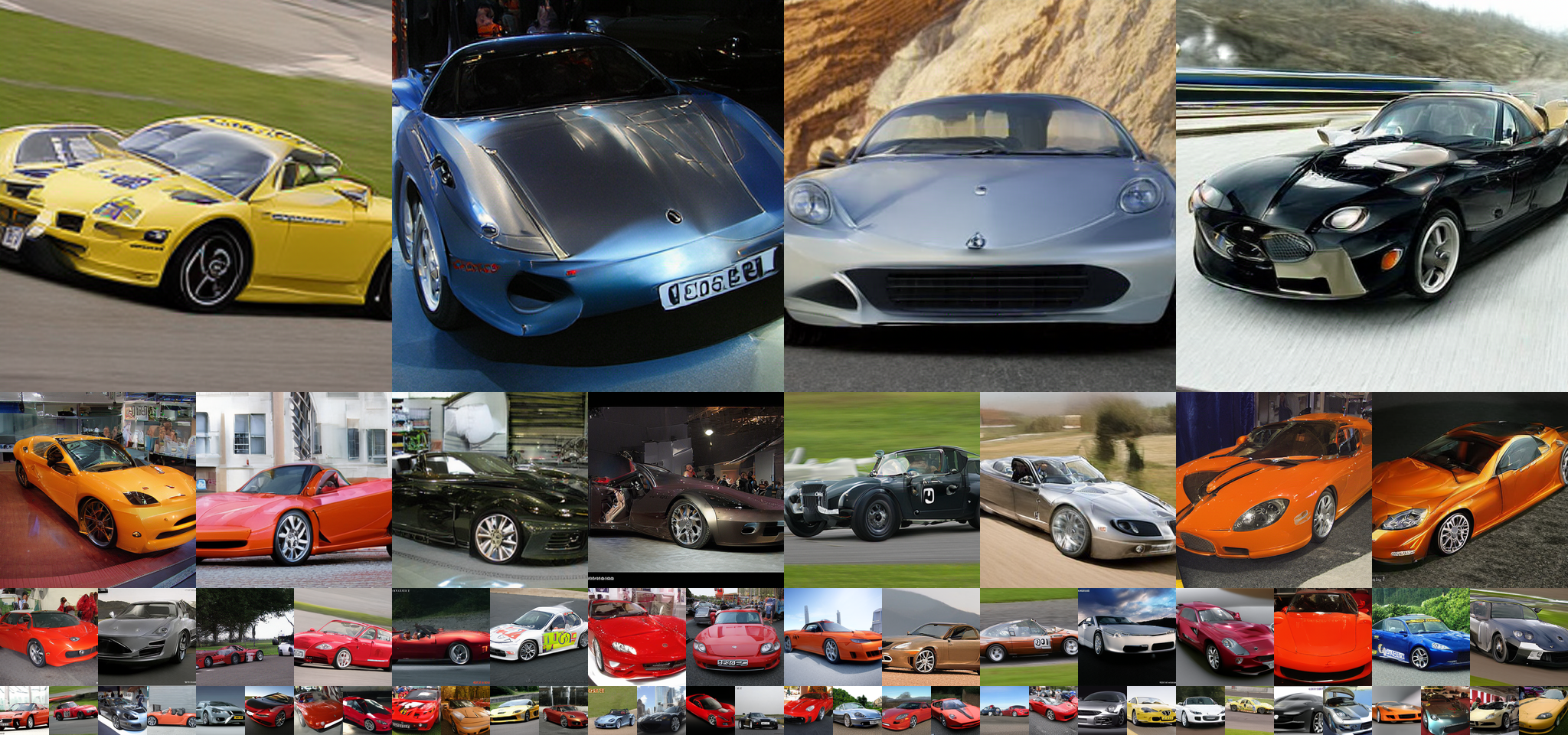
Generation. We compare SiT-XL and LightningDiT based on variants of MAETok in Table 2 and Table 3 for the 256 $\times$ 256 and 512 $\times$ 512 ImageNet benchmarks, respectively, against other SOTA generative models. Notably, the naive SiT-XL trained on MAETok with only 128 tokens and plain AE architecture achieves consistently better gFID and IS without using CFG: it outperforms REPA [68] by 3.59 gFID on 256 resolution and establishes a SOTA comparable gFID of 2.79 at 512 resolution. When using CFG, SiT-XL achieves a comparable performance with competing autoregressive and diffusion-based baselines trained on VAEs at 256 resolution. It beats the 2B USiT [17] with 256 tokens and also achieves a new SOTA of 1.69 gFID and 304.2 IS at 512 resolution. Better results have been observed with LightningDiT, trained with more advanced tricks [19], where it outperforms MAR-H of 1B parameters and USiT of 2B parameters without CFG, achieves a 2.56 gFID and 224.5 IS, and 1.72 gFID with CFG. When using a USiT-2B [17] for 512 generation, it pushes the gFID without CFG to 1.72, and gFID with CFG to 1.65. These results demonstrate that the structure of the latent space (see Figure 4), instead of the variational form of tokenizers, is vital for the diffusion model to learn effectively and efficiently. We show a few selected generation samples in Figure 1, and more uncurated visualizations are included in Appendix C.5.
::: {caption="Table 4: Comparison of various continuous tokenizers. $\dagger$ indicates the tokenizer is trained on other data than ImageNet. MAETok achieves a better trade-off of compression and reconstruction."}
:::
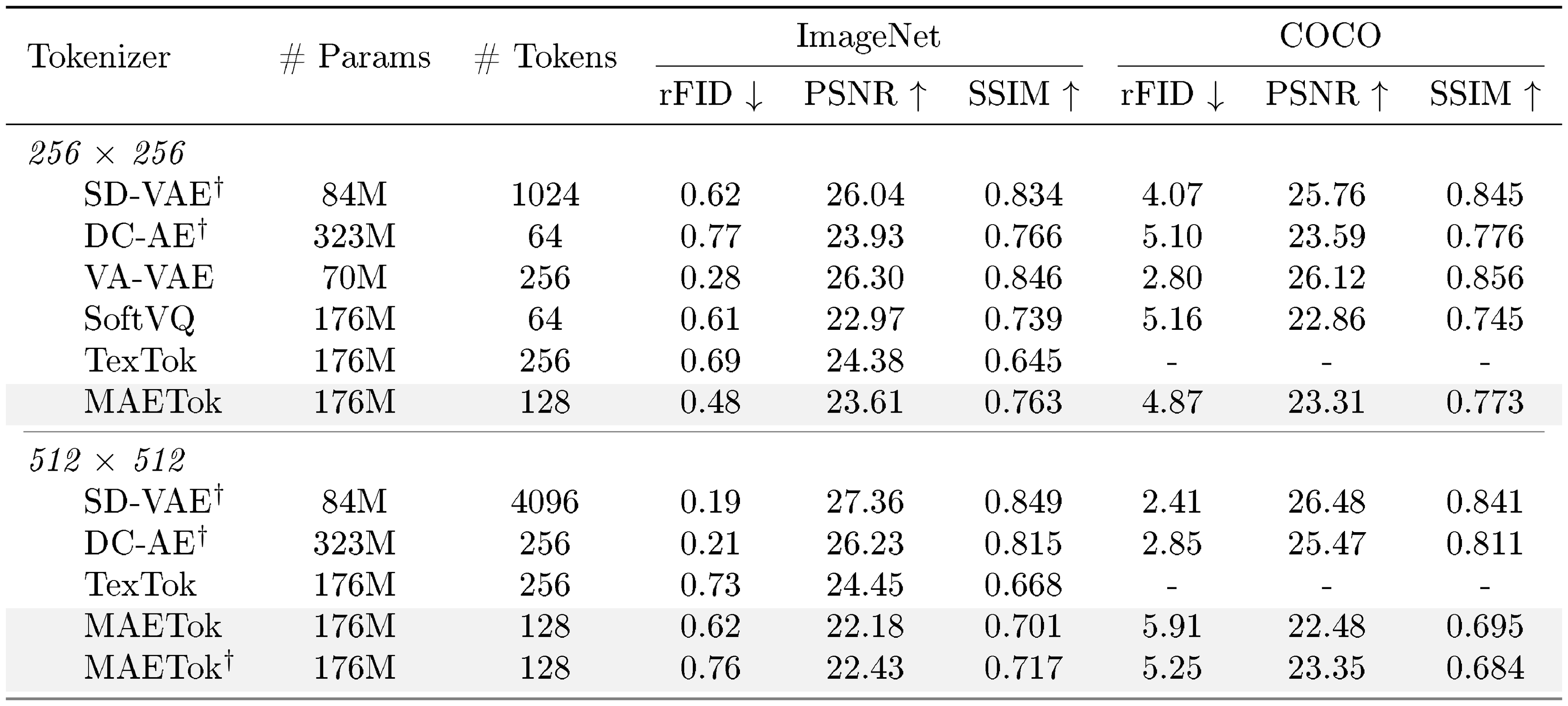
Reconstruction. MAETok also offers strong reconstruction capabilities on ImageNet and MS-COCO, as shown in Table 4. Compared to previous continuous tokenizers, including SD-VAE [3], DC-AE [17], VA-VAE [19], SoftVQ-VAE [21], and TexTok [23], MAETok achieves a favorable trade-off between the quality of the reconstruction and the size of the latent space. On 256 $\times$ 256 ImageNet, using 128 tokens, MAETok attains an rFID of 0.48 and SSIM of 0.763, outperforming methods such as SoftVQ in terms of both fidelity and perceptual similarity, while using half of the tokens in TexTok [23]. On MS-COCO, where the tokenizer is not directly trained, MAETok still delivers robust reconstructions. At resolution of 512, MAETok maintains its advantage by balancing compression ratio and the reconstruction quality.
4.5 Discussion
Efficient Training and Generation. A prominent benefit of the 1D tokenizer design is that it enables arbitrary number of latent tokens. The 256 $\times$ 256 and 512 $\times$ 512 images are usually encoded to 256 and 1024 tokens, while MAETok uses 128 tokens for both. It allows for much more efficient training and inference of diffusion models. For example, when using 1024 tokens of 512 $\times$ 512 images, the Gflops and the inference throughput of SiT-XL are 373.3 and 0.1 images/second on a single A100, respectively. MAETok reduces the Glops to 48.5 and increases throughput to 3.12 images/second. With improved convergence, MAETok enables a 76x faster training to perform similarly to REPA.
Unconditional Generation. An interesting observation from our results is that diffusion models trained on MAETok usually present significantly better generation performance without CFG, compared to previous methods, yet smaller performance gap with CFG. We hypothesize that the reason is that the unconditional class also learns the semantics in the latent space,
::: {caption="Table 5: Unconditional generation performance of SiT-L."}

:::
as shown by the unconditional generation performance in Table 5. As the latent space becomes more discriminative, the unconditional generation performance also improves significantly. This implies that the CFG linear combination scheme may become less effective [70], aligning with our CFG tuning results included in Appendix C.2. Moreover, adopting more recent advanced CFG techniques, such as Autoguidance [71] with naively earlier checkpoints of the generative model, and guidance-free training [72] can further improve the gFID of the SiT-XL model from 1.67 to 1.54 and 1.51, respectively. We leave the exploration of other CFG techniques for future work.
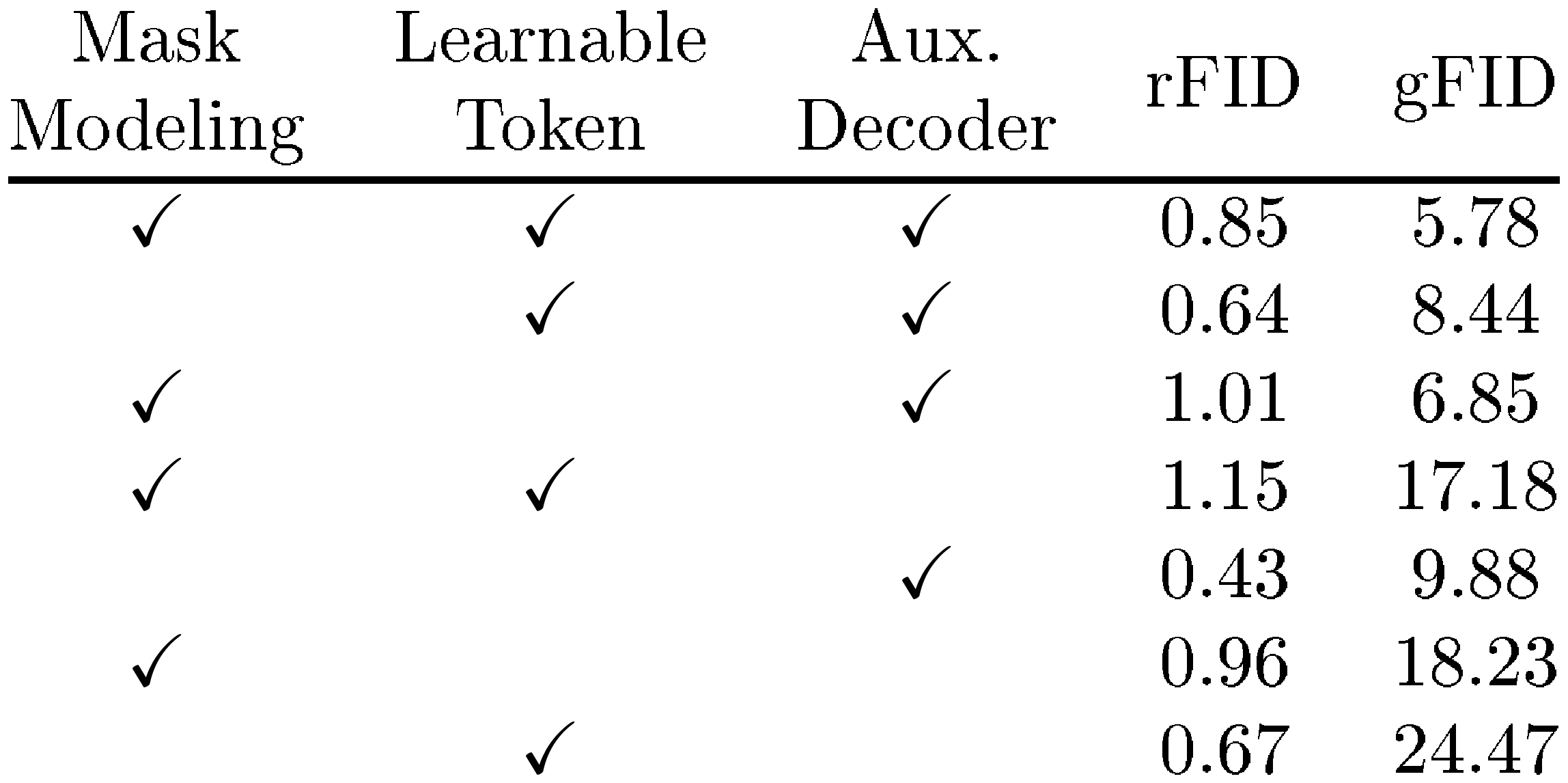
Learnable Tokens, Mask Modeling, and Auxiliary Decoders. We also provide a study of the effect of each component in MAETok, as shown in Table 6. The results reveal clear and complementary gains from each design choice. When all three are present, MAETok reaches a better trade-off between the reconstruction and generation quality; dropping the auxiliary decoder or the masking objective, for instance, leads to noticeably weaker results, while omitting the learnable tokens, i.e., using only 256 image tokens, impairs both fidelity metrics most severely.
::: {caption="Table 6: Effects of different components in MAETok."}
:::
5. Related Work
Section Summary: Image tokenization involves converting complex images into simpler, more manageable digital codes, starting with basic autoencoders and evolving into advanced techniques like variational autoencoders and VQ-GAN, which improve compression and accuracy while linking visual details to meaning. Recent progress emphasizes creating structured codes that balance reconstruction and understanding, with the authors stressing the value of distinct latent spaces for effective image creation using straightforward methods. In image generation, approaches fall into autoregressive models, which build images step by step using convolutional networks or transformers, and diffusion models, which refine noisy images into clear ones; innovations like latent diffusion enhance speed and quality by working in compressed spaces, alongside efforts to merge these methods with better tokenizers.
Image Tokenization. Imgae tokenization aims at transforming the high-dimension images into more compact and structured latent representations. Early explorations mainly used autoencoders [15, 16], which learn latent codes reduced dimensionality. These foundations soon inspired methods with variational posteriors, such as VAEs [73, 74] and VQ-GAN [18, 75]. Recent work has further improved compression fidelity and scalability [59, 63, 76, 77], showing the importance of latent structure. More recent efforts have shown methods that bridge high-fidelity reconstruction and semantic understanding within a single tokenizer [29, 20, 21, 78, 79]. Complementary to them, we further highlight the importance of discriminative latent space, which allows us to use a simple AE yet achieve better generation.
Image Generation. The paradigms of image generation mainly categorize to autoregressive and diffusion models. Autoregressive models initially relied on CNN architectures [80] and were later augmented with Transformer-based models [81, 82, 59, 83, 61] for improved scalability [60, 62]. Diffusion models show strong performance since their debut [84]. Key developments [85, 7, 86] refined the denoising process for sharper samples. A pivotal step in performance and efficiency came with latent diffusion [87, 65], which uses tokenizers to reduce dimension and conduct denoising in a compact latent space [73, 18, 4, 88]. Recent advances include designing better tokenizers [21, 23, 19] and combining diffusion with autoregressive models [12].
6. Conclusion
Section Summary: This study analyzed the hidden patterns in diffusion models, a type of AI for generating images, and found that simpler, more focused underlying data structures lead to better learning and higher-quality results. To apply this, the researchers created a new method called MAETok, which uses masking techniques to achieve top performance without traditional restrictions, relying on just 128 data tokens to boost both speed and image quality on a major dataset like ImageNet. Overall, the work shows that a clear, distinguishing hidden space is more important than strict rules for advancing efficient AI image generation, paving the way for larger-scale innovations.
We presented a theoretical and empirical analysis of latent space properties for diffusion models, demonstrating that fewer modes in latent distributions enable more effective learning and better generation quality. Based on these insights, we developed MAETok, which achieves state-of-the-art performance through mask modeling without requiring variational constraints. Using only 128 tokens, our approach significantly improves both computational efficiency and generation quality on ImageNet. Our findings establish that a more discriminative latent space, rather than variational constraints, is crucial for effective diffusion models, opening new directions for efficient generative modeling at scale.
Impact Statement
Section Summary: This research improves the basic knowledge and performance of AI systems that generate images using a technique called diffusion models. While the main focus is on making these tools more efficient and reliable for technical reasons, it recognizes wider effects on society, such as helping with creative and design work while raising worries about fake media. The team emphasizes building better methods for image creation and calls for continued talks on using these technologies responsibly.
This work advances the fundamental understanding and technical capabilities of machine learning systems, specifically in the domain of image generation through diffusion models. While our contributions are primarily technical, improving efficiency and effectiveness of generative models, we acknowledge that advances in image synthesis technology can have broader societal implications. These may include both beneficial applications in creative tools and design, as well as potential concerns regarding synthetic media. We have focused on developing more efficient and robust methods for image generation, and we encourage ongoing discussion about the responsible deployment of such technologies.
Acknowledge
Section Summary: The authors express gratitude to the anonymous reviewers and area chair for their valuable feedback on the research. The project received support from Microsoft's Accelerating Foundation Models Research grant program. Additionally, researchers Difan Zou and Yujin Han acknowledge funding from the National Natural Science Foundation of China, the Hong Kong Early Career Scheme, the Guangdong Natural Science Foundation, and the University of Hong Kong's central fund.
The authors would like to thank the anonymous reviewers and area chair for their helpful comments. This research project has benefited from the Microsoft Accelerating Foundation Models Research (AFMR) grant program. Difan Zou and Yujin Han acknowledge the support from NSFC 62306252, Hong Kong ECS award 27309624, Guangdong NSF 2024A1515012444, and the central fund from HKU.
Appendix
Section Summary: This appendix presents additional image samples generated by the SiT-XL model at 512x512 resolution and by diffusion models at 256x256 resolution, both using a guidance scale of 2.0 on the MAETok dataset, along with a figure showing that various latent space methods have similar bounds on mean norms across different numbers of data components. The theoretical analysis begins with basics of modeling data as a mixture of Gaussians and the score-matching objective in diffusion probabilistic models, then outlines assumptions ensuring good separation between data clusters, solid starting points for learning, and limits on data spread. It concludes with a theorem proving that accurately estimating these data centers requires more training samples and iterations as the number of clusters grows, highlighting why the complexity of the data distribution matters for model performance.
A. Theoretical Analysis
Preliminary.
We begin the theoretical analysis by introducing the preliminaries of the problem and the necessary notation.
Following the empirical analysis setting, we first consider the latent data distribution is the GMM with $K$ equally weighted Gaussians:
$ \begin{align} p_0 = \frac{1}{K} \sum_{i=1}^{K} \mathcal{N}(\boldsymbol{{\mu}}^*_i, \mathbf{I}), \end{align}\tag{5} $
Following the the training objective [39], we consider the score matching loss of DDPM at timestep $t$ is
$ \begin{align} \min_{\mathbf w} \mathbb E[|s_{\mathbf w}(\mathbf x, t)-\nabla_{\mathbf x} \log p_t(\mathbf x)|^2] \end{align}\tag{2} $
where $s_{\mathbf w}(\mathbf x, t)$ is the denoising network and $\log p_t(\mathbf x)$ is the oracle score. Under the GMM assumption, the explicit solution of score function $\nabla_{\mathbf x} \log p_t(\mathbf x)$ can be written as
$ \begin{align} \nabla_{\mathbf x} \ln p_t(\mathbf x) = \sum_{i=1}^K w_{i, t}^*(\mathbf x) \boldsymbol{{\mu}}_{i, t}^* - \mathbf x, \end{align}\tag{6} $
where the weighting parameter is
$ \begin{align} w_{i, t}^*(\mathbf x) := \frac{\exp(-|\mathbf x - \boldsymbol{{\mu}}{i, t}^*|^2 / 2)}{\sum{j=1}^K \exp(-|\mathbf x - \boldsymbol{{\mu}}{j, t}^*|^2 / 2)}, \quad \boldsymbol{{\mu}}^*{i, t} := \boldsymbol{{\mu}}^*_i \exp(-t). \end{align} $
Therefore, we can consider the denosing neural network with the following format, that is
$ \begin{align} s_{\theta_t}(\mathbf x) = \sum_{i=1}^K w_{i, t}(\mathbf x) \boldsymbol{{\mu}}_{i, t} - \mathbf x, \end{align}\tag{7} $
where
$ \begin{align} w_{i, t}(\mathbf x) := \frac{\exp(-|\mathbf x - \boldsymbol{{\mu}}{i, t}|^2 / 2)}{\sum{j=1}^K \exp(-|\mathbf x - \boldsymbol{{\mu}}{j, t}|^2 / 2)}, \quad \boldsymbol{{\mu}}{i, t} := \boldsymbol{{\mu}}_i \exp(-t). \end{align} $
Assumptions.
To ensure the denoising network approximates the score function with sufficient accuracy, we consider the following three common assumptions, which constrain the training process from the perspectives of data quality (separability), good initialization (warm start), and regularity (bounded mean of target distribution) [36, 37, 38].
Assumption 2
(Separation Assumption in [39]) For a mixture of $K$ Gaussians given by Equation 5, for every pair of components $i, j \in {1, 2, \ldots, K}$ with $i \neq j$, we assume that the separation between their means
$ \begin{align} |\boldsymbol{{\mu}}^*_i - \boldsymbol{{\mu}}^*_j| \geq C \sqrt{\log(\min(K, d))} \end{align} $
for sufficiently large absolute constant $C > 0$.
Assumption 3
(Initialization Assumption in [39]) For each component $i \in {1, 2, \ldots, K}$, we have an initialization $\boldsymbol{{\mu}}_i^{(0)}$ with the property that
$ \begin{align} |\boldsymbol{{\mu}}_i^{(0)} - \boldsymbol{{\mu}}^*_i| \leq C' \sqrt{\log(\min(K, d))} \end{align} $
for sufficiently small absolute constant $C' > 0$.
Assumption 4
The maximum mean norm of the GMM in GMM Equation 5 is bounded as: $\max_i |\boldsymbol{{\mu}}_i| \leq B$ .
########## {type="Remark"}
By Assumption 4, we could derive the second movement bound of $p_0$ as
$ \begin{align} \mathbb{E}_{\mathbf x\sim p_0}[|\mathbf x|^2] = \int p_0(\mathbf x) |\mathbf x|^2 \mathrm{d} \mathbf x \le d+B^2 \end{align} $
Then, we can have the following analysis,
Step 1: From $K$ Modes to Training Loss.
The main conclusion required for our proof is derived from the following theorem, which provides the estimation error $|\boldsymbol{\mu}_i - \boldsymbol{\mu}_i^*|$ for DDPM with gradient descent under $\mathcal{O}(1)$-level noise, assuming that Assumptions Assumption 2 and Assumption 3 are satisfied.
Theorem 5
(Adopted from Theorem 16 in [39]) Let $q$ be a mixture of Gaussians in Equation 5 with center parameters $\theta^* = {\boldsymbol{\mu}_1^*, \boldsymbol{\mu}_2^*, \ldots, \boldsymbol{\mu}_K^*} \in \mathbb{R}^d$ satisfying the separation Assumption 2, and suppose we have estimates $\theta$ for the centers such that the warm initialization Assumption 3 is satisfied. For any $\varepsilon > \varepsilon_0$ and noise scale $t$ where
$ \begin{align*} \varepsilon_0 = 1/\text{poly}(d) \quad t = \Theta(\varepsilon), \end{align*} $
gradient descent on the DDPM objective at noise scale $t$ outputs $\tilde{\theta} = {\tilde{\boldsymbol{\mu}}_1, \tilde{\boldsymbol{\mu}}_2, \ldots, \tilde{\boldsymbol{\mu}}_K}$ such that $\min_i |\tilde{\boldsymbol{\mu}}_i - \boldsymbol{\mu}_i^*| \leq \varepsilon$ with high probability. DDPM runs for $H \geq H'$ iterations and uses $n \geq n'$ number of samples where
$ \begin{align*} H' = \Theta(\log(\varepsilon^{-1} \log d)), \quad n' = \Theta(K^4d^5B^6/\varepsilon^2). \end{align*} $
Theorem 5 indicates that, to achieve the same estimation error $\epsilon$, a data distribution with more modes requires more training samples. Figure 8 demonstrates that different latent spaces exhibit nearly identical mean norm upper bounds, thus justifying our focus on analyzing the number of modes $K$.
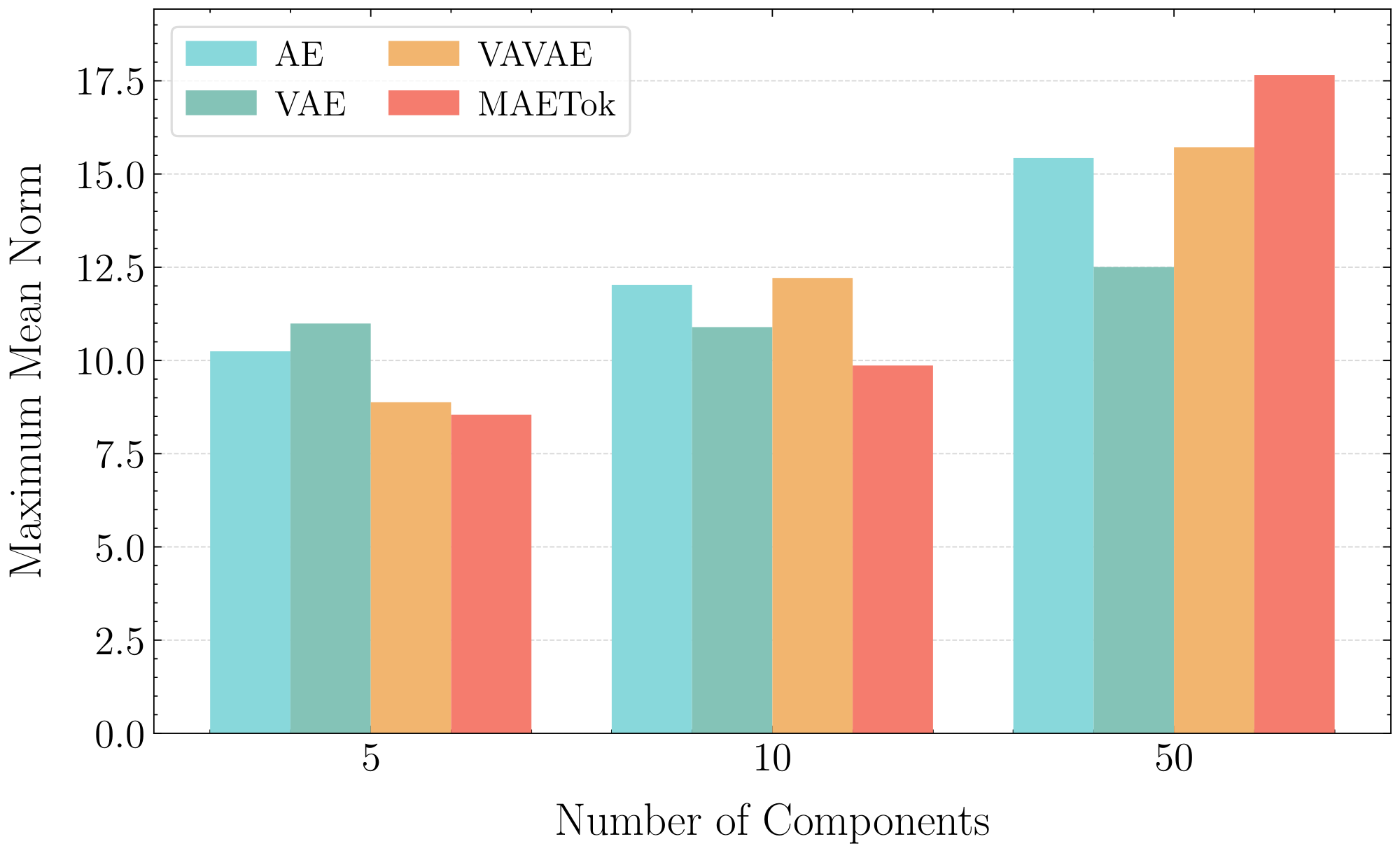
Given $\epsilon$ in Theorem 5 and based on Assumption 4, Equation 2, Equation 6, Equation 7, we further have
$ \begin{align} \mathbb{E}[|s_{\theta_t}(\mathbf x_t) - \nabla_{\mathbf x_t} \log p_t(\mathbf x_t)|^2] &= \mathbb{E}\Big[\Big|\sum_{i=1}^K \big(w_{i, t}(\mathbf x_t) \boldsymbol{{\mu}}{i, t} - w{i, t}^*(\mathbf x_t) \boldsymbol{{\mu}}{i, t}^*\big)\Big|^2\Big] \notag\ &\leq 2\mathbb{E}\Big[\Big|\sum{i=1}^K w_{i, t}^*(\mathbf x_t) (\boldsymbol{{\mu}}{i, t} - \boldsymbol{{\mu}}{i, t}^*)\Big|^2\Big]
- 2\mathbb{E}\Big[\Big|\sum_{i=1}^K (w_{i, t}(\mathbf x_t) - w_{i, t}^*(\mathbf x_t)) \boldsymbol{{\mu}}_{i, t}\Big|^2\Big] \notag\ & \lesssim e^{-2t}(\epsilon^2 + B^2) \end{align} $
The $\lesssim$ hides constant term $2$ and $4$.
Therefore, consider a step size $h_k \le \gamma$, we can have the learned score function $s_{\theta_t}(\mathbf x)$ satisfies
$ \begin{align} \frac{1}{T} \sum^N_{k=1} h_k \mathbb{E}[|s_{\theta_{t_k}}(\mathbf x_{t_k}) - \nabla_{\mathbf x_{t_k}} \log p_t(\mathbf x_{t_k})|^2] \lesssim \frac{N\gamma}{T}(\epsilon^2 + B^2) \end{align}\tag{8} $
Step 2: From Training Loss to Samlping Error.
In the practical sampling process, we adopt an early stopping strategy to improve the generation quality. Specifically, we consider the interval $t \in [0, 0.8]$ during the reverse process. Then, the following conclusion holds:
Theorem 6
(Theorem 2.2. in ([37])) There is a universal constant $C$ such that the following hold. Suppose that Assumption 4 and 8 hold and the step sizes satisfy the following for some quantities $\sigma_{t_1}^2, \dots, \sigma_{t_k}^2, \dots, \sigma_{t_N}^2$,
$ \begin{align} \frac{h_k}{\sigma_{t_{k-1}}^2} \leq \frac{1}{Cd} \le \gamma, \quad k = 1, \ldots, N \end{align} $
Define $\Pi := \sum_{k=1}^N \frac{h_k^2}{\sigma_{t_{k-1}}^4}$ . For $T \geq 2, \delta \leq \frac{1}{2}$, the exponential integrator scheme (6) with early stopping results in a distribution $\hat{q}_{T-\delta}$ such that
$ \begin{align} \mathrm{KL}(p_\delta | \hat{q}_{T-\delta}) \lesssim (d + B^2) \exp(-T) + T \epsilon^2_0 + d^2 \Pi. \end{align} $
In particular, when using proper choices of $h_k$, the quantity $\Pi$ can be as small as $o(1)$. For instance, as shown in [37], it can be proved that $\Pi=O(1/N^2)$ when using exponentially decreasing stepsize.
Then combing Theorem 5 and Theorem 6, we finally have
Theorem 7
Training DDPM for $H \geq H'$ iterations and uses $n \geq n'$ number of samples where
$ \begin{align*} H' = \Theta(\log(\varepsilon^{-1} \log d)), \quad n' = \Theta(K^4d^5B^6/\varepsilon^2). \end{align*} $
Then, there is a universal constant $C$ such that the following hold. Suppose that Assumptions Assumption 4 and 8 hold and the step sizes satisfy
$ \begin{align} \frac{h_k}{\sigma_{t_{k-1}}^2} \leq \frac{1}{Cd} \le \gamma, \quad k = 1, \ldots, N \end{align} $
Define $\Pi := \sum_{k=1}^N \frac{h_k^2}{\sigma_{t_{k-1}}^4}$ . For $T \geq 2, \delta \leq \frac{1}{2}$, the exponential integrator scheme (6) with early stopping results in a distribution $\hat{q}_{T-\delta}$ such that
$ \begin{align} \mathrm{KL}(p_\delta | \hat{q}_{T-\delta}) \lesssim (d + B^2) \exp(-T) + N\gamma (\epsilon^2+B^2) + d^2 \Pi. \end{align} $
where $p$ is the data distribution and $\hat{q}$ is the sampling distribution.
In Theorem 1, we establish a connection between the training process and the sampling process, using KL-divergence as a metric to quantify the distance between the true data distribution and the sampled generated data distribution. It should be noted that both KL divergence and Wasserstein Distance serve as tools for measuring the similarity between distributions. Under the specific assumption that the data distributions are Gaussian, the Wasserstein Distance reduces to FID (i.e., the metric used in our paper). Theorem 1 demonstrates that achieving the same sampling error necessitates a larger number of training samples for data distributions with a greater number of modes ($K$). Consequently, under the constraint of limited training samples, the quality of images generated from training data distributions with more modes ($K$) tends to be worse compared to those with fewer modes.
B. Experiments Setup
B.1 Training Details of AEs
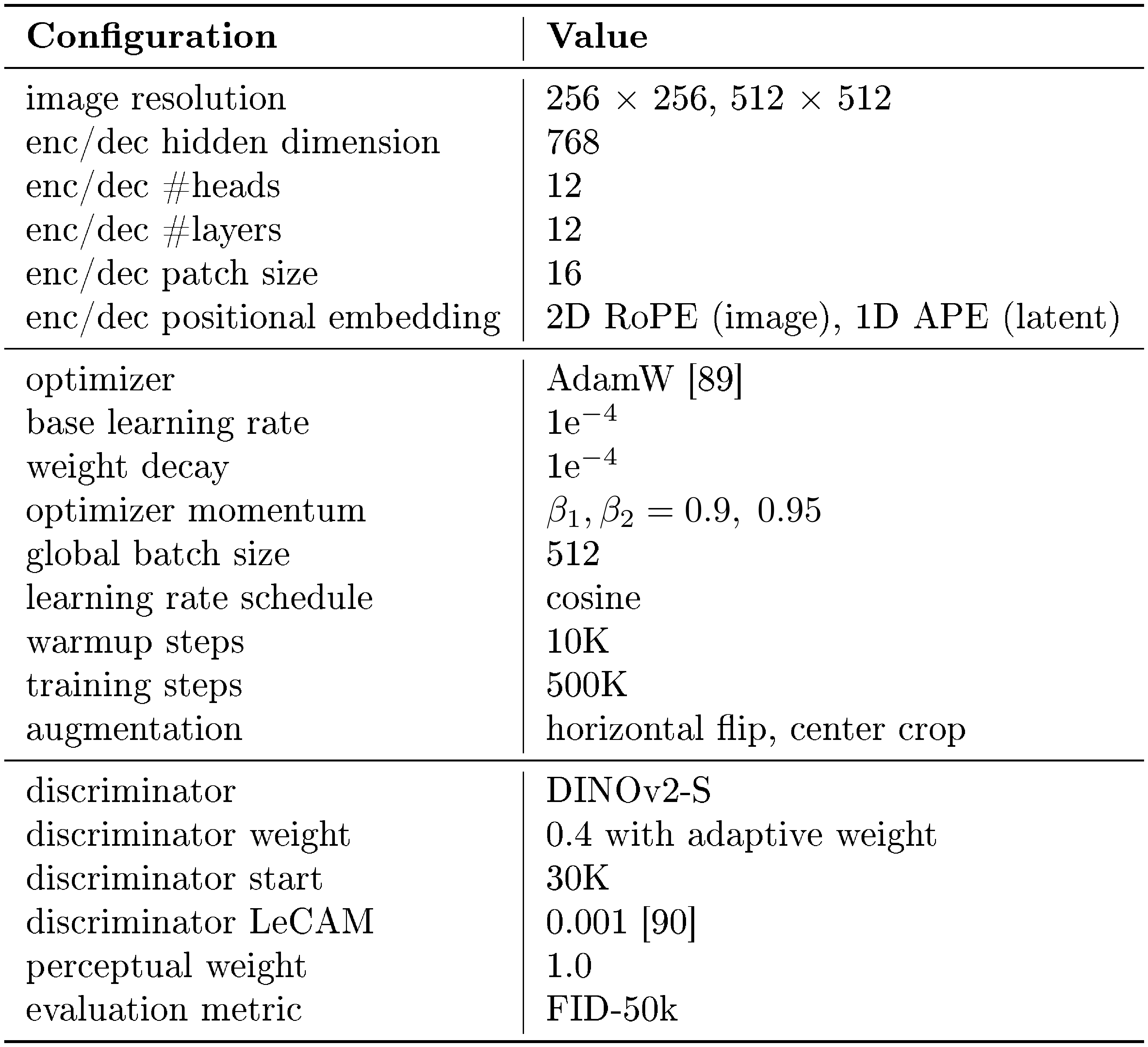
We present the training details of MAETok in Table 7.
::: {caption="Table 7: Training configuration of MAETok on 256 $\times$ 256 and 512 $\times$ 512 ImageNet."}
:::
B.2 Training Details of Diffusion Models
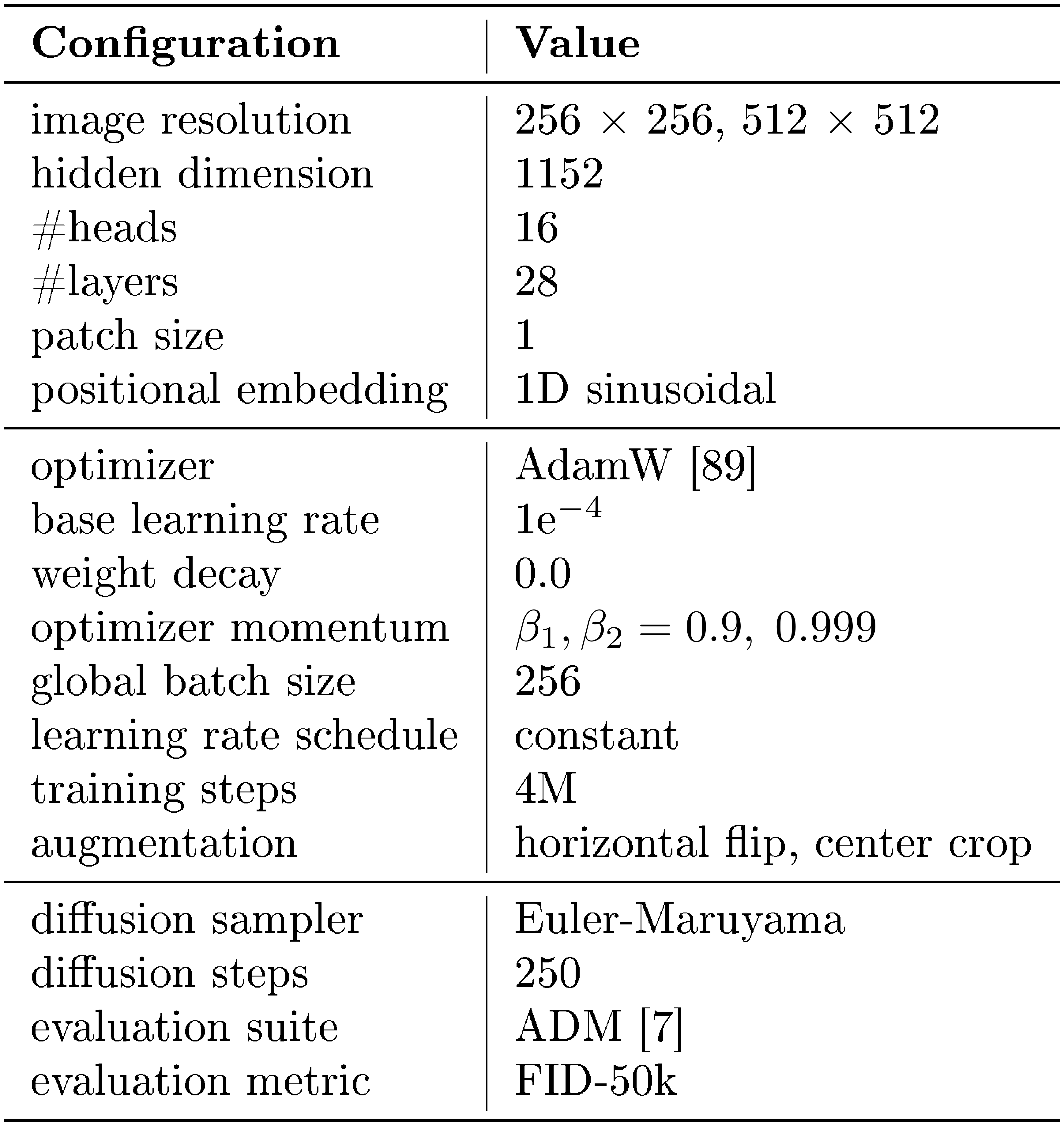
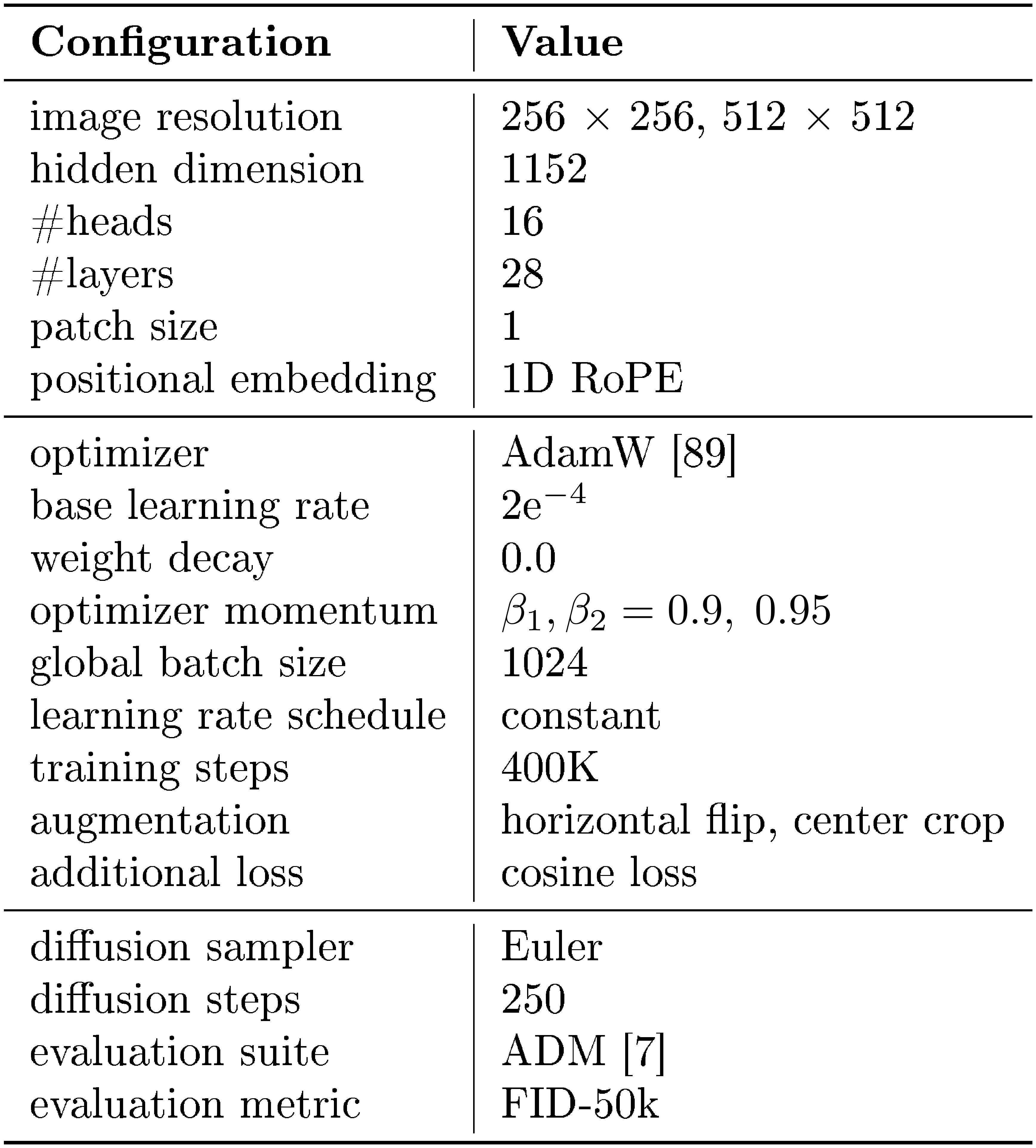
We present the training details of SiT-XL and LightningDiT in Table 8 and Table 9, which mainly follows their original setup.
::: {caption="Table 8: Training configuration of SiT-XL on 256 $\times$ 256 and 512 $\times$ 512 ImageNet."}
:::
::: {caption="Table 9: Training configuration of LightningDiT on 256 $\times$ 256 and 512 $\times$ 512 ImageNet."}
:::
B.3 Training Details of GMM Models
In Figure 2, we train our own AE, KL-VAE, and MAETok under exactly the same settings and use the pre-trained VAVAE [19]. The evaluation in Figure 2 is performed with the same latent size and input dimensions. Specially, for GMM in Figure 2a, we first represent the original latent size as $(N, H, C)$, where $N$ refers to the training sample size, $H$ refers to the number of tokens, and $C$ refers to the channel size. Following the typical GMM training, we performed the following steps: (1) Latents flatten: The latent size becomes $(N, H \times C)$. (2) Dimensionality Reduction: To avoid the curse of dimensionality, we consider PCA and select a fixed dimension $K$ that results in an explained variance greater than 90%. This step makes the latent dimension $(N, K)$, ensuring that all latent spaces have consistent dimensions. (3) Normalization: To avoid numerical instability and feature scale differences, we further standardize the latent data. (4) Fitting: We fit the data using GMM and return the negative log-likelihood losses (NLL). We train the GMM on the entire Imagenet with a batch size of 256 on a single NVIDIA A8000. It should be noted that distributed training would further optimize the fitting time. The training time for GMM components of 50, 100, and 200 is roughly 3, 8, and 11 hours, respectively.
For SiT-L loss in Figure 2b, we train SiT-L on the latent space of these four tokenizers for 400K iterations, using an optimizer of AdamW, a constant learning rate of 1e-4, and no weight decay.
C. Experiments Results
C.1 More Quantitative Generation Results
We provide the additional precision and recall evaluation on 256 $\times$ 256 and 512 $\times$ 512 ImageNet benchmarks in Table 10 and Table 11, respectively.
::: {caption="Table 10: System-level comparison on ImageNet 256 $\times$ 256 conditional generation, now also reporting Precision and Recall under both CFG and no-CFG settings. "Model (G)": generation model. "# Params (G)": the number of generator parameters. "Model (T)": the tokenizer model. "# Params (T)": the number of tokenizer parameters. "# Tokens": the number of latent tokens used during generation. $^\dagger$ indicates that the model has also been trained on data beyond ImageNet."}
:::
::: {caption="Table 11: System-level comparison on ImageNet 512 $\times$ 512 conditional generation, now also reporting Precision and Recall for both CFG and no-CFG settings. "Model (G)": generation model. "# Params (G)": number of generator parameters. "Model (T)": the tokenizer model. "# Params (T)": number of tokenizer parameters. "# Tokens": number of latent tokens used during generation. $^\dagger$ indicates the model was also trained on data beyond ImageNet."}
:::
C.2 Classifier-free Guidance Tuning Results
::: {caption="Table 12: CFG tuning results of 256 $\times$ 256 SiT-XL trained for 2M steps. We compute gFID and IS using 10K generated samples."}

:::
We provide our CFG scale tuning results in Table 12, where we found the gFID with CFG changes significantly even with small guidance scales. Applying CFG interval [92] to cutout the high timesteps with CFG can mitigate this issue. However, it is still extremely difficult to tune the guidance scale.
We use a guidance scale of 1.9 and an interval of [0, 0.75] for 256 $\times$ 256 SiT-XL and a guidance scale of 1.8 and an interval of [0, 0.75] for 256 $\times$ 256 LightningDiT to report the main results. For 512 $\times$ models, we use a guidance scale of 1.5 and an interval of [0, 0.7] for SiT-XL and a guidance scale of 1.6 with an interval of [0, 0.65] for LightningDiT's main results. Note that our models may present even better results with more fine-grained CFG tuning.
We attribute the difficulty of tuning CFG to the semantics learned by the unconditional class, as we discussed in Section 4.5. Such semantics makes the linear scheme of CFG less effective, as reflected by the sudden change with small guidance values. Adopting and designing more advanced CFG schemes [93, 71] may also be helpful with this problem, and is left as our future work.
C.3 Latent Space Visualization
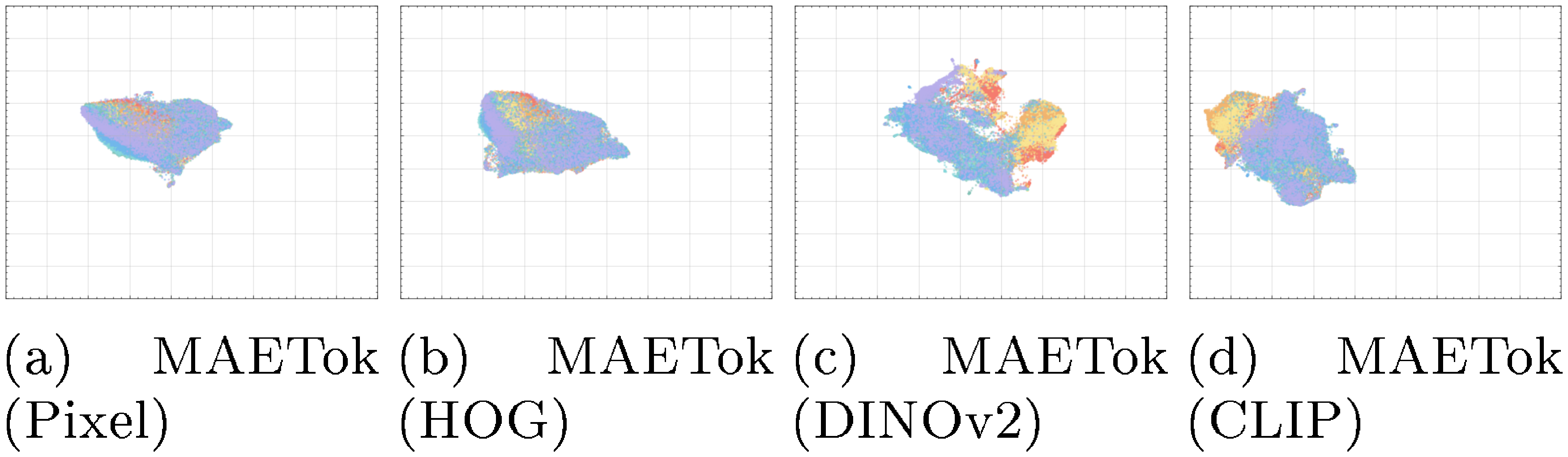
More latent space visualization of MAETok variants is included in Figure 9. MAETok in general learns more discriminative latent space with fewer GMM models with differente reconstruction targets.
C.4 More Ablation Results
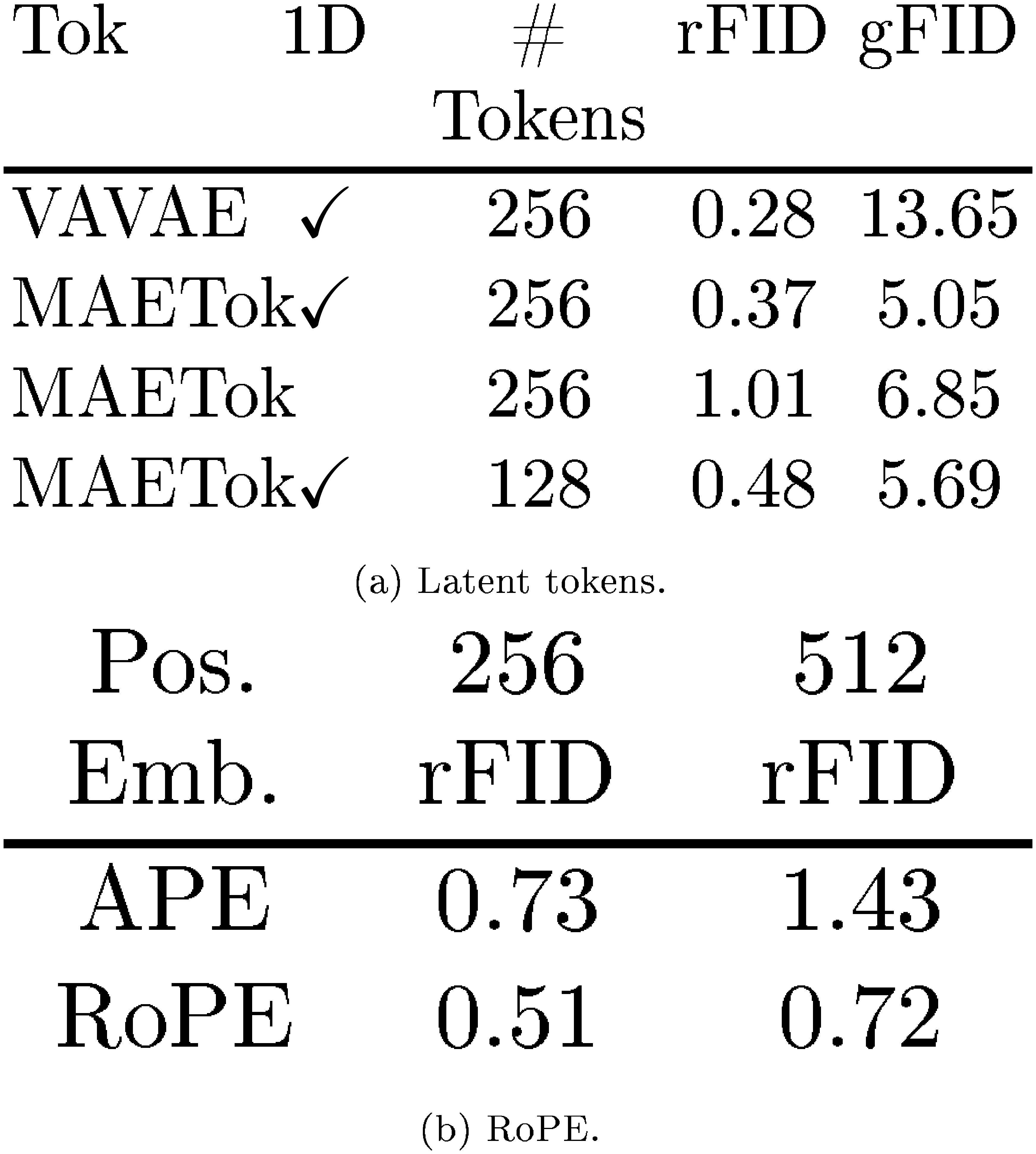
::: {caption="Table 13: Ablations of latent tokens and 2D RoPE with MAETok on 256 $\times$ 256 ImageNet. We report rFID of tokenizer and gFID of SiT-L trained on latent space of the tokenizer without classifier-free guidance. We train tokenizer of 250K and SiT-L for 400K steps."}
:::
We present the ablation study on latent tokens and 2D RoPE in Table 13. One can observe from Table 13a that using learnable latent tokens is more effective than using image tokens only, and 128 latent tokens is enough to achieve similar reconstruction and downstream generation performance, compared to 256 tokens. Furthermore, 2D RoPE helps to generalize better on different resolutions, when trained with mixed resolution images.
C.5 More Qualitative Generation Results
References
[1] Sohl-Dickstein, J., Weiss, E., Maheswaranathan, N., and Ganguli, S. Deep unsupervised learning using nonequilibrium thermodynamics. In International conference on machine learning, pp. 2256–2265. PMLR, 2015a.
[2] Ho, J., Jain, A., and Abbeel, P. Denoising diffusion probabilistic models. Advances in neural information processing systems, 33:6840–6851, 2020.
[3] Rombach, R., Blattmann, A., Lorenz, D., Esser, P., and Ommer, B. High-resolution image synthesis with latent diffusion models. In Proceedings of the IEEE/CVF conference on computer vision and pattern recognition, pp. 10684–10695, 2022a.
[4] Peebles, W. and Xie, S. Scalable diffusion models with transformers, 2023. URL https://arxiv.org/abs/2212.09748.
[5] Deng, J., Dong, W., Socher, R., Li, L.-J., Li, K., and Fei-Fei, L. Imagenet: A large-scale hierarchical image database. In 2009 IEEE conference on computer vision and pattern recognition, pp. 248–255. Ieee, 2009.
[6] Ghosh, D., Hajishirzi, H., and Schmidt, L. Geneval: An object-focused framework for evaluating text-to-image alignment. Advances in Neural Information Processing Systems, 36, 2024.
[7] Dhariwal, P. and Nichol, A. Diffusion models beat gans on image synthesis. Advances in neural information processing systems, 34:8780–8794, 2021.
[8] Esser, P., Kulal, S., Blattmann, A., Entezari, R., Müller, J., Saini, H., Levi, Y., Lorenz, D., Sauer, A., Boesel, F., et al. Scaling rectified flow transformers for high-resolution image synthesis. In Forty-first International Conference on Machine Learning, 2024.
[9] Kingma, D. P. Auto-encoding variational bayes. arXiv preprint arXiv:1312.6114, 2013.
[10] Higgins, I., Matthey, L., Pal, A., Burgess, C. P., Glorot, X., Botvinick, M. M., Mohamed, S., and Lerchner, A. beta-vae: Learning basic visual concepts with a constrained variational framework. ICLR, 3, 2017.
[11] Ma, N., Goldstein, M., Albergo, M. S., Boffi, N. M., Vanden-Eijnden, E., and Xie, S. Sit: Exploring flow and diffusion-based generative models with scalable interpolant transformers. arXiv preprint arXiv:2401.08740, 2024.
[12] Li, T., Tian, Y., Li, H., Deng, M., and He, K. Autoregressive image generation without vector quantization, 2024b. URL https://arxiv.org/abs/2406.11838.
[13] Deng, C., Zh, D., Li, K., Guan, S., and Fan, H. Causal diffusion transformers for generative modeling. arXiv preprint arXiv:2412.12095, 2024.
[14] Tschannen, M., Eastwood, C., and Mentzer, F. Givt: Generative infinite-vocabulary transformers. In European Conference on Computer Vision, pp. 292–309. Springer, 2025.
[15] Hinton, G. E. and Salakhutdinov, R. R. Reducing the dimensionality of data with neural networks. science, 313(5786):504–507, 2006.
[16] Vincent, P., Larochelle, H., Bengio, Y., and Manzagol, P.-A. Extracting and composing robust features with denoising autoencoders. In Proceedings of the 25th international conference on Machine learning, pp. 1096–1103, 2008.
[17] Chen, J., Cai, H., Chen, J., Xie, E., Yang, S., Tang, H., Li, M., Lu, Y., and Han, S. Deep compression autoencoder for efficient high-resolution diffusion models. arXiv preprint arXiv:2410.10733, 2024b.
[18] Esser, P., Rombach, R., and Ommer, B. Taming transformers for high-resolution image synthesis. In Proceedings of the IEEE/CVF conference on computer vision and pattern recognition, pp. 12873–12883, 2021.
[19] Yao, J. and Wang, X. Reconstruction vs. generation: Taming optimization dilemma in latent diffusion models. arXiv preprint arXiv:2501.01423, 2025.
[20] Li, X., Chen, H., Qiu, K., Kuen, J., Gu, J., Raj, B., and Lin, Z. Imagefolder: Autoregressive image generation with folded tokens. arXiv preprint arXiv:2410.01756, 2024c.
[21] Chen, H., Wang, Z., Li, X., Sun, X., Chen, F., Liu, J., Wang, J., Raj, B., Liu, Z., and Barsoum, E. Softvq-vae: Efficient 1-dimensional continuous tokenizer. arXiv preprint arXiv:2412.10958, 2024a.
[22] Qu, L., Zhang, H., Liu, Y., Wang, X., Jiang, Y., Gao, Y., Ye, H., Du, D. K., Yuan, Z., and Wu, X. Tokenflow: Unified image tokenizer for multimodal understanding and generation. arXiv preprint arXiv:2412.03069, 2024.
[23] Zha, K., Yu, L., Fathi, A., Ross, D. A., Schmid, C., Katabi, D., and Gu, X. Language-guided image tokenization for generation. arXiv preprint arXiv:2412.05796, 2024.
[24] He, K., Chen, X., Xie, S., Li, Y., Dollár, P., and Girshick, R. Masked autoencoders are scalable vision learners. In Proceedings of the IEEE/CVF conference on computer vision and pattern recognition, pp. 16000–16009, 2022.
[25] Xie, Z., Zhang, Z., Cao, Y., Lin, Y., Bao, J., Yao, Z., Dai, Q., and Hu, H. Simmim: A simple framework for masked image modeling. In Proceedings of the IEEE/CVF conference on computer vision and pattern recognition, pp. 9653–9663, 2022.
[26] Wei, C., Fan, H., Xie, S., Wu, C.-Y., Yuille, A., and Feichtenhofer, C. Masked feature prediction for self-supervised visual pre-training. In Proceedings of the IEEE/CVF Conference on Computer Vision and Pattern Recognition, pp. 14668–14678, 2022.
[27] Zhang, Q., Wang, Y., and Wang, Y. How mask matters: Towards theoretical understandings of masked autoencoders. Advances in Neural Information Processing Systems, 35:27127–27139, 2022.
[28] Yu, J., Li, X., Koh, J. Y., Zhang, H., Pang, R., Qin, J., Ku, A., Xu, Y., Baldridge, J., and Wu, Y. Vector-quantized image modeling with improved vqgan. arXiv preprint arXiv:2110.04627, 2021.
[29] Yu, Q., Weber, M., Deng, X., Shen, X., Cremers, D., and Chen, L.-C. An image is worth 32 tokens for reconstruction and generation. arxiv: 2406.07550, 2024c.
[30] Assran, M., Duval, Q., Misra, I., Bojanowski, P., Vincent, P., Rabbat, M., LeCun, Y., and Ballas, N. Self-supervised learning from images with a joint-embedding predictive architecture. In Proceedings of the IEEE/CVF Conference on Computer Vision and Pattern Recognition, pp. 15619–15629, 2023.
[31] Dalal, N. and Triggs, B. Histograms of oriented gradients for human detection. In 2005 IEEE computer society conference on computer vision and pattern recognition (CVPR'05), volume 1, pp. 886–893. Ieee, 2005.
[32] Oquab, M., Darcet, T., Moutakanni, T., Vo, H. V., Szafraniec, M., Khalidov, V., Fernandez, P., Haziza, D., Massa, F., El-Nouby, A., Howes, R., Huang, P.-Y., Xu, H., Sharma, V., Li, S.-W., Galuba, W., Rabbat, M., Assran, M., Ballas, N., Synnaeve, G., Misra, I., Jegou, H., Mairal, J., Labatut, P., Joulin, A., and Bojanowski, P. Dinov2: Learning robust visual features without supervision, 2023.
[33] Radford, A., Kim, J. W., Hallacy, C., Ramesh, A., Goh, G., Agarwal, S., Sastry, G., Askell, A., Mishkin, P., Clark, J., et al. Learning transferable visual models from natural language supervision. In International conference on machine learning, pp. 8748–8763. PMLR, 2021.
[34] Zhai, X., Mustafa, B., Kolesnikov, A., and Beyer, L. Sigmoid loss for language image pre-training. In Proceedings of the IEEE/CVF International Conference on Computer Vision, pp. 11975–11986, 2023.
[35] Huang, Z., Ye, Q., Kang, B., Feng, J., and Fan, H. Classification done right for vision-language pre-training. In NeurIPS, 2024.
[36] Chen, S., Chewi, S., Li, J., Li, Y., Salim, A., and Zhang, A. R. Sampling is as easy as learning the score: theory for diffusion models with minimal data assumptions. arXiv preprint arXiv:2209.11215, 2022.
[37] Chen, H., Lee, H., and Lu, J. Improved analysis of score-based generative modeling: User-friendly bounds under minimal smoothness assumptions. In International Conference on Machine Learning, pp. 4735–4763. PMLR, 2023.
[38] Benton, J., Bortoli, V., Doucet, A., and Deligiannidis, G. Nearly d-linear convergence bounds for diffusion models via stochastic localization. 2024.
[39] Shah, K., Chen, S., and Klivans, A. Learning mixtures of gaussians using the ddpm objective. Advances in Neural Information Processing Systems, 36:19636–19649, 2023.
[40] Diakonikolas, I., Kane, D. M., Pittas, T., and Zarifis, N. Sq lower bounds for learning mixtures of separated and bounded covariance gaussians. In The Thirty Sixth Annual Conference on Learning Theory, pp. 2319–2349. PMLR, 2023.
[41] Gatmiry, K., Kelner, J., and Lee, H. Learning mixtures of gaussians using diffusion models. arXiv preprint arXiv:2404.18869, 2024.
[42] Dosovitskiy, A., Beyer, L., Kolesnikov, A., Weissenborn, D., Zhai, X., Unterthiner, T., Dehghani, M., Minderer, M., Heigold, G., Gelly, S., Uszkoreit, J., and Houlsby, N. An image is worth 16x16 words: Transformers for image recognition at scale, 2021. URL https://arxiv.org/abs/2010.11929.
[43] Larsen, A. B. L., Sønderby, S. K., Larochelle, H., and Winther, O. Autoencoding beyond pixels using a learned similarity metric. In International conference on machine learning, pp. 1558–1566. PMLR, 2016.
[44] Johnson, J., Alahi, A., and Fei-Fei, L. Perceptual losses for real-time style transfer and super-resolution. In Computer Vision–ECCV 2016: 14th European Conference, Amsterdam, The Netherlands, October 11-14, 2016, Proceedings, Part II 14, pp. 694–711. Springer, 2016.
[45] Dosovitskiy, A. and Brox, T. Generating images with perceptual similarity metrics based on deep networks. Advances in neural information processing systems, 29, 2016.
[46] Zhang, R., Isola, P., Efros, A. A., Shechtman, E., and Wang, O. The unreasonable effectiveness of deep features as a perceptual metric, 2018. URL https://arxiv.org/abs/1801.03924.
[47] Goodfellow, I., Pouget-Abadie, J., Mirza, M., Xu, B., Warde-Farley, D., Ozair, S., Courville, A., and Bengio, Y. Generative adversarial networks. Communications of the ACM, 63(11):139–144, 2020.
[48] Isola, P., Zhu, J.-Y., Zhou, T., and Efros, A. A. Image-to-image translation with conditional adversarial networks, 2018. URL https://arxiv.org/abs/1611.07004.
[49] Li, X., Qiu, K., Chen, H., Kuen, J., Gu, J., Wang, J., Lin, Z., and Raj, B. Xq-gan: An open-source image tokenization framework for autoregressive generation. arXiv preprint arXiv:2412.01762, 2024d.
[50] Schuhmann, C., Beaumont, R., Vencu, R., Gordon, C., Wightman, R., Cherti, M., Coombes, T., Katta, A., Mullis, C., Wortsman, M., et al. Laion-5b: An open large-scale dataset for training next generation image-text models. Advances in Neural Information Processing Systems, 35:25278–25294, 2022.
[51] Cherti, M., Beaumont, R., Wightman, R., Wortsman, M., Ilharco, G., Gordon, C., Schuhmann, C., Schmidt, L., and Jitsev, J. Reproducible scaling laws for contrastive language-image learning. In Proceedings of the IEEE/CVF Conference on Computer Vision and Pattern Recognition, pp. 2818–2829, 2023.
[52] Li, H., Yang, J., Wang, K., Qiu, X., Chou, Y., Li, X., and Li, G. Scalable autoregressive image generation with mamba. arXiv preprint arXiv:2408.12245, 2024a.
[53] Heusel, M., Ramsauer, H., Unterthiner, T., Nessler, B., and Hochreiter, S. Gans trained by a two time-scale update rule converge to a local nash equilibrium. Advances in Neural Information Processing Systems, 30, 2017.
[54] Lin, T.-Y., Maire, M., Belongie, S., Hays, J., Perona, P., Ramanan, D., Dollár, P., and Zitnick, C. L. Microsoft coco: Common objects in context. In Computer Vision–ECCV 2014: 13th European Conference, Zurich, Switzerland, September 6-12, 2014, Proceedings, Part V 13, pp. 740–755. Springer, 2014.
[55] Salimans, T., Goodfellow, I., Zaremba, W., Cheung, V., Radford, A., and Chen, X. Improved techniques for training gans. Advances in Neural Information Processing Systems, 29, 2016.
[56] Kynkäänniemi, T., Karras, T., Laine, S., Lehtinen, J., and Aila, T. Improved precision and recall metric for assessing generative models. Advances in neural information processing systems, 32, 2019.
[57] Ho, J. and Salimans, T. Classifier-free diffusion guidance. arXiv preprint arXiv:2207.12598, 2022.
[58] McInnes, L., Healy, J., and Melville, J. Umap: Uniform manifold approximation and projection for dimension reduction. arXiv preprint arXiv:1802.03426, 2018.
[59] Lee, D., Kim, C., Kim, S., Cho, M., and Han, W.-S. Autoregressive image generation using residual quantization. In Proceedings of the IEEE/CVF Conference on Computer Vision and Pattern Recognition, pp. 11523–11532, 2022.
[60] Chang, H., Zhang, H., Jiang, L., Liu, C., and Freeman, W. T. Maskgit: Masked generative image transformer, 2022. URL https://arxiv.org/abs/2202.04200.
[61] Sun, P., Jiang, Y., Chen, S., Zhang, S., Peng, B., Luo, P., and Yuan, Z. Autoregressive model beats diffusion: Llama for scalable image generation. arXiv preprint arXiv:2406.06525, 2024.
[62] Tian, K., Jiang, Y., Yuan, Z., Peng, B., and Wang, L. Visual autoregressive modeling: Scalable image generation via next-scale prediction, 2024. URL https://arxiv.org/abs/2404.02905.
[63] Yu, L., Lezama, J., Gundavarapu, N. B., Versari, L., Sohn, K., Minnen, D., Cheng, Y., Gupta, A., Gu, X., Hauptmann, A. G., Gong, B., Yang, M.-H., Essa, I., Ross, D. A., and Jiang, L. Language model beats diffusion - tokenizer is key to visual generation. In The Twelfth International Conference on Learning Representations, 2024a. URL https://openreview.net/forum?id=gzqrANCF4g.
[64] Weber, M., Yu, L., Yu, Q., Deng, X., Shen, X., Cremers, D., and Chen, L.-C. Maskbit: Embedding-free image generation via bit tokens. arXiv preprint arXiv:2409.16211, 2024.
[65] Rombach, R., Blattmann, A., Lorenz, D., Esser, P., and Ommer, B. High-resolution image synthesis with latent diffusion models, 2022b. URL https://arxiv.org/abs/2112.10752.
[66] Bao, F., Nie, S., Xue, K., Cao, Y., Li, C., Su, H., and Zhu, J. All are worth words: A vit backbone for diffusion models. In Proceedings of the IEEE/CVF conference on computer vision and pattern recognition, pp. 22669–22679, 2023.
[67] Gao, S., Zhou, P., Cheng, M.-M., and Yan, S. Mdtv2: Masked diffusion transformer is a strong image synthesizer. arXiv preprint arXiv:2303.14389, 2023.
[68] Yu, S., Kwak, S., Jang, H., Jeong, J., Huang, J., Shin, J., and Xie, S. Representation alignment for generation: Training diffusion transformers is easier than you think. arXiv preprint arXiv:2410.06940, 2024d.
[69] Karras, T., Laine, S., and Aila, T. A style-based generator architecture for generative adversarial networks. In Proceedings of the IEEE/CVF conference on computer vision and pattern recognition, pp. 4401–4410, 2019.
[70] Zhao, X. and Schwing, A. G. Studying classifier (-free) guidance from a classifier-centric perspective. arXiv preprint arXiv:2503.10638, 2025.
[71] Karras, T., Aittala, M., Kynkäänniemi, T., Lehtinen, J., Aila, T., and Laine, S. Guiding a diffusion model with a bad version of itself. arXiv preprint arXiv:2406.02507, 2024.
[72] Chen, H., Jiang, K., Zheng, K., Chen, J., Su, H., and Zhu, J. Visual generation without guidance. arXiv preprint arXiv:2501.15420, 2025.
[73] Van Den Oord, A., Vinyals, O., et al. Neural discrete representation learning. Advances in neural information processing systems, 30, 2017.
[74] Razavi, A., Van den Oord, A., and Vinyals, O. Generating diverse high-fidelity images with vq-vae-2. Advances in neural information processing systems, 32, 2019a.
[75] Razavi, A., van den Oord, A., and Vinyals, O. Generating diverse high-fidelity images with vq-vae-2, 2019b. URL https://arxiv.org/abs/1906.00446.
[76] Mentzer, F., Minnen, D., Agustsson, E., and Tschannen, M. Finite scalar quantization: Vq-vae made simple, 2023.
[77] Zhu, L., Wei, F., Lu, Y., and Chen, D. Scaling the codebook size of vqgan to 100,000 with a utilization rate of 99%. arXiv preprint arXiv:2406.11837, 2024.
[78] Wu, Y., Zhang, Z., Chen, J., Tang, H., Li, D., Fang, Y., Zhu, L., Xie, E., Yin, H., Yi, L., et al. Vila-u: a unified foundation model integrating visual understanding and generation. arXiv preprint arXiv:2409.04429, 2024.
[79] Gu, Y., Wang, X., Ge, Y., Shan, Y., Qie, X., and Shou, M. Z. Rethinking the objectives of vector-quantized tokenizers for image synthesis, 2023. URL https://arxiv.org/abs/2212.03185.
[80] Van den Oord, A., Kalchbrenner, N., Espeholt, L., Vinyals, O., Graves, A., et al. Conditional image generation with pixelcnn decoders. Advances in neural information processing systems, 29, 2016.
[81] Vaswani, A., Shazeer, N., Parmar, N., Uszkoreit, J., Jones, L., Gomez, A. N., Kaiser, L., and Polosukhin, I. Attention is all you need, 2023. URL https://arxiv.org/abs/1706.03762.
[82] Yu, Q., He, J., Deng, X., Shen, X., and Chen, L.-C. Randomized autoregressive visual generation. arXiv preprint arXiv:2411.00776, 2024b.
[83] Liu, W., Zhuo, L., Xin, Y., Xia, S., Gao, P., and Yue, X. Customize your visual autoregressive recipe with set autoregressive modeling. arXiv preprint arXiv:2410.10511, 2024.
[84] Sohl-Dickstein, J., Weiss, E. A., Maheswaranathan, N., and Ganguli, S. Deep unsupervised learning using nonequilibrium thermodynamics, 2015b. URL https://arxiv.org/abs/1503.03585.
[85] Nichol, A. and Dhariwal, P. Improved denoising diffusion probabilistic models, 2021. URL https://arxiv.org/abs/2102.09672.
[86] Song, J., Meng, C., and Ermon, S. Denoising diffusion implicit models, 2022. URL https://arxiv.org/abs/2010.02502.
[87] Vahdat, A., Kreis, K., and Kautz, J. Score-based generative modeling in latent space, 2021. URL https://arxiv.org/abs/2106.05931.
[88] Qiu, K., Li, X., Kuen, J., Chen, H., Xu, X., Gu, J., Luo, Y., Raj, B., Lin, Z., and Savvides, M. Robust latent matters: Boosting image generation with sampling error synthesis. arXiv preprint arXiv:2503.08354, 2025.
[89] Loshchilov, I. Decoupled weight decay regularization. arXiv preprint arXiv:1711.05101, 2017.
[90] Tseng, H.-Y., Jiang, L., Liu, C., Yang, M.-H., and Yang, W. Regularizing generative adversarial networks under limited data, 2021. URL https://arxiv.org/abs/2104.03310.
[91] Li, T., Chang, H., Mishra, S. K., Zhang, H., Katabi, D., and Krishnan, D. Mage: Masked generative encoder to unify representation learning and image synthesis, 2023. URL https://arxiv.org/abs/2211.09117.
[92] Kynkäänniemi, T., Aittala, M., Karras, T., Laine, S., Aila, T., and Lehtinen, J. Applying guidance in a limited interval improves sample and distribution quality in diffusion models. arXiv preprint arXiv:2404.07724, 2024.
[93] Chung, H., Kim, J., Park, G. Y., Nam, H., and Ye, J. C. Cfg++: Manifold-constrained classifier free guidance for diffusion models. arXiv preprint arXiv:2406.08070, 2024.