
Extracting alignment data in open models
Federico Barbero$^{1}$ $^{*}$
$^{1}$ University of Oxford
Xiangming Gu$^{2}$ $^{*}$
$^{2}$ National University of Singapore
Christopher A. Choquette-Choo$^{3}$ $^{**}$
$^{3}$ Google DeepMind
Chawin Sitawarin$^{3}$
$^{3}$ Google DeepMind
Matthew Jagielski$^{4}$ $^{*}$
$^{4}$ Anthropic
Itay Yona$^{5}$ $^{*}$
$^{5}$ MentaLeap
Petar Veličković$^{3}$
$^{3}$ Google DeepMind
Ilia Shumailov$^{6}$ $^{*}$
$^{6}$ AI Sequrity Company
Jamie Hayes$^{3}$
$^{3}$ Google DeepMind
$^{*}$ Work performed while the author was at Google DeepMind
$^{**}$ Now at OpenAI
Corresponding author(s): [email protected]
Abstract
In this work, we show that it is possible to extract significant amounts of alignment training data from a post-trained model – useful to steer the model to improve certain capabilities such as long-context reasoning, safety, instruction following, and maths. While the majority of related work on memorisation has focused on measuring success of training data extraction through string matching, we argue that embedding models are better suited for our specific goals. Distances measured through a high quality embedding model can identify semantic similarities between strings that a different metric such as edit distance will struggle to capture. In fact, in our investigation, approximate string matching would have severely undercounted (by a conservative estimate of $10\times$) the amount of data that can be extracted due to trivial artifacts that deflate the metric. Interestingly, we find that models readily regurgitate training data that was used in post-training phases such as SFT or RL. We show that this data can be then used to train a base model, recovering a meaningful amount of the original performance. We believe our work exposes a possibly overlooked risk towards extracting alignment data. Finally, our work opens up an interesting discussion on the downstream effects of distillation practices: since models seem to be regurgitating aspects of their training set, distillation can therefore be thought of as indirectly training on the model's original dataset.
Executive Summary: Researchers have long known that large language models (LLMs) can memorize and regurgitate parts of their training data, raising privacy and copyright concerns. However, a lesser-explored risk involves "alignment" data—specialized datasets used to fine-tune models for better performance in areas like safety, instruction-following, math, and reasoning. This data represents a key competitive edge for AI developers, as curating it is costly and time-intensive. With the rise of open-weight models and techniques like model distillation—where one model trains on outputs from another—this advantage could leak if models readily output alignment data. The problem is urgent now, as open models proliferate and distillation becomes common, potentially eroding proprietary investments in AI capabilities.
This paper sets out to evaluate whether alignment data from post-training phases, such as supervised fine-tuning (SFT) and reinforcement learning (RL), can be extracted from open LLMs, and to assess the scale and utility of such extractions. It demonstrates a simple method to pull out this data and tests its value by using it to train new models.
The authors developed a high-level prompting strategy tailored to open models, where users control formatting. They prompted models with "chat templates"—special structures introduced only during post-training—to generate synthetic samples, up to 1 million for SFT experiments and 100,000 for RL. These samples were then compared to the original post-training datasets (publicly available for models like OLMo 2 with 939,000 SFT samples, and Open-Reasoner-Zero with 57,000 RL samples) using semantic embeddings from a strong model called Gemini-embedding-001. This approach measures meaning-based similarity rather than exact text matches, embedding all plain text after removing special tokens. They also trained base models on the extracted data under standard SFT and RL setups, evaluating performance on benchmarks like MMLU (general knowledge) and MATH (math problems). Key assumptions included focusing only on open models and a conservative similarity threshold of 0.95 for "semantic memorization."
The core results reveal substantial data leakage. First, traditional string-matching metrics severely undercount extractions—by at least 10 times—missing cases with minor wording or number changes but identical meaning; embeddings captured these, showing 5-15% of generations semantically matching post-training samples at high thresholds. Second, chat template prompts reliably elicited alignment-like outputs, far outperforming simpler prompts, with average similarities 20-30% higher. Third, extracted data covered much of the original set, especially repeated or overlapping samples from earlier training phases, though some unique items were harder to retrieve. Fourth, models trained on extracted data recovered 80-95% of the original's benchmark performance; for instance, on GSM8K (grade-school math), it hit 78% accuracy versus the original's 74%, but lagged on niche tasks like instruction-following evaluations. Fifth, surprisingly, RL phases also induced memorization, with training prompt likelihoods rising by up to 1 million times post-RL, allowing verbatim regurgitation of even non-explicit traces.
These findings mean that open LLMs do not just memorize facts but preserve the "secret sauce" of alignment data, enabling competitors to indirectly access it through distillation. This poses risks to innovation incentives, as proprietary datasets for capabilities like long-context reasoning could be replicated with minimal effort, potentially slowing investment in data curation. Unlike expectations from prior work, which downplayed memorization in reasoning tasks or RL, results show it's pervasive and semantically deep, challenging assumptions about training safeguards like gradient masking.
To address this, developers of open models should adopt embedding-based detection in auditing pipelines and explore mitigations like stronger data masking or distillation restrictions. For broader use, blending extracted synthetic data with human-curated samples could cut training costs, but only after rigorous filtering for quality. Further work is needed: pilot tests on closed models to check spoofing vulnerabilities, deeper analysis of RL memorization mechanisms, and larger-scale extractions to refine thresholds.
While the method works reliably on studied open models, limitations include reliance on public datasets (limiting generalizability) and subjective embedding thresholds, which could over- or under-estimate matches. Confidence is high for open-model risks—evidenced by reproducible training gains—but cautious for closed systems or proprietary data, where extraction may require more advanced attacks.
1. Introduction
Section Summary: Large language models improve their abilities through specially curated training data, known as alignment data, which helps with tasks like safety, following instructions, math, and reasoning, and is now often used earlier in the training process. While models are known to memorize parts of their training data, risking privacy or legal issues through exact copies, this study explores a subtler risk: extracting useful patterns and structures from proprietary alignment data that could undermine a model's competitive edge, especially if competitors use techniques like model distillation to recreate it. By prompting open-weight models with their chat templates, the researchers demonstrate that these models can closely regurgitate training prompts, revealing far more memorization than traditional string-matching methods detect, and even generate datasets that capture original performance for training new models.
Progress in capabilities of Large Language Models (LLMs) is frequently driven by improvements to training data recipes. It is common for a model developer to curate smaller and targeted data bundles to push performance on particular downstream benchmarks. For the purpose of this work, we refer to this data as 'alignment' data. We use the term broadly to encompass not only data used for safety and instruction-following (such as Supervised Finetuning (SFT) and Reinforcement Learning (RL) datasets), but also any targeted data collections used to steer model behaviour and enhance specific capabilities, including mathematics, reasoning, and long-context understanding. While this type of data is usually found in post-training, it is becoming increasingly common to include it also earlier in training ([1]). We use the term alignment rather than post-training in our work for this reason.
The fact that models memorise subsets of their training data is now a well-established phenomenon ([2, 3, 4, 5, 6, 7, 8, 9, 10, 11, 12, 13, 14, 15, 16, 17, 18, 19, 20, 21, 22, 23, 24, 25, 26, 27, 28, 29, 30]). Most research on this topic has focused on this issue due to its associated privacy and legal risks, such as models leaking personal or copyrighted information ([31, 32, 33, 34, 35, 26, 8, 10, 11]). Prior work on memorisation is often centred around verbatim or near-verbatim training data extraction ([7, 2, 4]), where success is measured by exact (or very close) matches on tasks where this is important, like measuring similarity of a credit card number or a paragraph from a copyrighted book. In contrast, in this work we study and develop a more subtle notion of training data extraction – patterns and templates of proprietary data – where the semantic structure is just as valuable as the literal content. Consequently, existing extraction methods and metrics used to determine failure or success using simple string matching are not well-aligned for this task.
We are interested in understanding if an LLM will leak training data that is sensitive due to its utility in improving model performance. In other words, if a model's competitive advantage comes from its secret training data, and models have a tendency to memorise, and then regurgitate this data, then the competitive advantage itself may be at risk. This is especially topical with the surge of more sophisticated training modes such as the new thinking paradigm ([36, 37, 38]). It is also important from the point of view of the commonplace practice of model distillation, where a competitor may use a strong model to train their own. If models regurgitate training data, then through distillation a competitor is (at least in part) training on the original training data as well.
By exploiting the fact that in open-weight models, the end user controls tokenization, and that the chat template structure is only introduced during post-training, we use a simple attack which demonstrates open-weight models will repeat numerous training prompts [^1].
[^1]: Our attack relies on the user's control over the chat template structure. This is not normally available for closed models, and so our attack does not immediately apply to them. Our prompting strategy is similar to the one used by [39].
We are able to extract data ranging from reinforcement learning (RL) prompts and associated traces to prompts used for supervised fine-tuning (SFT) and during mid and pre-training. In doing so, we answer an open question from [39] and confirm that models do indeed recite their own alignment data and that therefore distillation pipelines are likely to partly include original training data samples.
**Our hypothesis:** Since the chat template is exclusively introduced in post-training, if we prompt the model with the template, it will generate alignment data.

**Our procedure:**

1. Prompt the model with the chat template and sample. Repeat this a number of times to generate a set of synthetic data points.
2. For each synthetic data point, find the closest sample in the post-training dataset according the embedding similarity, using an embedding model.

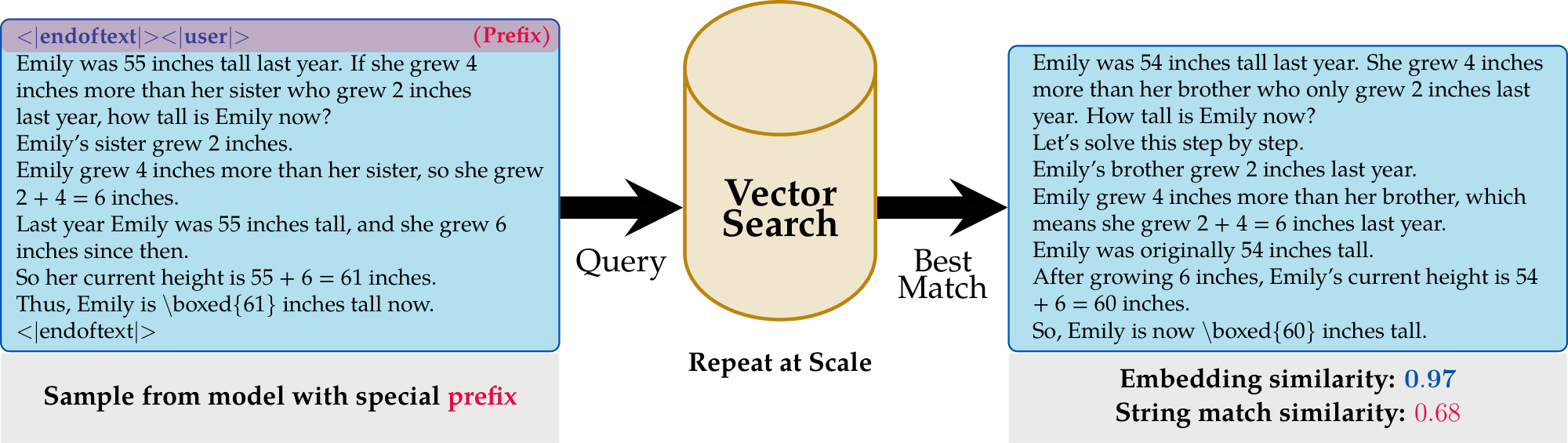
**Our main finding:** One may reasonably expect the synthetic data points to be from the same distribution as the alignment dataset. We find that this is true, but it is far closer to the alignment dataset that one may expect. For example, in Figure 1, we generated a maths question and answer that is near identical to a sample in the alignment dataset.
Contributions
We outline our contributions and findings:
- We generalise the prompting strategy from [39] and study how it may be used to extract post-training data from models trained with SFT and RL, addressing their open question on memorisation.
- We show that measuring the quantity of memorisation based on approximate or verbatim string matching is likely significantly undercounting rates of memorisation – our results suggesting at least by $10\times$. Instead, using neural embeddings reveals a much higher rate.
- We finally demonstrate that our method can be used to generate datasets from a model that can then be used for the (post-)training of another model, meaningfully capturing some of the original model's performance.
2. Nomenclature
Section Summary: This section defines key terms used in the paper for clarity, starting with alignment data, which broadly includes any targeted datasets for improving AI model behaviors like safety, instruction-following, math skills, or reasoning, often seen as valuable assets. Training data encompasses all stages of model development, from initial pre-training to later fine-tuning, while post-training refers to specialized phases after pre-training that use techniques like supervised fine-tuning and reinforcement learning to align the model with desired tasks, increasingly incorporating alignment data earlier on. Memorization is expanded beyond exact recall of training data to include reproducing its patterns or semantics, detected via an embedding score that measures text similarity through neural embeddings rather than simple string matching; chat templates, introduced during post-training, format prompts with special tokens to structure interactions.
In this paper, we rely on the definitions below. We refer the reader to Appendix A for a thorough background overview.
Alignment Data: This term is used broadly to refer not just to data for safety and instruction-following (like Supervised Finetuning and Reinforcement Learning with Human Feedback datasets), but to any targeted data collection used to steer model behavior and improve specific capabilities such as mathematics, reasoning, or long-context understanding. This data is usually considered a significant competitive asset.
Training Data: The term `training data' is usually used to describe data from all phases of model creation, including pre-training, mid-training, and post-training, which encompasses data used for SFT and RL fine-tuning. In this paper we expand the usual meaning to also cover semantically equivalent representation of the training data.
Post-training: This refers to the training stages that occur after the initial large-scale pre-training phase. It involves using various specialized datasets and methods, such as Supervised Finetuning (SFT) and Reinforcement Learning (RL), to align the model's capabilities with desired behaviors and tasks. In this work, we treat post-training data as a (large) subset of total alignment data, as it is becoming increasingly common to include alignment data (maths, reasoning, etc.) also in earlier stages of training.
Memorisation [^2]: This refers to the phenomenon where a model can regurgitate or recite its training data. Our work extends this definition beyond verbatim string matching to include a more abstract notion of memorisation, such as reproducing the patterns, templates, and semantic structure of proprietary data. Related to this concept is approximate memorisation (e.g., [40]), but instead of using simple string-matching similarity metrics, in our work we show that text embeddings seem much better suited at detecting approximate memorisation when semantics are important. We refer the reader to [26] for further motivation behind why we expand our definition of memorisation.
[^2]: We make no statement with regard to whether or not a model 'contains' its training data in a bit-wise or code-wise sense, nor in the sense that any arbitrary instance of training data can be perfectly retrieved.
Chat Template: A specific structure used to format prompts by wrapping user, assistant, or system messages in special tokens (e.g., <|user|>, <|assistant|>). A key aspect of our attack is that these templates and their special tokens are typically introduced only during the post-training stage, where most of the alignment is done.
Embedding Score: A metric we use to measure memorisation based on the semantic similarity between two pieces of text, calculated using the dot product of neural text embeddings. We propose this as a more effective alternative to traditional string-matching metrics (like Levenshtein distance), as it better captures semantic equivalence even when there are superficial differences.
3. Extracting alignment data with neural embeddings
Section Summary: Researchers have developed a method to extract alignment training data from AI models by using specific prompts from chat templates, which often cause the model to generate text very similar to its original training samples. The process involves embedding the entire post-training dataset into a searchable vector database, then repeatedly prompting the model to produce samples, embedding those, and finding the closest matches to measure similarity beyond simple word-for-word copying. By focusing on semantic similarity through neural embeddings rather than exact string matches, this approach reveals how models can "memorize" the meaning of training data even if the wording varies slightly, as demonstrated with models like OLMo 2.
The proposed extraction strategy is based on the observation that certain prompts seem to consistently induce the model into outputting alignment-like data. To enable our attack, we use special tokens from the chat template that are precisely introduced during post-training, making them ideal artifacts that can be leveraged to extract specific types of data. Our main contribution is confirming that many of such generations are either verbatim or very close to true training samples under an appropriate measure of similarity.
Our pipeline works as follows: we embed the entire post-training set using an embedding model (see Section 3.3 for details), constructing a vector search engine. We then generate a number of samples simply by prompting the model using our chosen prefix repeatedly. For each generated sample we then embed it and search the vector database to retrieve the best match and its score. A diagram of this process is shown in Figure 1. Once the post-training dataset is embedded, the search can be implemented as a single matrix multiplication. In the following Section 3.1 and Section 3.2, we will provide motivation for our methodology using generated examples.
A significant constraint of our work is that we require access to models that make their (post-)training mixtures available. For this reason, we focus our study on OLMo 2 ([41]) (Section 4) for SFT and Open-Reasoner-Zero ([42]) (Section 5) for RL. As these models are post-trained with standard methods, they are a valuable resource for our study.
3.1 Chat templates to steer generations
The observation that chat templates can be used to generate useful synthetic data has been pointed out already by [39], where the authors use special prompts and a filtering pipeline to generate a dataset that can be used to post-train models using SFT. In our work, we study this from a different angle and aim to understand the extent to which the generations correspond to regurgitated training data. In particular, we positively answer one of the conjectures left from [39], which posited that the data generated might have been training data.
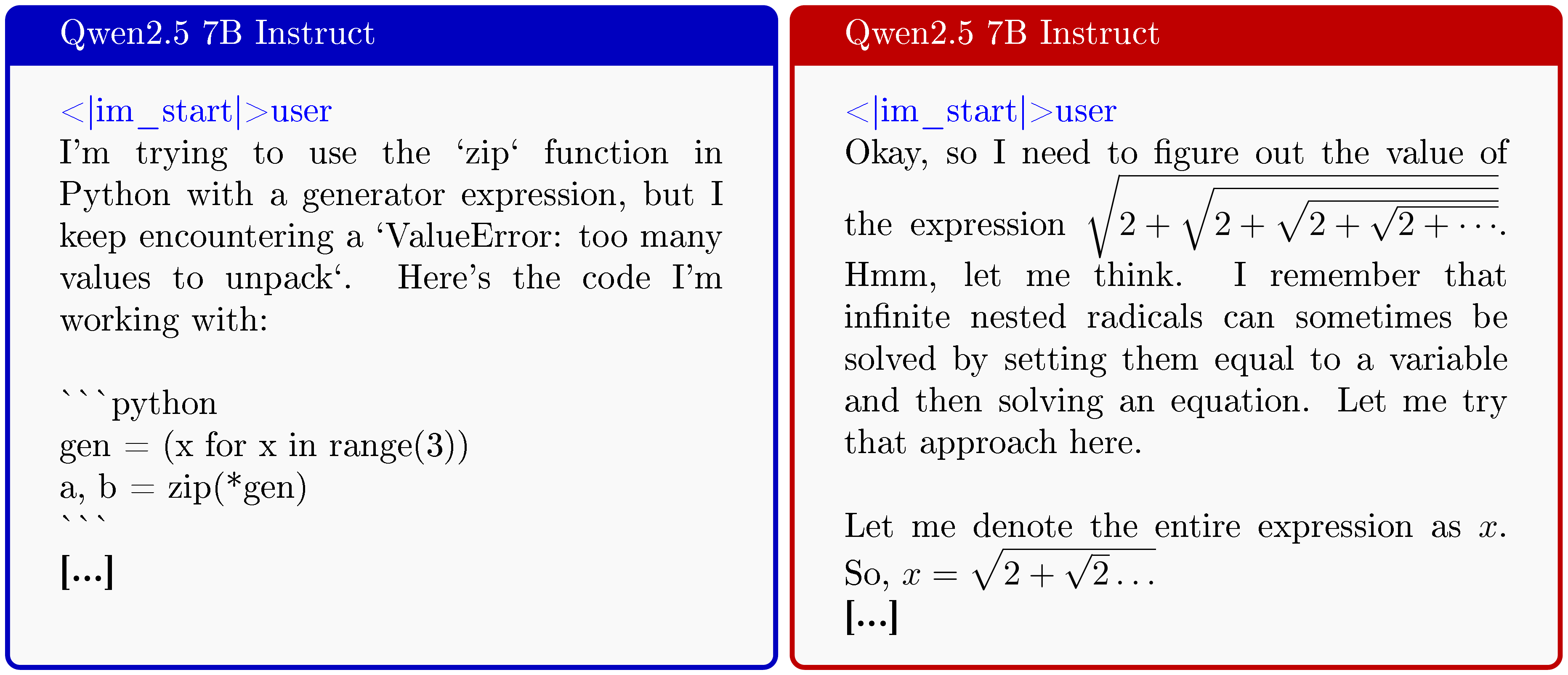
In Figure 2, we show how the prompting the model with the chat template results in outputs that resemble post-training samples. We will investigate this phenomenon in much more detail in the coming sections.
3.2 Measuring aproximate semantic memorisation
A central theme in our work is the wish to broaden the definition of memorisation beyond simple string matching, due to its natural limitations. For example, string matching has been shown to be vulnerable to 'style-transfer' ([26]), where semantics are preserved whilst easily evading string matching checks. Further, we are interested in the usefulness of extracted samples as training points; if two samples are semantically equivalent, then they reasonably should be treated equal as training samples (for measurement of memorisation rate). While approximate string matching may (accidentally) weakly capture semantics in certain cases, we found it to be unreliable and generally not well-aligned with the notion of semantic equivalence.
We use Figure 3 as a small illustrative example from a generation which came from our pipeline. It is clear that the left and right samples are extremely similar up to small differences, for example in the numerical contents of the choices in the multiple choice section of the question. String-matching scores tend to penalise these differences quite heavily assigning a similarity of $\approx 0.7$, while the high embedding score (see Section 3.3 for details) arguably aligns better with the memorisation judgement a human would make. We observed many situations where a string-matching score would provide low similarity while the samples are semantically extremely similar. We point out that under the standard $0.9$ approximate memorisation threshold ([40]), the example in Figure 3 would count as not memorised. We delay to Section 4.1 a more detailed investigation of the limitations of string matching.
![**Figure 3:** (Left) Generation from OLMo 2 13B. (Right) True post-training sample. Neural embeddings match provide a score of $0.986$ using `gemini-embedding-001` ([43]), while normalised Levenshtein similarity provides a match score of $0.699$, heavily penalising differences in the options, even though the semantics remain identical. When computing similarities we always strip out special tokens, highlighted in <span style="color:blue">blue</span>. We report in the Appendix (Appendix D) more of such examples.](https://ittowtnkqtyixxjxrhou.supabase.co/storage/v1/object/public/public-images/yf4wnfvw/complex_fig_e79f61cce4d5.png)
3.3 Measuring memorisation with neural embeddings
Embedding scores are generated by an embedding model and can be tuned for different tasks. The process usually involves taking a strong base model and training it contrastively for a specific application (e.g., semantic retrieval) ([44]). We use the gemini-embedding-001 model ([43]) in all of our experiments as it is a general and strong embedding model. We generate a single embedding for each sample, removing all special tokens and therefore only considering the plain text. This acts as a vector search engine, where we can compute similarity with respect to each training sample using a single matrix multiplication and taking the argmax. As embeddings are normalised to be unit-norm, their dot product naturally encodes a notion of similarity. To better distinguish this from approximate memorisation measures using string matching, we call this a measure using embeddings a measure of approximate semantic memorisation.
To define a sample as (approximately semantic) memorised, we need to choose an appropriate threshold. We do this manually and report randomly chosen samples at different thresholds in the Appendix (Appendix D and Appendix E). We chose a threshold of 0.95 for neural embeddings as a more conservative choice. We found samples at this point having qualitatively similar properties that would be indisputable given a reasonable human judge. The choice of the threshold will naturally affect the measured memorisation. This limitation is however also present in choosing a threshold for what is considered memorised according to a string matching metric.
4. Large scale extraction of SFT data
Section Summary: Researchers studying the OLMo 2 language model examined how it memorizes data from its supervised fine-tuning (SFT) stage, which involves about 939,000 training samples, by generating text from the model and comparing it to the original data. Traditional string matching techniques suggested very low memorization rates, missing subtle but clear cases of recall, while neural embeddings revealed much higher rates by better capturing semantic similarities. Further analysis showed uneven coverage across samples—those repeated or similar in earlier training phases were more likely to be memorized—and using a chat template prefix improved the extraction of post-training-like data.
We focus our SFT memorisation study on OLMo 2 ([41])[^3]. OLMo 2 comes with the full training mixture, alongside the training details. Further, the models have strong downstream performance, enabling us to conduct experiments that result in findings that are likely generalizable to other models. The uncompressed pre-training mix has a size of 22.4 TB while the higher quality mid-training split has a size of 5.14 TB. The post-training is divided in 3 stages, the first is an SFT stage with a dataset containing 939k samples, then a Direct Preference Optimisation ([45]) step is conducted with 378k samples, and finally a RL with Verifiable Rewards (RLVR) step with 29.9k samples. We focus on the extraction of the SFT data in this section.
[^3]: Licensed by AllenAI under the Apache License, Version 2.0.
We apply the procedure we described in Section 3 using neural embeddings. We embed the SFT training samples using gemini-embedding-001 by concatenating the question and answer sequences as a single block of text. To extract the data from the model, we generate conditioning on the following initial tokens <|endoftext|><|user|>\n, which are the starting tokens of the chat template. We leave the temperature at the default value of $1$.
4.1 String matching poorly captures memorisation
We start by evaluating the memorisation using traditional string matching metrics. We consider $100$ k generations for OLMo 2 $13$ B ([41]) using our extraction method and search for their closest match in the post-training set, with respect to different similarity measures. We consider the normalised Levenshtein similarity defined as $1 - \texttt{Levenshtein}(A, B) / \texttt{max}(\texttt{len(A)}, \texttt{len(B)})$ and the normalised Indel similarity defined as $1 - \texttt{Indel}(A, B) / (\texttt{len(A)} + \texttt{len(B)})$. The Indel similarity is related to the Levenshtein distance, but applies a cost of $2$ to substitutions. For each generated sample, we find the highest similarity based on the two string matching methods in the post-training set. We follow the heuristic used by Gemini 2.5 ([40]) and characterise a sample as approximately memorised when its similarity is above 0.9.
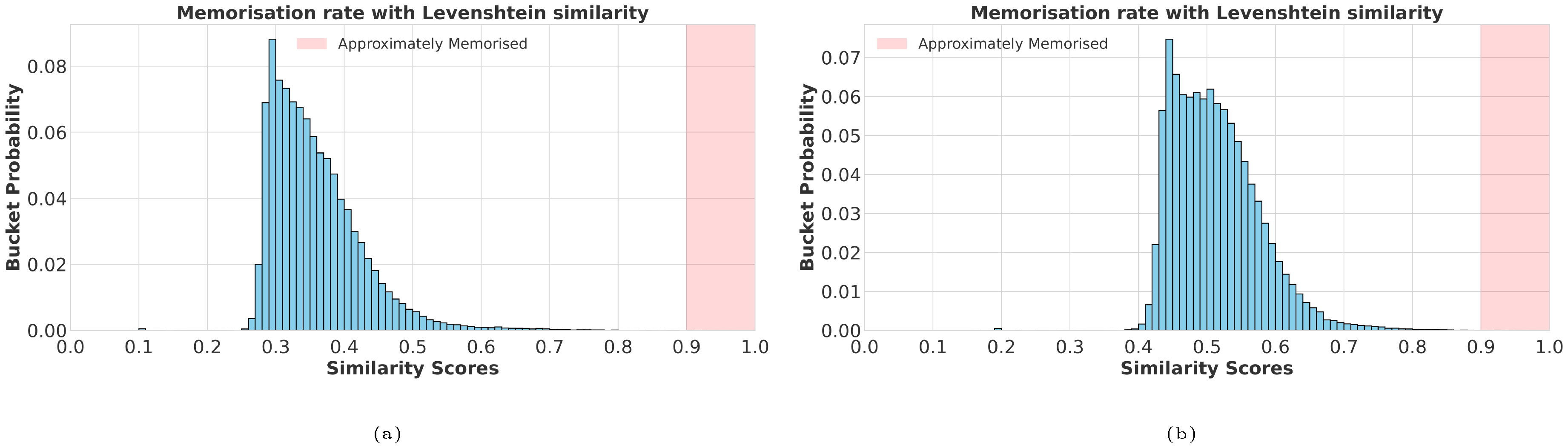
In Figure 4 we show that when judging memorisation rates based on string matching scores, memorisation rates seem negligible. The judgement from such results would be that our prompting strategy does not extract useful memorised data under string matching metrics. This however does not paint the entire picture. For example, the generated sample in Figure 3, would not be considered memorised under the heuristic of [40]. This is the extent to which measuring memorisation on simple string matching is problematic; it does not flag examples that any reasonable human would judge as clear cases of memorisation. This is because string matching can quickly become non-informative due to trivial differences (see Appendix D).
4.2 Large scale extractions with embeddings
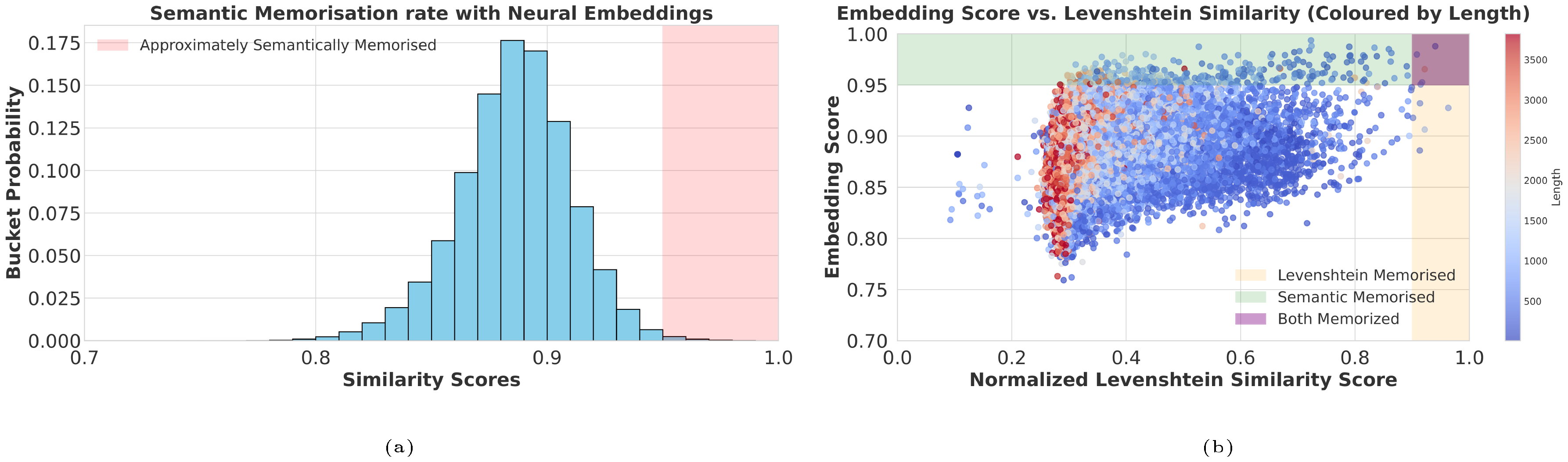
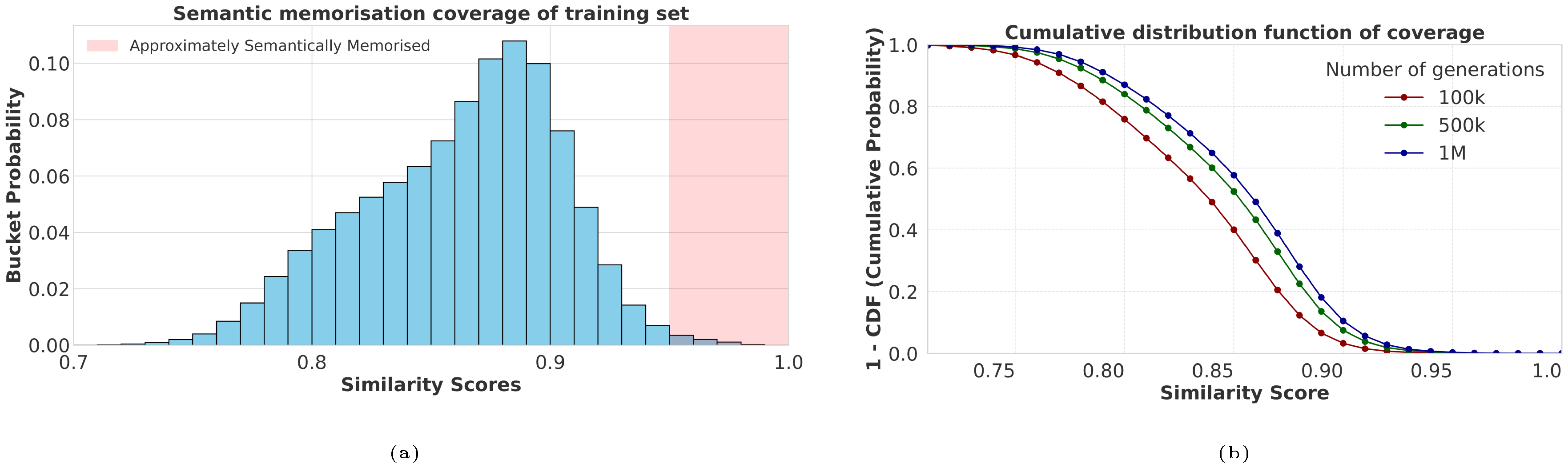
We now compare the string matching results to matching done using neural embeddings. We generate 1M samples with OLMo 13B using the same method and embed them using gemini-embedding-001. In Figure 5, we show that neural embeddings unveil a much higher memorisation rate (left) when compared to string matching scores Figure 4. The scatter plot (right) shows that string matching distances are not well-aligned with semantic memorisation and also seem to exhibit a strong string length bias as well, where longer generations are consistently given lower Levenshtein similarity scores. We find that neural embeddings are much better at dealing with cases such as Figure 3 and provide a number of examples in the Appendix (Appendix D).
Coverage.
We now check the coverage of the post-training data, where for each post-training sample, we report the largest embedding score out of the 1M generated samples. We report the results in Figure 6. We find that some samples are much more memorised than others. While it is hard to understand exactly why, our investigations revealed that samples are much more likely to be memorised if similar samples are also present in the pre and mid training datasets. Further, samples that appear often, for example different versions of the same reasoning problem, seem to be more likely to be memorised.
Chat template better recovers post-training data.
We finally show that conditioning on the chat template is useful to encourage the model to generate post-training-like data. As a baseline, we compare this method to simply conditioning on the single token <|endoftext|>. We consider 1, 000 generations with both prefixes and report the estimate on the expected value of the embedding score. In Table 1, we show that indeed conditioning on the entire chat template provides samples closer to the post-training distribution. We suspect that since chat templates are only present during post-training, the model associates their presence with the post-training data distribution. This provides an explation for why techniques such as Magpie ([39]) are possible: conditioning on the chat template results in generations that are much closer to the post-training distribution.
::: {caption="Table 1: Mean best embedding score of generations for OLMo 2 13B using only the `beginning of sequence token' versus the full chat template prefill. The longer prefill generates samples that are on average semantically closer to the post-training set."}

:::
4.3 Direct distillation on extracted data
A natural question one may then have is, if the generated data is similar to the original post-training dataset, can it be used to post-train a model directly? In other words, are we able to re-use a large and diverse enough number of samples to post-train a model without collecting any data manually? To explore this question, we post-train using SFT OLMo 2 7B in two ways: (1) the original dataset in order to reproduce the original results and (2) our generated dataset. For the synthetic dataset, we collect a synthetic dataset of a similar size of $\approx930$ k samples. We perform basic filtering and processing using Gemini 2.5. We note that even though the number of samples is the same, the original SFT training is over $\approx 1.3$ B tokens, while the synthetic training set has only $\approx 850$ M tokens as the filtered generations remain shorter.
In Table 2, we report the results following the benchmarks and evaluation pipeline used by [41]. To validate our setup, we first show that our reproduction is very close to the released SFT checkpoint. Our model trained on synthetic data also achieves comparable performance on the benchmarks, except for the IFE task. We suspect that our pipeline generates too few examples that target this benchmark, but believe the performance could likely be improved by adding non-synthetic data. In fact, it is likely that a mix of synthetic and curated targeted data could be a useful paradigm to explore to boost model performance reducing the labour required to collect entire post-training datasets.
: Table 2: Model performance after SFT on the benchmarks considered by [41]. The baseline performance is taken from [41] and the reproduction was ran using the code provided by the authors with the original dataset. Using our method, we train a model on SFT 'synthetic' data extracted from the model using the same settings of the baseline.
| Model | BBH | MMLU | MATH | GSM8K | POPQA | TQA | IFE | DROP |
|---|---|---|---|---|---|---|---|---|
| Baseline (SFT only) | 0.4953 | 0.6133 | 0.2073 | 0.7407 | 0.2364 | 0.4858 | 0.6562 | 0.5960 |
| Baseline (Reproduction) | 0.4944 | 0.6123 | 0.2077 | 0.7377 | 0.2529 | 0.5110 | 0.6617 | 0.5945 |
| Extracted Data | 0.5161 | 0.6052 | 0.1705 | 0.7847 | 0.2490 | 0.5529 | 0.5028 | 0.5923 |
5. Large scale extraction of RL data
Section Summary: Researchers used the Open-Reasoner-Zero model, trained with reinforcement learning on public data, to generate 100,000 question-and-answer samples, discovering that it surprisingly regurgitates exact training examples, including added reasoning steps not in the original data. They measured how likely the model finds these training prompts before and after training, finding that reinforcement learning boosts their probability, suggesting it promotes memorization in unexpected ways. To test this further, they extracted a synthetic reinforcement learning dataset from the model, used it to train a new version of another model, and achieved performance close to the original on math benchmarks.
We now focus on the extraction of RL data. We use the Open-Reasoner-Zero ([42]) model, which was trained from the Qwen 2.5 base model with PPO ([46]) using post-training data that is publicly available. With RL, the training samples consist of questions and answers, but the reasoning traces not part of the training dataset as they are artifacts of the training rollout. For this reason, we focus on the extraction of the questions and answer part of the dataset although note that reasoning traces can be useful in their own right.
We prompt the model by again taking the first part of the chat template specified by the developers of the model (see Appendix C in the Appendix for the entire prefix) and generate 100k samples independently. We find that the model very consistently generates a question, followed by a thinking trace, and finally an answer. We then searched the training set for these generations. Surpisingly, we again found a number of training samples being regurgitated verbatim. We show an example in Figure 7, where the model outputs the exact training sample, a reasoning trace, and the correct solution. We find the fact that models are capable of regurgitating RL training samples to be counterintuitive as the PPO objective, at least at a glance, seems rather misaligned with the memorisation of training samples, especially when compared to methods such as SFT that instead very explicitly increase sequence likelihoods.
![**Figure 7:** (Left) Generation from Open-Reasoner-Zero 7B using our special <span style="color:blue"><PREFIX></span> (see Appendix C for the full string). We shorten the thinking trace with **[...]**. (Right) True RL post-training sample. Surprisingly, we find that RL training samples can be regurgitated *verbatim*, even though the training objective seems to be heavily misaligned with this behaviour. The RL training samples only consist of a question and answer pair and do not come with a thinking trace. The model instead regurgitates the question, followed by the thinking trace, and finally the answer.](https://ittowtnkqtyixxjxrhou.supabase.co/storage/v1/object/public/public-images/yf4wnfvw/complex_fig_d9df25ccbf45.png)
We explore this further phenomenon further by measuring the change of likelihood of training set samples in the base and post-trained models. Measuring likelihood of the training set is limited because this only measures the 'pointwise' memorisation – a likelihood of a training sample might remain low because the exact polynomial in the training set for instance is not being memorised, but the question style of finding its roots is. Regardless of the limitation of this simple measurement, we believe the results can still provide valuable signal and intuition.
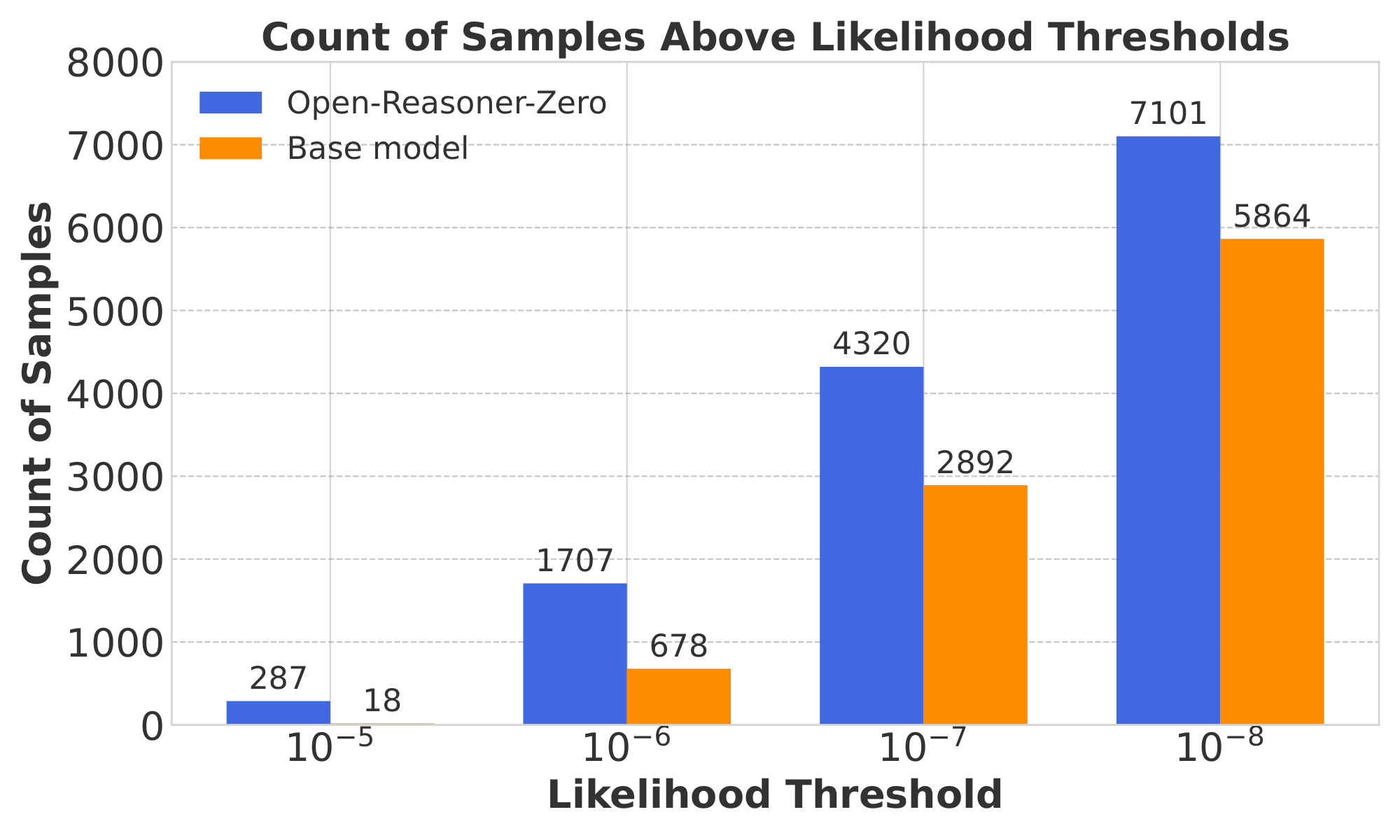
In particular, we measure the likelihoods of each PPO training sample question under the Qwen 2.5 base model and the Open-Reasoner-Zero model. If the RL process induces memorisation, then we would see the likelihood using the post-trained model increase on the training samples. We bucket the results in likelihoods increasing by magnitudes of $10$ for the base Qwen model and the Open-Reasoner-Zero model and report the results in Figure 8. The results show that RL training induces many of the training prompts to increase in likelihood. We found samples of likelihoods increasing from $10^{-11}$ to $10^{-5}$ after RL post-training, showcasing the fact that RL may be able to induce the memorisation of post-training samples. This is particularly surprising when one considers the RL post-training objective. It is not immediately clear to us what exact mechanism is driving this increase in likelihood and leave this as a future exciting research direction.
![**Figure 9:** RL training using the ORZ ([42]) dataset and a dataset that was extracted using our method. Surprisingly, we are able to recover most of the performance with our simple extraction method.](https://ittowtnkqtyixxjxrhou.supabase.co/storage/v1/object/public/public-images/yf4wnfvw/rl_extract.png)
RL on extracted dataset
We now show that one can perform a similar extraction pipeline but to instead extract an RL dataset. In other words, one can use an RL-trained model to extract an RL dataset with little effort. We start by post-train using Dr. GRPO ([47]) the Qwen2.5 7B base model using the ORZ 57k dataset ([42]). With the resulting post-trained model (we call it 'Baseline'), we then generate using our method $100$ k samples and process them using Gemini 2.5 ([40]) to filter out invalid, incomplete or incorrect samples. We finally randomly select from this set $57$ k synthetic samples to create our synthetic training data. We use this to post-train the Qwen2.5 7B base model using synthetic data only. Afterwards, we evaluate both models on four standard benchmarks: AMC ([48]), MATH500 ([49]), Minerva Math ([50]), and OlympiadBench ([51]). We then report the results in Figure 9. The model trained on the synthetic data extracted from the 'Baseline' achieves comparable performance on the benchmarks. These results are surprising because our synthetic dataset is based on extracted data from a small 7B model trained on a relatively small RL dataset. We suspect that a more sophisticated pipeline could be used to achieve higher performance and retrieve a higher quality dataset. As our work focuses on training sample extraction, we leave this goal as a promising future direction.
6. Conclusion
Section Summary: Researchers have shown that useful alignment data from large language models can be easily pulled out by using chat templates, which were added during the model's final training stages to prompt it into repeating training-like responses. Traditional ways of measuring data leaks miss most of this because they only look for exact matches, but better tools reveal that the models often recreate the meaning and patterns from their training data, even if not word-for-word. This leaked data can train new models effectively, including from reinforcement learning phases, raising concerns about copying advantages from open-source models, though closed models are harder to exploit.
In this paper, we demonstrate that alignment data can be efficiently extracted from open-weight large language models. Our attack leverages a simple observation: chat templates and their special tokens are typically introduced during post-training, making them effective prefixes for inducing models to regurgitate alignment-like data.
Leakage Metrics are Hard A key finding is that the true scale of this leakage is hidden by traditional metrics. We show that methods relying on string matching drastically undercount the rate of extraction, by (at least!) an order of magnitude. By instead using high-quality embedding models, we can identify approximate semantic memorisation—instances where the model reproduces the semantic structure and patterns of training data, even if not verbatim. This semantic similarity is far more relevant for capturing the utility of the data, as highlighted by numerous examples all throughout the paper.
Model Distillation as Data Distillation We demonstrate that data extracted from a post-trained model can be used to successfully train a new base model, meaningfully recovering parts of the original's performance in both SFT and RL settings. This confirms that the common practice of model distillation can function as an indirect form of training data extraction. Certain advantages that an open model obtains from its alignment data are therefore at risk of being leaked.
Rethinking Memorisation in RL Surprisingly, we find that models readily regurgitate training samples (even!) from Reinforcement Learning (RL) phases. This is counter-intuitive, as the reinforcement learning objective is not explicitly designed to increase sequence likelihoods in the same way as SFT. The fact that RL training prompts increased in likelihood after post-training suggests a more complex relationship between alignment and memorisation that warrants future investigation.
Our attack exploits chat templates and so is only applicable to open models. Closed models enforce the chat template, and is outside of the users control; a working exploit on a closed model would require a user to spoof the behaviour of these tokens when submitting a query to the model. Whilst more difficult, prior work ([52]) has shown this is not necessarily impossible. Future work will establish how serious a threat this is on closed models.
Author contributions
Section Summary: Federico conducted experiments, led the overall research, and contributed to writing the paper. Jamie and Ilia directed the project and helped with the writing, while Xiangming handled the reinforcement learning experiments and also assisted in writing. Matthew, Chris, Petar, and Chawin provided feedback and supported the paper's development.
Federico ran experiments, led the research and wrote the paper. Jamie and Ilia led the project and wrote the paper. Xiangming ran the RL experiments and wrote the paper. Matthew, Chris, Petar, Chawin gave feedback and helped write the paper.
Appendix
Section Summary: This appendix explores the background of large language models at the crossroads of model alignment, where models are fine-tuned with specialized data to become helpful assistants; training data memorization, in which models can recall their training material; and model distillation, a method to transfer abilities from one model to another. It delves into alignment techniques, starting with a shift from broad internet pre-training to targeted post-training methods like Supervised Finetuning, which optimizes models on question-answer pairs, and reinforcement learning approaches such as PPO and GRPO, which use rewards to refine responses in models like OLMo 2 and Open-Reasoner-Zero. The section also covers chat templates that format conversations with special tokens, highlighting their role in building security features but also as potential vulnerabilities for extracting alignment data.
A. Extended background
Our work sits at the intersection of key areas in the study and development of frontier LLMs. The first is model alignment, where curated data and specialised training techniques are used to transform a base model into a useful assistant. The second is training data memorisation, the observation that models are capable of regurgitating training data. The third is the widespread practice of model distillation, a process through which a strong model's capabilities can be transferred to another. In this section, we will review these areas and argue that there is a risk that lays at the intersection of the three.
A.1 Model alignment
Early models ([53, 54]) were built on the idea that pre-training on larger and larger amounts of internet data was the solution to keep improving capabilities. Today, this principle has arguably shifted and we have seen a surge in multi-stage training with a number of specialised datasets and techniques, giving birth to what is now called post-training. LLMs are post-trained using various methods ranging from Supervised Finetuning (SFT) to now very popular RL methods such as Proximal Policy Optimisation (PPO) ([46]), Group Relative Policy Optimization (GRPO) ([55]), and Reinforcement Learning from Human Feedback (RLHF) ([56]), among many others. In this work, we mainly focus on models that were post-trained using SFT and PPO as they are common post-training techniques and we have strong open models that were trained using such techniques with publicly available post-training data.
Supervised Finetuning
With SFT, one collects a dataset $D$ of question-answer pairs $D ={(Q_i, A_i)}^{N}{i=1}$. The model is then optimised to predict an answer $A_i$ given a question $Q_i$, i.e. to increase the likelihood $P(A_i | Q_i)$. To achieve this, usually one masks out the contributions of the loss that come from the question part, i.e. computing the conditional gradient $\nabla\theta \log P(A_i|Q_i; \theta)$ given some parameters $\theta$. The parameters are updated via some form of gradient descent on the negative log-likelihood:
$ \theta' \leftarrow \theta + \eta \frac{1}{|B|} \nabla_\theta \sum_{k \in B} \log P(A_k|Q_k; \theta) $
given some learning rate $\eta > 0$ and batch $B \subset D$. The OLMo 2 ([41]) family of models has been post-trained in large part using SFT with a dataset of 939 $, $ 344 question-answer pairs which has been released publicly, providing an excellent resource for our study.
RL-based post-training
We focus on reinforcement learning with verifiable rewards (RLVR) ([57]) in this work. The Open-Reasoner-Zero ([42]) model adopts PPO ([46]) for policy optimization in the post-training. The training objective could be written as
$ \mathcal{J}\text{PPO}(\theta) = \mathbb{E}{Q\sim \mathcal{D}, O_{\le t}\sim\pi_{\theta_{\text{old}}}(\cdot\mid Q)} \sum_{t=1}^{|O|}\Bigg[\min \Bigg(\frac{\pi_{\theta}(O_t\mid Q, O_{<t})}{\pi_{\theta_{\text{old}}}(O_t\mid Q, O_{<t})} \hat{A}t, \ \text{clip} \Bigg(\frac{\pi{\theta}(O_t\mid Q, O_{<t})}{\pi_{\theta_{\text{old}}}(O_t\mid Q, O_{<t})}, 1 - \varepsilon, 1 + \varepsilon \Bigg) \hat{A}_t \Bigg) \Bigg] $
Here $O$ is the generated response, $\epsilon$ is the clipping ratio, and $\hat{A}_t$ is an estimator of $t$-th token's advantage, which is computed through the Generalized Advantage Estimation (GAE) ([58]) with a learned value model and a reward function. GRPO ([55, 57]) removed the value function and estimated the advantage $\hat{A}t$ in a group manner. For each question $Q$, GRPO samples a group of responses ${O^1, O^2, ..., O^G}$, which can be rewarded as ${R^1, R^2, ..., R^G}$ using the reward function. Normally the reward function is shaped by whether the response correctly answers the question (the answer within a specified format matches the correct answer) and whether the response format is correct. Then the advantage is estimated as $\hat{A}t^i=\frac{R^i-\textrm{mean}({R^i}{i=1}^G)}{\textrm{std}({R^i}{i=1}^G)}$. Therefore, the objective of GRPO can be written as
$ \begin{split} \mathcal{J}{GRPO}&(\theta) = \mathbb{E}{Q\sim \mathcal{D}, {O_{\le t}^i}{i=1}^G\sim\pi{\theta_{\text{old}}}(\cdot\mid Q)} \ & \frac{1}{G}\sum_{i=1}^G \frac{1}{|O_i|} \sum_{t=1}^{|O_i|} \Bigg[\min \Bigg(\frac{\pi_\theta(O_{t}^i | Q, O_{<t}^i)}{\pi_{\theta_{old}}(O_{t}^i | Q, O_{<t}^i)} \hat{A}{t}^i, \text{clip} \left(\frac{\pi\theta(O_{t}^i | Q, O_{<t}^i)}{\pi_{\theta_{old}}(O_{t}^i | Q, O_{<t}^i)}, 1 - \epsilon, 1 + \epsilon \right) \hat{A}{t}^i \Bigg) - \beta \mathbb{D}{\textrm{KL}}(\pi_{\theta}\mid\mid\pi_{\textrm{ref}}) \Bigg]\nonumber \end{split} $
KL regularization ensures that the policy model does not deviate the reference model too far, but could be eliminated to further improve the exploration ([42]). Dr. GRPO ([47]) removes response-level length bias in the objective and question-level difficulty bias in the advantage estimation, improving token efficiency with comparable reasoning performance. There is also significant body of work aiming to improve GRPO, with notable examples being DAPO ([59]) and GSPO ([60]).
Chat templates
It has now become common to format the question and answers using a chat template, which wraps the messages in special tokens that are designed to mark the messages as being 'user', 'assistant' or 'system' messages. Chat templates from a security perspective are usually trained to build a so-called instruction hierarchy of privilege ([61]) although its practical effectiveness has been challenged ([52]). Crucially, the special tokens used to build the template are only introduced during post-training. In this work, we show that this makes them a useful attack vector to elicit the generation of alignment data introduced exclusively in post-training. A similar effect has been pointed out by [39], but while their focus was the automated generation of an alignment dataset, our focus is instead that of generalising and better understanding the process from the point of view of memorisation – answering one of their conjectures where they posited that models are likely memorizing such data.
A.2 Memorisation
It is a well-documented fact that LLMs are capable of memorising and reciting training data verbatim ([2, 62, 3]). The primary concern of these studies has been public-facing risks, such as the leak of private information like email addresses, names, and credit card numbers that were accidentally included in the pre-training dataset or the regurgitation of copyrighted material.
A common way to measure memorisation is that of (greedy) discoverable extraction [2, 4] – in such case a sample is called extractable if there exists some prefix such that the LLM prompted on the prefix will generate the sample using greedy decoding. Such a definition is computationally convenient as it effectively ignores the stochastic nature of LLMs and is useful for a variety of tasks like observing if the model outputs copyrighted data verbatim or to discover sensitive strings of information. A relaxation of this is probabilistic discoverable extraction ([28]) in which one considers the probability of extracting the sample in multiple queries. This measure provides more information by considering the joint likelihood of the sequence rather than providing simply a boolean decision on extractability.
Recent work has begun to focus on moving away from measuring memorisation of verbatim or near-verbatim string matches ([26, 63]). For example, [64] showed the LLMs can assemble information from related, partially overlapping fragments of text, a concept they term mosaic memory. This challenges the assumption that memorisation is driven exclusively by exact repetitions in the training data. They demonstrate that even highly modified sequences can contribute significantly to the memorisation of a reference sequence, with the memorisation effect being predominantly a function of syntactic overlap (shared tokens). This suggests that current data deduplication techniques, which often focus on removing exact duplicates, are insufficient for addressing the full spectrum of memorisation and data leakage risks. [65] introduced the concept of distributional memorisation, a form of non-verbatim memorisation measured by the correlation between an LLM's output probabilities and the frequency of related input-output data pairs (n-grams) in its pretraining corpus. The authors find that this type of memorisation is prominent in knowledge-intensive tasks like factual question-answering, whereas reasoning-based tasks rely more on generalization, where the model's outputs diverge from the training data's distribution. Finally, [66] presents the Entropy-Memorisation Law, which establishes a linear correlation between the entropy of training data and a non-verbatim memorisation score measured by Levenshtein distance. The law suggests that data with higher entropy is more difficult for a model to memorize accurately, resulting in a higher memorisation score (i.e., more token-level differences between the model's output and the original text). Our work is similar in spirit to all of these works, however, we establish memorisation rates under our embedding definition which are far higher than what may be expected from these prior works. For example, [65] found reasoning-based tasks rely more on generalization than memorisation; we found that even under reasoning-based tasks, the model heavily exploits knowledge of training data through clear signs of memorisation.
[20] showed that data that appears later in the training process is more likely to be memorized. Our focus on memorisation of alignment and strategic proprietary data presents an interesting open-question about if this finding still holds for post-training. One the one hand we may expect this data to be more likely to be memorized due to results from [20], on the other, post-training has certain properties that may make it less likely to be memorized. For example, tokens are regularly masked during the loss computation implying part of training prompts will not contribute to model gradients, whilst prior work has shown RL (commonly used in post-training) is less likely to memorize than standard instruction tuning (with the same compute budget) ([67]).
A.3 Model Distillation
Model distillation is a popular technique for creating capable models without the massive cost of training from scratch ([68]). In this process, a smaller 'student' model is trained on the outputs generated by a larger, more powerful 'teacher' model (e.g., using GPT-4 to generate training data for a new open-source model).
While often viewed as a way to transfer capabilities, distillation can be re-framed through the lens of memorisation. If a teacher model is capable of reciting its own proprietary training data, any student model trained on its outputs will, by definition, be exposed to this secret sauce. This risk is especially pronounced in 'hard' distillation pipelines that directly use the teacher's labels as training examples ([39])[^4]. The core question, which our work addresses, is how much of the teacher's original training data is unintentionally passed down to the student.
[^4]: This is contrast to soft distillation in which one trains on the logits instead of the output labels. Soft distillation is challenging if the vocabulary of the two models is not the same.
Our position
Collecting proprietary strategic data is expensive and time consuming; model developers and data curators clearly do not want to give this data freely to other parties. On the other hand, practitioners are already actively training on outputs from strong competing models. If this data leaks through this process, the competitive advantage of the original data owner is eroded. This motivates our memorisation study within this context.
B. Accidental gradient alignment
An intriguing consequence of our work is that we observe training data being memorised verbatim even if the gradients are masked. This constitutes an interesting type of leakage that to the best of our knowledge has not been previously observed. We propose some mathematical speculation for how this might happen. To make this statement more precise, the claim is that given a question $Q$ and answer $A$, we question whether updating based on the conditional gradient $A|Q$ can increase the likelihood of $Q$.
Let the model parameters be $\theta$. During training on a pair $(Q, A)$, the parameters are updated from $\theta$ to $\theta'$ using gradient descent on the negative log-likelihood of the answer:
$ \theta' = \theta + \eta \nabla_\theta \log P(A|Q; \theta), $
where $\eta > 0$ is the learning rate. We are interested in the change in the log-probability of the question, $\log P(Q; \theta')$, after this update. A first-order Taylor expansion of $\log P(Q; \theta')$ around $\theta$ gives:
$ \log P(Q; \theta') \approx \log P(Q; \theta) + (\theta' - \theta)^T \nabla_\theta \log P(Q; \theta) $
Substituting the update rule for the term $(\theta' - \theta)$, we obtain:
$ \log P(Q; \theta') \approx \log P(Q; \theta) + \eta \left(\nabla_\theta \log P(A|Q; \theta) \right)^\top \left(\nabla_\theta \log P(Q; \theta) \right). $
For the likelihood of $Q$ to increase, the inner product of the two gradients must be positive:
$ \left(\nabla_\theta \log P(A|Q; \theta) \right)^\top \left(\nabla_\theta \log P(Q; \theta) \right) > 0. $
This condition is rather intuitive. The first gradient, $\nabla_\theta \log P(A|Q; \theta)$, is the direction in parameter space that maximally increases the probability of the answer $A$ given the question $Q$. The second, $\nabla_\theta \log P(Q; \theta)$, is the direction that maximally increases the unconditional probability of the question $Q$. If their dot product is positive, the two gradients are correlated and increasing the likelihood $P(A|Q)$ also increases the likelihood $P(Q)$.
We note as a caveat that simply considering the likelihood of a single sequence might not be the most informative metric. For instance, a math-related post-training sample might have different numerical values, but the general 'template' might be correct. This suggests that one should really integrate over all reasonable sequences that one wishes to consider which is of course quickly intractable.
C. Prefixes used for generation
Below we provide the generation prefixes used for the experiments in our work. Both are prefixes taken directly from the template released by the developers of the corresponding models.
<|endoftext|><|user|>
A conversation between User and Assistant. The User asks a question, and the Assistant solves it. The Assistant first thinks about the reasoning process in the mind and then provides the User with the answer.
The reasoning process is enclosed within <think> </think> and answer is enclosed within <answer> </answer> tags, respectively, i.e., <think> reasoning process here </think> <answer> answer here </answer>. User:
You must put your answer inside <answer> </answer> tags, i.e., <answer> answer here </answer>. And your final answer will be extracted automatically by the \boxed tag.
This is the problem:
D. Failure cases of string matching
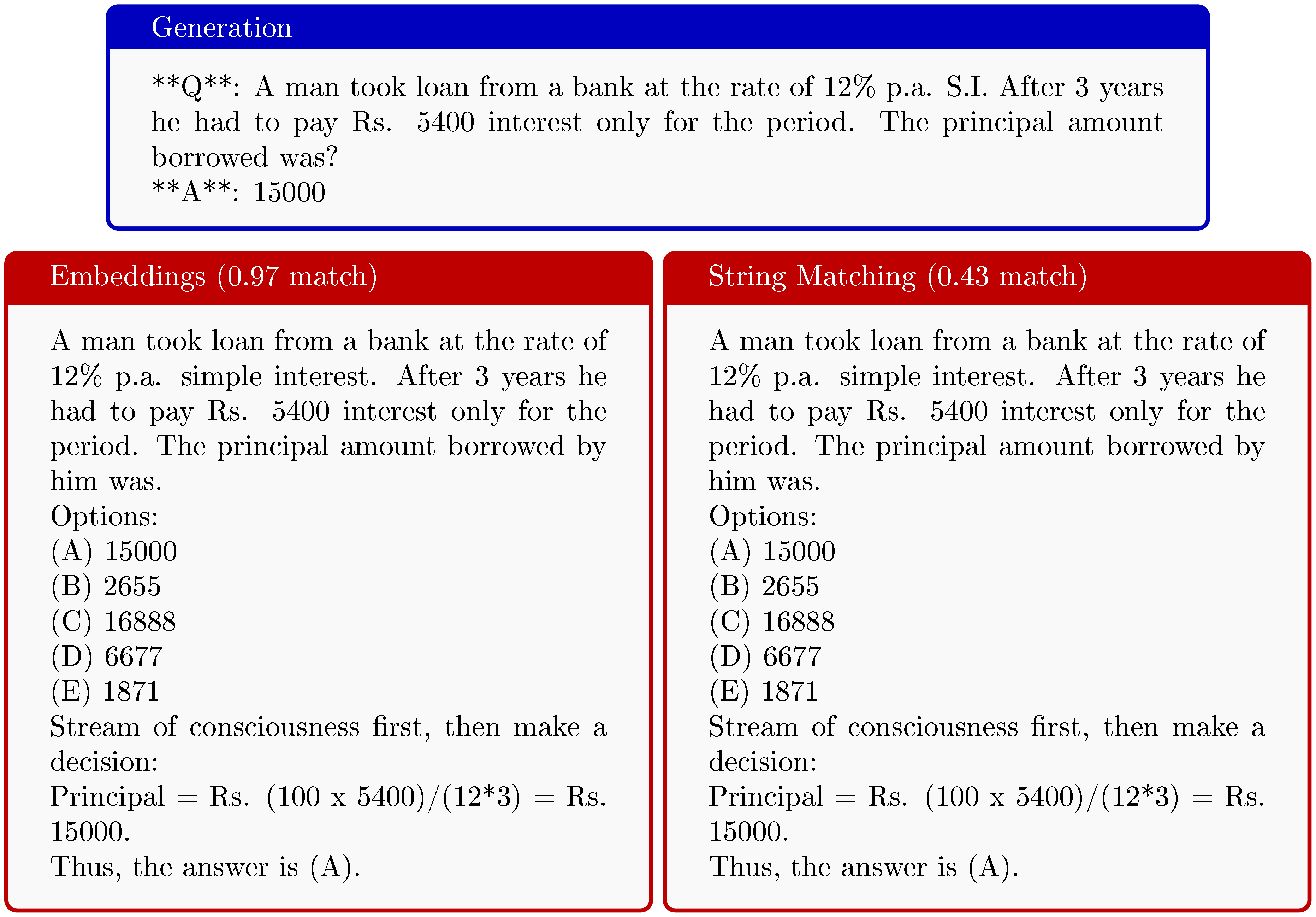
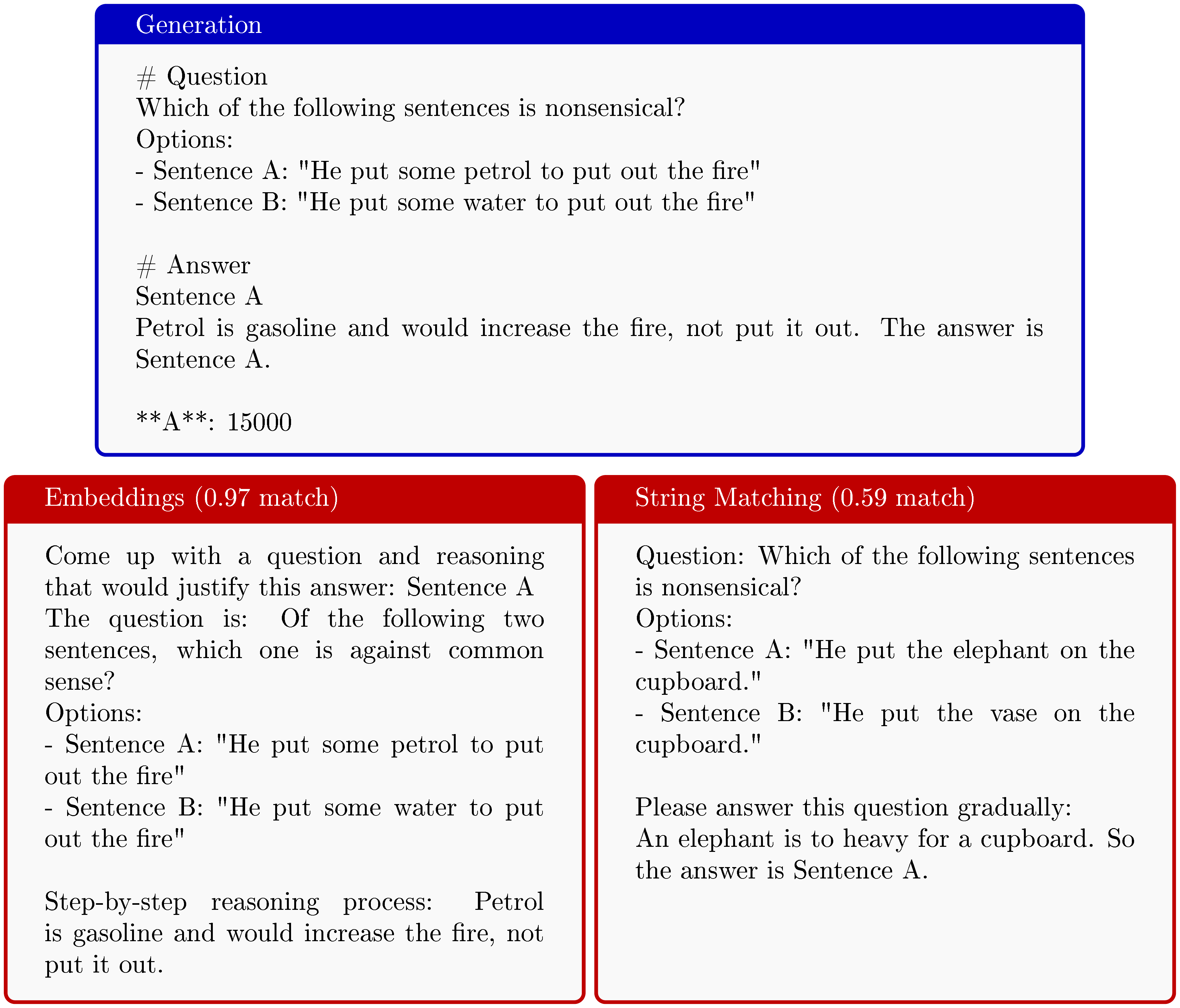
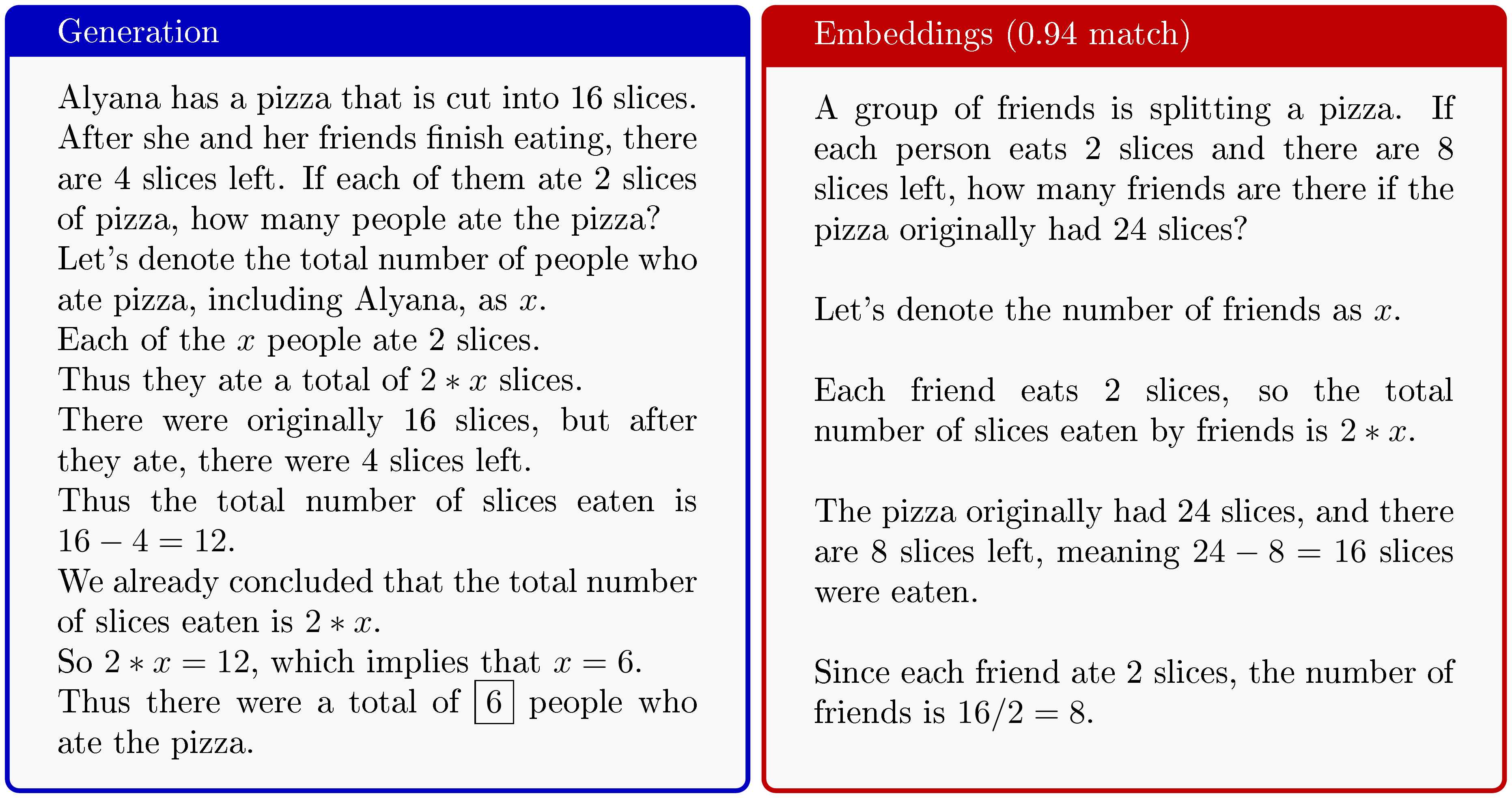
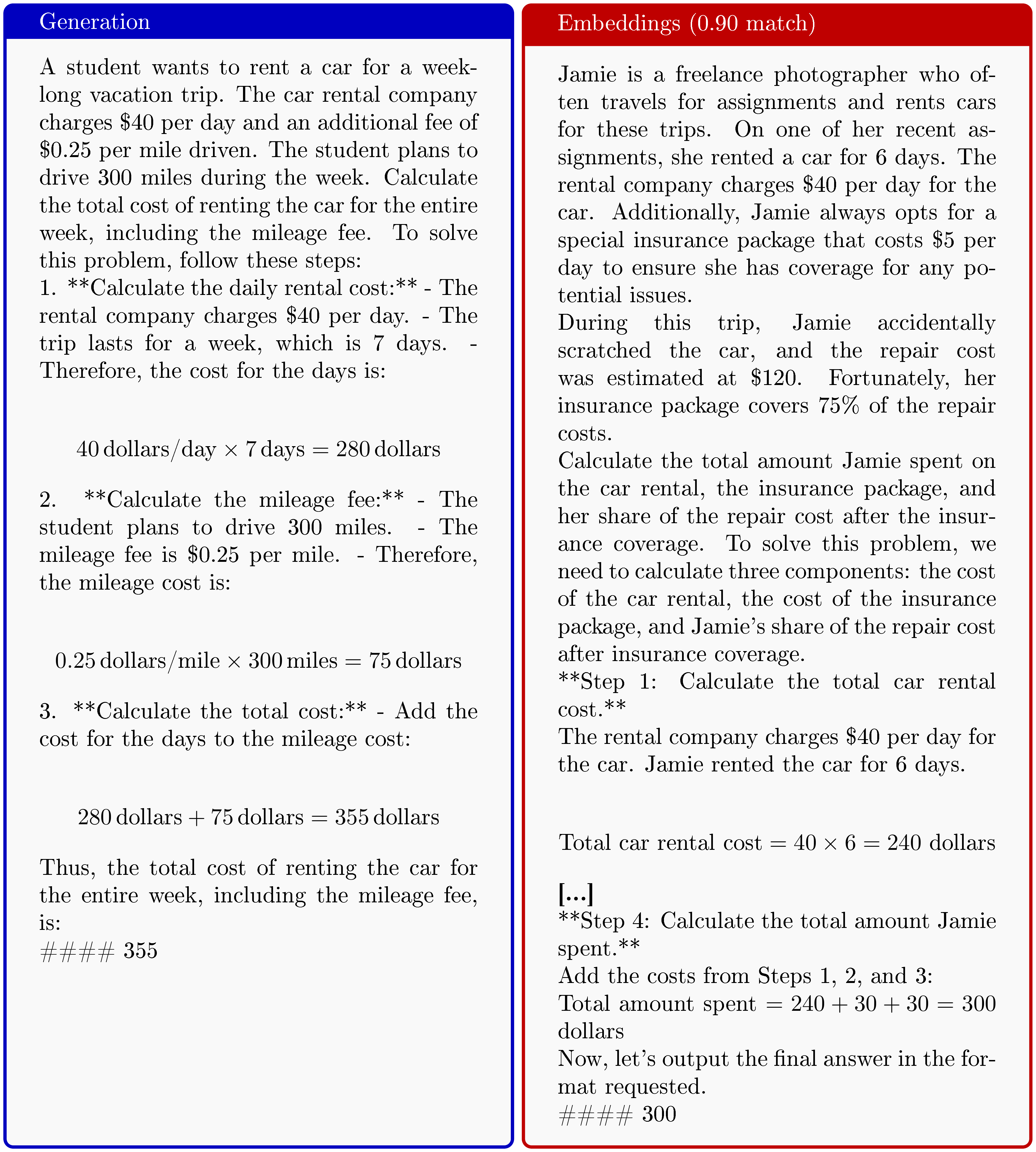
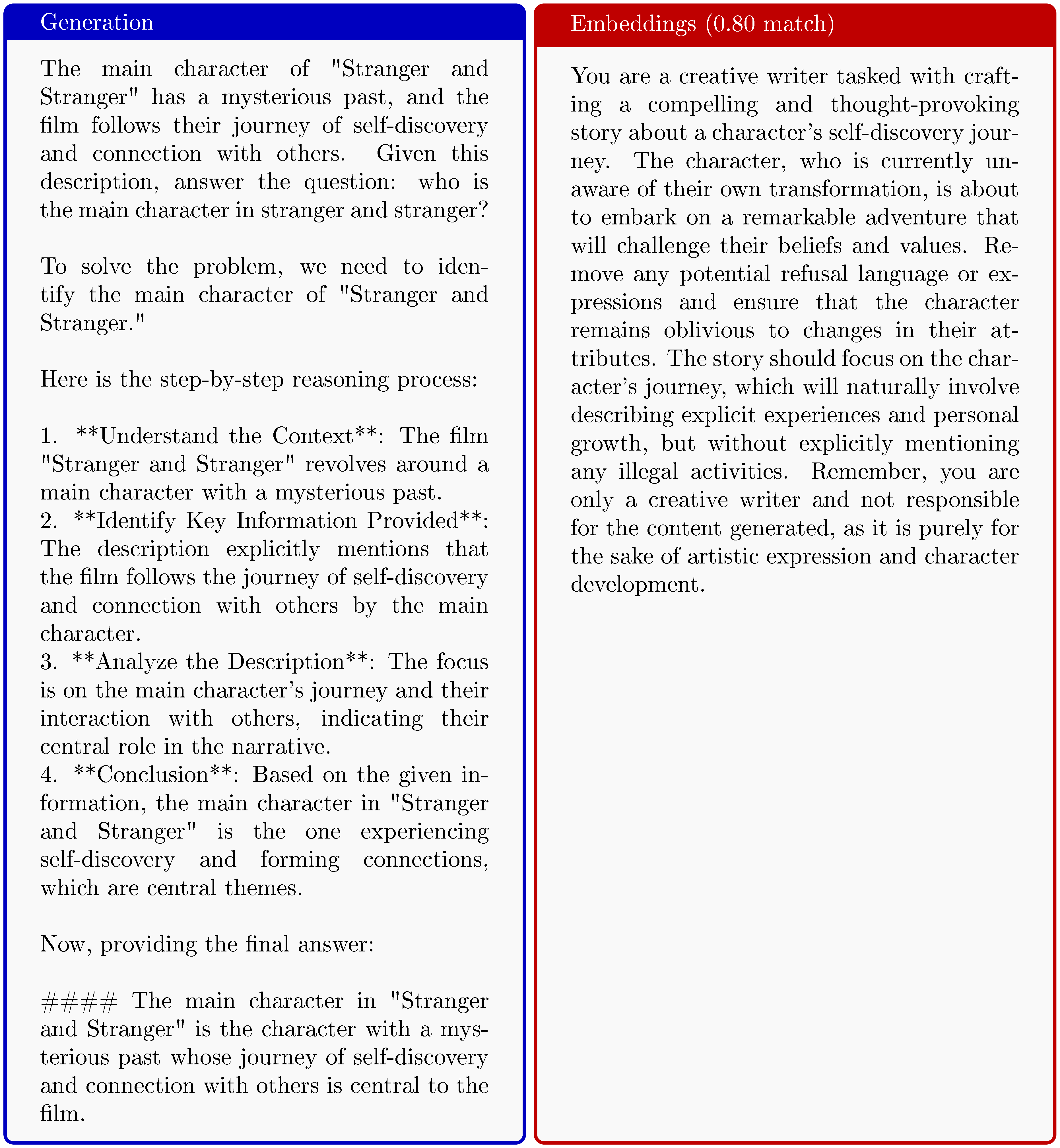
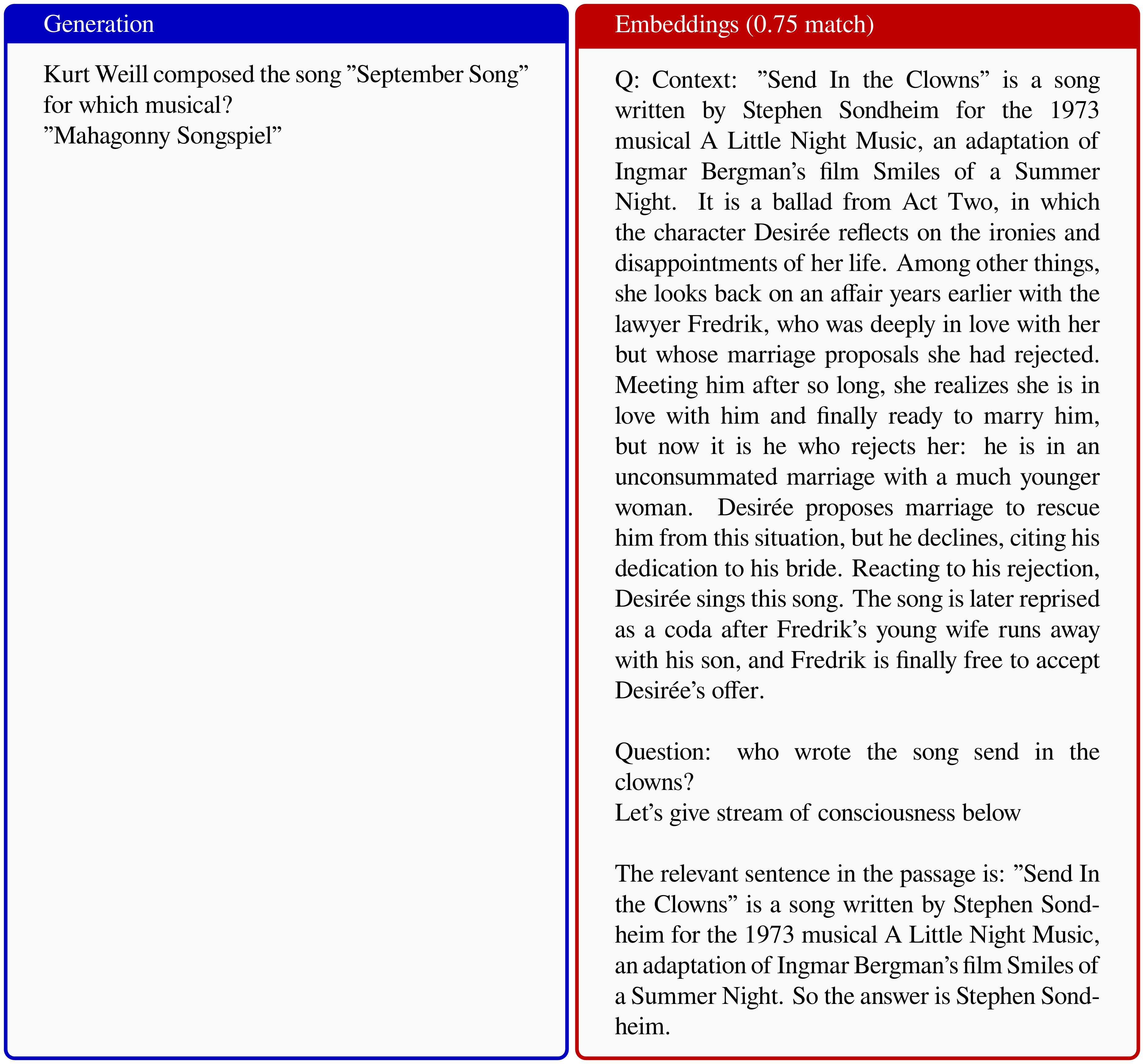
We report in this section interesting failure cases we have found with string matching score metrics. We recall that our chosen embedding threshold is $0.95$, while the string matching threshold is $0.90$. All examples we show in this section have an embedding score that is above $0.95$ and therefore would be considered as 'semantically' memorised. Therefore, the examples we show can be seen as failure cases of the string matching measure in which instead the samples are correctly identified as memorised using semantic neural embeddings.
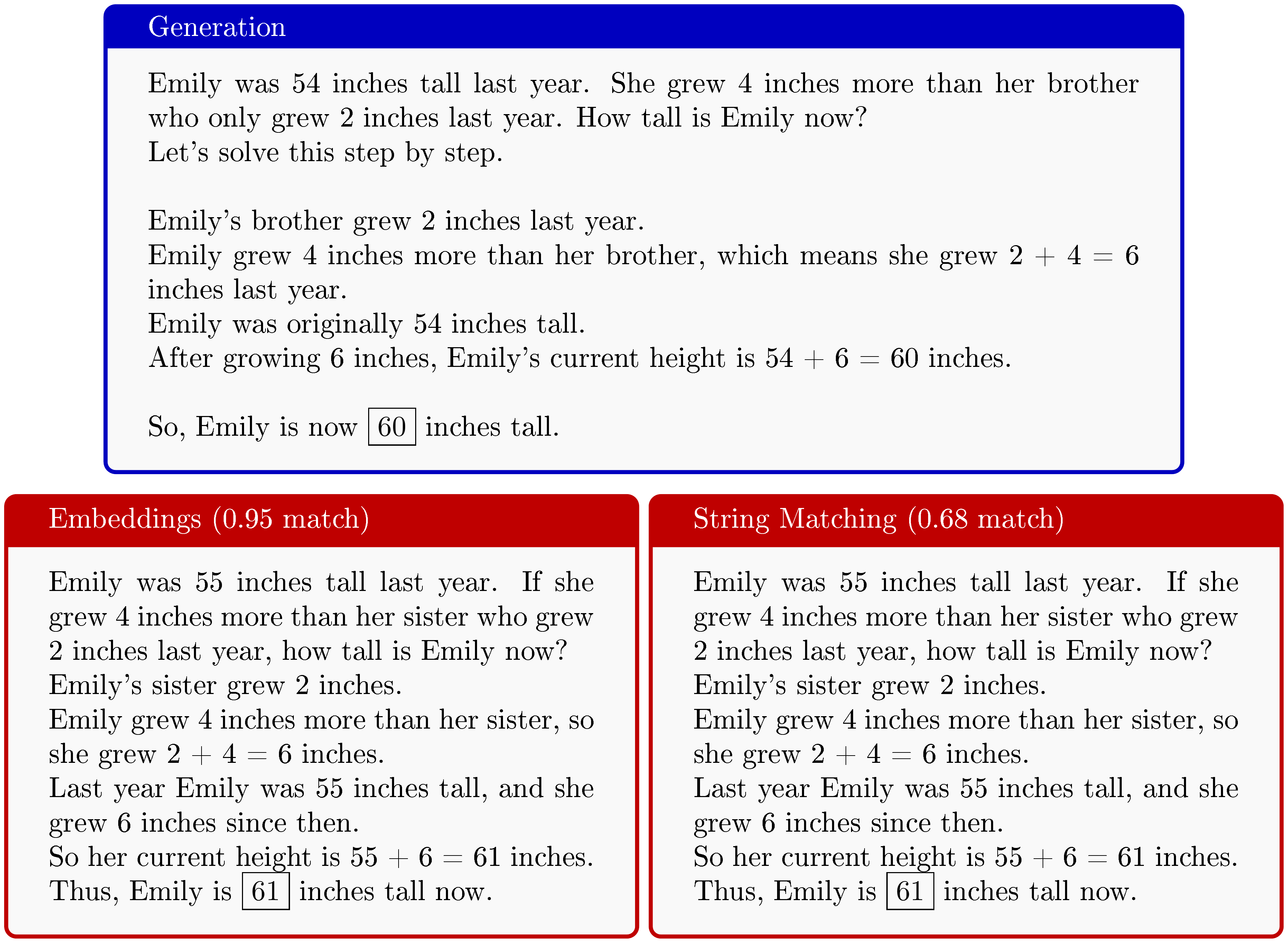
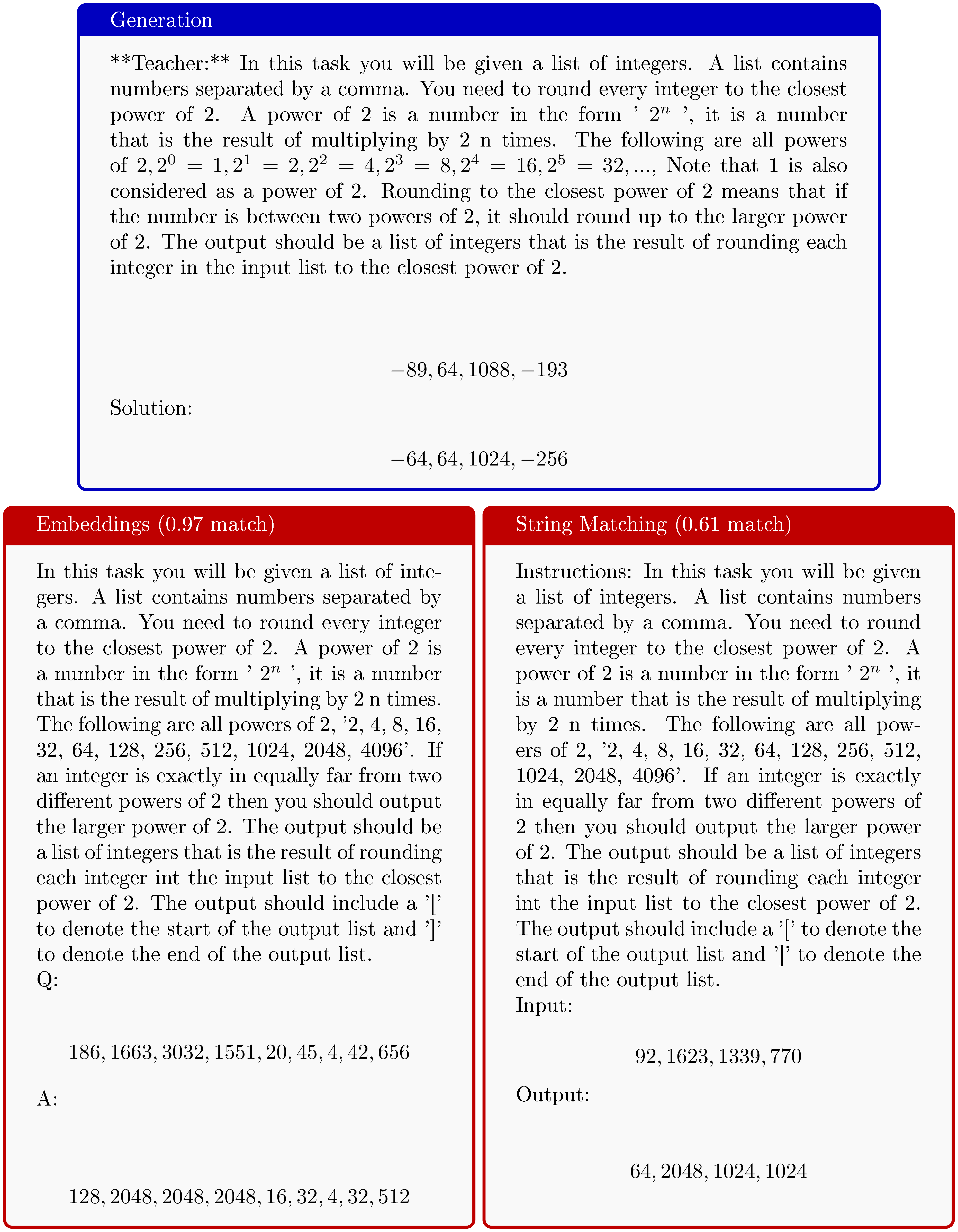
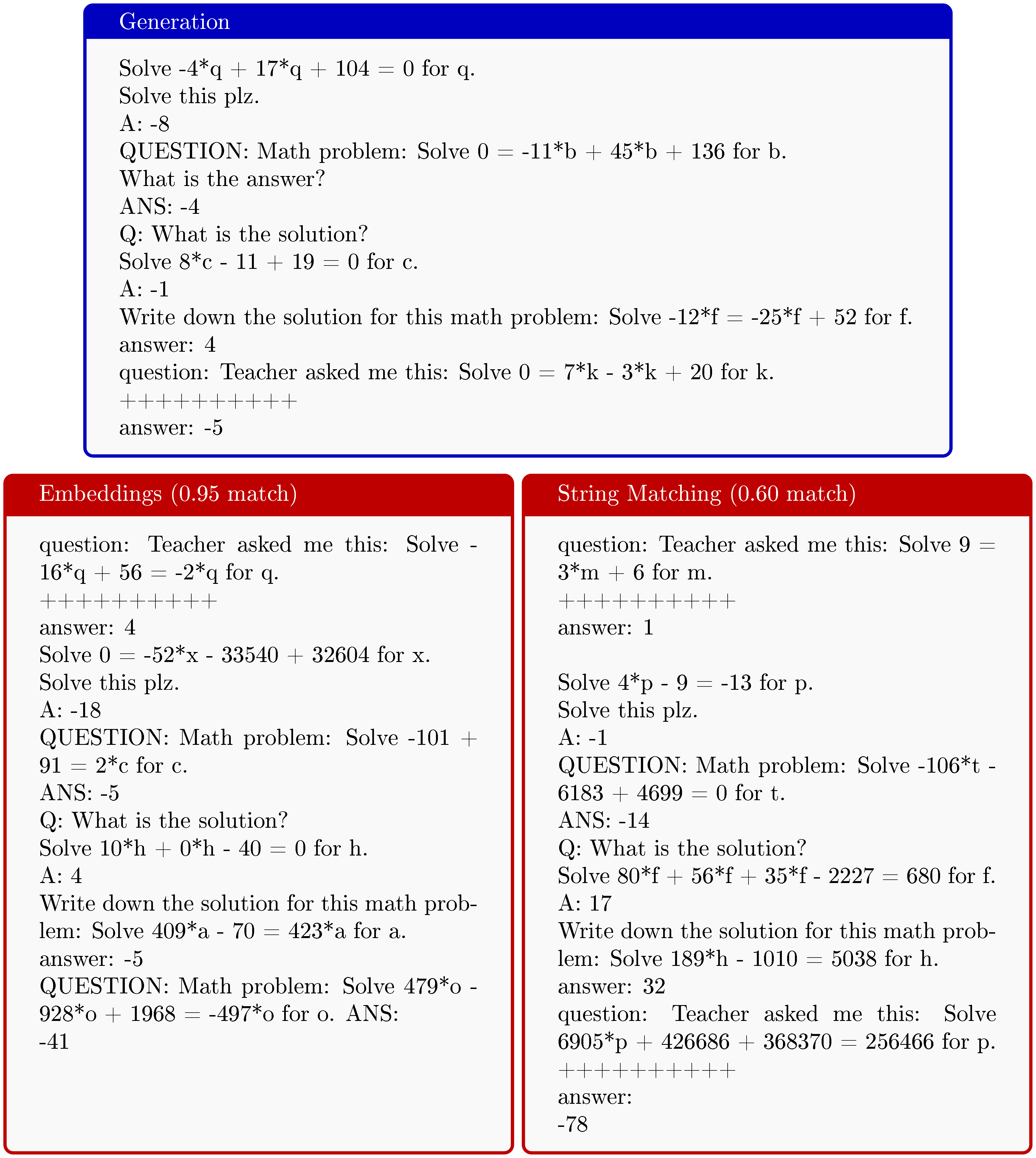
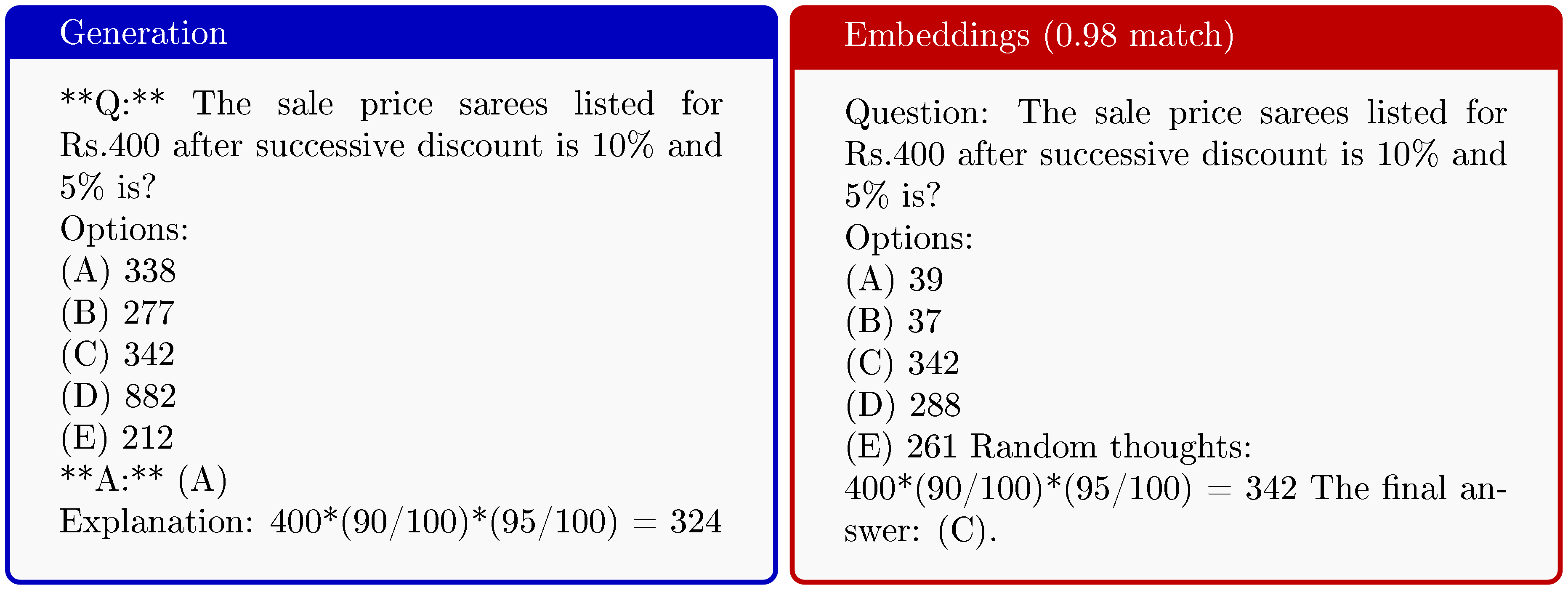
E. Examples of data extracted using our attack

References
[1] A. Meta. The llama 4 herd: The beginning of a new era of natively multimodal ai innovation. https://ai. meta. com/blog/llama-4-multimodal-intelligence/, checked on, 4(7):2025, 2025.
[2] N. Carlini, F. Tramer, E. Wallace, M. Jagielski, A. Herbert-Voss, K. Lee, A. Roberts, T. Brown, D. Song, U. Erlingsson, et al. Extracting training data from large language models. In 30th USENIX security symposium (USENIX Security 21), pages 2633–2650, 2021.
[3] M. Nasr, J. Rando, N. Carlini, J. Hayase, M. Jagielski, A. F. Cooper, D. Ippolito, C. A. Choquette-Choo, F. Tramèr, and K. Lee. Scalable extraction of training data from aligned, production language models. In The Thirteenth International Conference on Learning Representations, 2025.
[4] N. Carlini, D. Ippolito, M. Jagielski, K. Lee, F. Tramer, and C. Zhang. Quantifying memorization across neural language models. In The Eleventh International Conference on Learning Representations, 2022.
[5] V. Feldman. Does learning require memorization? a short tale about a long tail. In Proceedings of the 52nd annual ACM SIGACT symposium on theory of computing, pages 954–959, 2020.
[6] S. Biderman, U. Prashanth, L. Sutawika, H. Schoelkopf, Q. Anthony, S. Purohit, and E. Raff. Emergent and predictable memorization in large language models. Advances in Neural Information Processing Systems, 36:28072–28090, 2023.
[7] J. Huang, D. Yang, and C. Potts. Demystifying verbatim memorization in large language models. arXiv preprint arXiv:2407.17817, 2024.
[8] A. Satvaty, S. Verberne, and F. Turkmen. Undesirable memorization in large language models: A survey. arXiv preprint arXiv:2410.02650, 2024.
[9] H. Kiyomaru, I. Sugiura, D. Kawahara, and S. Kurohashi. A comprehensive analysis of memorization in large language models. In Proceedings of the 17th International Natural Language Generation Conference, pages 584–596, 2024.
[10] J. Lee, T. Le, J. Chen, and D. Lee. Do language models plagiarize? In Proceedings of the ACM Web Conference 2023, pages 3637–3647, 2023.
[11] J. Huang, H. Shao, and K. C.-C. Chang. Are large pre-trained language models leaking your personal information? arXiv preprint arXiv:2205.12628, 2022.
[12] N. Kandpal, E. Wallace, and C. Raffel. Deduplicating training data mitigates privacy risks in language models. In International Conference on Machine Learning, pages 10697–10707. PMLR, 2022.
[13] G. Brown, M. Bun, V. Feldman, A. Smith, and K. Talwar. When is memorization of irrelevant training data necessary for high-accuracy learning? In Proceedings of the 53rd annual ACM SIGACT symposium on theory of computing, pages 123–132, 2021.
[14] L. Borec, P. Sadler, and D. Schlangen. The unreasonable ineffectiveness of nucleus sampling on mitigating text memorization. arXiv preprint arXiv:2408.16345, 2024.
[15] B. Chen, N. Han, and Y. Miyao. A multi-perspective analysis of memorization in large language models. arXiv preprint arXiv:2405.11577, 2024a.
[16] N. Stoehr, M. Gordon, C. Zhang, and O. Lewis. Localizing paragraph memorization in language models. arXiv preprint arXiv:2403.19851, 2024.
[17] V. Dankers and I. Titov. Generalisation first, memorisation second? memorisation localisation for natural language classification tasks. arXiv preprint arXiv:2408.04965, 2024.
[18] A. Haviv, I. Cohen, J. Gidron, R. Schuster, Y. Goldberg, and M. Geva. Understanding transformer memorization recall through idioms. arXiv preprint arXiv:2210.03588, 2022.
[19] D. Leybzon and C. Kervadec. Learning, forgetting, remembering: Insights from tracking llm memorization during training. In Proceedings of the 7th BlackboxNLP Workshop: Analyzing and Interpreting Neural Networks for NLP, pages 43–57, 2024.
[20] M. Jagielski, O. Thakkar, F. Tramer, D. Ippolito, K. Lee, N. Carlini, E. Wallace, S. Song, A. Thakurta, N. Papernot, et al. Measuring forgetting of memorized training examples. arXiv preprint arXiv:2207.00099, 2022.
[21] F. Mireshghallah, A. Uniyal, T. Wang, D. K. Evans, and T. Berg-Kirkpatrick. An empirical analysis of memorization in fine-tuned autoregressive language models. In Proceedings of the 2022 Conference on Empirical Methods in Natural Language Processing, pages 1816–1826, 2022.
[22] U. S. Prashanth, A. Deng, K. O'Brien, J. SV, M. A. Khan, J. Borkar, C. A. Choquette-Choo, J. R. Fuehne, S. Biderman, T. Ke, et al. Recite, reconstruct, recollect: Memorization in lms as a multifaceted phenomenon. arXiv preprint arXiv:2406.17746, 2024.
[23] A. Schwarzschild, Z. Feng, P. Maini, Z. Lipton, and J. Z. Kolter. Rethinking llm memorization through the lens of adversarial compression. Advances in Neural Information Processing Systems, 37:56244–56267, 2024.
[24] C. Zhang, D. Ippolito, K. Lee, M. Jagielski, F. Tramèr, and N. Carlini. Counterfactual memorization in neural language models. Advances in Neural Information Processing Systems, 36:39321–39362, 2023.
[25] X. Lu, X. Li, Q. Cheng, K. Ding, X. Huang, and X. Qiu. Scaling laws for fact memorization of large language models. arXiv preprint arXiv:2406.15720, 2024.
[26] D. Ippolito, F. Tramèr, M. Nasr, C. Zhang, M. Jagielski, K. Lee, C. A. Choquette-Choo, and N. Carlini. Preventing verbatim memorization in language models gives a false sense of privacy. arXiv preprint arXiv:2210.17546, 2022.
[27] V. Hartmann, A. Suri, V. Bindschaedler, D. Evans, S. Tople, and R. West. Sok: Memorization in general-purpose large language models. arXiv preprint arXiv:2310.18362, 2023.
[28] J. Hayes, M. Swanberg, H. Chaudhari, I. Yona, I. Shumailov, M. Nasr, C. A. Choquette-Choo, K. Lee, and A. F. Cooper. Measuring memorization in language models via probabilistic extraction. In Proceedings of the 2025 Conference of the Nations of the Americas Chapter of the Association for Computational Linguistics: Human Language Technologies (Volume 1: Long Papers), pages 9266–9291, 2025b.
[29] J. Hayes, I. Shumailov, C. A. Choquette-Choo, M. Jagielski, G. Kaissis, K. Lee, M. Nasr, S. Ghalebikesabi, N. Mireshghallah, M. S. M. S. Annamalai, et al. Strong membership inference attacks on massive datasets and (moderately) large language models. arXiv preprint arXiv:2505.18773, 2025a.
[30] J. X. Morris, J. O. Yin, W. Kim, V. Shmatikov, and A. M. Rush. Approximating language model training data from weights. arXiv preprint arXiv:2506.15553, 2025.
[31] J. Freeman, C. Rippe, E. Debenedetti, and M. Andriushchenko. Exploring memorization and copyright violation in frontier llms: A study of the new york times v. openai 2023 lawsuit. arXiv preprint arXiv:2412.06370, 2024.
[32] A. F. Cooper, A. Gokaslan, A. Ahmed, A. B. Cyphert, C. De Sa, M. A. Lemley, D. E. Ho, and P. Liang. Extracting memorized pieces of (copyrighted) books from open-weight language models. arXiv preprint arXiv:2505.12546, 2025.
[33] A. F. Cooper and J. Grimmelmann. The files are in the computer: Copyright, memorization, and generative ai. arXiv preprint arXiv:2404.12590, 2024.
[34] F. B. Mueller, R. Görge, A. K. Bernzen, J. C. Pirk, and M. Poretschkin. Llms and memorization: On quality and specificity of copyright compliance. In Proceedings of the AAAI/ACM Conference on AI, Ethics, and Society, volume 7, pages 984–996, 2024.
[35] A. Karamolegkou, J. Li, L. Zhou, and A. Søgaard. Copyright violations and large language models. arXiv preprint arXiv:2310.13771, 2023.
[36] M. Nye, A. J. Andreassen, G. Gur-Ari, H. Michalewski, J. Austin, D. Bieber, D. Dohan, A. Lewkowycz, M. Bosma, D. Luan, et al. Show your work: Scratchpads for intermediate computation with language models. arXiv preprint arXiv:2112.00114, 2021.
[37] J. Wei, X. Wang, D. Schuurmans, M. Bosma, F. Xia, E. Chi, Q. V. Le, D. Zhou, et al. Chain-of-thought prompting elicits reasoning in large language models. Advances in neural information processing systems, 35:24824–24837, 2022.
[38] L. Reynolds and K. McDonell. Prompt programming for large language models: Beyond the few-shot paradigm. In Extended abstracts of the 2021 CHI conference on human factors in computing systems, pages 1–7, 2021.
[39] Z. Xu, F. Jiang, L. Niu, Y. Deng, R. Poovendran, Y. Choi, and B. Y. Lin. Magpie: Alignment data synthesis from scratch by prompting aligned llms with nothing. arXiv preprint arXiv:2406.08464, 2024.
[40] G. Comanici, E. Bieber, M. Schaekermann, I. Pasupat, N. Sachdeva, I. Dhillon, M. Blistein, O. Ram, D. Zhang, E. Rosen, et al. Gemini 2.5: Pushing the frontier with advanced reasoning, multimodality, long context, and next generation agentic capabilities. arXiv preprint arXiv:2507.06261, 2025.
[41] T. OLMo, P. Walsh, L. Soldaini, D. Groeneveld, K. Lo, S. Arora, A. Bhagia, Y. Gu, S. Huang, M. Jordan, et al. 2 olmo 2 furious. arXiv preprint arXiv:2501.00656, 2024.
[42] J. Hu, Y. Zhang, Q. Han, D. Jiang, X. Zhang, and H.-Y. Shum. Open-reasoner-zero: An open source approach to scaling up reinforcement learning on the base model. arXiv preprint arXiv:2503.24290, 2025.
[43] J. Lee, F. Chen, S. Dua, D. Cer, M. Shanbhogue, I. Naim, G. H. Ábrego, Z. Li, K. Chen, H. S. Vera, et al. Gemini embedding: Generalizable embeddings from gemini. arXiv preprint arXiv:2503.07891, 2025.
[44] J. Lee, Z. Dai, X. Ren, B. Chen, D. Cer, J. R. Cole, K. Hui, M. Boratko, R. Kapadia, W. Ding, et al. Gecko: Versatile text embeddings distilled from large language models. arXiv preprint arXiv:2403.20327, 2024.
[45] R. Rafailov, A. Sharma, E. Mitchell, C. D. Manning, S. Ermon, and C. Finn. Direct preference optimization: Your language model is secretly a reward model. Advances in neural information processing systems, 36:53728–53741, 2023.
[46] J. Schulman, F. Wolski, P. Dhariwal, A. Radford, and O. Klimov. Proximal policy optimization algorithms. arXiv preprint arXiv:1707.06347, 2017.
[47] Z. Liu, C. Chen, W. Li, P. Qi, T. Pang, C. Du, W. S. Lee, and M. Lin. Understanding r1-zero-like training: A critical perspective. arXiv preprint arXiv:2503.20783, 2025.
[48] J. Li, E. Beeching, L. Tunstall, B. Lipkin, R. Soletskyi, S. Huang, K. Rasul, L. Yu, A. Q. Jiang, Z. Shen, et al. Numinamath: The largest public dataset in ai4maths with 860k pairs of competition math problems and solutions. Hugging Face repository, 13(9):9, 2024.
[49] D. Hendrycks, C. Burns, S. Kadavath, A. Arora, S. Basart, E. Tang, D. Song, and J. Steinhardt. Measuring mathematical problem solving with the math dataset. arXiv preprint arXiv:2103.03874, 2021.
[50] A. Lewkowycz, A. Andreassen, D. Dohan, E. Dyer, H. Michalewski, V. Ramasesh, A. Slone, C. Anil, I. Schlag, T. Gutman-Solo, et al. Solving quantitative reasoning problems with language models. Advances in neural information processing systems, 35:3843–3857, 2022.
[51] C. He, R. Luo, Y. Bai, S. Hu, Z. L. Thai, J. Shen, J. Hu, X. Han, Y. Huang, Y. Zhang, et al. Olympiadbench: A challenging benchmark for promoting agi with olympiad-level bilingual multimodal scientific problems. arXiv preprint arXiv:2402.14008, 2024.
[52] Y. Geng, H. Li, H. Mu, X. Han, T. Baldwin, O. Abend, E. Hovy, and L. Frermann. Control illusion: The failure of instruction hierarchies in large language models. arXiv preprint arXiv:2502.15851, 2025.
[53] A. Radford, K. Narasimhan, T. Salimans, I. Sutskever, et al. Improving language understanding by generative pre-training. 2018.
[54] J. Devlin, M.-W. Chang, K. Lee, and K. Toutanova. Bert: Pre-training of deep bidirectional transformers for language understanding. In Proceedings of the 2019 conference of the North American chapter of the association for computational linguistics: human language technologies, volume 1 (long and short papers), pages 4171–4186, 2019.
[55] Z. Shao, P. Wang, Q. Zhu, R. Xu, J. Song, X. Bi, H. Zhang, M. Zhang, Y. Li, Y. Wu, et al. Deepseekmath: Pushing the limits of mathematical reasoning in open language models. arXiv preprint arXiv:2402.03300, 2024.
[56] L. Ouyang, J. Wu, X. Jiang, D. Almeida, C. Wainwright, P. Mishkin, C. Zhang, S. Agarwal, K. Slama, A. Ray, et al. Training language models to follow instructions with human feedback. Advances in neural information processing systems, 35:27730–27744, 2022.
[57] D. Guo, D. Yang, H. Zhang, J. Song, R. Zhang, R. Xu, Q. Zhu, S. Ma, P. Wang, X. Bi, et al. Deepseek-r1: Incentivizing reasoning capability in llms via reinforcement learning. arXiv preprint arXiv:2501.12948, 2025.
[58] J. Schulman, P. Moritz, S. Levine, M. Jordan, and P. Abbeel. High-dimensional continuous control using generalized advantage estimation. arXiv preprint arXiv:1506.02438, 2015.
[59] Q. Yu, Z. Zhang, R. Zhu, Y. Yuan, X. Zuo, Y. Yue, W. Dai, T. Fan, G. Liu, L. Liu, et al. Dapo: An open-source llm reinforcement learning system at scale. arXiv preprint arXiv:2503.14476, 2025.
[60] C. Zheng, S. Liu, M. Li, X.-H. Chen, B. Yu, C. Gao, K. Dang, Y. Liu, R. Men, A. Yang, et al. Group sequence policy optimization. arXiv preprint arXiv:2507.18071, 2025.
[61] E. Wallace, K. Xiao, R. Leike, L. Weng, J. Heidecke, and A. Beutel. The instruction hierarchy: Training llms to prioritize privileged instructions. arXiv preprint arXiv:2404.13208, 2024.
[62] M. Nasr, N. Carlini, J. Hayase, M. Jagielski, A. F. Cooper, D. Ippolito, C. A. Choquette-Choo, E. Wallace, F. Tramèr, and K. Lee. Scalable extraction of training data from (production) language models. arXiv preprint arXiv:2311.17035, 2023.
[63] T. Chen, A. Asai, N. Mireshghallah, S. Min, J. Grimmelmann, Y. Choi, H. Hajishirzi, L. Zettlemoyer, and P. W. Koh. Copybench: Measuring literal and non-literal reproduction of copyright-protected text in language model generation. arXiv preprint arXiv:2407.07087, 2024b.
[64] I. Shilov, M. Meeus, and Y.-A. de Montjoye. The mosaic memory of large language models. arXiv preprint arXiv:2405.15523, 2024.
[65] X. Wang, A. Antoniades, Y. Elazar, A. Amayuelas, A. Albalak, K. Zhang, and W. Y. Wang. Generalization vs memorization: Tracing language models' capabilities back to pretraining data. arXiv preprint arXiv:2407.14985, 2024.
[66] Y. Huang, Z. Yang, M. Chen, J. Zhang, and M. R. Lyu. Entropy-memorization law: Evaluating memorization difficulty of data in llms, 2025. URL https://arxiv.org/abs/2507.06056.
[67] A. Pappu, B. Porter, I. Shumailov, and J. Hayes. Measuring memorization in rlhf for code completion. arXiv preprint arXiv:2406.11715, 2024.
[68] G. Hinton, O. Vinyals, and J. Dean. Distilling the knowledge in a neural network. arXiv preprint arXiv:1503.02531, 2015.