
On-Policy Distillation of Language Models: Learning from Self-Generated Mistakes
Rishabh Agarwal$^{1,2}$ $^{*}$
Google DeepMind, Mila
Nino Vieillard$^{1}$ $^{*}$
Google DeepMind
Yongchao Zhou$^{1,3}$
Google DeepMind, University of Toronto
Piotr Stanczyk$^{1}$ $^{\dagger}$
Google DeepMind
Sabela Ramos$^{1}$ $^{\dagger}$
Google DeepMind
Matthieu Geist$^{1}$
Google DeepMind
Olivier Bachem$^{1}$
Google DeepMind
$^{*}$ denotes equal contribution.
$^{\dagger}$ denotes infrastructure contribution.
Correspondence to Rishabh Agarwal [email protected] and Nino Vieillard [email protected].
Abstract
Knowledge distillation (KD) is widely used for compressing a teacher model to reduce its inference cost and memory footprint, by training a smaller student model. However, current KD methods for auto-regressive sequence models suffer from distribution mismatch between output sequences seen during training and those generated by the student during inference. To address this issue, we introduce Generalized Knowledge Distillation (GKD). Instead of solely relying on a fixed set of output sequences, GKD trains the student on its self-generated output sequences by leveraging feedback from the teacher on such sequences. Unlike supervised KD approaches, GKD also offers the flexibility to employ alternative loss functions between the student and teacher, which may be useful when the student lacks the expressivity to mimic the teacher’s distribution. Furthermore, GKD facilitates the seamless integration of distillation with RL fine-tuning of language models. We demonstrate the efficacy of GKD for distilling auto-regressive T5 language models for task-specific distillation on summarization, translation, and reasoning tasks, and task-agnostic distillation for instruction tuning.
Executive Summary: GKD is a new approach to knowledge distillation that trains smaller student language models on a mixture of fixed data and the sequences those students themselves generate during training, while allowing flexible choices of how the student should match the teacher’s token-level predictions.
Large language models deliver strong results but impose high inference costs and memory demands during deployment. Standard distillation methods try to compress them by training a smaller student to mimic a larger teacher, yet they typically rely on a fixed set of output sequences. Because the student generates its own sequences at inference time, this creates a mismatch that degrades quality, especially on tasks such as summarization, translation, and reasoning.
The paper evaluates whether training the student on its own (“on-policy”) outputs, combined with the option to use different divergence measures between student and teacher distributions, can close the mismatch and improve compression performance. Experiments cover both task-specific distillation on summarization, translation, and arithmetic reasoning and task-agnostic instruction tuning.
The work starts from supervised-fine-tuned T5 models of varying sizes and uses the fine-tuned T5-XL (≈3 B parameters) as teacher. Students range from 77 M to 800 M parameters. The method mixes a controllable fraction of student-generated sequences with fixed ground-truth or teacher-generated sequences and optimizes forward KL, reverse KL, or generalized Jensen-Shannon divergence. Results are measured on XSum (ROUGE-2), WMT14 en-de (BLEU), GSM8K accuracy, and held-out MMLU/BBH benchmarks.
On-policy GKD produces roughly 2.1×, 1.7×, and 1.9× larger gains than standard supervised or sequence-level KD on summarization, translation, and reasoning, respectively, averaged across student sizes. Pure on-policy training consistently outperforms mixtures that retain substantial fixed data. Mode-seeking divergences (reverse KL or high-β JSD) improve quality at the expense of diversity and often outperform forward KL on held-out tasks. GKD can be combined directly with reinforcement learning from AI feedback, simultaneously raising factual consistency and summarization scores above the teacher while preserving downstream performance. On instruction tuning, on-policy GKD with reverse KL yields 1–2 % absolute gains on MMLU and BBH.
The practical implication is that organizations can deploy smaller, cheaper models that retain most of a large teacher’s capability without incurring the full cost of the teacher at inference time. The approach also offers a straightforward route to integrate distillation with existing RLHF/RLAIF pipelines, potentially reducing the capability drop often observed after alignment.
Teams that already fine-tune language models should adopt on-policy distillation with a modest student-data fraction (λ ≈ 0.5–1.0) and test both forward KL and reverse KL or JSD(0.9) on a small validation sweep. When factual consistency or another scalar reward matters, combine GKD with RL as shown. For very tight latency budgets, further measure the inference-speed versus quality trade-off at the chosen student size.
The main limitations are the assumption that the initial supervised student already produces outputs of adequate quality for the teacher to critique, and the need to run student sampling during training, which adds modest overhead. Results are strongest when at least 25–50 % of the training sequences are student-generated; performance gains diminish if this fraction is reduced too far.
1. Introduction
Section Summary: Large language models deliver strong results across many tasks but are expensive to run because of their size. This paper introduces a method called Generalized Knowledge Distillation (GKD) that trains a smaller student model to match a larger teacher by practicing on sequences the student generates itself, rather than on fixed data. The approach also allows more flexible ways to align the two models, producing larger gains on summarization, translation, and reasoning tasks while supporting both task-specific and general-purpose compression.
![**Figure 1:** **Comparing GKD with KD approaches** across different student model sizes. We use the T5 models ([1]) trained with supervised FT as students. We use supervised FT T5-XL ($\sim$ 3B params) as the teacher, whose performance is indicated by the horizontal line. Supervised KD and FT use ground-truth output sequences for training while SeqKD trains on output sequences generated by the teacher. On-policy GKD trains on output sequences sampled from the student. For GKD, we use JSD (0.1) on WMT and forward KL on other tasks. For evaluation, we use greedy sampling for XSum and GSM8K and beam search for WMT.](https://ittowtnkqtyixxjxrhou.supabase.co/storage/v1/object/public/public-images/rtrr63wx/intro_fig_gkd.png)
Auto-regressive sequence models, such as language models (LMs), have shown impressive capabilities in numerous tasks, where the key to this success is often scaling the amount of training data as well as the number of model parameters ([2]). However, scaling parameter count comes at a cost, and the deployment of such models is limited by either their inference cost or memory footprint. Thus, a crucial goal for practical use of large capable models is to compress them by reducing their parameter count, while retaining as much as possible of their performance.
One of the prevalent techniques for compressing models is knowledge distillation ([3]). Distillation is the process of training a model – the student – to replicate the knowledge of another model – the teacher – on a specific set of tasks. Typically, the student has fewer parameters than the teacher and as such, distillation can improve task-specific performance while maintaining lower inference cost and memory footprint than the teacher. Current distillation methods for auto-regressive sequence models either require generating a fixed set of output sequences from the teacher model ([4]), which can be expensive, or a fixed dataset of sequences that the teacher can label by assigning token-level probabilities ([5]). However, using a fixed dataset can lead to distribution mismatch between output sequences seen during training and the sequences generated by the student auto-regressively during inference, a well-known problem in imitation learning ([6, 7]). Furthermore, the common objective for distillation is to minimize the forward KL between the teacher and the student distributions. However, the student may not be expressive enough to fit the teacher's distribution, which can result in student-generated samples that are unlikely to be generated by the teacher (e.g., Figure 16).
In this paper, we propose Generalized KD (GKD) to mitigate the above issues. First, we recognize that KD for auto-regressive sequence models can be viewed as an imitation learning problem with an interactive expert ([8]). Using this insight, GKD trains the student on its self-generated sequences that are on-policy, instead of a fixed set of outputs sequences, using teacher probabilities as expert labels on these sequences. Our idea is further supported by the recent success of fine-tuning large language models on their own output sequences ([9, 10]). Furthermore, GKD provides the flexibility to optimize alternative divergence measures, such as reverse KL and generalized JSD (Section 2), that can use student's limited capacity to focus on generating samples that are likely under the teacher.
GKD unifies some existing KD methods for autoregressive LMs while instantiating new on-policy methods that substantially outperform prevalent approaches. In terms of performance gains over the initial student from on-policy GKD, averaged across T5 student models of different sizes, we see relative gains of $\mathbf{2.1}\times$ on summarization, $\mathbf{1.7}\times$ on machine translation, and $\mathbf{1.9}\times$ on arithmetic reasoning tasks, compared to the performance improvements achieved with baseline KD methods (Figure 1). Additionally, we exhibit GKD's efficacy in task-agnostic distillation, resulting in 2% and 1% absolute accuracy improvement on the held-out BBH and MMLU benchmark suites (Figure 10).
Our key contributions are:
- To tackle discrepancy during training and inference for auto-regressive LMs, we present GKD that leverages on-policy student-generated outputs for distillation, guided by the token-level teacher probabilities over these outputs. GKD substantially outperforms commonly-used methods in task-specific (Figure 1) and task-agnostic KD (Figure 10).
- We demonstrate that on-policy GKD can be seamlessly combined with RL fine-tuning (e.g., RLAIF) of language models, a combination that has not been previously explored (Figure 5).
- Through a systematic evaluation of design choices in GKD, we offer practical insights about the importance of using student-generated on-policy output sequences during distillation and the task-dependent nature of optimal divergence between the student and the teacher.
2. Preliminaries
Section Summary: The preliminaries describe how auto-regressive sequence models generate text one token at a time, predicting each next word from a probability distribution over the vocabulary that is conditioned on the input and prior tokens; a temperature parameter controls the randomness of this sampling, producing more varied outputs at higher values or more deterministic ones at lower values. They also introduce KL divergence as a standard way to quantify how one probability distribution differs from another, highlighting that the forward and reverse directions are asymmetric and tend to produce mode-seeking versus mean-seeking behavior when one distribution approximates another. Finally, the text presents a bounded generalized Jensen-Shannon divergence that interpolates between these two KL directions through a weighting parameter.
Auto-regressive Generative Sequence Models. We denote the input and output sequence as $x, y$ respectively. Let $\mathbb{V}$ denote the vocabulary comprising of $M$ tokens, $y_{<n+1} = (y_1, y_2, \dots, y_{n})$ denote the generated output sequence up to the $n^{th}$ token, and $L_y$ denote the length of sequence $y$. A token-level auto-regressive policy $p(. | y_{<n}, x) \in (0, 1)^{M}$ outputs a next-token probability distribution over all tokens in $\mathbb{V}$, conditioned on the input $x$ and output sequence $y_{<n}$. Furthermore, $y \sim p(\cdot|x)$ corresponds to a sampled output sequence $y$ given the input $x$. For ease of notation, we define $p(y_n|x) := p(y_n | y_{<n}, x)$. Auto-regressive generation involves predicting tokens one at a time, based on the previously generated tokens. The probability of predicting $n^{th}$ token $y_n$, $p(y_n|x)$, is determined using a softmax with temperature $\gamma$: $p(y_n|x) = \frac{\exp(z_{n}/\gamma)}{\sum_{i=1}^{M} \exp(z_i /\gamma)}$, where $z_n$ is the logit score for the token $y_n$. Higher values of $\gamma$ introduces more randomness, while a lower value makes the output more deterministic by favoring the most probable words. During training, the student's temperature is kept at 1. For evaluation, we use *greedy sampling* ($\gamma \rightarrow 0$) or *temperature sampling* ($\gamma > 0$).
KL-Based Divergences. The divergence between two probability distributions is a measure of the similarity of the distributions, with KL divergence a prevalent measure. The KL divergence between two discrete distributions $P(\mathcal{C})$ and $Q(\mathcal{C})$ is given by: $\mathcal{D}{KL}(P|Q) = \sum{c \in \mathcal{C}} P(c) \log \frac{P(c)}{Q(c)}$.
The KL divergence is not symmetric: $\mathcal{D}{KL}(P|Q) \neq \mathcal{D}{KL}(Q|P)$. As such, we refer to $\mathcal{D}{KL}(P|Q)$ as the forward KL while $\mathcal{D}{KL}(Q|P)$ as the reverse KL between $P$ and $Q$. Forward KL under an empirical data distribution corresponds to maximum likelihood, which we optimize in supervised learning. Given model capacity mismatch, when approximating $P(\mathcal{C})$ using a distribution $Q_\theta(\mathcal{C})$, minimizing the reverse and forward KL results in mean and mode-seeking behavior (Figure 16).
While KL divergence can be unbounded, a well-known divergence that is bounded even for probability distributions with disjoint supports is the generalized JSD (Jensen-Shannon divergence). JSD($\beta$) interpolates between the forward and reverse KL using the bounded coefficient $ 0 < \beta < 1$:
$ \mathcal{D}{{JSD}(\beta)}(P|Q) = \beta \mathcal{D}{KL}\Big(P \Big | \beta P + (1- \beta)Q \Big) + (1 - \beta) \mathcal{D}_{KL}\Big(Q \Big | \beta P + (1 - \beta) Q\Big) $
[11] show that $ \lim_{\beta\to 0} \mathcal{D}{{JSD}(\beta)}(P|Q)/{\beta} = \mathcal{D}{KL}(P|Q)$. As such, gradients of JSD $(\beta)$ behave similarly to forward KL and reverse KL when $\beta$ is close to 0 and 1 respectively.
3. Distillation for Auto-regressive Sequence Models
Section Summary: This section explains how to transfer knowledge from a large "teacher" sequence model to a smaller "student" model that generates text one token at a time. Standard approaches train the student only on fixed datasets of either human-written or teacher-generated sequences, which creates a mismatch because the partial sequences the student sees during training differ from those it encounters when generating text on its own. To fix this, the authors introduce on-policy distillation, where the student produces its own outputs and receives token-level guidance from the teacher on those sequences, then generalize the method (GKD) to flexibly mix fixed and self-generated data while allowing different measures of divergence between the two models.
Problem Setup. We are given two auto-regressive sequence models of different capacity, where $p_{\text{S}}$ and $p_{\text{T}}$ refers to the student and teacher respectively. We assume that the student has learnable parameters $\theta$ and $p_{\text{S}}^\theta$ is differentiable w.r.t $\theta$. We are also given a dataset of inputs $X$. Optionally, we can also assume access to a dataset of input-output sequence pairs $(X, Y)$. If not given, such a dataset can be generated by sampling sequences from the teacher. For a divergence $\mathcal{D}$, we define the discrepancy between token-level distributions of $p_T$ and $p_S$ as
$ \mathcal{D}\big(p_{\text{T}} | p_{\text{S}}^\theta\big)(y|x) := \frac{1}{L_y} \sum_{n=1}^{L_y} \mathcal{D}\big(p_{\text{T}}(\cdot|y_{<n}, x) | p_{\text{S}}^\theta(\cdot|y_{<n}, x)\big),\tag{1} $
for an input $x$ and output sequence $y$. For example, using JSD($\beta$) as $\mathcal{D}$ in equation 1 results in $\mathcal{D}{JSD(\beta)}\big(p{\text{T}} || p_{\text{S}}^\theta\big)(y|x) = \frac{1}{L_y} \sum_n \mathcal{D}{JSD(\beta)} \big(p{\text{T}}(\cdot|y_{<n}, x)\big | p_{\text{S}}^\theta(\cdot|y_{<n}, x))$.
Supervised FT. If we are only given a fixed dataset of ground-truth output sequences but not query access to the teacher policy, then a simple approach is to minimize the negative log-likelihood of such sequences under the student policy: $L_{SFT}(\theta) = \mathbb{E}{(x, y) \sim (X, Y)} \big[-\log p{\text{S}}^\theta(y|x)\big]$.
Sequence-Level KD ([4]). SeqKD maximizes the likelihood of high probability sequences generated by the teacher, and can be viewed as supervised FT on teacher-generated outputs.
Supervised KD ([3, 5]) is a widely used technique where the student is trained to imitate the token-level probability distributions of the teacher. The student $p_S$ is trained with the supervised objective $L_{SD}$ over the target token-level probabilities of the teacher $p_T$:
$ L_{SD}(\theta) := \mathbb{E}{(x, y) \sim (X, Y)} \Big[\mathcal{D}{KL}\big(p_{\text{T}} | p_{\text{S}}^\theta\big)(y|x)\Big],\tag{2} $
where the expectation is over the samples from the dataset. This supervised objective results in a rich training signal by leveraging the full token-level distribution of the teacher.
3.1 Generalized Knowledge Distillation (GKD)
As discussed above, commonly-used KD approaches use a fixed dataset of output sequences, either using ground-truth targets or teacher-generated sequences. However, distilling auto-regressive student models using such approaches results in train-inference distribution mismatch. This is because the partial sequences encountered by the student during the auto-regressive generation phase at inference can be quite different from the ones seen during the training phase. Since predictions at any step are contingent upon previous steps in auto-regressive models, this mismatch can have a cascading effect where error in prediction at early step can affect the future predictions, resulting in poor quality text generation. To address this mismatch, we draw heavily from imitation learning (IL). In particular, on-policy imitation approaches (e.g. [8]) iteratively collect sequences using the student policy, obtain expert labels for those sequences, and then retrain the student on this dataset. Despite their popularity in robotics and deep RL ([12, 13, 14]), on-policy approaches are typically not used for distilling auto-regressive models.
Extending on-policy imitation to distillation, we present on-policy KD. When using on-policy data during distillation, the student receives token-specific feedback from the teacher's logits on the erroneous tokens in its self-generated output sequences. This enables a form of feedback loop akin to what we observe in RL, which helps minimize the train-inference distribution mismatch. Moreover, as the student evolves during training, the data it generates also improves in quality. Given an input $x$, the student generates the output sequence $y$ and imitates the teacher token-level distributions, $p_T(y_n | x)$, on intermediate states $y_{<n}$. Specifically, the on-policy loss $\mathcal{L}_{OD}$ is given by
$ L_{OD}(\theta) := \mathbb{E}{x \sim X} \Big[\mathbb{E}{y \sim p_{\text{S}}(\cdot|x)} \big[\mathcal{D}{KL}\big(p{\text{T}} | p_{\text{S}}^\theta\big)(y|x)\big] \Big],\tag{3} $
where we do not backpropagate through the student's sampling distribution $p_{\text{S}}(\cdot|x)$, similar to on-policy imitation. Not backpropagating through the sampling makes the training stable and computationally efficient. In on-policy KD, the training is done on output sequences that the student is likely to generate. During training, we use a temperature of $\gamma = 1$ to encourage diversity in student generated sequences. Moreover, given unlabeled input prompts, generating sequences using the student is computationally cheaper than the teacher, due to differences in their model sizes.
**Given**: Teacher model p(T), Student Model p(S)(θ), Dataset (X, Y) containing (input, output) pairs
**Hyperparameters**: Student data fraction λ ∈ [0, 1], Divergence D, Learning rate η
**for** each step k = 1, …, K **do**
  Generate a random value u ∼ Uniform(0,1)
  **if** u ≤ λ **then**
    Sample inputs x from X and generate outputs y ∼ p(S)(θ)(· | x) to obtain B = ((x(b), y(b))) for b = 1..B
  **else**
    Sample batch of inputs and outputs from (X, Y) to obtain B = ((x(b), y(b))) for b = 1..B.
  **end if**
  Update θ to minimize L(GKD): θ ← θ - η 1/B ∑ over (x, y) ∈ B ∇θ D(p(T) ‖ p(S)(θ)) (y|x)
**end for**
Building further upon on-policy KD, we unify supervised and on-policy approaches and propose a more general approach, which we call Generalized KD (GKD). In GKD, we can choose both the divergence to optimize as well as the output sequences to train on. Specifically, we can optimize any divergence between the teacher and student token-level probability distributions. For output sequences, GKD uses a mixture of fixed dataset, either teacher-generated or ground-truth, and on-policy student-generated sequences. Abstractly, GKD minimizes an objective of the form:
$ \boxed{L_GKD(\theta) := (1 - \lambda) \mathbb{E}{(x, y) \sim (X, Y)} \big[\mathcal{D}(p{T} | p_{S}^\theta)(y|x) \big] + \lambda \mathbb{E}{x\sim X} \Big[\mathbb{E}{y \sim p_{S}(\cdot|x)} \big[\mathcal{D}(p_{T} | p_{S}^\theta)(y|x)\big]\Big]}, $
where $D(p_{\text{T}}, p_{\text{S}})(y|x)$ is a divergence between teacher and student distributions (equation 1), and $\lambda \in [0, 1]$ is a hyper-parameter that controls the student data fraction, that is, the fraction of on-policy student-generated outputs. Akin to on-policy KD, we do not backpropagate gradients through the student's sampling process. On-policy and supervised KD are instantiations of GKD with divergence $\mathcal{D}$ set to forward KL and student data fractions $\lambda$ to $1$ and $0$ respectively. That said, GKD allows for other choices for the fraction $\lambda$ and the divergence, which we explore in this work.
Remark. As opposed to a randomly initialized student, we assume access to a student that can generate sequences of adequate quality, which the teacher can provide feedback upon. In our experiments, we start from student models that have undergone supervised FT. This is analogous to two-stage RLHF training, which is widely used for LMs, where we first run SFT followed by the online RL fine-tuning. As such, GKD can leverage hyperparameter tuning insights from RLHF and can be combined with RLHF with small compute overhead and no additional hyperparameters.
Choice of Divergence in GKD. While forward KL is commonly-used for distillation, it requires the student to cover the entire support of the teacher token-level distribution $p_{\text{T}}(.|y_{<n}, x)$. In doing so, the student might end up assigning probability mass to tokens $v$ which have low probability under $p_{\text{T}}(.|y_{<n}, x)$, which can result in hallucination and low-quality generations. When the student has much lower model capacity than the teacher, this issue is likely to happen with temperature sampling (e.g., Figure 16). Alternatively, mode-seeking divergences, such as reverse KL, prioritize the tokens where the teacher assigns high probability, which can avoid low-quality generations but at the expense of less diverse generations for a given input. Our experiments indicate that optimal divergence seems to be task-dependent. Overall, the diversity and performance trade-offs for a particular task needs to be considered when choosing the GKD divergence (e.g., Figure 4, Figure 10).
3.2 RL Fine-tuning + On-policy GKD
In some tasks, it is plausible that distilling from a teacher model only provides a proxy to our main objective, which can also be non-differentiable. We can directly optimize this objective with reinforcement learning (RL). Conveniently, on-policy GKD can be easily combined with RL fine-tuning from human (RLHF) or AI feedback (RLAIF), as it only requires output samples from the student. Indeed, consider that one wants to optimize the student policy for a scalar reward $r$, while staying close to a teacher policy, then we get a regularized RL fine-tuning objective of the form:
$ \mathbb{E}{x\sim X} \Big[(1-\alpha) \underbrace{E{y \sim p_{S}^\theta(\cdot|x)} \left[r(y)\right]}{RL objective} - \alpha \underbrace{\mathbb{E}{y \sim p_{S}(\cdot|x)} \big[\mathcal{D}(p_{T} | p_{S}^\theta)(y|x)\big]}_{Generalized On-Policy Distillation} \Big],\tag{4} $
where $\alpha \in [0, 1]$ controls the strength of the distillation loss compared to the RL objective. With $\alpha=1$, it will perform only distillation. The above objective allows us to maximize reward while improving other model capabilities via distillation, which can possibly reduce the "alignment tax" decrease in general model capabilities when aligning language models with human preferences ([9]). We apply the above idea to mitigate hallucination using RLAIF, while simultaneously improving downstream performance via distillation (Figure 5).
Remark. In RLHF or RLAIF, we typically use reverse KL to constrain the learned policy to stay close to the initial policy. If one wants to only make slight modifications to existing RL fine-tuning workflows, we recommend using reverse KL or JSD $(0.9)$ when integrating GKD with RL.
4. Experiments
Section Summary: The authors evaluate Generalized Knowledge Distillation (GKD) by transferring knowledge from a large pretrained T5-XL teacher model to much smaller T5 student models across summarization, translation, and reasoning tasks. They test various GKD settings that mix teacher-generated and ground-truth data with different probability divergences, comparing them to standard distillation baselines such as sequence-level and supervised KD. Results on the XSum summarization benchmark show that on-policy GKD variants consistently outperform these baselines in quality and data efficiency, while also revealing how the choice of divergence trades off output diversity against factual consistency and performance at different sampling temperatures.
In this section, we evaluate GKD for distilling language models, a typical class of auto-regressive sequence models, on abstractive summarization, machine translation, and arithmetic reasoning.
Student / Teacher Models. Our experiments start from student and teacher models with different sizes, specifically open-sourced T5 models ([1]), that are pretrained on the same datasets. We use supervised fine-tuned T5-XL ($\sim3$ B params) as the teacher. For students, we use T5-small (77M params), T5-base (250M params), and T5-large (800M params), which are smaller than the teacher by a factor of $38\times$, $12\times$ and $3.8\times$ respectively. See Appendix A.2 for more details.
GKD Variants. For choice of divergence $\mathcal{D}$ in GKD in Algorithm 1, we use forward KL, reverse KL and three variants of JSD $(\beta)$: JSD $(0.1)$, JSD $(0.5)$ and JSD $(0.9)$. For student data fraction $\lambda$, we try $\lambda=1$ (On-policy), $\lambda=0.5$ (Mixed) and $\lambda=0$ (Supervised). In particular, we are interested in the on-policy variants ($\lambda=1$), which have not been previously explored.
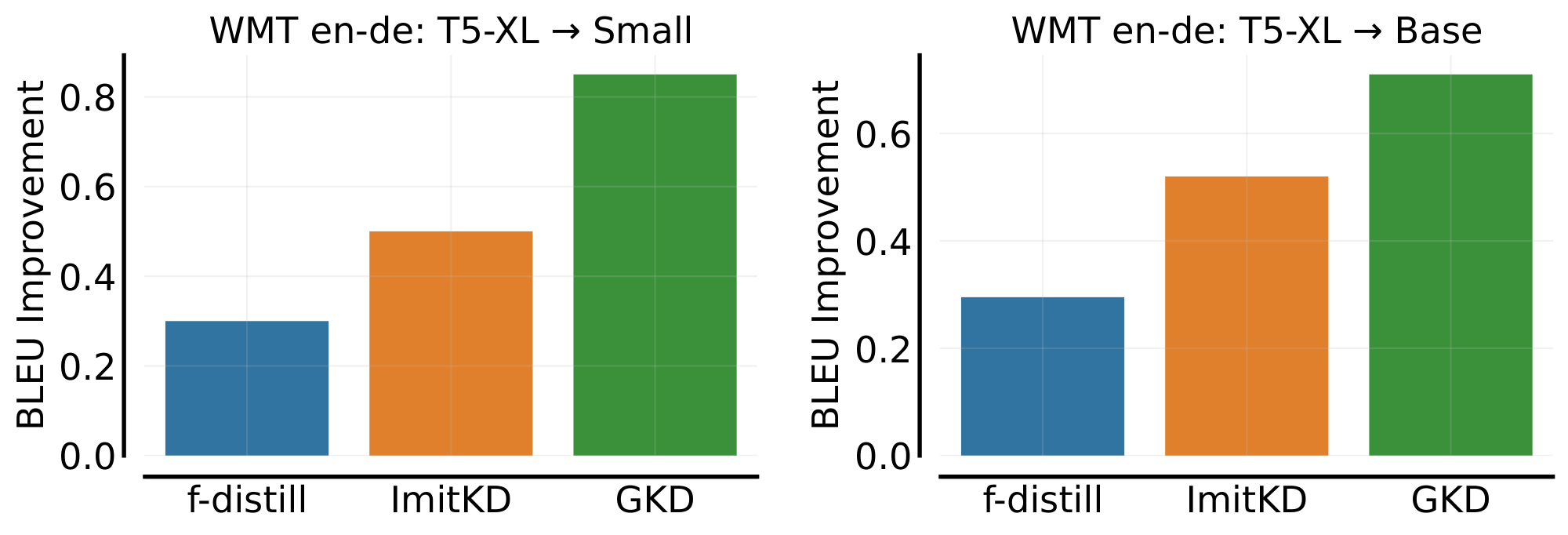
Baselines. We compare to the widely-used KD methods discussed in Section 3: SeqKD and Supervised KD. We also evaluate ImitKD ([15]) and f-distill ([16]), which can be viewed as "mixed" data variants of GKD ($\lambda=0.5$) with forward KL and total variation distance as divergence. All the baselines start from the same supervised fine-tuned student checkpoint as GKD.
![**Figure 4:** **Effect of Divergence on Performance and Diversity**. Utilizing on-policy GKD with different divergences, we evaluate the trade-off between the distilled student's generation quality and diversity, by varying the sampling temperature. We quantify diversity using Self-BLEU ([17]), where a score of 100 indicates deterministic outputs and 0 signifies maximum diversity. Transitioning from forward KL to reverse KL, through generalized JSD, leads to decreased diversity, attributed to the enhanced mode-seeking characteristic of the divergence. Mode-seeking divergences often yield superior quality, especially at high temperatures ($\gamma=1$). Reducing the temperature curtails diversity while narrowing performance differences among divergences.](https://ittowtnkqtyixxjxrhou.supabase.co/storage/v1/object/public/public-images/rtrr63wx/diversity_vs_performance_long.png)
4.1 Case Study: Abstractive Summarization
We start by evaluating GKD on an abstractive summarization task of generating a summary that captures salient ideas of the input document. To do so, we use the XSum dataset ([18]), which consists of news articles paired with human-written summaries. Following PaLM ([19]), we evaluate performance using ROUGE-2 score ([20]) of predicted summaries on the validation split of XSum but observe similar trends in ROUGE-L and ROUGE-1. We use T5 models supervised fine-tuned on XSum as students for distillation while the fine-tuned T5-XL as the teacher. See Appendix A.3 for additional experimental details.
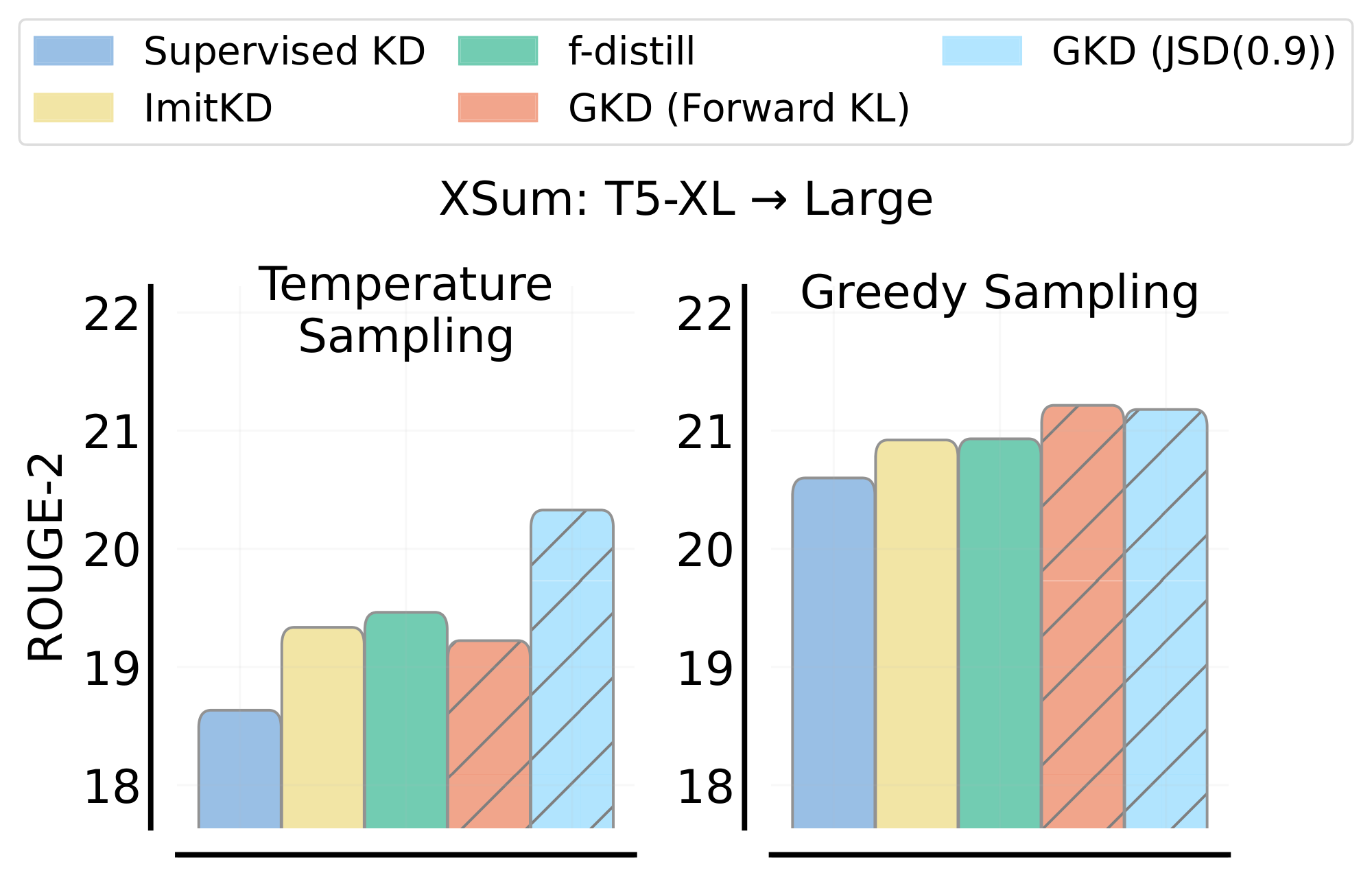
Comparison to baselines. First, we explore how GKD compares to widely-used KD approaches, namely SeqKD and Supervised KD, across different student model sizes. As shown in Figure 1, we observe consistent improvements with GKD, which demonstrates the scalability of GKD with respect to the student capacity. Notably, GKD allows us to surpass the few-shot performance of PaLM (540B) using a $7000\times$ smaller T5 model. We also compare GKD variants with ImitKD and f-distill, and evaluate performance with greedy sampling and temperature sampling ($\gamma=1$) in Figure 2. On-policy GKD with JSD (0.9) outperforms these additional baselines in both scenarios.
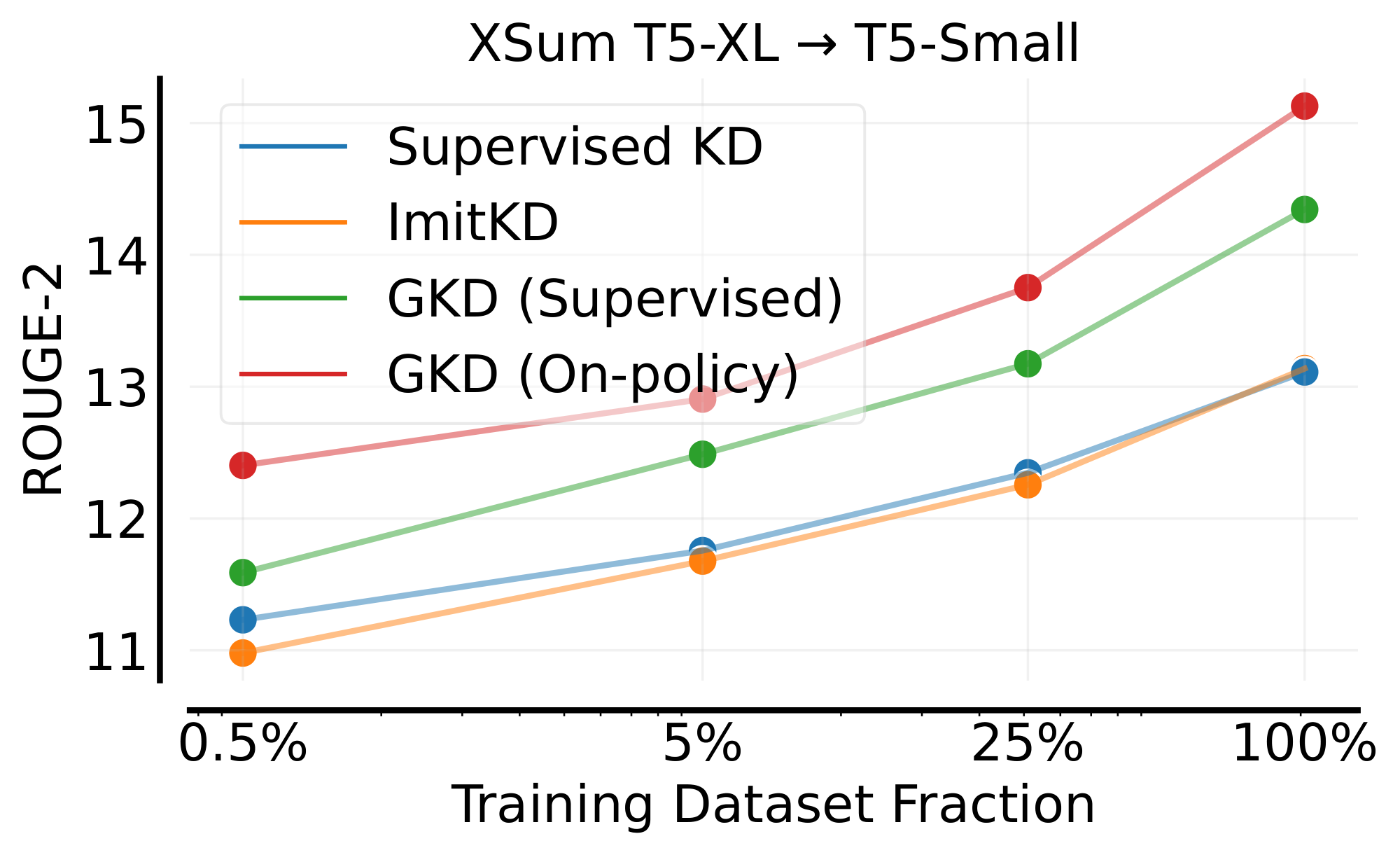
Data efficiency and scaling. To evaluate the efficiency and scalability of GKD, we distilled the T5-XL teacher using subsampled XSum training datasets: 1K (0.5%), 10K (5%), and 50K (25%) examples. We used T5-small as the student and report data scaling curves in Figure 3. Notably, on-policy GKD on the 5% subsampled dataset, without any ground-truth summaries, outperforms supervised KD and ImitKD with entire training dataset with ground-truth summaries.
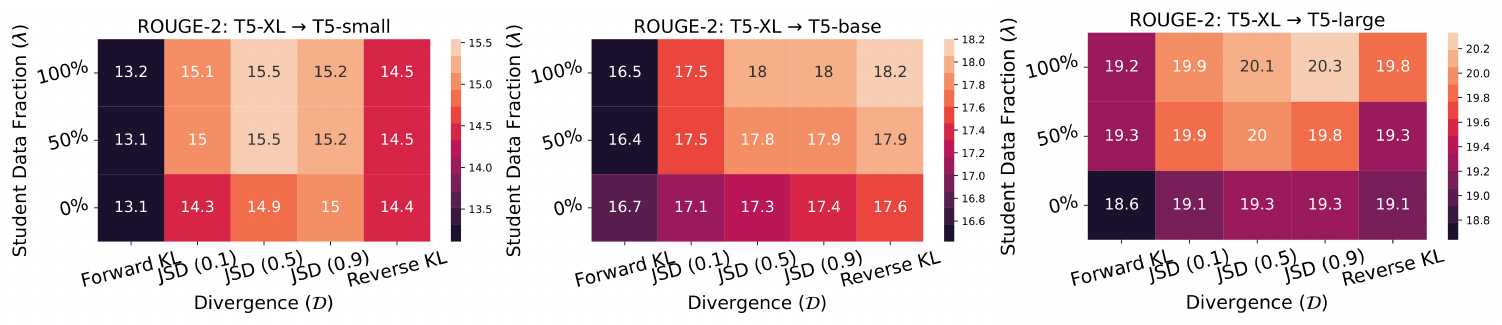
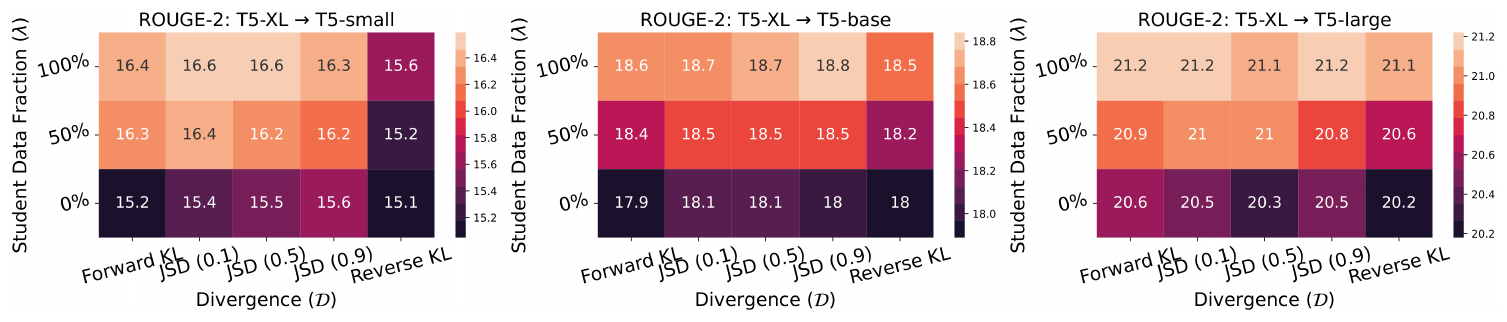
GKD Ablations. We ablated different divergences and student data fractions in GKD for various student sizes in Figure 12 and Figure 13. On-policy and mixed variants consistently outperform supervised variants. Mode-seeking divergences perform better when evaluation is done using temperature sampling while the choice of divergence doesn't affect performance much with greedy sampling.
Choosing GKD Divergence. The divergence chosen for distillation is crucial in determining the trade-off between summarization quality and diversity. As the sampling temperature can also be adjusted to balance summary quality and diversity, the optimal choice of divergence is temperature-dependent. To understand this dependence, we evaluate T5-small distilled using on-policy GKD with different divergences. As shown in Figure 4, certain divergences, like JSD (0.5) and JSD (0.9), offer better quality but less diversity at high temperatures. However, as temperature decreases, the difference in quality among divergences narrows, while diversity also drops.
On-policy GKD with RL. In summarization, we want model-generated summaries to be factually consistent with their input documents. However, distillation alone might not improve factual consistency as even large models halluncinate and generate inconsistent summaries. Recently, [21] mitigate hallucination on summarization tasks by using RL with textual entailment feedback as the reward (RLEF), as faithful summaries must be textually entailed from their input documents. Inspired by their success, we explore combining RL fine-tuning using a REINFORCE-like objective with on-policy GKD, as described in Section 3.2. As shown in Figure 5, GKD with RL fine-tuning substantially improves factual consistency compared to the teacher model while obtaining large improvements in summarization quality for the distilled student model.
![**Figure 5:** **RLAIF + On-policy GKD**. We show the trade-off between reward maximization and summarization performance on XSum. We report improvements relative to the original T5-base student. Following [21], we use the textual entailment score from a T5-XXL NLI classifier as the reward. $\alpha$ controls the strength of the on-policy GKD loss with JSD (0.9). As $\alpha$ increases, ROUGE-2 increases while improvement in factual consistency decreases. For comparison, we show the relative performance of the $12\times$ larger T5-XL teacher. RLEF\* corresponds to RLAIF method from [21], where the student is regularized towards the original student model itself instead of the teacher. On-policy GKD + RL achieves higher ROUGE-2 compared to RLEF\* while generating more factually consistent summaries compared to the teacher.](https://ittowtnkqtyixxjxrhou.supabase.co/storage/v1/object/public/public-images/rtrr63wx/tradeoff_rl_xsum.png)
:::: {cols="2"}
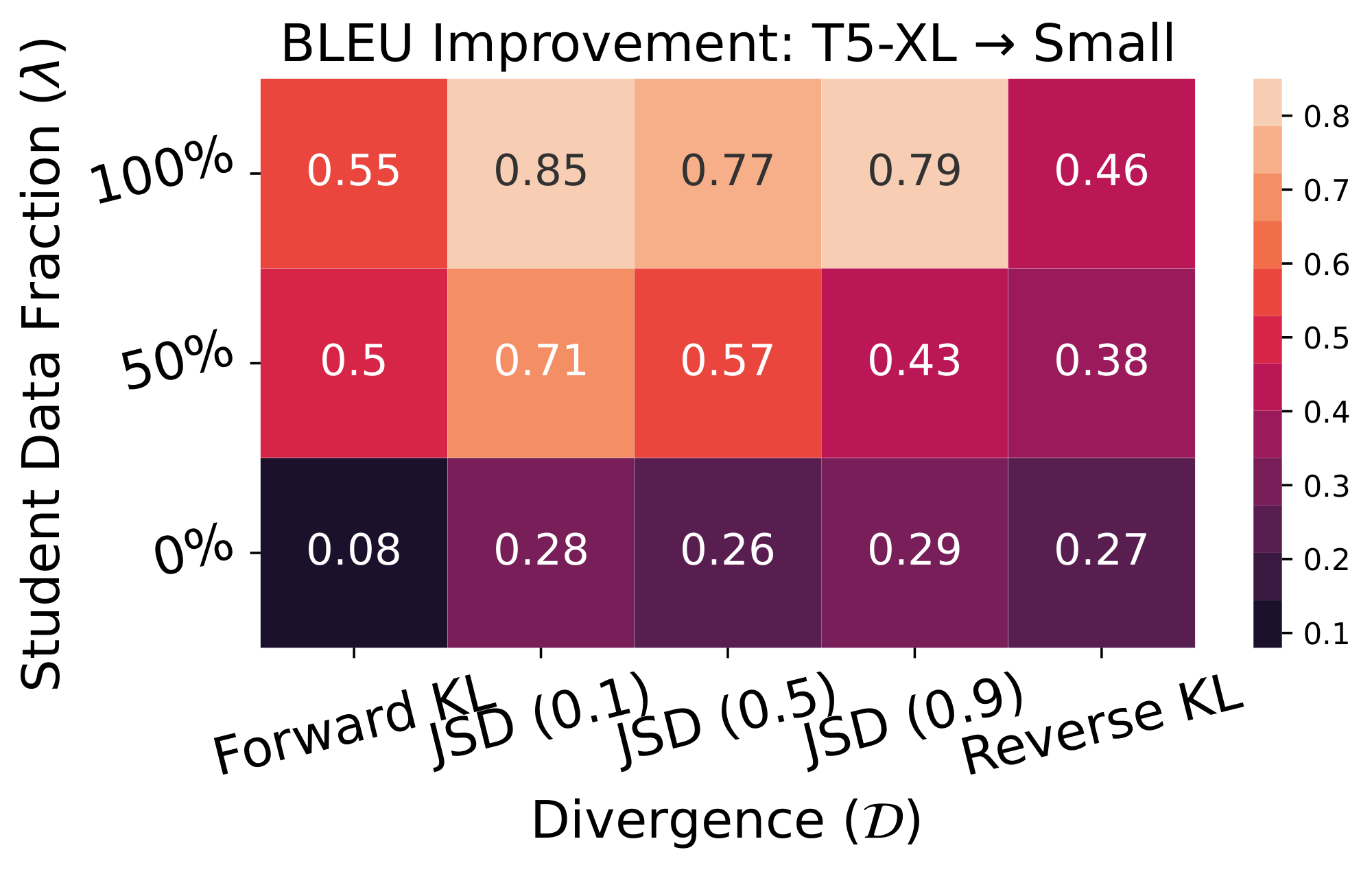
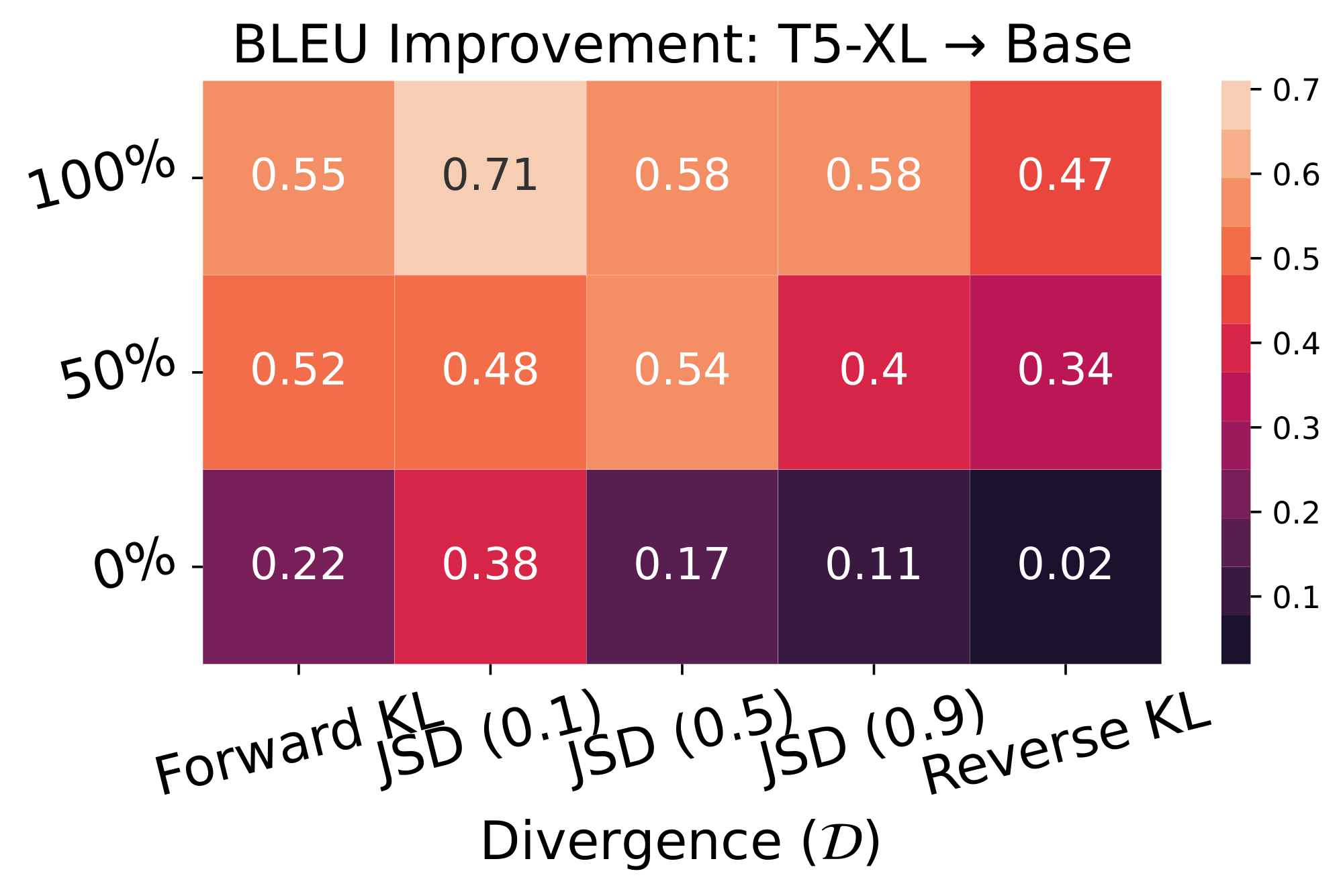
Figure 6: Varying student data fraction and divergence in GKD on WMT en $\rightarrow$ de. For evaluation, we use beam search and report the improvement in BLEU score of distilled student relative to the original student. Results are averaged across three seeds. We observe that using only student-generated output samples outperform other GKD variants. We use the T5-XL ($\sim$ 3B params) supervised fine-tuned on WMT as the teacher, which obtains a BLEU score of 28. (Left) We use T5-small (77M params) as the student, which obtain a BLEU score of 25.58. (Right) Student corresponds to T5-base (250M params) with a BLEU score of 26.98. ::::
4.2 Machine Translation
To evaluate GKD beyond summarization, we consider the task on translating English to German using WMT14 en-de ([22]). We report performance on the validation split using the BLEU score, which measures the similarity of machine-translated text to high quality reference translations. We use supervised fine-tuned T5-XL as the teacher with a softmax-temperature of $1.0$ (BLEU score of 28). See Appendix A.5 for additional experimental details.
Results. Figure 1 and Figure 15 show that on-policy GKD outperforms commonly-used KD approaches. Furthermore, we ablate GKD variants using T5-small and T5-base as students in Figure 6. We observe that generalized JSD divergences perform better than forward or reverse KL but their performance gap reduces when using a larger student. Moreover, using purely on-policy and mixed data distributions consistently outperform GKD variants only using a fixed supervised dataset, showing the importance of generating on-policy output sequences from the student. The efficacy of on-policy data on WMT aligns with our findings on XSum.
4.3 Arithmetic Reasoning
[23] show that reasoning abilities only appear to emerge in LLMs with at least several billions parameters, making KD important for improving reasoning abilities of smaller models. To this end, we evaluate GKD on GSM8K ([24]), a high-quality dataset of grade school math word problems requiring multi-step logical inference. Here, we explore GKD in conjunction with chain-of-thought (CoT) ([23]), a common approach to improve reasoning abilities of LLMs by prompting them to produce intermediate reasoning steps before giving the final answer.
Setup. We perform few-shot prompting by prepending the math problems in GSM8K with the first 4 CoT input-output exemplars from [23]. For evaluation, we report accuracy on the test split by checking whether the target answer matches the final answer given an external calculator, akin to [24]. For supervised training, we use the CoT outputs generated by [25], resulting in around 5.3K (problem, CoTs) pairs in the original training split of GSM8K. We use Flan-T5 models ([26]) supervised fine-tuned for 10K steps on the above CoT dataset as a starting point for distillation. We use the fine-tuned FLAN T5-XL as the teacher, which obtains a test accuracy of 27.9. See additional experimental in Appendix A.4.
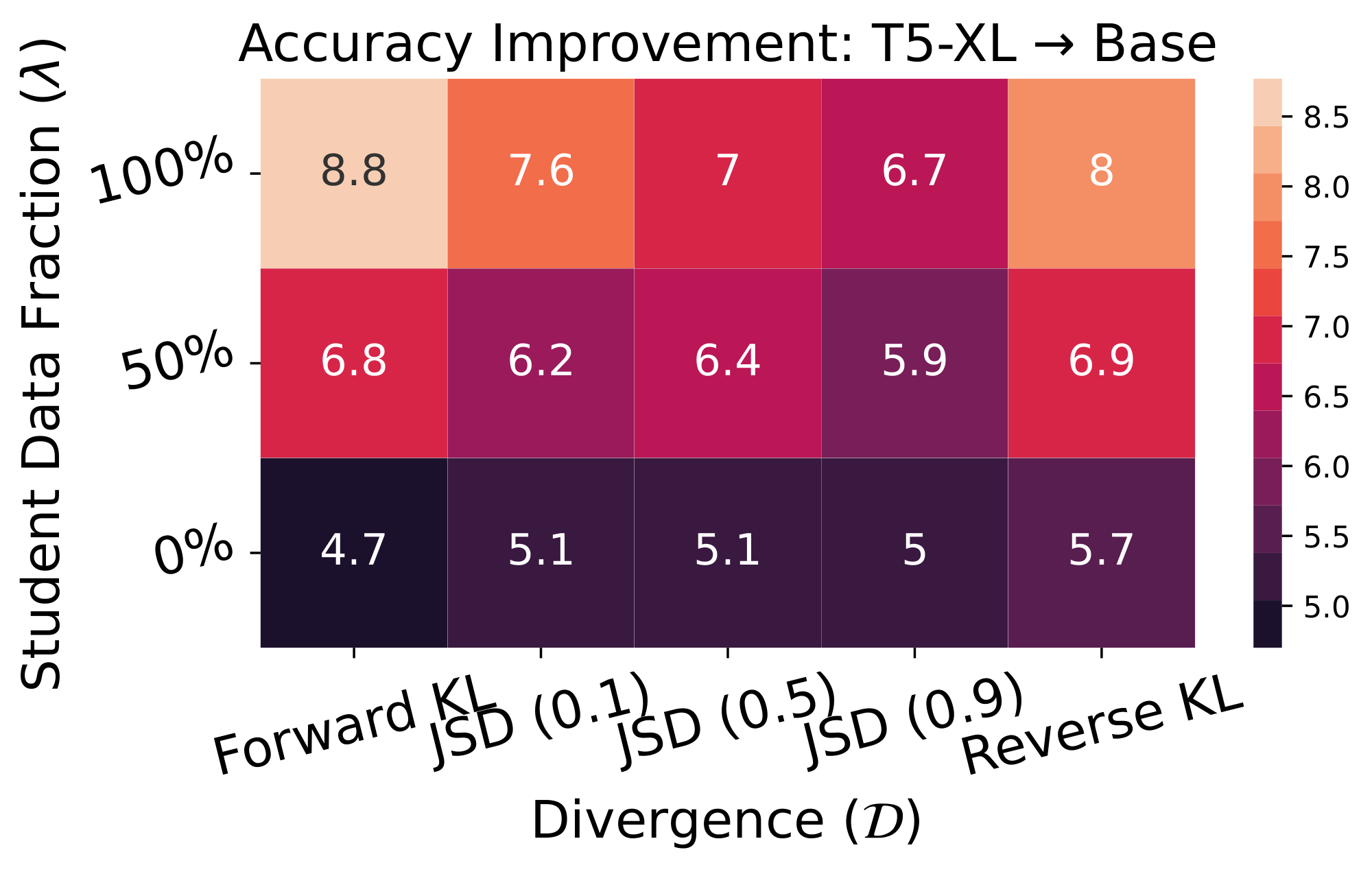
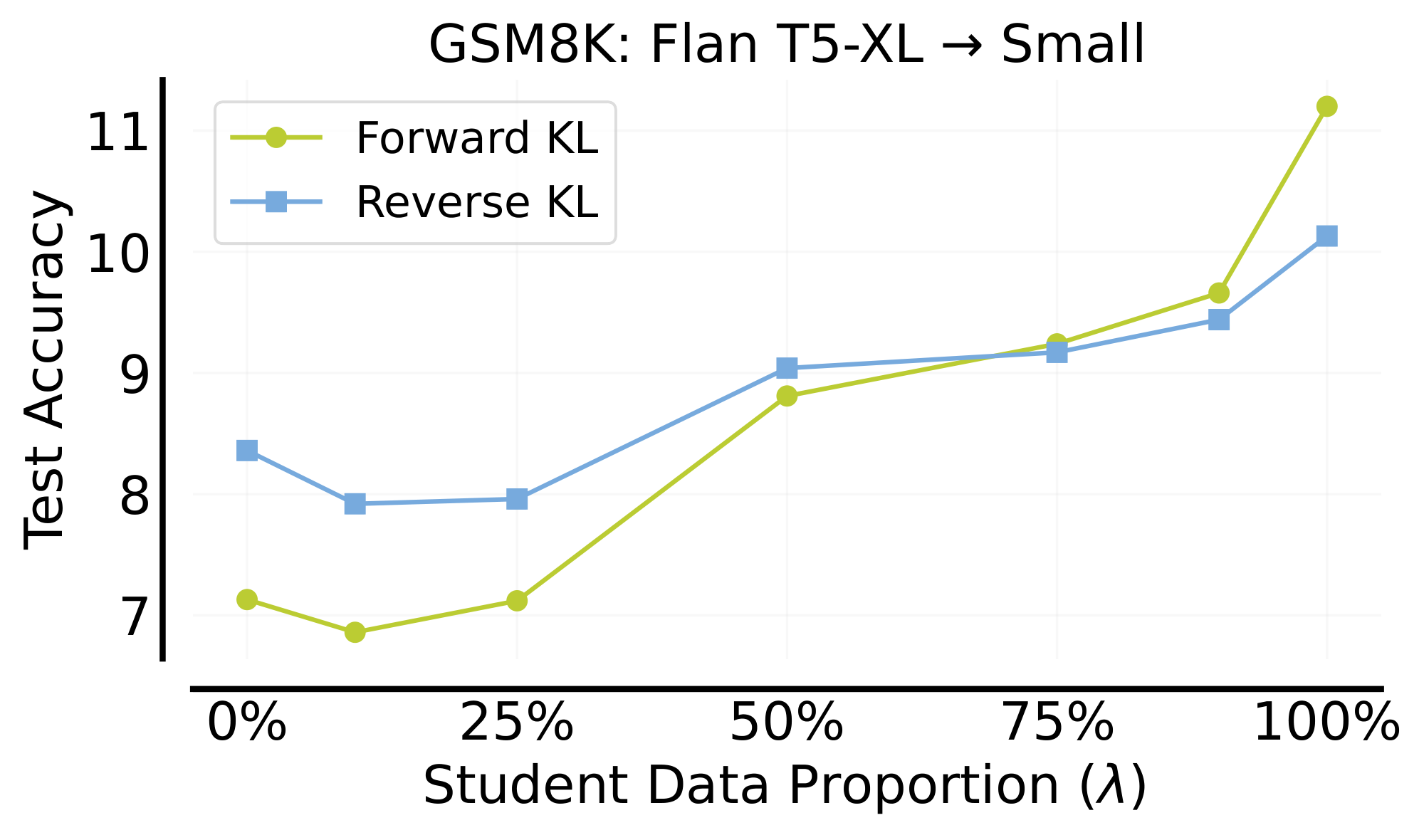
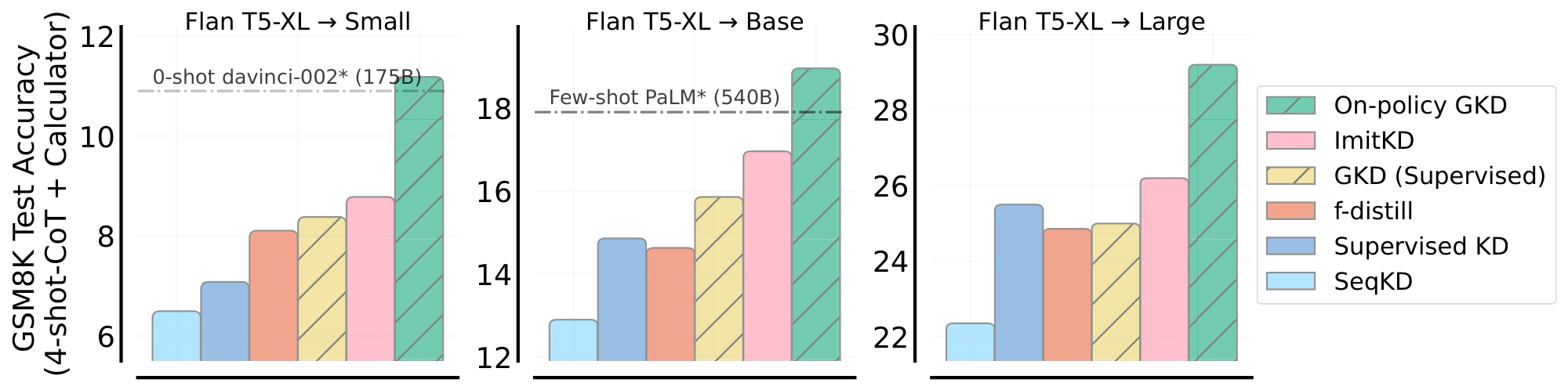
Results. We first ablate GKD variants and report results in Figure 7 and Figure 14. We observe that when using only the fixed CoT dataset or mixing it with student-generated CoTs, performance consistently falls short of using solely the student-generated CoTs. Furthermore, forward KL performs quite well, similar to our findings on XSum with greedy sampling. Notably, reverse KL also performs well, especially when training using only a fixed dataset. Additionally, Figure 8 shows that performance consistently improves as the proportion of on-policy data increases, provided that at least 25% of the data is on-policy. Moreover, we demonstrate that on-policy GKD have superior performance compared to baseline KD methods, across all student sizes, as shown in Figure 9. Finally, we observe promising results with GKD for self-distillation on GSM8k, as shown in Appendix A.1.
4.4 Task-agnostic Distillation: Instruction Tuning
![**Figure 10:** **Task-agnostic Distillation on FLAN** ([26]). On-policy GKD with reverse KL outperforms other approaches. The evaluation metric on both the MMLU and BBH benchmark suites is few-shot prompted accuracy (exact match), where we take an unweighted average over all tasks. These evaluation benchmarks are held-out (not included in the distillation data). Here, we do not run SeqKD due to its computational inefficiency for generating data from the teacher during training. The teacher FLAN T5-XL achieves an accuracy of 52.4% on MMLU and 41% on BBH, while the student T5-large model obtains an accuracy of 35.6% on MMLU and 31.25% on BBH.](https://ittowtnkqtyixxjxrhou.supabase.co/storage/v1/object/public/public-images/rtrr63wx/mmlu_bbh_delta_app.png)
While task-specific distillation provides optimized performance for predefined tasks, which is often crucial for deployment purposes, task-agnostic distillation offers a compelling alternative in scenarios where the exact nature of the task is not known beforehand and can vary during deployment. As highlighted by [5], the allure of task-agnostic distillation lies in its efficiency: once distilled, a model can be re-purposed for multiple downstream tasks via prompting or fine-tuning.
Setup. To study task-agnostic KD, we focus on instruction tuning ([26]). Our aim is to enhance the distilled model's proficiency to handle diverse tasks presented in the form of instructions. To achieve this, we employ the FLAN T5-XL model as our teacher and distill its knowledge into the FLAN T5-Base, as introduced by [26]. Our distillation process utilizes the comprehensive FLAN2021 instruction tuning dataset, which boasts 5.36 million examples spanning 62 distinct language understanding and generation tasks. For hyperparameter details, see Table 4.
Evaluation. To gauge the versatility of a task-agnostic model, it is essential to test it across a diverse set of tasks. In line with [26], we evaluate our distilled T5-base student on two held-out benchmark suites: (1) MMLU (Massive Multitask Language Understanding) includes exam questions from 57 tasks such as mathematics, history, law, and medicine, and (2) BBH (BIG-Bench Hard) includes 23 tasks from BIG-Bench for which PaLM 540B ([19]) performs below average human raters. For performance, we report the distilled model's ability to directly predict the answer via standard few-shot prompting, averaged across tasks in MMLU and BBH.
Results. We report the performance of distilled checkpoints obtained after 50K training steps for various methods in Figure 10. We find that on-policy GKD with reverse KL substantially outperforms supervised KD and ImitKD. Notably, in the context of instruction tuning, we find that using reverse KL performs much better than forward KL. We hypothesize that the efficacy of reverse KL in instruction tuning may stem from its mode-seeking nature as it ensures that the model zeroes in on the main intent or behavior specified by the instruction. As a result, the model might prioritize core behaviors over less relevant details, leading to better performance on held-out tasks.
5. Related work
Section Summary: The section reviews prior work on knowledge distillation for language models, including supervised and sequence-level methods that train students to mimic teachers but can suffer from exposure bias during generation. It positions GKD as a more general and effective framework that connects distillation to imitation learning, outperforming alternatives like ImitKD, f-distill, and the concurrent MiniLLM approach while also allowing joint optimization with reinforcement learning fine-tuning. Additional related directions include enhancing distillation with reasoning traces such as chain-of-thought and applying these ideas to speed up inference via speculative decoding.
Knowledge distillation. Supervised KD ([27, 3]) is a classic approach and has been successfully used for distilling auto-regressive models ([5]). Another approach for distilling such models is sequence-level KD ([4]). On-policy GKD substantially outperforms supervised KD and SeqKD (Figure 1). Other KD approaches train the student to match different quantities obtained from the teacher, such as hidden states ([28]) or attention scores ([29]). However, none of these approaches make the connection between distillation and imitation learning, and a purely supervised approach can suffer from train-inference mismatch, also known as exposure bias ([30, 31]). While [32] argue that this mismatch may not be critical, several papers demonstrate that exposure bias leads to poor text generation ([33, 34, 35]).
ImitKD ([15]) identifies this connection by sampling sequences from both the student and a fixed dataset but does not push the idea further. Unlike GKD, ImitKD does not explore purely on-policy data collection, nor does it integrate RL fine-tuning. Moreover, ImitKD keeps the forward KL at the token level, which is not necessary when one has access to the teacher's log-probabilities, rather than just samples. Furthermore, GKD demonstrates the scalability of the idea, handling student models roughly $26\times$ larger than those explored by ImitKD. ImitKD can be viewed as GKD with forward KL and a non-increasing schedule on $\lambda$, a simple choice being $\lambda = 0.5$. More recently, f-distill ([16]) formulates sequence-level KD as minimizing an f-divergence and propose an tractable objective based on total variation distance between the token-level student and teacher distributions. In essence, both ImitKD and f-distill are specific instances of GKD, which we demonstrate lead to worse empirical results than on-policy GKD (Figure 2, Figure 9).
The concurrent work on MiniLLM ([36]) also exploits the link to imitation and frame distillation as an RL problem. In particular, MiniLLM optimizes reverse KL between the teacher and the student at the sequence level (while likelihood maximization is the forward one) using a policy gradient approach. However, we argue that GKD is simpler and more stable, being closer to supervised training, since it does not backpropagate through the student's sampling process. Indeed, MiniLLM relies on a number of stabilizing tricks, to tackle high variance, reward hacking, and generation length bias. GKD is also more general as it can also be used with other divergences such as forward KL or JSD, which can perform better than reverse KL (Figure 6, Figure 7).
RL fine-tuning. There are now numerous examples of language models being fine-tuned with RL, be the reward optimizing for some metric ([37]), or learned using human feedback ([9]). In these approaches, it is typical to regularize the RL fine-tuned model towards the initial (usually supervised fine-tuned) model. However, as far as we know, we are the first to perform distillation and RL fine-tuning at the same time (Figure 5). If it may seem natural, it is quite different from an optimization perspective, as it changes the regularization towards the initial policy to towards the teacher policy, and we show empirically that it is a viable approach.
Distillation with reasoning traces or rationales. Chain-of-Thought prompting ([38, 23]) has recently demonstrated that LLMs can solve complex reasoning tasks, step by step, just by prompting. This idea was quickly adapted to KD, by extending the teacher dataset with CoT prompts for fine-tuning the student ([25, 39, 40]). The distillation is still done in a supervised way, and other kind of enhanced prompts could be considered ([41, 42]). We adopt the same approach, but combine it with on-policy distillation with various divergences. It shows the versatility of GKD, and improves upon the purely supervised approaches, as seen in our results on GSM8K (Figure 9).
Application to speculative decoding. [43] and [44] apply GKD to improve the alignment between draft and target model for better inference speedup from speculative decoding.
6. Conclusion
Section Summary: The researchers introduced a method called GKD that helps reduce the gap between how autoregressive language models are trained and how they are actually used when knowledge is transferred from a large model to a smaller one. Their experiments showed this approach worked better than standard distillation techniques on tasks such as summarizing articles, translating between languages, and solving math problems, and it can also be paired with reinforcement learning to improve training that uses human preferences. They see potential to apply the same idea to other generative models in areas like audio, video, and image creation.
In this work, we proposed GKD to address the train-inference distribution mismatch when distilling auto-regressive language models. GKD consistently outperformed commonly-used knowledge distillation approaches on three language generation tasks: abstractive summarization, machine translation, and arithmetic reasoning. We further showed that GKD can be combined with reinforcement learning to optimize a sequence-level reward in addition to distilling the knowledge of a large teacher model, which we believe can improve the widely-used RLHF training phase for language models. One interesting direction for future work would be extending GKD to auto-regressive sequence models for audio ([45]), video ([46]) and text-to-image generation ([47]). We hope that our work will be valuable for researchers and practitioners who are working on improving performance and efficiency of generative auto-regressive sequence models.
Appendix
Section Summary: The appendix explores self-distillation using GKD on the GSM8K math dataset, showing that on-policy variants can improve a student model beyond its own fine-tuned teacher by training on the student's own generated outputs rather than fixed data. It then details the starting checkpoints, fine-tuning steps, and optimizer settings for various-sized T5 models across summarization, translation, and math tasks, while noting that the extra computation from student sampling during training remains modest relative to inference costs and can be justified by performance gains, especially when combined with RLHF. Finally, it reports hyperparameter choices such as learning rates and sampling temperatures for XSum experiments, along with ablations confirming that on-policy and mixed data approaches consistently beat purely supervised distillation.
A.1 Self-Distillation
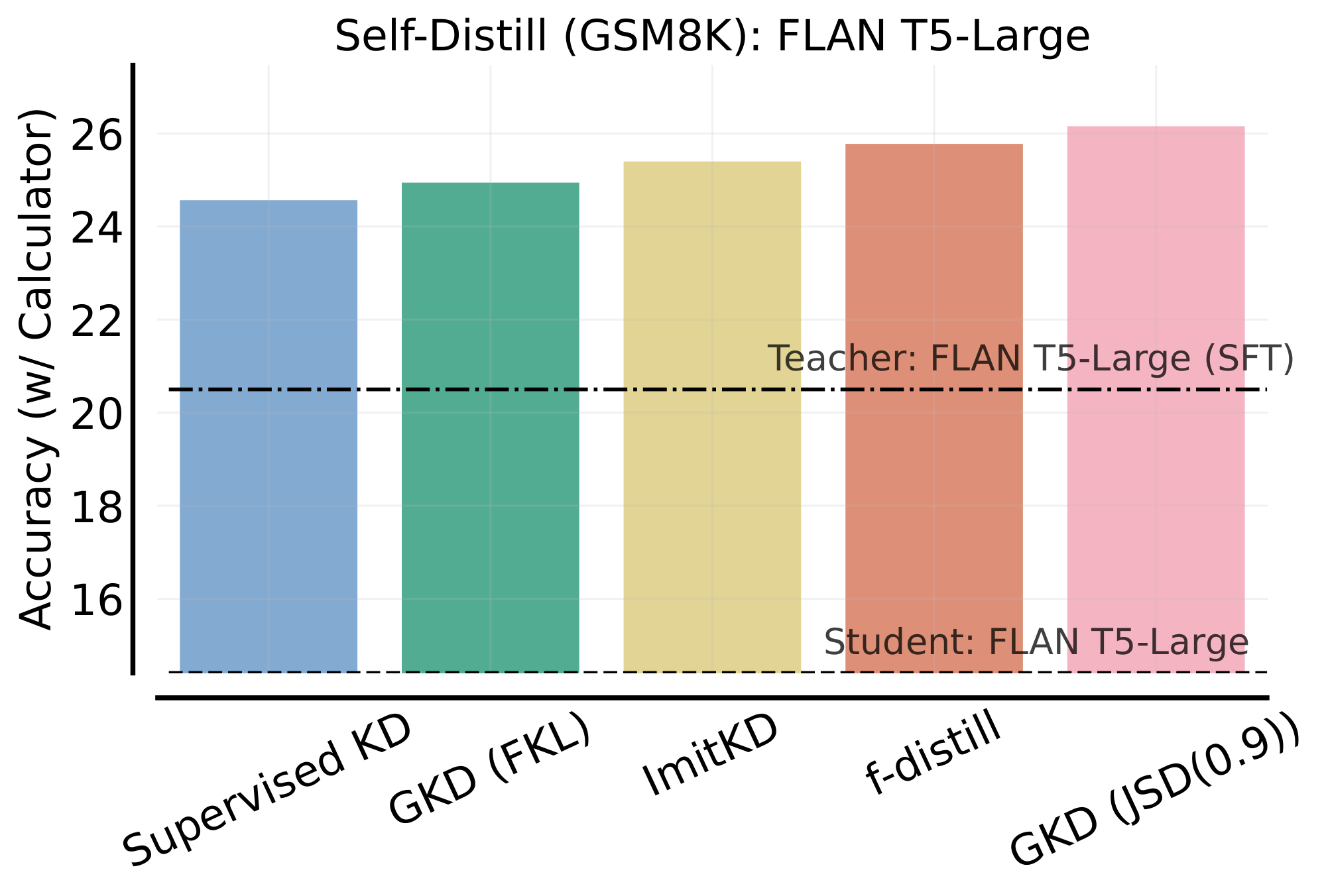
Self-Distillation. We investigate whether GKD works for self-distillation ([48]), where we want to transfer knowledge from a teacher model to a student model with the same architecture and size. To investigate this, we consider self-distillation on GSM8K with FLAN-T5 large as the student and teacher, where the teacher is supervised fine-tuned on GSM8K. As shown in Figure 11, self-distilled students surpass surpasses the teacher's performance on the test set. Moreover, distillation using student-generated data outperforms supervised KD, with on-policy GKD performing the best.
A.2 T5 Models
As base checkpoints, we start from LM-adapted T5v1.1 models. These LM-adapted models are initialized from T5v1.1 and trained for an additional 100K steps on the LM objective discussed in the T5 paper ([1]). These checkpoints are open-sourced at https://console.cloud.google.com/storage/browser/t5-data/pretrained_models.
In our experiments, we initialize both the student and teacher models for distillation by running further supervised FT on the original training dataset, as described below:
- XSum. For small, base, large and XL models, we use LM-Adapted T5v1.1 models supervised fine-tuned for 100K, 50K, 38k and 8K steps respectively.
- WMT. For small, base, large and XL models, we use LM-Adapted T5v1.1 models supervised fine-tuned for 250K, 250K, 110k and 50K steps respectively.
- GSM8K. All models were supervised fine-tuned starting from FLAN-T5 models on the Palm-540 generated CoT dataset for 10K steps.
Similar to T5 and FLAN-T5, our experiments use the Adafactor optimizer ([49]).
Computational cost of GKD. All methods including baselines start from the supervised fine-tuned student checkpoint, which requires training for a few hours on the smallest TPUv3 (8 cores). On GSM8K, the computational overhead from student sampling is approximately $1.8\times$, $2\times$ and $2.2\times$ compared to sampling from a fixed dataset of outputs, for a student-teacher ratio of $38\times$, $12\times$ and $3.8\times$. For RLHF + GKD, the computational overhead is somewhat small as we are only running inference to get teacher logits instead of student logits.
Moreover, the majority of cost in real world use cases is due to serving cost at inference time and not due to fine tuning. Concretely, if it is too costly to sample from the student during fine-tuning, it might also be too expensive to serve this model to users (which may range from tens of thousands to billions). Overall, performance benefits from on-policy GKD might be worth the compute cost, especially when combined with RLHF.
A.3 XSum
Learning rate sweep. We performed a sweep over the learning rate in 0.0001, 0.0003, 0.001 and found 0.0003 to be the best for T5-base, T5-large and 0.001 leads to best performance for T5-small. As such, by default we use an LR of 0.0003 except when reporting results for T5-small, which uses 0.001. We found that reverse KL was more sensitive to higher LRs and we default to using 0.0003 for all models when using reverse KL.
Teacher Softmax-temperature. When using greedy sampling for evaluation, we set the teacher temperature to 1. However, when reporting student performance with temperature sampling ($\gamma=1$), as done in Figure 2 and Figure 3, we set teacher temperature to 0.1 for the student.
\begin{tabularx}{0.65\ccccccccc}{lX}
  \toprule
  \textbf{Hyperparameter} & \textbf{Value} \\
  \midrule
  Training Steps & 40, 000 \\
  Batch size & 32 \\
  Eval Split & Validation \\
  Dropout & 0.0 \\
  Learning Rate (LR) & 0.0003\\
  LR Warmup Steps & 2, 000 \\
  LR Cooldown (Begin, End) & (30, 000, 40, 000) \\
  Warmup Schedule & Linear (from 0 to LR)\\
  Cooldown Schedule & Linear (from LR to 0)\\
  Max Input Length & 1024 \\
  Max Output Length & 64 \\
  Evaluation & Greedy \& Temp. Sampling \\
  \bottomrule
  \end{tabularx}
GKD Ablations. We ablated different divergences and student data fractions in GKD for various student sizes in Figure 12 and Figure 13. On-policy and mixed variants consistently outperform supervised variants. Mode-seeking divergences perform better when evaluation is done using temperature sampling while the choice of divergence doesn't affect performance much with greedy sampling.
A.4 GSM8K
For training, we use the CoT outputs generated from Palm-540B by [25]. We report accuracy on the original test split of the GSM8K dataset ([24]). We use checkpoints at the end of training after distillation for reporting results, which are averaged across 3 seeds.
\begin{tabularx}{0.65\ccccccccc}{lX}
  \toprule
  \textbf{Hyperparameter} & \textbf{Value} \\
  \midrule
  Training Steps & 40, 000 \\
  Batch size & 32 \\
  Evaluation Split & Test \\
  Dropout & 0.05 \\
  Learning Rate (LR) & 0.0003 \\
  LR Warmup Steps & 2, 000 \\
  LR Cooldown (Begin, End) & (30, 000, 40, 000) \\
  Warmup Schedule & Linear (from 0 to LR)\\
  Cooldown Schedule & Linear (from LR to 0)\\
  Max Input Length & 512 \\
  Max Output Length & 320 \\
  Checkpoint & Flan-T5 \\
  Teacher softmax temperature & 0.1 \\
  Evaluation & Greedy Sampling \\
  \bottomrule
  \end{tabularx}
:::: {cols="2"}
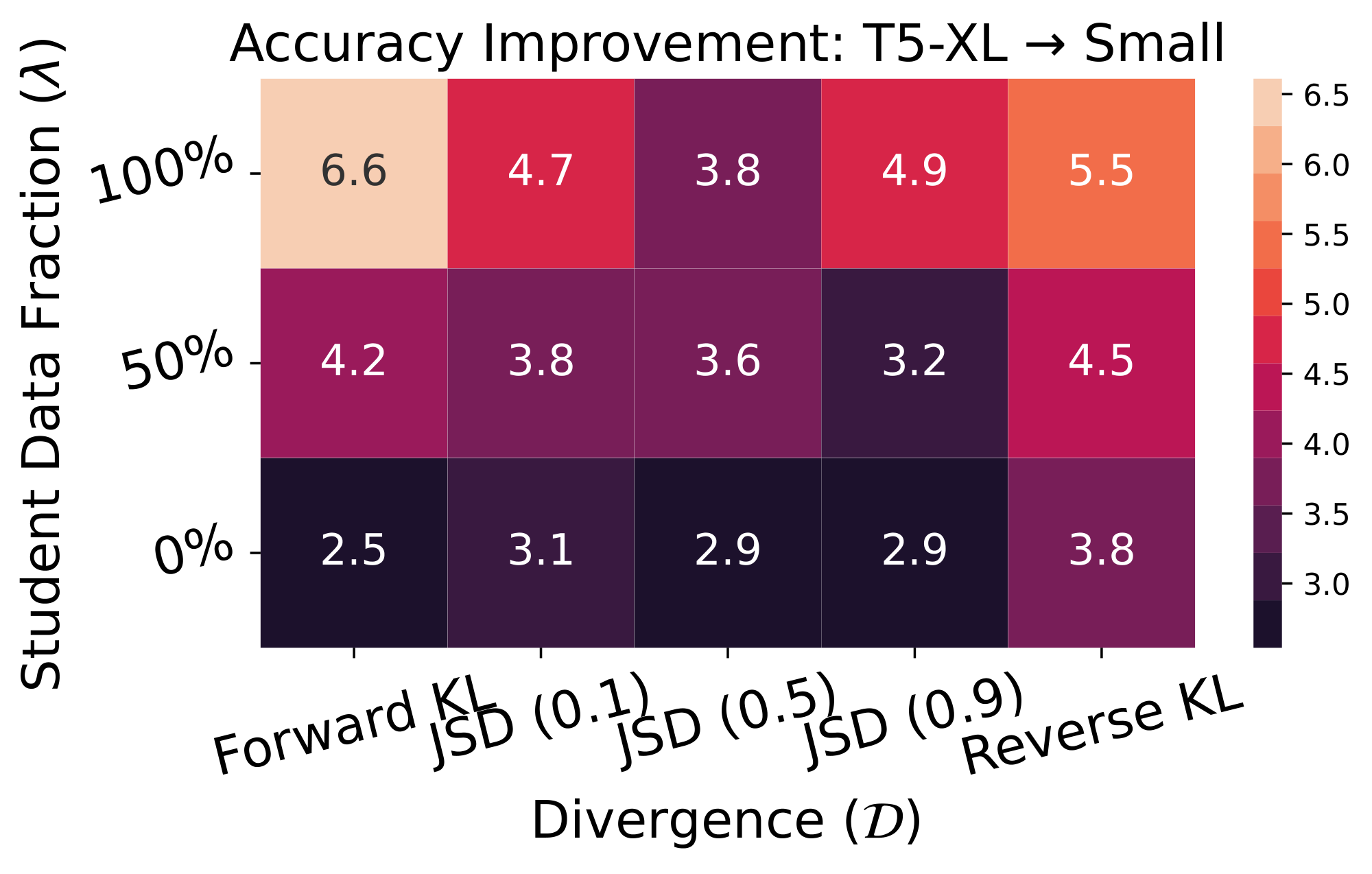
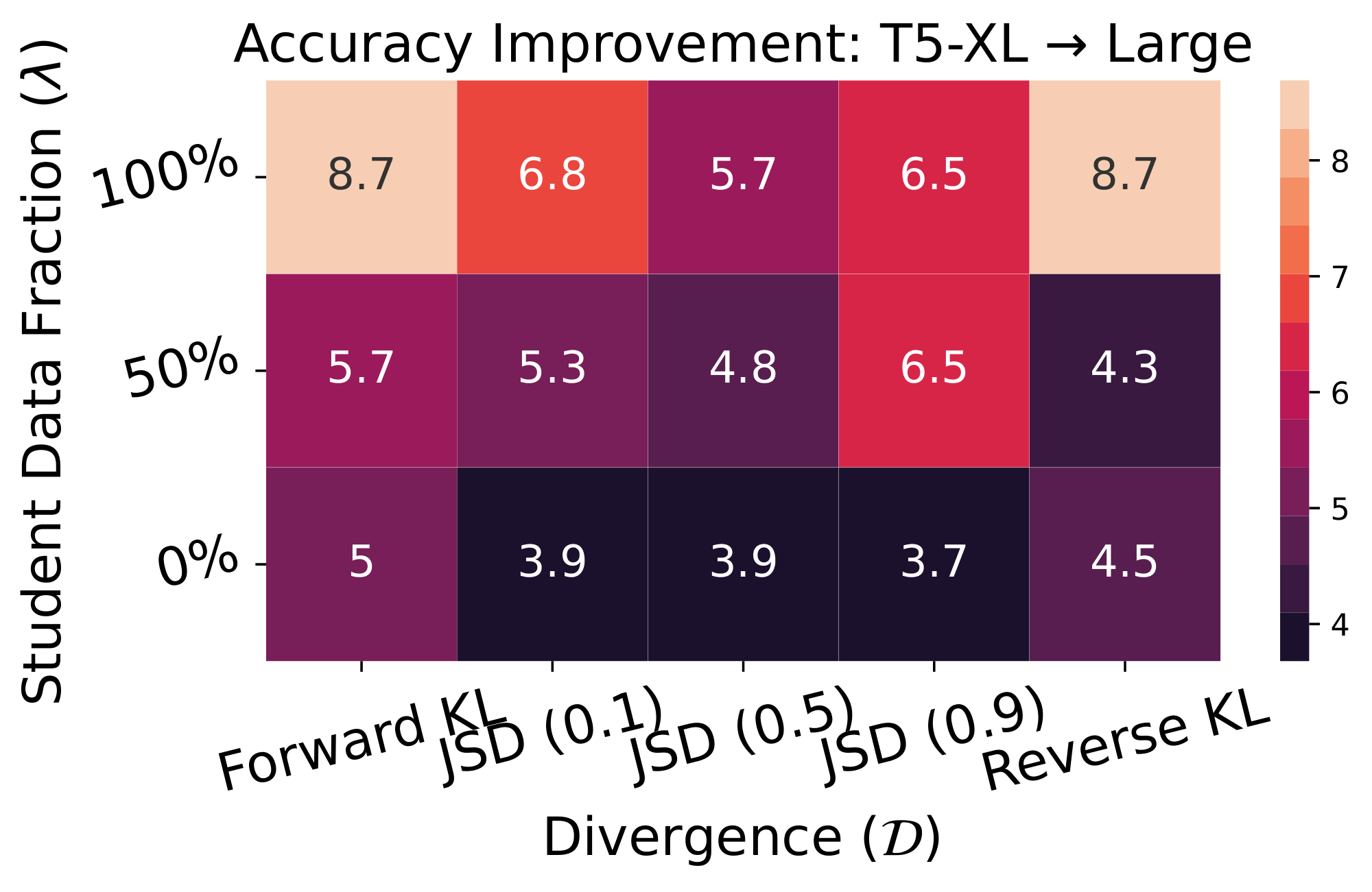
Figure 14: Ablating GKD variants on GSM8K with 4-shot CoT. For evaluation, we use greedy sampling and report improvement in test accuracy of the student after distillation. Results are averaged across three seeds. Using only student-generated output samples typically outperform other GKD variants. We use the supervised fine-tuned T5-XL as the teacher, which obtains an accuracy of 27.9. (Left) We use T5-small as the student, which obtains an accuracy of 4.585. (Right) Student corresponds to T5-base with an accuracy of 20.5. ::::
Few-shot CoT Prompt. Here, we specify the 4-shot CoT prompt used for the experiments:
Q: There are 15 trees in the grove. Grove workers will plant trees in the grove today. After they are done, there will be 21 trees. How many trees did the grove workers plant today?
A: There are 15 trees originally. Then there were 21 trees after some more were planted. So there must have been 21 - 15 = 6. The answer is 6.
Q: If there are 3 cars in the parking lot and 2 more cars arrive, how many cars are in the parking lot?
A: There are originally 3 cars. 2 more cars arrive. 3 + 2 = 5. The answer is 5.
Q: Leah had 32 chocolates and her sister had 42. If they ate 35, how many pieces do they have left in total?
A: Originally, Leah had 32 chocolates. Her sister had 42. So in total they had 32 + 42 = 74. After eating 35, they had 74 - 35 = 39. The answer is 39.
Q: Jason had 20 lollipops. He gave Denny some lollipops. Now Jason has 12 lollipops. How many lollipops did Jason give to Denny?
A: Jason started with 20 lollipops. Then he had 12 after giving some to Denny. So he gave Denny 20 - 12 = 8. The answer is 8.
A.5 WMT
For evaluation, we use beam search with same hyperparameters as [1]. We report performance of the final checkpoints obtained after training. To reduce the variance in results, we report the results averaged across 3 seeds.
\begin{tabularx}{0.65\ccccccccc}{lX}
  \toprule
  \textbf{Hyperparameter} & \textbf{Value} \\
  \midrule
  Training Steps & 100, 000 \\
  Batch size & 32 \\
  Seqio Task Name & 'wmt\_t2t\_ende\_v003' \\
  Eval Split & Validation \\
  Dropout & 0.0 \\
  Warmup Steps & 5, 000 \\
  Warmup Schedule & Linear (from 0 to LR)\\
  Learning Rate (LR) & 0.0003 \\
  Input Length (Tokenized) & 80 \\
  Output Length (Tokenized) & 80 \\
  Teacher softmax temperature & 1.0 \\
  Evaluation & Beam Search \\
  \bottomrule
  \end{tabularx}
A.6 Instruction Tuning
\begin{tabularx}{0.65\ccccccccc}{lX}
  \toprule
  \textbf{Hyperparameter} & \textbf{Value} \\
  \midrule
  Training Steps & 50, 000 \\
  Batch size & 128 \\
  Task & \href{https://huggingface.co/datasets/conceptofmind/flan2021_submix_original}{FLAN2021} \\
  Dropout & 0.0 \\
  Warmup Schedule & No Warmup \\
  Learning Rate (LR) & 0.0001 \\
  Input Length (Tokenized) & 2048 \\
  Output Length (Tokenized) & 256 \\
  Teacher softmax temperature & 1.0 \\
  Evaluation & Greedy Sampling \\
  \bottomrule
  \end{tabularx}
A.7 Mode-seeking vs Mode-covering KL
![**Figure 16:** **Mode-seeking *vs* Model-covering KL with capacity mismatch**. We show the learned distribution $Q_\theta$ when minimizing the forward and reverse KL w.r.t $Q$ between a mixture distribution $P$ and a unimodal Gaussian $Q_\theta$. Reverse KL is mode-seeking as it forces $Q_\theta$ to be zero where $P$ is zero and hence makes it concentrate on one of the modes (last plot). However, forward KL is mode-covering as it ensures that there is some mass under $Q_\theta$ wherever there is some mass under $P$. See [50] to replicate this plot.](https://ittowtnkqtyixxjxrhou.supabase.co/storage/v1/object/public/public-images/rtrr63wx/reverse_forward_kl.png)
References
Section Summary: This section compiles a numbered list of academic citations, primarily recent papers and preprints on machine learning topics such as language model scaling, knowledge distillation, imitation learning, and human feedback training. The references range from foundational works in neural networks and autonomous systems from the 1990s and 2010s to contemporary studies on efficient model compression and text generation evaluation published up to 2023. They draw from conferences, journals, and arXiv submissions to support claims in the main text.
[1] Colin Raffel, Noam Shazeer, Adam Roberts, Katherine Lee, Sharan Narang, Michael Matena, Yanqi Zhou, Wei Li, and Peter J Liu. Exploring the limits of transfer learning with a unified text-to-text transformer. The Journal of Machine Learning Research, 21(1):5485–5551, 2020.
[2] Jared Kaplan, Sam McCandlish, Tom Henighan, Tom B Brown, Benjamin Chess, Rewon Child, Scott Gray, Alec Radford, Jeffrey Wu, and Dario Amodei. Scaling laws for neural language models. arXiv preprint arXiv:2001.08361, 2020.
[3] Geoffrey Hinton, Oriol Vinyals, and Jeff Dean. Distilling the knowledge in a neural network. arXiv preprint arXiv:1503.02531, 2015.
[4] Yoon Kim and Alexander M Rush. Sequence-level knowledge distillation. arXiv preprint arXiv:1606.07947, 2016.
[5] Victor Sanh, Lysandre Debut, Julien Chaumond, and Thomas Wolf. Distilbert, a distilled version of bert: smaller, faster, cheaper and lighter. arXiv preprint arXiv:1910.01108, 2019.
[6] Dean A Pomerleau. Efficient training of artificial neural networks for autonomous navigation. Neural computation, 3(1):88–97, 1991.
[7] Stéphane Ross and Drew Bagnell. Efficient reductions for imitation learning. In Proceedings of the thirteenth international conference on artificial intelligence and statistics, pp. 661–668. JMLR Workshop and Conference Proceedings, 2010.
[8] Stéphane Ross, Geoffrey Gordon, and Drew Bagnell. A reduction of imitation learning and structured prediction to no-regret online learning. In Proceedings of the fourteenth international conference on artificial intelligence and statistics, pp. 627–635. JMLR Workshop and Conference Proceedings, 2011.
[9] Long Ouyang, Jeffrey Wu, Xu Jiang, Diogo Almeida, Carroll Wainwright, Pamela Mishkin, Chong Zhang, Sandhini Agarwal, Katarina Slama, Alex Ray, et al. Training language models to follow instructions with human feedback. Advances in Neural Information Processing Systems, 35:27730–27744, 2022.
[10] Avi Singh, John D Co-Reyes, Rishabh Agarwal, Ankesh Anand, Piyush Patil, Peter J Liu, James Harrison, Jaehoon Lee, Kelvin Xu, Aaron Parisi, et al. Beyond human data: Scaling self-training for problem-solving with language models. arXiv preprint arXiv:2312.06585, 2023.
[11] Ferenc Huszár. How (not) to train your generative model: Scheduled sampling, likelihood, adversary? arXiv preprint arXiv:1511.05101, 2015.
[12] Emilio Parisotto, Jimmy Lei Ba, and Ruslan Salakhutdinov. Actor-mimic: Deep multitask and transfer reinforcement learning. arXiv preprint arXiv:1511.06342, 2015.
[13] Michael Kelly, Chelsea Sidrane, Katherine Driggs-Campbell, and Mykel J Kochenderfer. Hg-dagger: Interactive imitation learning with human experts. In 2019 International Conference on Robotics and Automation (ICRA), pp. 8077–8083. IEEE, 2019.
[14] Rishabh Agarwal, Max Schwarzer, Pablo Samuel Castro, Aaron C Courville, and Marc Bellemare. Reincarnating reinforcement learning: Reusing prior computation to accelerate progress. Advances in Neural Information Processing Systems, 35:28955–28971, 2022.
[15] Alexander Lin, Jeremy Wohlwend, Howard Chen, and Tao Lei. Autoregressive knowledge distillation through imitation learning. arXiv preprint arXiv:2009.07253, 2020.
[16] Yuqiao Wen, Zichao Li, Wenyu Du, and Lili Mou. f-divergence minimization for sequence-level knowledge distillation. arXiv preprint arXiv:2307.15190, 2023.
[17] Yaoming Zhu, Sidi Lu, Lei Zheng, Jiaxian Guo, Weinan Zhang, Jun Wang, and Yong Yu. Texygen: A benchmarking platform for text generation models. In The 41st international ACM SIGIR conference on research & development in information retrieval, pp. 1097–1100, 2018.
[18] Shashi Narayan, Shay B Cohen, and Mirella Lapata. Don't give me the details, just the summary! topic-aware convolutional neural networks for extreme summarization. arXiv preprint arXiv:1808.08745, 2018.
[19] Aakanksha Chowdhery, Sharan Narang, Jacob Devlin, Maarten Bosma, Gaurav Mishra, Adam Roberts, Paul Barham, Hyung Won Chung, Charles Sutton, Sebastian Gehrmann, et al. Palm: Scaling language modeling with pathways. arXiv preprint arXiv:2204.02311, 2022.
[20] Chin-Yew Lin. Rouge: A package for automatic evaluation of summaries. In Text summarization branches out, pp. 74–81, 2004.
[21] Paul Roit, Johan Ferret, Lior Shani, Roee Aharoni, Geoffrey Cideron, Robert Dadashi, Matthieu Geist, Sertan Girgin, Léonard Hussenot, Orgad Keller, et al. Factually consistent summarization via reinforcement learning with textual entailment feedback. arXiv preprint arXiv:2306.00186, 2023.
[22] Ondřej Bojar, Christian Buck, Christian Federmann, Barry Haddow, Philipp Koehn, Johannes Leveling, Christof Monz, Pavel Pecina, Matt Post, Herve Saint-Amand, et al. Findings of the 2014 workshop on statistical machine translation. In Proceedings of the ninth workshop on statistical machine translation, pp. 12–58, 2014.
[23] Jason Wei, Xuezhi Wang, Dale Schuurmans, Maarten Bosma, Ed Chi, Quoc Le, and Denny Zhou. Chain of thought prompting elicits reasoning in large language models. arXiv preprint arXiv:2201.11903, 2022.
[24] Karl Cobbe, Vineet Kosaraju, Mohammad Bavarian, Mark Chen, Heewoo Jun, Lukasz Kaiser, Matthias Plappert, Jerry Tworek, Jacob Hilton, Reiichiro Nakano, et al. Training verifiers to solve math word problems. arXiv preprint arXiv:2110.14168, 2021.
[25] Lucie Charlotte Magister, Jonathan Mallinson, Jakub Adamek, Eric Malmi, and Aliaksei Severyn. Teaching small language models to reason. arXiv preprint arXiv:2212.08410, 2022.
[26] Hyung Won Chung, Le Hou, Shayne Longpre, Barret Zoph, Yi Tay, William Fedus, Eric Li, Xuezhi Wang, Mostafa Dehghani, Siddhartha Brahma, et al. Scaling instruction-finetuned language models. arXiv preprint arXiv:2210.11416, 2022.
[27] Cristian Buciluǎ, Rich Caruana, and Alexandru Niculescu-Mizil. Model compression. In Proceedings of the 12th ACM SIGKDD international conference on Knowledge discovery and data mining, pp. 535–541, 2006.
[28] Xiaoqi Jiao, Yichun Yin, Lifeng Shang, Xin Jiang, Xiao Chen, Linlin Li, Fang Wang, and Qun Liu. Tinybert: Distilling bert for natural language understanding. In Findings of the Association for Computational Linguistics: EMNLP 2020, pp. 4163–4174, 2020.
[29] Wenhui Wang, Furu Wei, Li Dong, Hangbo Bao, Nan Yang, and Ming Zhou. Minilm: Deep self-attention distillation for task-agnostic compression of pre-trained transformers. Advances in Neural Information Processing Systems, 33:5776–5788, 2020.
[30] Marc'Aurelio Ranzato, Sumit Chopra, Michael Auli, and Wojciech Zaremba. Sequence level training with recurrent neural networks. arXiv preprint arXiv:1511.06732, 2015.
[31] Samy Bengio, Oriol Vinyals, Navdeep Jaitly, and Noam Shazeer. Scheduled sampling for sequence prediction with recurrent neural networks. Advances in neural information processing systems, 28, 2015.
[32] Tianxing He, Jingzhao Zhang, Zhiming Zhou, and James Glass. Exposure bias versus self-recovery: Are distortions really incremental for autoregressive text generation? arXiv preprint arXiv:1905.10617, 2019.
[33] Wen Zhang, Yang Feng, Fandong Meng, Di You, and Qun Liu. Bridging the gap between training and inference for neural machine translation. In Anna Korhonen, David Traum, and Llu'ıs Màrquez (eds.), Proceedings of the 57th Annual Meeting of the Association for Computational Linguistics, 2019. URL https://aclanthology.org/P19-1426.
[34] Ting-Rui Chiang and Yun-Nung Chen. Relating neural text degeneration to exposure bias. arXiv preprint arXiv:2109.08705, 2021.
[35] Kushal Arora, Layla El Asri, Hareesh Bahuleyan, and Jackie Chi Kit Cheung. Why exposure bias matters: An imitation learning perspective of error accumulation in language generation. arXiv preprint arXiv:2204.01171, 2022.
[36] Yuxian Gu, Li Dong, Furu Wei, and Minlie Huang. Knowledge distillation of large language models. arXiv preprint arXiv:2306.08543, 2023.
[37] Lijun Wu, Fei Tian, Tao Qin, Jianhuang Lai, and Tie-Yan Liu. A study of reinforcement learning for neural machine translation. arXiv preprint arXiv:1808.08866, 2018.
[38] Maxwell Nye, Anders Johan Andreassen, Guy Gur-Ari, Henryk Michalewski, Jacob Austin, David Bieber, David Dohan, Aitor Lewkowycz, Maarten Bosma, David Luan, et al. Show your work: Scratchpads for intermediate computation with language models. arXiv preprint arXiv:2112.00114, 2021.
[39] Namgyu Ho, Laura Schmid, and Se-Young Yun. Large language models are reasoning teachers. arXiv preprint arXiv:2212.10071, 2022.
[40] Cheng-Yu Hsieh, Chun-Liang Li, Chih-Kuan Yeh, Hootan Nakhost, Yasuhisa Fujii, Alexander Ratner, Ranjay Krishna, Chen-Yu Lee, and Tomas Pfister. Distilling step-by-step! outperforming larger language models with less training data and smaller model sizes. arXiv preprint arXiv:2305.02301, 2023.
[41] Shiyang Li, Jianshu Chen, Yelong Shen, Zhiyu Chen, Xinlu Zhang, Zekun Li, Hong Wang, Jing Qian, Baolin Peng, Yi Mao, et al. Explanations from large language models make small reasoners better. arXiv preprint arXiv:2210.06726, 2022.
[42] Subhabrata Mukherjee, Arindam Mitra, Ganesh Jawahar, Sahaj Agarwal, Hamid Palangi, and Ahmed Awadallah. Orca: Progressive learning from complex explanation traces of gpt-4. arXiv preprint arXiv:2306.02707, 2023.
[43] Yongchao Zhou, Kaifeng Lyu, Ankit Singh Rawat, Aditya Krishna Menon, Afshin Rostamizadeh, Sanjiv Kumar, Jean-François Kagy, and Rishabh Agarwal. Distillspec: Improving speculative decoding via knowledge distillation. arXiv preprint arXiv:2310.08461, 2023.
[44] Xiaoxuan Liu, Lanxiang Hu, Peter Bailis, Ion Stoica, Zhijie Deng, Alvin Cheung, and Hao Zhang. Online speculative decoding. arXiv preprint arXiv:2310.07177, 2023.
[45] Alec Radford, Jong Wook Kim, Tao Xu, Greg Brockman, Christine McLeavey, and Ilya Sutskever. Robust speech recognition via large-scale weak supervision. In International Conference on Machine Learning, pp. 28492–28518. PMLR, 2023.
[46] Ruben Villegas, Mohammad Babaeizadeh, Pieter-Jan Kindermans, Hernan Moraldo, Han Zhang, Mohammad Taghi Saffar, Santiago Castro, Julius Kunze, and Dumitru Erhan. Phenaki: Variable length video generation from open domain textual description. arXiv preprint arXiv:2210.02399, 2022.
[47] Jiahui Yu, Yuanzhong Xu, Jing Yu Koh, Thang Luong, Gunjan Baid, Zirui Wang, Vijay Vasudevan, Alexander Ku, Yinfei Yang, Burcu Karagol Ayan, et al. Scaling autoregressive models for content-rich text-to-image generation. Transactions on Machine Learning Research, 2022.
[48] Junho Yim, Donggyu Joo, Jihoon Bae, and Junmo Kim. A gift from knowledge distillation: Fast optimization, network minimization and transfer learning. In Proceedings of the IEEE conference on computer vision and pattern recognition, pp. 4133–4141, 2017.
[49] Noam Shazeer and Mitchell Stern. Adafactor: Adaptive learning rates with sublinear memory cost. In International Conference on Machine Learning, pp. 4596–4604. PMLR, 2018.
[50] Tuan Anh Le. Reverse vs forward kl, December 2017. URL https://www.tuananhle.co.uk/notes/reverse-forward-kl.html.