
Soft Actor-Critic: Off-Policy Maximum Entropy Deep Reinforcement Learning with a Stochastic Actor
Tuomas Haarnoja ${}^{1}$
Aurick Zhou ${}^{1}$
Pieter Abbeel ${}^{1}$
Sergey Levine ${}^{1}$
${}^{1}$ Berkeley Artificial Intelligence Research, University of California, Berkeley, USA. Correspondence to: Tuomas Haarnoja [email protected].
Abstract
Model-free deep reinforcement learning (RL) algorithms have been demonstrated on a range of challenging decision making and control tasks. However, these methods typically suffer from two major challenges: very high sample complexity and brittle convergence properties, which necessitate meticulous hyperparameter tuning. Both of these challenges severely limit the applicability of such methods to complex, real-world domains. In this paper, we propose soft actor-critic, an off-policy actor-critic deep RL algorithm based on the maximum entropy reinforcement learning framework. In this framework, the actor aims to maximize expected reward while also maximizing entropy. That is, to succeed at the task while acting as randomly as possible. Prior deep RL methods based on this framework have been formulated as Q-learning methods. By combining off-policy updates with a stable stochastic actor-critic formulation, our method achieves state-of-the-art performance on a range of continuous control benchmark tasks, outperforming prior on-policy and off-policy methods. Furthermore, we demonstrate that, in contrast to other off-policy algorithms, our approach is very stable, achieving very similar performance across different random seeds.
Executive Summary: Reinforcement learning (RL), a technique for training AI agents to make decisions through trial and error, has shown promise in areas like gaming and robotics. However, applying model-free deep RL—where agents learn directly from interactions without building explicit models of the environment—remains challenging for real-world tasks. Key issues include high sample complexity, often requiring millions of interactions, and unstable training that demands extensive hyperparameter tuning. These barriers slow adoption in complex domains like robotic control, where data collection is costly and time-intensive, especially amid growing demand for autonomous systems in manufacturing, healthcare, and transportation.
This paper introduces and evaluates Soft Actor-Critic (SAC), an off-policy RL algorithm designed to address these limitations by incorporating a maximum entropy framework. SAC trains an agent to maximize both expected rewards and policy randomness (entropy), promoting robust exploration while reusing past data for efficiency. The goal is to demonstrate SAC's ability to achieve superior sample efficiency and stability in continuous control tasks, such as simulating legged robots or walkers.
The authors derive SAC from a theoretical foundation called soft policy iteration, which alternates between evaluating a policy's value and improving it in the maximum entropy setting; they prove its convergence to an optimal policy within a given class. For practical use, this is approximated using neural networks to represent the policy (a stochastic actor), Q-function (estimating action values), and value function (estimating state values). Training occurs off-policy via a replay buffer storing up to a million past experiences, allowing reuse of data without new collections for every update. Two Q-functions reduce overestimation bias. The approach was tested on standard OpenAI Gym benchmarks (e.g., Hopper, Ant, Humanoid with 17-21 action dimensions) over simulations equivalent to millions of steps, with five runs per method using different random seeds to assess stability. Key assumptions include continuous state and action spaces and bounded rewards, with neural networks (two hidden layers of 256 units) optimized via Adam with fixed hyperparameters across tasks except reward scaling.
SAC's key results highlight its advantages on challenging benchmarks. First, it outperforms state-of-the-art methods like Deep Deterministic Policy Gradient (DDPG) and Proximal Policy Optimization (PPO) by a wide margin on hard tasks: DDPG fails entirely on Ant and Humanoid (achieving near-zero returns), while SAC reaches scores 5-10 times higher, solving Humanoid in under 1 million steps versus PPO's 3-5 million. Second, SAC learns 2-3 times faster than PPO on most tasks due to off-policy data reuse and shows far greater stability, with performance varying by less than 10% across seeds compared to DDPG's 50-100% swings. Third, against Soft Q-Learning (SQL), another maximum entropy method, SAC converges 20-50% quicker and achieves 15-30% higher final returns. Fourth, ablations confirm entropy maximization with a stochastic policy boosts stability: a deterministic variant (resembling DDPG) fails consistently on complex tasks, while SAC succeeds. Finally, SAC requires minimal tuning—only reward scale (e.g., 5-20 per task)—unlike baselines needing adjustments for each environment.
These findings mean SAC makes RL more practical for real-world applications by cutting data needs by half or more compared to on-policy methods and reducing training failures from hyperparameter issues, which can slash development costs and timelines in robotics or autonomous driving. It challenges prior views that off-policy maximum entropy RL is unstable in continuous spaces, showing instead that stochastic policies enhance robustness against estimation errors and enable diverse behaviors, improving safety and adaptability. Unlike deterministic approaches prone to local optima, SAC's entropy term prevents overcommitment to suboptimal actions, yielding policies that perform 10-20% better under uncertainty.
Leaders should prioritize SAC for new RL projects in continuous control, integrating it into frameworks like those for robotic manipulation or vehicle navigation; start with reward scaling tuned via quick pilots (e.g., 5 for low-dimensional tasks, 10-20 for high). For immediate decisions, deploy SAC over DDPG or PPO to accelerate prototyping. Next steps include real-world validation on physical robots to bridge simulation gaps, exploring hybrids with trust-region methods for even finer stability, and scaling to higher dimensions (e.g., multi-agent systems). Trade-offs: SAC's entropy focus may slightly reduce peak determinism versus baselines, but gains in reliability outweigh this for most uses.
While SAC excels in simulations, limitations include reliance on neural network approximations, which can amplify errors in unseen states, and sensitivity to reward scaling—poor choices degrade performance by 30-50%. Tests cover simulated benchmarks from 2016-2017 suites, not real hardware, so generalization needs confirmation. Confidence is high for benchmark tasks (supported by consistent multi-seed results and head-to-head comparisons), but cautious for novel domains without further tuning or data.
1. Introduction
Section Summary: Model-free deep reinforcement learning has shown promise for tasks like games and robot control, but it struggles with needing vast amounts of data and being sensitive to settings like learning rates. To address these issues, the authors build on a maximum entropy approach that encourages exploration and robustness by adding an entropy term to the reward objective, allowing for more efficient reuse of past experiences in off-policy learning. They introduce soft actor-critic (SAC), a stable algorithm that outperforms existing methods on complex, high-dimensional problems without the instability of prior off-policy techniques.
Model-free deep reinforcement learning (RL) algorithms have been applied in a range of challenging domains, from games ([1, 2]) to robotic control ([3]). The combination of RL and high-capacity function approximators such as neural networks holds the promise of automating a wide range of decision making and control tasks, but widespread adoption of these methods in real-world domains has been hampered by two major challenges. First, model-free deep RL methods are notoriously expensive in terms of their sample complexity. Even relatively simple tasks can require millions of steps of data collection, and complex behaviors with high-dimensional observations might need substantially more. Second, these methods are often brittle with respect to their hyperparameters: learning rates, exploration constants, and other settings must be set carefully for different problem settings to achieve good results. Both of these challenges severely limit the applicability of model-free deep RL to real-world tasks.
One cause for the poor sample efficiency of deep RL methods is on-policy learning: some of the most commonly used deep RL algorithms, such as TRPO [3], PPO ([4]) or A3C ([5]), require new samples to be collected for each gradient step. This quickly becomes extravagantly expensive, as the number of gradient steps and samples per step needed to learn an effective policy increases with task complexity. Off-policy algorithms aim to reuse past experience. This is not directly feasible with conventional policy gradient formulations, but is relatively straightforward for Q-learning based methods ([6]). Unfortunately, the combination of off-policy learning and high-dimensional, nonlinear function approximation with neural networks presents a major challenge for stability and convergence ([7]). This challenge is further exacerbated in continuous state and action spaces, where a separate actor network is often used to perform the maximization in Q-learning. A commonly used algorithm in such settings, deep deterministic policy gradient (DDPG) ([8]), provides for sample-efficient learning but is notoriously challenging to use due to its extreme brittleness and hyperparameter sensitivity ([9, 10]).
We explore how to design an efficient and stable model-free deep RL algorithm for continuous state and action spaces. To that end, we draw on the maximum entropy framework, which augments the standard maximum reward reinforcement learning objective with an entropy maximization term ([11, 12, 13, 14, 15]). Maximum entropy reinforcement learning alters the RL objective, though the original objective can be recovered using a temperature parameter ([15]). More importantly, the maximum entropy formulation provides a substantial improvement in exploration and robustness: as discussed by [16], maximum entropy policies are robust in the face of model and estimation errors, and as demonstrated by [15], they improve exploration by acquiring diverse behaviors. Prior work has proposed model-free deep RL algorithms that perform on-policy learning with entropy maximization ([17]), as well as off-policy methods based on soft Q-learning and its variants ([18, 19, 15]). However, the on-policy variants suffer from poor sample complexity for the reasons discussed above, while the off-policy variants require complex approximate inference procedures in continuous action spaces.
In this paper, we demonstrate that we can devise an off-policy maximum entropy actor-critic algorithm, which we call soft actor-critic (SAC), which provides for both sample-efficient learning and stability. This algorithm extends readily to very complex, high-dimensional tasks, such as the Humanoid benchmark ([9]) with 21 action dimensions, where off-policy methods such as DDPG typically struggle to obtain good results ([20]). SAC also avoids the complexity and potential instability associated with approximate inference in prior off-policy maximum entropy algorithms based on soft Q-learning ([15]). We present a convergence proof for policy iteration in the maximum entropy framework, and then introduce a new algorithm based on an approximation to this procedure that can be practically implemented with deep neural networks, which we call soft actor-critic. We present empirical results that show that soft actor-critic attains a substantial improvement in both performance and sample efficiency over both off-policy and on-policy prior methods. We also compare to twin delayed deep deterministic (TD3) policy gradient algorithm ([21]), which is a concurrent work that proposes a deterministic algorithm that substantially improves on DDPG.
2. Related Work
Section Summary: The section reviews earlier research on actor-critic algorithms in reinforcement learning, which combine policy evaluation and improvement but face challenges like poor sample efficiency in on-policy versions and instability in off-policy ones like DDPG, a deterministic method that struggles with complex tasks. It highlights how the soft actor-critic approach improves on these by using a stochastic policy with off-policy learning and entropy maximization for better exploration and stability, outperforming DDPG and related methods. The discussion also covers maximum entropy reinforcement learning frameworks from fields like inverse RL and optimal control, noting that prior continuous-action adaptations, such as soft Q-learning, lack true actor-critic structures and often underperform state-of-the-art off-policy techniques, whereas this new method proves more reliable and effective.
Our soft actor-critic algorithm incorporates three key ingredients: an actor-critic architecture with separate policy and value function networks, an off-policy formulation that enables reuse of previously collected data for efficiency, and entropy maximization to enable stability and exploration. We review prior works that draw on some of these ideas in this section. Actor-critic algorithms are typically derived starting from policy iteration, which alternates between policy evaluation—computing the value function for a policy—and policy improvement—using the value function to obtain a better policy ([22, 23]). In large-scale reinforcement learning problems, it is typically impractical to run either of these steps to convergence, and instead the value function and policy are optimized jointly. In this case, the policy is referred to as the actor, and the value function as the critic. Many actor-critic algorithms build on the standard, on-policy policy gradient formulation to update the actor ([24]), and many of them also consider the entropy of the policy, but instead of maximizing the entropy, they use it as an regularizer ([4, 3, 5, 25]). On-policy training tends to improve stability but results in poor sample complexity.
There have been efforts to increase the sample efficiency while retaining robustness by incorporating off-policy samples and by using higher order variance reduction techniques ([17, 20]). However, fully off-policy algorithms still attain better efficiency. A particularly popular off-policy actor-critic method, DDPG [8], which is a deep variant of the deterministic policy gradient ([26]) algorithm, uses a Q-function estimator to enable off-policy learning, and a deterministic actor that maximizes this Q-function. As such, this method can be viewed both as a deterministic actor-critic algorithm and an approximate Q-learning algorithm. Unfortunately, the interplay between the deterministic actor network and the Q-function typically makes DDPG extremely difficult to stabilize and brittle to hyperparameter settings ([9, 10]). As a consequence, it is difficult to extend DDPG to complex, high-dimensional tasks, and on-policy policy gradient methods still tend to produce the best results in such settings ([20]). Our method instead combines off-policy actor-critic training with a stochastic actor, and further aims to maximize the entropy of this actor with an entropy maximization objective. We find that this actually results in a considerably more stable and scalable algorithm that, in practice, exceeds both the efficiency and final performance of DDPG. A similar method can be derived as a zero-step special case of stochastic value gradients (SVG(0)) [27]. However, SVG(0) differs from our method in that it optimizes the standard maximum expected return objective, and it does not make use of a separate value network, which we found to make training more stable.
Maximum entropy reinforcement learning optimizes policies to maximize both the expected return and the expected entropy of the policy. This framework has been used in many contexts, from inverse reinforcement learning ([11]) to optimal control ([28, 12, 13]). In guided policy search ([29, 30]), the maximum entropy distribution is used to guide policy learning towards high-reward regions. More recently, several papers have noted the connection between Q-learning and policy gradient methods in the framework of maximum entropy learning ([17, 15, 19, 18]). While most of the prior model-free works assume a discrete action space, [31] approximate the maximum entropy distribution with a Gaussian and [15] with a sampling network trained to draw samples from the optimal policy. Although the soft Q-learning algorithm proposed by [15] has a value function and actor network, it is not a true actor-critic algorithm: the Q-function is estimating the optimal Q-function, and the actor does not directly affect the Q-function except through the data distribution. Hence, [15] motivates the actor network as an approximate sampler, rather than the actor in an actor-critic algorithm. Crucially, the convergence of this method hinges on how well this sampler approximates the true posterior. In contrast, we prove that our method converges to the optimal policy from a given policy class, regardless of the policy parameterization. Furthermore, these prior maximum entropy methods generally do not exceed the performance of state-of-the-art off-policy algorithms, such as DDPG, when learning from scratch, though they may have other benefits, such as improved exploration and ease of fine-tuning. In our experiments, we demonstrate that our soft actor-critic algorithm does in fact exceed the performance of prior state-of-the-art off-policy deep RL methods by a wide margin.
3. Preliminaries
Section Summary: This section introduces basic concepts for policy learning in continuous action spaces within an infinite-horizon Markov decision process, which includes continuous states and actions, probabilistic transitions between states, and bounded rewards from the environment. It contrasts standard reinforcement learning, which aims to maximize the expected total rewards, with a maximum entropy approach that adds a policy entropy term to encourage more stochastic and exploratory behavior, controlled by a temperature parameter that can be adjusted or omitted by scaling rewards. This entropy-augmented objective offers benefits like better exploration, support for multiple near-optimal actions, faster learning, and is extended to infinite horizons using discounts; the paper proposes a novel off-policy actor-critic method called soft actor-critic to optimize it.
We first introduce notation and summarize the standard and maximum entropy reinforcement learning frameworks.
3.1 Notation
We address policy learning in continuous action spaces. We consider an infinite-horizon Markov decision process (MDP), defined by the tuple $(\mathcal{S}, \mathcal{A}, p, r)$, where the state space $\mathcal{S}$ and the action space $\mathcal{A}$ are continuous, and the unknown state transition probability $p:\ \mathcal{S} \times \mathcal{S} \times \mathcal{A} \rightarrow [0, , \infty)$ represents the probability density of the next state ${\mathbf{s}{t+1}}\in \mathcal{S}$ given the current state ${\mathbf{s}t}\in \mathcal{S}$ and action ${\mathbf{a}t}\in \mathcal{A}$. The environment emits a bounded reward $r: \mathcal{S} \times \mathcal{A} \rightarrow [r\mathrm{min}, r\mathrm{max}]$ on each transition. We will use $\rho\pi({\mathbf{s}t})$ and $\rho\pi({\mathbf{s}_t}, {\mathbf{a}_t})$ to denote the state and state-action marginals of the trajectory distribution induced by a policy $\pi({\mathbf{a}_t}| {\mathbf{s}_t})$.
3.2 Maximum Entropy Reinforcement Learning
Standard RL maximizes the expected sum of rewards $\sum_t \operatorname{\mathbb{E}}_{({\mathbf{s}_t}, {\mathbf{a}t})\sim\rho\pi}\left[r({\mathbf{s}_t}, {\mathbf{a}t})\right]$. We will consider a more general maximum entropy objective (see e.g. [16]), which favors stochastic policies by augmenting the objective with the expected entropy of the policy over $\rho\pi({\mathbf{s}_t})$:
$ \begin{align} J(\pi) = \sum_{t=0}^{T} \operatorname{\mathbb{E}}_{({\mathbf{s}_t}, {\mathbf{a}t}) \sim \rho\pi}\left[r({\mathbf{s}_t}, {\mathbf{a}_t}) + \alpha \mathcal{H}(\pi({, \cdot, }| {\mathbf{s}_t}))\right]. \end{align}\tag{1} $
The temperature parameter $\alpha$ determines the relative importance of the entropy term against the reward, and thus controls the stochasticity of the optimal policy. The maximum entropy objective differs from the standard maximum expected reward objective used in conventional reinforcement learning, though the conventional objective can be recovered in the limit as $\alpha \rightarrow 0$. For the rest of this paper, we will omit writing the temperature explicitly, as it can always be subsumed into the reward by scaling it by $\alpha ^{-1}$.
This objective has a number of conceptual and practical advantages. First, the policy is incentivized to explore more widely, while giving up on clearly unpromising avenues. Second, the policy can capture multiple modes of near-optimal behavior. In problem settings where multiple actions seem equally attractive, the policy will commit equal probability mass to those actions. Lastly, prior work has observed improved exploration with this objective ([15, 18]), and in our experiments, we observe that it considerably improves learning speed over state-of-art methods that optimize the conventional RL objective function. We can extend the objective to infinite horizon problems by introducing a discount factor $\gamma$ to ensure that the sum of expected rewards and entropies is finite. Writing down the maximum entropy objective for the infinite horizon discounted case is more involved ([32]) and is deferred to Appendix A.
Prior methods have proposed directly solving for the optimal Q-function, from which the optimal policy can be recovered ([11, 14, 15]). We will discuss how we can devise a soft actor-critic algorithm through a policy iteration formulation, where we instead evaluate the Q-function of the current policy and update the policy through an off-policy gradient update. Though such algorithms have previously been proposed for conventional reinforcement learning, our method is, to our knowledge, the first off-policy actor-critic method in the maximum entropy reinforcement learning framework.
4. From Soft Policy Iteration to Soft Actor-Critic
Section Summary: This section explains how the soft actor-critic algorithm for reinforcement learning originates from a modified version of policy iteration that incorporates maximum entropy principles to encourage exploration. It starts with soft policy iteration, which alternates between evaluating a policy's value using a special operator that accounts for randomness in actions and improving the policy by shifting it toward the best actions based on those values, proven to converge to the optimal policy in simple, table-based environments. For real-world complex scenarios with continuous actions, the approach is adapted into the practical soft actor-critic method, which uses neural networks to approximate values and policies, updating them efficiently through gradient descent rather than exhaustive iterations.
Our off-policy soft actor-critic algorithm can be derived starting from a maximum entropy variant of the policy iteration method. We will first present this derivation, verify that the corresponding algorithm converges to the optimal policy from its density class, and then present a practical deep reinforcement learning algorithm based on this theory.
4.1 Derivation of Soft Policy Iteration
We will begin by deriving soft policy iteration, a general algorithm for learning optimal maximum entropy policies that alternates between policy evaluation and policy improvement in the maximum entropy framework. Our derivation is based on a tabular setting, to enable theoretical analysis and convergence guarantees, and we extend this method into the general continuous setting in the next section. We will show that soft policy iteration converges to the optimal policy within a set of policies which might correspond, for instance, to a set of parameterized densities.
In the policy evaluation step of soft policy iteration, we wish to compute the value of a policy $\pi$ according to the maximum entropy objective in Equation 1. For a fixed policy, the soft Q-value can be computed iteratively, starting from any function $Q: \mathcal{S}\times \mathcal{A} \rightarrow \mathbb{R}$ and repeatedly applying a modified Bellman backup operator $\mathcal{T}^\pi$ given by
$ \begin{align} \mathcal{T}^\pi Q({\mathbf{s}_t}, {\mathbf{a}t}) \triangleq r({\mathbf{s}t}, {\mathbf{a}t}) + \gamma \operatorname{\mathbb{E}}{{\mathbf{s}{t+1}} \sim p}\left[V({\mathbf{s}{t+1}})\right], \end{align}\tag{2} $
where
$ \begin{align} V({\mathbf{s}t}) = \operatorname{\mathbb{E}}{{\mathbf{a}_t}\sim \pi}\left[Q({\mathbf{s}_t}, {\mathbf{a}_t}) - \log \pi({\mathbf{a}_t}| {\mathbf{s}_t})\right] \end{align}\tag{3} $
is the soft state value function. We can obtain the soft value function for any policy $\pi$ by repeatedly applying $\mathcal{T}^\pi$ as formalized below.
########## {caption="Lemma 1: Soft Policy Evaluation"}
Consider the soft Bellman backup operator $\mathcal{T}^\pi$ in Equation 2 and a mapping $Q^0: \mathcal{S} \times \mathcal{A}\rightarrow \mathbb{R}$ with $| \mathcal{A}|<\infty$, and define $Q^{k+1} = \mathcal{T}^\pi Q^k$. Then the sequence $Q^k$ will converge to the soft Q-value of $\pi$ as $k\rightarrow \infty$.
Proof: See Appendix B.1.
In the policy improvement step, we update the policy towards the exponential of the new Q-function. This particular choice of update can be guaranteed to result in an improved policy in terms of its soft value. Since in practice we prefer policies that are tractable, we will additionally restrict the policy to some set of policies $\Pi$, which can correspond, for example, to a parameterized family of distributions such as Gaussians. To account for the constraint that $\pi \in \Pi$, we project the improved policy into the desired set of policies. While in principle we could choose any projection, it will turn out to be convenient to use the information projection defined in terms of the Kullback-Leibler divergence. In the other words, in the policy improvement step, for each state, we update the policy according to
$ \begin{align} \pi_\mathrm{new} = \arg\underset{\pi'\in \Pi}{\min}\mathrm{D_{KL}}\left(\pi'({, \cdot, }| {\mathbf{s}t});\middle|;\frac{\exp\left(Q^{\pi\mathrm{old}}({\mathbf{s}t}, {, \cdot, })\right)}{Z^{\pi\mathrm{old}}({\mathbf{s}_t})}\right). \end{align}\tag{4} $
The partition function $Z^{\pi_\mathrm{old}}({\mathbf{s}_t})$ normalizes the distribution, and while it is intractable in general, it does not contribute to the gradient with respect to the new policy and can thus be ignored, as noted in the next section. For this projection, we can show that the new, projected policy has a higher value than the old policy with respect to the objective in Equation 1. We formalize this result in Lemma 2.
########## {caption="Lemma 2: Soft Policy Improvement"}
Let $\pi_\mathrm{old} \in \Pi$ and let $\pi_\mathrm{new}$ be the optimizer of the minimization problem defined in Equation 4. Then $Q^{\pi_\mathrm{new}}({\mathbf{s}_t}, {\mathbf{a}t}) \geq Q^{\pi\mathrm{old}}({\mathbf{s}_t}, {\mathbf{a}_t})$ for all $({\mathbf{s}_t}, {\mathbf{a}_t}) \in \mathcal{S}\times \mathcal{A}$ with $| \mathcal{A}|<\infty$.
Proof: See Appendix B.2.
The full soft policy iteration algorithm alternates between the soft policy evaluation and the soft policy improvement steps, and it will provably converge to the optimal maximum entropy policy among the policies in $\Pi$ (Theorem 3). Although this algorithm will provably find the optimal solution, we can perform it in its exact form only in the tabular case. Therefore, we will next approximate the algorithm for continuous domains, where we need to rely on a function approximator to represent the Q-values, and running the two steps until convergence would be computationally too expensive. The approximation gives rise to a new practical algorithm, called soft actor-critic.
########## {caption="Theorem 3: Soft Policy Iteration"}
Repeated application of soft policy evaluation and soft policy improvement from any $\pi\in\Pi$ converges to a policy $\pi ^*$ such that $Q^{\pi ^*}({\mathbf{s}_t}, {\mathbf{a}_t}) \geq Q^{\pi}({\mathbf{s}_t}, {\mathbf{a}_t})$ for all $\pi \in \Pi$ and $({\mathbf{s}_t}, {\mathbf{a}_t}) \in \mathcal{S}\times \mathcal{A}$, assuming $| \mathcal{A}|<\infty$.
Proof: See Appendix B.3.
4.2 Soft Actor-Critic
As discussed above, large continuous domains require us to derive a practical approximation to soft policy iteration. To that end, we will use function approximators for both the Q-function and the policy, and instead of running evaluation and improvement to convergence, alternate between optimizing both networks with stochastic gradient descent. We will consider a parameterized state value function $V_{\psi}({\mathbf{s}t})$, soft Q-function $Q\theta({\mathbf{s}_t}, {\mathbf{a}t})$, and a tractable policy $\pi{\phi}({\mathbf{a}_t}| {\mathbf{s}_t})$. The parameters of these networks are ${\psi}, \ \theta$, and ${\phi}$. For example, the value functions can be modeled as expressive neural networks, and the policy as a Gaussian with mean and covariance given by neural networks. We will next derive update rules for these parameter vectors.
The state value function approximates the soft value. There is no need in principle to include a separate function approximator for the state value, since it is related to the Q-function and policy according to Equation 3. This quantity can be estimated from a single action sample from the current policy without introducing a bias, but in practice, including a separate function approximator for the soft value can stabilize training and is convenient to train simultaneously with the other networks. The soft value function is trained to minimize the squared residual error
$ \begin{align} J_V({\psi}) = \operatorname{\mathbb{E}}{{\mathbf{s}t} \sim \mathcal{D}}\left[\frac{1}{2}\left(V{\psi}({\mathbf{s}t}) - \operatorname{\mathbb{E}}{{\mathbf{a}t}\sim \pi{\phi}}\left[Q\theta({\mathbf{s}_t}, {\mathbf{a}t}) - \log \pi{\phi}({\mathbf{a}_t}| {\mathbf{s}_t})\right]\right)^2\right], \end{align}\tag{5} $
where $\mathcal{D}$ is the distribution of previously sampled states and actions, or a replay buffer. The gradient of Equation 5 can be estimated with an unbiased estimator
$ \begin{align} \hat \nabla_{\psi} J_V({\psi}) = \nabla_{\psi} V_{\psi}({\mathbf{s}t}) \left(V{\psi}({\mathbf{s}t}) - Q\theta({\mathbf{s}_t}, {\mathbf{a}t}) + \log \pi{\phi}({\mathbf{a}_t}| {\mathbf{s}_t})\right), \end{align}\tag{6} $
where the actions are sampled according to the current policy, instead of the replay buffer. The soft Q-function parameters can be trained to minimize the soft Bellman residual
$ \begin{align} J_Q(\theta) = \operatorname{\mathbb{E}}_{({\mathbf{s}_t}, {\mathbf{a}t})\sim\mathcal{D}}\left[\frac{1}{2}\left(Q\theta({\mathbf{s}_t}, {\mathbf{a}_t}) - \hat Q({\mathbf{s}_t}, {\mathbf{a}_t})\right)^2\right], \end{align}\tag{7} $
with
$ \begin{align} \hat Q({\mathbf{s}t}, {\mathbf{a}t}) = r({\mathbf{s}t}, {\mathbf{a}t}) + \gamma \operatorname{\mathbb{E}}{{\mathbf{s}{t+1}}\sim p}\left[V{\bar\psi}({\mathbf{s}{t+1}})\right], \end{align} $
which again can be optimized with stochastic gradients
$ \begin{align} \hat \nabla_\theta J_Q(\theta) = \nabla_\theta Q_\theta({\mathbf{a}_t}, {\mathbf{s}t}) \left(Q\theta({\mathbf{s}_t}, {\mathbf{a}_t}) - r({\mathbf{s}t}, {\mathbf{a}t}) - \gamma V{\bar\psi}({\mathbf{s}{t+1}})\right). \end{align} $
The update makes use of a target value network $V_{\bar\psi}$, where $\bar\psi$ can be an exponentially moving average of the value network weights, which has been shown to stabilize training ([6]). Alternatively, we can update the target weights to match the current value function weights periodically (see Appendix E). Finally, the policy parameters can be learned by directly minimizing the expected KL-divergence in Equation 4:
$ \begin{align} J_\pi({\phi}) = \operatorname{\mathbb{E}}{{\mathbf{s}t}\sim\mathcal{D}}\left[\mathrm{D{KL}}\left(\pi{\phi}({, \cdot, }| {\mathbf{s}t});\middle|;\frac{\exp\left(Q\theta({\mathbf{s}t}, {, \cdot, })\right)}{Z\theta({\mathbf{s}_t})}\right)\right]. \end{align}\tag{8} $
There are several options for minimizing $J_\pi$. A typical solution for policy gradient methods is to use the likelihood ratio gradient estimator ([33]), which does not require backpropagating the gradient through the policy and the target density networks. However, in our case, the target density is the Q-function, which is represented by a neural network an can be differentiated, and it is thus convenient to apply the reparameterization trick instead, resulting in a lower variance estimator. To that end, we reparameterize the policy using a neural network transformation
$ \begin{align} {\mathbf{a}t} = f{\phi}(\epsilon_t; {\mathbf{s}_t}), \end{align} $
where $\epsilon_t$ is an input noise vector, sampled from some fixed distribution, such as a spherical Gaussian. We can now rewrite the objective in Equation 8 as
$ \begin{align} J_\pi({\phi}) = \operatorname{\mathbb{E}}{{\mathbf{s}t}\sim\mathcal{D}, \epsilon_t\sim \mathcal{N}}\left[\log \pi{\phi}(f{\phi}(\epsilon_t; {\mathbf{s}_t})| {\mathbf{s}t}) - Q\theta({\mathbf{s}t}, f{\phi}(\epsilon_t; {\mathbf{s}_t}))\right], \end{align}\tag{9} $
where $\pi_{\phi}$ is defined implicitly in terms of $f_{\phi}$, and we have noted that the partition function is independent of ${\phi}$ and can thus be omitted. We can approximate the gradient of Equation 9 with
$ \begin{align} &\hat\nabla_{\phi} J_\pi({\phi}) = \nabla_{\phi} \log \pi_{\phi}({\mathbf{a}_t}| {\mathbf{s}t}) \notag\ &\ \ \ \ \ \ \ + (\nabla{\mathbf{a}t} \log \pi{\phi}({\mathbf{a}_t}| {\mathbf{s}_t})
- \nabla_{\mathbf{a}_t} Q({\mathbf{s}t}, {\mathbf{a}t}))\nabla{\phi} f{\phi}(\epsilon_t; {\mathbf{s}_t}), \end{align}\tag{10} $
where ${\mathbf{a}t}$ is evaluated at $f{\phi}(\epsilon_t; {\mathbf{s}_t})$. This unbiased gradient estimator extends the DDPG style policy gradients ([8]) to any tractable stochastic policy.
Initialize parameter vectors ${\psi}$, ${\bar\psi}$, $\theta$, ${\phi}$.
**for** each iteration **do**
  **for** each environment step **do**
    ${\mathbf{a}_t} \sim \pi_{\phi}({\mathbf{a}_t}| {\mathbf{s}_t})$
    ${\mathbf{s}_{t+1}} \sim p({\mathbf{s}_{t+1}}| {\mathbf{s}_t}, {\mathbf{a}_t})$
    $\mathcal{D} \leftarrow \mathcal{D} \cup \left\{({\mathbf{s}_t}, {\mathbf{a}_t}, r({\mathbf{s}_t}, {\mathbf{a}_t}), {\mathbf{s}_{t+1}})\right\}$
  **end for**
  **for** each gradient step **do**
    ${\psi} \leftarrow {\psi} - \lambda_V \hat \nabla_{\psi} J_V({\psi})$
    $\theta_i \leftarrow \theta_i - \lambda_Q \hat \nabla_{\theta_i} J_Q(\theta_i)$ for $i\in\{1, 2\}$
    ${\phi} \leftarrow {\phi} - \lambda_\pi \hat \nabla_{\phi} J_\pi({\phi})$
    ${\bar\psi}\leftarrow \tau {\psi} + (1-\tau){\bar\psi}$
  **end for**
**end for**
Our algorithm also makes use of two Q-functions to mitigate positive bias in the policy improvement step that is known to degrade performance of value based methods ([34, 21]). In particular, we parameterize two Q-functions, with parameters $\theta_i$, and train them independently to optimize $J_Q(\theta_i)$. We then use the minimum of the Q-functions for the value gradient in Equation 6 and policy gradient in Equation 10, as proposed by [21]. Although our algorithm can learn challenging tasks, including a 21-dimensional Humanoid, using just a single Q-function, we found two Q-functions significantly speed up training, especially on harder tasks. The complete algorithm is described in Algorithm 1. The method alternates between collecting experience from the environment with the current policy and updating the function approximators using the stochastic gradients from batches sampled from a replay buffer. In practice, we take a single environment step followed by one or several gradient steps (see Appendix D for all hyperparameter). Using off-policy data from a replay buffer is feasible because both value estimators and the policy can be trained entirely on off-policy data. The algorithm is agnostic to the parameterization of the policy, as long as it can be evaluated for any arbitrary state-action tuple.
5. Experiments
Section Summary: The experiments evaluate the new method, called soft actor-critic (SAC), against established reinforcement learning algorithms like DDPG, PPO, and TD3 on tough tasks from OpenAI Gym and a complex Humanoid simulation, focusing on how quickly and reliably they learn. SAC matches or beats these methods on simpler tasks and significantly outperforms them on harder ones, learning faster than PPO and succeeding where DDPG fails entirely, while also edging out similar entropy-based approaches like SQL in speed and final results. An ablation study further shows that SAC's use of stochastic policies with entropy maximization greatly improves training stability compared to a deterministic version, reducing variability across different runs especially on challenging benchmarks.
The goal of our experimental evaluation is to understand how the sample complexity and stability of our method compares with prior off-policy and on-policy deep reinforcement learning algorithms. We compare our method to prior techniques on a range of challenging continuous control tasks from the OpenAI gym benchmark suite ([35]) and also on the rllab implementation of the Humanoid task ([9]). Although the easier tasks can be solved by a wide range of different algorithms, the more complex benchmarks, such as the 21-dimensional Humanoid (rllab), are exceptionally difficult to solve with off-policy algorithms ([9]). The stability of the algorithm also plays a large role in performance: easier tasks make it more practical to tune hyperparameters to achieve good results, while the already narrow basins of effective hyperparameters become prohibitively small for the more sensitive algorithms on the hardest benchmarks, leading to poor performance ([20]).
We compare our method to deep deterministic policy gradient (DDPG) ([8]), an algorithm that is regarded as one of the more efficient off-policy deep RL methods ([9]); proximal policy optimization (PPO) ([4]), a stable and effective on-policy policy gradient algorithm; and soft Q-learning (SQL) ([15]), a recent off-policy algorithm for learning maximum entropy policies. Our SQL implementation also includes two Q-functions, which we found to improve its performance in most environments. We additionally compare to twin delayed deep deterministic policy gradient algorithm (TD3) ([21]), using the author-provided implementation. This is an extension to DDPG, proposed concurrently to our method, that first applied the double Q-learning trick to continuous control along with other improvements. We have included trust region path consistency learning (Trust-PCL) ([31]) and two other variants of SAC in Appendix E. We turned off the exploration noise for evaluation for DDPG and PPO. For maximum entropy algorithms, which do not explicitly inject exploration noise, we either evaluated with the exploration noise (SQL) or use the mean action (SAC). The source code of our SAC implementation^1 and videos^2 are available online.
5.1 Comparative Evaluation
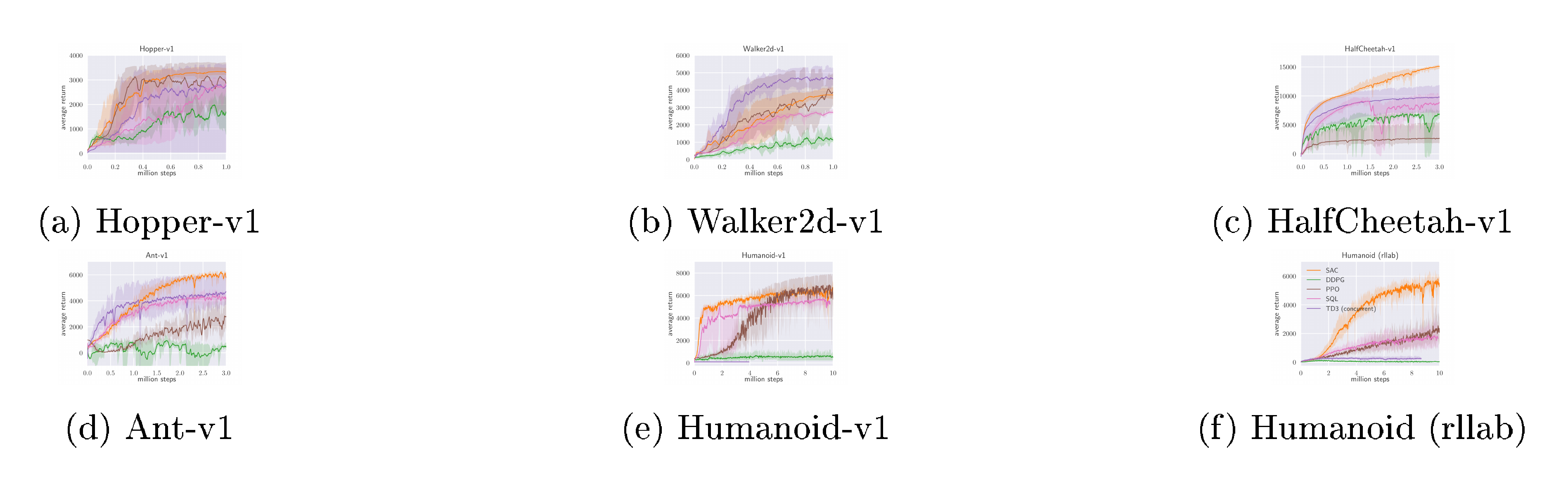
Figure 1 shows the total average return of evaluation rollouts during training for DDPG, PPO, and TD3. We train five different instances of each algorithm with different random seeds, with each performing one evaluation rollout every 1000 environment steps. The solid curves corresponds to the mean and the shaded region to the minimum and maximum returns over the five trials.
The results show that, overall, SAC performs comparably to the baseline methods on the easier tasks and outperforms them on the harder tasks with a large margin, both in terms of learning speed and the final performance. For example, DDPG fails to make any progress on Ant-v1, Humanoid-v1, and Humanoid (rllab), a result that is corroborated by prior work ([20, 9]). SAC also learns considerably faster than PPO as a consequence of the large batch sizes PPO needs to learn stably on more high-dimensional and complex tasks. Another maximum entropy RL algorithm, SQL, can also learn all tasks, but it is slower than SAC and has worse asymptotic performance. The quantitative results attained by SAC in our experiments also compare very favorably to results reported by other methods in prior work ([9, 20, 10]), indicating that both the sample efficiency and final performance of SAC on these benchmark tasks exceeds the state of the art. All hyperparameters used in this experiment for SAC are listed in Appendix D.
5.2 Ablation Study
The results in the previous section suggest that algorithms based on the maximum entropy principle can outperform conventional RL methods on challenging tasks such as the humanoid tasks. In this section, we further examine which particular components of SAC are important for good performance. We also examine how sensitive SAC is to some of the most important hyperparameters, namely reward scaling and target value update smoothing constant.
Stochastic vs. deterministic policy.
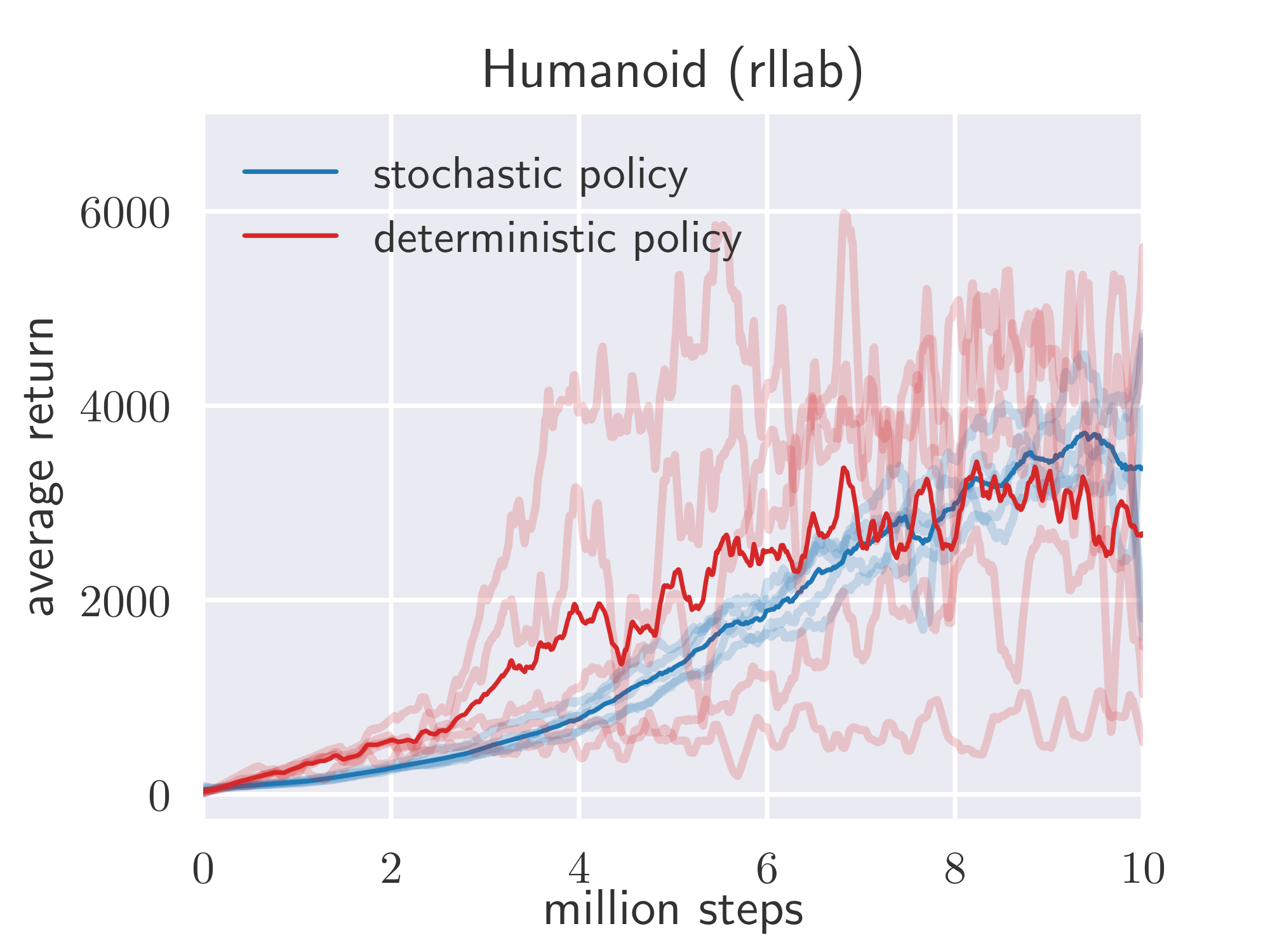
Soft actor-critic learns stochastic policies via a maximum entropy objective. The entropy appears in both the policy and value function. In the policy, it prevents premature convergence of the policy variance (Equation 8). In the value function, it encourages exploration by increasing the value of regions of state space that lead to high-entropy behavior (Equation 5). To compare how the stochasticity of the policy and entropy maximization affects the performance, we compare to a deterministic variant of SAC that does not maximize the entropy and that closely resembles DDPG, with the exception of having two Q-functions, using hard target updates, not having a separate target actor, and using fixed rather than learned exploration noise. Figure 2 compares five individual runs with both variants, initialized with different random seeds. Soft actor-critic performs much more consistently, while the deterministic variant exhibits very high variability across seeds, indicating substantially worse stability. As evident from the figure, learning a stochastic policy with entropy maximization can drastically stabilize training. This becomes especially important with harder tasks, where tuning hyperparameters is challenging. In this comparison, we updated the target value network weights with hard updates, by periodically overwriting the target network parameters to match the current value network (see Appendix E for a comparison of average performance on all benchmark tasks).

Policy evaluation.
Since SAC converges to stochastic policies, it is often beneficial to make the final policy deterministic at the end for best performance. For evaluation, we approximate the maximum a posteriori action by choosing the mean of the policy distribution. Figure 3a compares training returns to evaluation returns obtained with this strategy indicating that deterministic evaluation can yield better performance. It should be noted that all of the training curves depict the sum of rewards, which is different from the objective optimized by SAC and other maximum entropy RL algorithms, including SQL and Trust-PCL, which maximize also the entropy of the policy.
Reward scale.
Soft actor-critic is particularly sensitive to the scaling of the reward signal, because it serves the role of the temperature of the energy-based optimal policy and thus controls its stochasticity. Larger reward magnitudes correspond to lower entries. Figure 3b shows how learning performance changes when the reward scale is varied: For small reward magnitudes, the policy becomes nearly uniform, and consequently fails to exploit the reward signal, resulting in substantial degradation of performance. For large reward magnitudes, the model learns quickly at first, but the policy then becomes nearly deterministic, leading to poor local minima due to lack of adequate exploration. With the right reward scaling, the model balances exploration and exploitation, leading to faster learning and better asymptotic performance. In practice, we found reward scale to be the only hyperparameter that requires tuning, and its natural interpretation as the inverse of the temperature in the maximum entropy framework provides good intuition for how to adjust this parameter.
Target network update.
It is common to use a separate target value network that slowly tracks the actual value function to improve stability. We use an exponentially moving average, with a smoothing constant $\tau$, to update the target value network weights as common in the prior work [8, 6]. A value of one corresponds to a hard update where the weights are copied directly at every iteration and zero to not updating the target at all. In Figure 3c, we compare the performance of SAC when $\tau$ varies. Large $\tau$ can lead to instabilities while small $\tau$ can make training slower. However, we found the range of suitable values of $\tau$ to be relatively wide and we used the same value (0.005) across all of the tasks. In Figure 4 (Appendix E) we also compare to another variant of SAC, where instead of using exponentially moving average, we copy over the current network weights directly into the target network every 1000 gradient steps. We found this variant to benefit from taking more than one gradient step between the environment steps, which can improve performance but also increases the computational cost.
6. Conclusion
Section Summary: The researchers introduce soft actor-critic (SAC), a type of reinforcement learning algorithm that learns efficiently from fewer examples while staying stable and benefiting from adding randomness to decisions. Their math shows it leads to the best possible strategy, and tests prove it works better than leading methods like DDPG and PPO, using far fewer samples than DDPG. Overall, this approach hints at more reliable AI learning by embracing uncertainty, with exciting potential in future tweaks involving advanced techniques or smarter decision-making tools.
We present soft actor-critic (SAC), an off-policy maximum entropy deep reinforcement learning algorithm that provides sample-efficient learning while retaining the benefits of entropy maximization and stability. Our theoretical results derive soft policy iteration, which we show to converge to the optimal policy. From this result, we can formulate a soft actor-critic algorithm, and we empirically show that it outperforms state-of-the-art model-free deep RL methods, including the off-policy DDPG algorithm and the on-policy PPO algorithm. In fact, the sample efficiency of this approach actually exceeds that of DDPG by a substantial margin. Our results suggest that stochastic, entropy maximizing reinforcement learning algorithms can provide a promising avenue for improved robustness and stability, and further exploration of maximum entropy methods, including methods that incorporate second order information (e.g., trust regions ([3])) or more expressive policy classes is an exciting avenue for future work.
Acknowledgments
Section Summary: The authors express gratitude to Vitchyr Pong for insightful discussions, help with implementing their algorithm, and sharing the DDPG baseline code. They also thank Ofir Nachum for assistance in conducting Trust-PCL experiments and George Tucker for providing valuable feedback on an early version of the paper. The work received support from Siemens and Berkeley DeepDrive.
We would like to thank Vitchyr Pong for insightful discussions and help in implementing our algorithm as well as providing the DDPG baseline code; Ofir Nachum for offering support in running Trust-PCL experiments; and George Tucker for his valuable feedback on an early version of this paper. This work was supported by Siemens and Berkeley DeepDrive.
Appendix
Section Summary: The appendix explains the maximum entropy objective in reinforcement learning, a method that encourages both high rewards and exploratory behavior in decision-making processes, with a special formula accounting for how time discounts affect future outcomes without biasing the overall state distribution. It then provides mathematical proofs for foundational ideas: one lemma shows that evaluating policies under this "soft" approach converges to accurate value estimates; another demonstrates that updating policies improves expected outcomes; and a theorem proves that repeating these evaluation and update steps leads to an optimal strategy.
A. Maximum Entropy Objective
The exact definition of the discounted maximum entropy objective is complicated by the fact that, when using a discount factor for policy gradient methods, we typically do not discount the state distribution, only the rewards. In that sense, discounted policy gradients typically do not optimize the true discounted objective. Instead, they optimize average reward, with the discount serving to reduce variance, as discussed by [32]. However, we can define the objective that is optimized under a discount factor as
$ \begin{align} J(\pi) = \sum_{t=0}^\infty \operatorname{\mathbb{E}}{({\mathbf{s}t}, {\mathbf{a}t}) \sim \rho\pi}\left[\sum{l=t}^\infty \gamma^{l-t} \operatorname{\mathbb{E}}{\mathbf{s}_l\sim p, \mathbf{a}_l\sim \pi}\left[r({\mathbf{s}_t}, {\mathbf{a}_t}) + \alpha \mathcal{H}(\pi({, \cdot, }| {\mathbf{s}_t}))| {\mathbf{s}_t}, {\mathbf{a}_t}\right]\right]. \end{align} $
This objective corresponds to maximizing the discounted expected reward and entropy for future states originating from every state-action tuple $({\mathbf{s}_t}, {\mathbf{a}t})$ weighted by its probability $\rho\pi$ under the current policy.
B. Proofs
B.1 Lemma 1
Lemma 1 (Soft Policy Evaluation).* Consider the soft Bellman backup operator $\mathcal{T}^\pi$ in Equation 2 and a mapping $Q^0: \mathcal{S} \times \mathcal{A}\rightarrow \mathbb{R}$ with $| \mathcal{A}|<\infty$, and define $Q^{k+1} = \mathcal{T}^\pi Q^k$. Then the sequence $Q^k$ will converge to the soft Q-value of $\pi$ as $k\rightarrow \infty$.*
Proof: Define the entropy augmented reward as $r_\pi({\mathbf{s}_t}, {\mathbf{a}t}) \triangleq r({\mathbf{s}t}, {\mathbf{a}t}) + \operatorname{\mathbb{E}}{{\mathbf{s}{t+1}}\sim p}\left[\mathcal{H}\left(\pi({, \cdot, }| {\mathbf{s}{t+1}})\right)\right]$ and rewrite the update rule as
$ \begin{align} Q({\mathbf{s}t}, {\mathbf{a}t}) \leftarrow r\pi({\mathbf{s}t}, {\mathbf{a}t}) + \gamma \operatorname{\mathbb{E}}{{\mathbf{s}{t+1}}\sim p, {\mathbf{a}{t+1}} \sim \pi}\left[Q({\mathbf{s}{t+1}}, {\mathbf{a}{t+1}})\right] \end{align} $
and apply the standard convergence results for policy evaluation ([23]). The assumption $| \mathcal{A}|<\infty$ is required to guarantee that the entropy augmented reward is bounded.
B.2 Lemma 2
Lemma 2 (Soft Policy Improvement).* Let $\pi_\mathrm{old} \in \Pi$ and let $\pi_\mathrm{new}$ be the optimizer of the minimization problem defined in Equation 4. Then $Q^{\pi_\mathrm{new}}({\mathbf{s}_t}, {\mathbf{a}t}) \geq Q^{\pi\mathrm{old}}({\mathbf{s}_t}, {\mathbf{a}_t})$ for all $({\mathbf{s}_t}, {\mathbf{a}_t}) \in \mathcal{S}\times \mathcal{A}$ with $| \mathcal{A}|<\infty$.*
Proof: Let ${\pi_\mathrm{old}}\in \Pi$ and let $Q^{\pi_\mathrm{old}}$ and $V^{\pi_\mathrm{old}}$ be the corresponding soft state-action value and soft state value, and let ${\pi_\mathrm{new}}$ be defined as
$ \begin{align} {\pi_\mathrm{new}}({, \cdot, }| {\mathbf{s}t}) &= \arg \min{\pi' \in \Pi}\mathrm{D_{KL}}\left(\pi'({, \cdot, }| {\mathbf{s}t});\middle|;\exp\left(Q^{\pi\mathrm{old}}({\mathbf{s}t}, {, \cdot, }) - \log Z^{\pi\mathrm{old}}({\mathbf{s}t})\right)\right)\notag\ &= \arg\min{\pi'\in\Pi}J_{\pi_\mathrm{old}}(\pi'({, \cdot, }| {\mathbf{s}_t})). \end{align} $
It must be the case that $J_{\pi_\mathrm{old}}({\pi_\mathrm{new}}({, \cdot, }| {\mathbf{s}t})) \leq J{\pi_\mathrm{old}}({\pi_\mathrm{old}}({, \cdot, }| {\mathbf{s}t}))$, since we can always choose ${\pi\mathrm{new}} = {\pi_\mathrm{old}}\in\Pi$. Hence
$ \begin{align} \operatorname{\mathbb{E}}{{\mathbf{a}t}\sim {\pi\mathrm{new}}}\left[\log {\pi\mathrm{new}}({\mathbf{a}_t}| {\mathbf{s}t}) - Q^{\pi\mathrm{old}}({\mathbf{s}t}, {\mathbf{a}t}) + \log Z^{\pi\mathrm{old}}({\mathbf{s}t})\right] \leq \operatorname{\mathbb{E}}{{\mathbf{a}t}\sim {\pi\mathrm{old}}}\left[\log {\pi\mathrm{old}}({\mathbf{a}_t}| {\mathbf{s}t}) - Q^{\pi\mathrm{old}}({\mathbf{s}_t}, {\mathbf{a}t}) + \log Z^{\pi\mathrm{old}}({\mathbf{s}_t})\right], \end{align} $
and since partition function $Z^{\pi_\mathrm{old}}$ depends only on the state, the inequality reduces to
$ \begin{align} \operatorname{\mathbb{E}}{{\mathbf{a}t}\sim {\pi\mathrm{new}}}\left[Q^{\pi\mathrm{old}}({\mathbf{s}_t}, {\mathbf{a}t}) - \log {\pi\mathrm{new}}({\mathbf{a}_t}| {\mathbf{s}t})\right] \geq V^{\pi\mathrm{old}}({\mathbf{s}_t}). \end{align}\tag{11} $
Next, consider the soft Bellman equation:
$ \begin{align} Q^{\pi_\mathrm{old}}({\mathbf{s}t}, {\mathbf{a}t}) &= r({\mathbf{s}t}, {\mathbf{a}t}) + \gamma\operatorname{\mathbb{E}}{{\mathbf{s}{t+1}}\sim p}\left[V^{\pi\mathrm{old}}({\mathbf{s}{t+1}})\right]\notag\ &\leq r({\mathbf{s}t}, {\mathbf{a}t}) + \gamma\operatorname{\mathbb{E}}{{\mathbf{s}{t+1}}\sim p}\left[\operatorname{\mathbb{E}}{{\mathbf{a}{t+1}}\sim {\pi_\mathrm{new}}}\left[Q^{\pi_\mathrm{old}}({\mathbf{s}{t+1}}, {\mathbf{a}{t+1}}) - \log {\pi_\mathrm{new}}({\mathbf{a}{t+1}}| {\mathbf{s}{t+1}})\right]\right]\notag\ &\ \ \vdots\notag\ & \leq Q^{\pi_\mathrm{new}}({\mathbf{s}_t}, {\mathbf{a}_t}), \end{align} $
where we have repeatedly expanded $Q^{\pi_\mathrm{old}}$ on the RHS by applying the soft Bellman equation and the bound in Equation 11. Convergence to $Q^{\pi_\mathrm{new}}$ follows from Lemma 1.
B.3 Theorem 3
Theorem 3 (Soft Policy Iteration). * Repeated application of soft policy evaluation and soft policy improvement to any $\pi\in\Pi$ converges to a policy $\pi ^*$ such that $Q^{\pi ^*}({\mathbf{s}_t}, {\mathbf{a}_t}) \geq Q^{\pi}({\mathbf{s}_t}, {\mathbf{a}_t})$ for all $\pi \in \Pi$ and $({\mathbf{s}_t}, {\mathbf{a}_t}) \in \mathcal{S}\times \mathcal{A}$, assuming $| \mathcal{A}|<\infty$.*
Proof: Let $\pi_i$ be the policy at iteration $i$. By Lemma 2, the sequence $Q^{\pi_i}$ is monotonically increasing. Since $Q^\pi$ is bounded above for $\pi \in \Pi$ (both the reward and entropy are bounded), the sequence converges to some $\pi ^*$. We will still need to show that $\pi ^*$ is indeed optimal. At convergence, it must be case that $J_{\pi^*}({\pi^*}({, \cdot, }| {\mathbf{s}_t})) < J_{\pi^*}(\pi({, \cdot, }| {\mathbf{s}_t}))$ for all $\pi\in\Pi$, $\pi\neq \pi ^*$. Using the same iterative argument as in the proof of Lemma 2, we get $Q^{\pi^*}({\mathbf{s}_t}, {\mathbf{a}_t}) > Q^\pi({\mathbf{s}_t}, {\mathbf{a}_t})$ for all $({\mathbf{s}_t}, {\mathbf{a}_t})\in \mathcal{S}\times \mathcal{A}$, that is, the soft value of any other policy in $\Pi$ is lower than that of the converged policy. Hence ${\pi^*}$ is optimal in $\Pi$.
C. Enforcing Action Bounds
We use an unbounded Gaussian as the action distribution. However, in practice, the actions needs to be bounded to a finite interval. To that end, we apply an invertible squashing function ($\tanh$) to the Gaussian samples, and employ the change of variables formula to compute the likelihoods of the bounded actions. In the other words, let $\mathbf{u}\in \mathbb{R}^D$ be a random variable and $\mu(\mathbf{u}| \mathbf{s})$ the corresponding density with infinite support. Then $\mathbf{a} = \tanh(\mathbf{u})$, where $\tanh$ is applied elementwise, is a random variable with support in $(-1, 1)$ with a density given by
$ \begin{align} \pi (\mathbf{a}| \mathbf{s}) &= \mu(\mathbf{u}| \mathbf{s})\left|\det \left(\frac{\mathrm{d}\mathbf{a}}{\mathrm{d}\mathbf{u}} \right)\right|^{-1}. \end{align} $
Since the Jacobian $\frac{\mathrm{d}\mathbf{a}}{\mathrm{d}\mathbf{u}} = \mathrm{diag}(1 - \tanh^2(\mathbf{u}))$ is diagonal, the log-likelihood has a simple form
$ \begin{align} \log \pi (\mathbf{a}| \mathbf{s}) &= \log \mu(\mathbf{u}| \mathbf{s}) - \sum_{i=1}^D\log\left(1 - \tanh^2(u_i)\right), \end{align} $
where $u_i$ is the $i^\mathrm{th}$ element of $\mathbf{u}$.
D. Hyperparameters
Table 1 lists the common SAC parameters used in the comparative evaluation in Figure 1 and Figure 4. Table 2 lists the reward scale parameter that was tuned for each environment.
: Table 1: SAC Hyperparameters
\begin{tabular}{l l| l }
\toprule
\multicolumn{2}{l|}{Parameter} & Value\\
\midrule
\multicolumn{2}{l|}{\textit{Shared}}& \\
& optimizer &Adam ([36])\\
& learning rate & $3 \cdot 10^{-4}$ \\
& discount ($\gamma$) & 0.99\\
& replay buffer size & $10^6$ \\
& number of hidden layers (all networks) & 2\\
& number of hidden units per layer & 256\\
& number of samples per minibatch & 256\\
& nonlinearity & ReLU\\
\midrule
\multicolumn{2}{l|}{\textit{SAC}}& \\
& target smoothing coefficient ($\tau$)& 0.005\\
& target update interval & 1\\
& gradient steps & 1\\
\midrule
\multicolumn{2}{l|}{\textit{SAC (hard target update)}}& \\
& target smoothing coefficient ($\tau$)& 1\\
& target update interval & 1000\\
& gradient steps (except humanoids)& 4\\
& gradient steps (humanoids)& 1\\
\bottomrule
\end{tabular}
:Table 2: SAC Environment Specific Parameters
| Environment | Action Dimensions | Reward Scale |
|---|---|---|
| Hopper-v1 | 3 | 5 |
| Walker2d-v1 | 6 | 5 |
| HalfCheetah-v1 | 6 | 5 |
| Ant-v1 | 8 | 5 |
| Humanoid-v1 | 17 | 20 |
| Humanoid (rllab) | 21 | 10 |
E. Additional Baseline Results
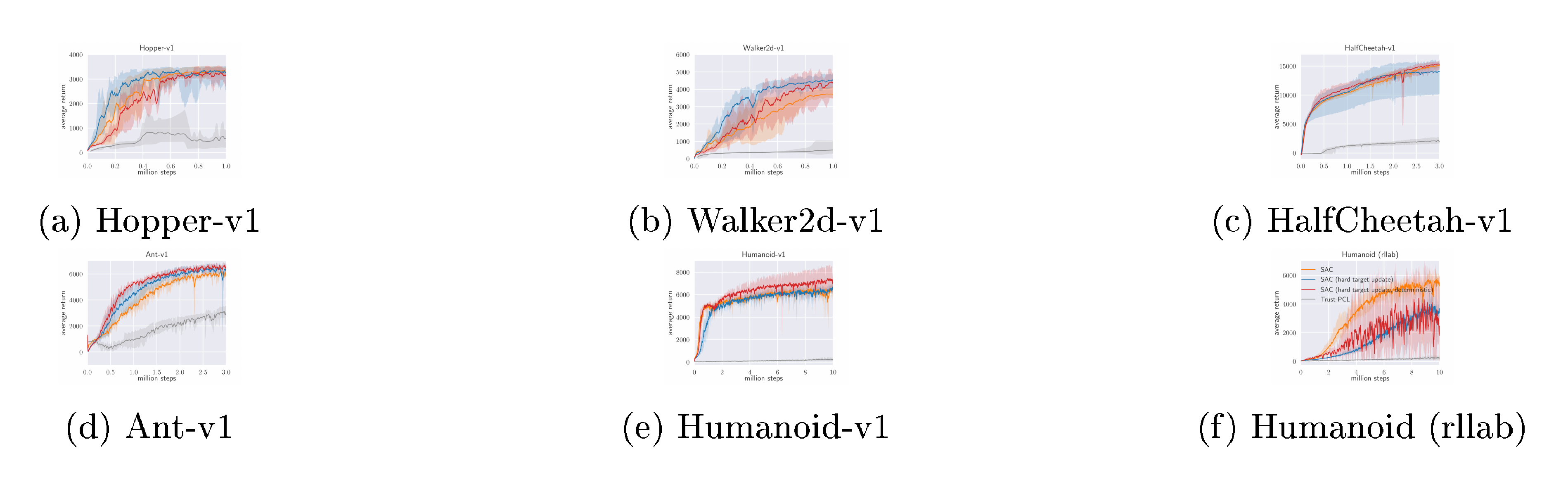
Figure 4 compares SAC to Trust-PCL (Figure 4. Trust-PC fails to solve most of the task within the given number of environment steps, although it can eventually solve the easier tasks ([31]) if ran longer. The figure also includes two variants of SAC: a variant that periodically copies the target value network weights directly instead of using exponentially moving average, and a deterministic ablation which assumes a deterministic policy in the value update (Equation 6) and the policy update (Equation 10), and thus strongly resembles DDPG with the exception of having two Q-functions, using hard target updates, not having a separate target actor, and using fixed exploration noise rather than learned. Both of these methods can learn all of the tasks and they perform comparably to SAC on all but Humanoid (rllab) task, on which SAC is the fastest.
References
Section Summary: This references section lists key academic papers and books on reinforcement learning, a branch of artificial intelligence where machines learn to make decisions by trial and error to maximize rewards. It includes groundbreaking works on applying deep neural networks to games like Atari and Go, as well as advancements in policy optimization techniques, actor-critic methods, and continuous control systems. Authors such as Mnih, Silver, Schulman, Sutton, and Barto feature prominently, covering topics from foundational concepts to modern algorithms for robotics and adaptive behaviors.
[1] Mnih, V., Kavukcuoglu, K., Silver, D., Graves, A., Antonoglou, I., Wierstra, D., and Riedmiller, M. Playing atari with deep reinforcement learning. arXiv preprint arXiv:1312.5602, 2013.
[2] Silver, D., Huang, A., Maddison, C. J., Guez, A., Sifre, L., van den Driessche, G., Schrittwieser, J., Antonoglou, I., Panneershelvam, V., Lanctot, M., Dieleman, S., Grewe, D., Nham, J., Kalchbrenner, N., Sutskever, I., Lillicrap, T., Leach, M., Kavukcuoglu, K., Graepel, T., and Hassabis, D. Mastering the game of go with deep neural networks and tree search. Nature, 529(7587):484–489, Jan 2016. ISSN 0028-0836. Article.
[3] Schulman, J., Levine, S., Abbeel, P., Jordan, M. I., and Moritz, P. Trust region policy optimization. In International Conference on Machine Learning (ICML), pp.\ 1889–1897, 2015.
[4] Schulman, J., Wolski, F., Dhariwal, P., Radford, A., and Klimov, O. Proximal policy optimization algorithms. arXiv preprint arXiv:1707.06347, 2017b.
[5] Mnih, V., Badia, A. P., Mirza, M., Graves, A., Lillicrap, T. P., Harley, T., Silver, D., and Kavukcuoglu, K. Asynchronous methods for deep reinforcement learning. In International Conference on Machine Learning (ICML), 2016.
[6] Mnih, V., Kavukcuoglu, K., Silver, D., Rusu, A. A., Veness, J., Bellemare, M. G., Graves, A., Riedmiller, M., Fidjeland, A. K., Ostrovski, G., et al. Human-level control through deep reinforcement learning. Nature, 518(7540):529–533, 2015.
[7] Bhatnagar, S., Precup, D., Silver, D., Sutton, R. S., Maei, H. R., and Szepesvári, C. Convergent temporal-difference learning with arbitrary smooth function approximation. In Advances in Neural Information Processing Systems (NIPS), pp.\ 1204–1212, 2009.
[8] Lillicrap, T. P., Hunt, J. J., Pritzel, A., Heess, N., Erez, T., Tassa, Y., Silver, D., and Wierstra, D. Continuous control with deep reinforcement learning. arXiv preprint arXiv:1509.02971, 2015.
[9] Duan, Y., Chen, X. Houthooft, R., Schulman, J., and Abbeel, P. Benchmarking deep reinforcement learning for continuous control. In International Conference on Machine Learning (ICML), 2016.
[10] Henderson, P., Islam, R., Bachman, P., Pineau, J., Precup, D., and Meger, D. Deep reinforcement learning that matters. arXiv preprint arXiv:1709.06560, 2017.
[11] Ziebart, B. D., Maas, A. L., Bagnell, J. A., and Dey, A. K. Maximum entropy inverse reinforcement learning. In AAAI Conference on Artificial Intelligence (AAAI), pp.\ 1433–1438, 2008.
[12] Toussaint, M. Robot trajectory optimization using approximate inference. In International Conference on Machine Learning (ICML), pp.\ 1049–1056. ACM, 2009.
[13] Rawlik, K., Toussaint, M., and Vijayakumar, S. On stochastic optimal control and reinforcement learning by approximate inference. Robotics: Science and Systems (RSS), 2012.
[14] Fox, R., Pakman, A., and Tishby, N. Taming the noise in reinforcement learning via soft updates. In Conference on Uncertainty in Artificial Intelligence (UAI), 2016.
[15] Haarnoja, T., Tang, H., Abbeel, P., and Levine, S. Reinforcement learning with deep energy-based policies. In International Conference on Machine Learning (ICML), pp.\ 1352–1361, 2017.
[16] Ziebart, B. D. Modeling purposeful adaptive behavior with the principle of maximum causal entropy. Carnegie Mellon University, 2010.
[17] O'Donoghue, B., Munos, R., Kavukcuoglu, K., and Mnih, V. PGQ: Combining policy gradient and Q-learning. arXiv preprint arXiv:1611.01626, 2016.
[18] Schulman, J., Abbeel, P., and Chen, X. Equivalence between policy gradients and soft Q-learning. arXiv preprint arXiv:1704.06440, 2017a.
[19] Nachum, O., Norouzi, M., Xu, K., and Schuurmans, D. Bridging the gap between value and policy based reinforcement learning. In Advances in Neural Information Processing Systems (NIPS), pp.\ 2772–2782, 2017a.
[20] Gu, S., Lillicrap, T., Ghahramani, Z., Turner, R. E., and Levine, S. Q-prop: Sample-efficient policy gradient with an off-policy critic. arXiv preprint arXiv:1611.02247, 2016.
[21] Fujimoto, S., van Hoof, H., and Meger, D. Addressing function approximation error in actor-critic methods. arXiv preprint arXiv:1802.09477, 2018.
[22] Barto, A. G., Sutton, R. S., and Anderson, C. W. Neuronlike adaptive elements that can solve difficult learning control problems. IEEE transactions on systems, man, and cybernetics, pp.\ 834–846, 1983.
[23] Sutton, R. S. and Barto, A. G. Reinforcement learning: An introduction, volume 1. MIT press Cambridge, 1998.
[24] Peters, J. and Schaal, S. Reinforcement learning of motor skills with policy gradients. Neural networks, 21(4):682–697, 2008.
[25] Gruslys, A., Azar, M. G., Bellemare, M. G., and Munos, R. The reactor: A sample-efficient actor-critic architecture. arXiv preprint arXiv:1704.04651, 2017.
[26] Silver, D., Lever, G., Heess, N., Degris, T., Wierstra, D., and Riedmiller, M. Deterministic policy gradient algorithms. In International Conference on Machine Learning (ICML), 2014.
[27] Heess, N., Wayne, G., Silver, D., Lillicrap, T., Erez, T., and Tassa, Y. Learning continuous control policies by stochastic value gradients. In Advances in Neural Information Processing Systems (NIPS), pp.\ 2944–2952, 2015.
[28] Todorov, E. General duality between optimal control and estimation. In IEEE Conference on Decision and Control (CDC), pp.\ 4286–4292. IEEE, 2008.
[29] Levine, S. and Koltun, V. Guided policy search. In International Conference on Machine Learning (ICML), pp.\ 1–9, 2013.
[30] Levine, S., Finn, C., Darrell, T., and Abbeel, P. End-to-end training of deep visuomotor policies. Journal of Machine Learning Research, 17(39):1–40, 2016.
[31] Nachum, O., Norouzi, M., Xu, K., and Schuurmans, D. Trust-PCL: An off-policy trust region method for continuous control. arXiv preprint arXiv:1707.01891, 2017b.
[32] Thomas, P. Bias in natural actor-critic algorithms. In International Conference on Machine Learning (ICML), pp.\ 441–448, 2014.
[33] Williams, R. J. Simple statistical gradient-following algorithms for connectionist reinforcement learning. Machine learning, 8(3-4):229–256, 1992.
[34] Hasselt, H. V. Double Q-learning. In Advances in Neural Information Processing Systems (NIPS), pp.\ 2613–2621, 2010.
[35] Brockman, G., Cheung, V., Pettersson, L., Schneider, J., Schulman, J., Tang, J., and Zaremba, W. OpenAI gym. arXiv preprint arXiv:1606.01540, 2016.
[36] Kingma, D. and Ba, J. Adam: A method for stochastic optimization. In International Conference for Learning Presentations (ICLR), 2015.