
ReLoRA: High-Rank Training Through Low-Rank Updates
Vladislav Lialin$^{\dagger, \ddagger, *}$ Sherin Muckatira$^{\dagger}$, Namrata Shivagunde$^{\dagger}$, and Anna Rumshisky$^{\dagger, \S}$
$^{\dagger}$ University of Massachusetts Lowell
$^{\ddagger}$ Eleuther AI
$^{\S}$ Amazon
$^{*}$ Correspondence to [email protected]
$^{2}$ github.com/guitaricet/relora
Abstract
Despite the dominance and effectiveness of scaling, resulting in large networks with hundreds of billions of parameters, the necessity to train overparameterized models remains poorly understood, while training costs grow exponentially. In this paper, we explore parameter-efficient training techniques as an approach to training large neural networks. We introduce a novel method called ReLoRA, which utilizes low-rank updates to train high-rank networks. We apply ReLoRA to training transformer language models with up to 1.3B parameters and demonstrate comparable performance to regular neural network training. ReLoRA saves up to 5.5Gb of RAM per GPU and improves training speed by 9-40% depending on the model size and hardware setup. Our findings show the potential of parameter-efficient techniques for large-scale pre-training. Our code is available on GitHub$^{2}$.
Executive Summary: ReLoRA is a parameter-efficient method for pre-training large transformer language models. It enables high-rank network updates by repeatedly applying, merging, and reinitializing low-rank LoRA-style updates while using warm starts, periodic optimizer resets, and a jagged learning-rate schedule to stabilize training.
The work addresses the rapid growth in training costs for models with hundreds of billions of parameters. Although parameter-efficient fine-tuning techniques have reduced the resources needed for adaptation, they have not been shown to work reliably for pre-training from scratch. The authors set out to test whether a restarted low-rank approach could match full-rank performance while cutting memory use and wall-clock time.
They trained transformer models ranging from 60 million to 1.3 billion parameters on the C4 dataset for a single epoch at compute-optimal token counts. ReLoRA was compared against full-rank training, a parameter-matched control baseline, and standard LoRA, with ablations isolating the effect of each algorithmic component. All experiments used the same data, architecture family, and bfloat16 precision.
ReLoRA reached final perplexities within 0.4–0.7 points of full-rank training at every scale and substantially outperformed both plain LoRA and the control baseline. At 1.3 billion parameters it achieved a perplexity of 17.27 versus 16.83 for full training after 23 billion tokens. It reduced per-GPU optimizer-state memory by up to 5.5 GB, allowed larger micro-batches, and delivered wall-clock speed-ups of 9 % on 8×A100 systems and 20–50 % on lower-bandwidth GPUs. Singular-value analysis confirmed that repeated low-rank merges produce update matrices whose rank distribution closely resembles full-rank training.
These results indicate that the dominant cost of large-model pre-training can be lowered without sacrificing downstream capability. The largest gains appear on hardware where memory bandwidth is the limiting factor, suggesting ReLoRA is especially attractive for academic or smaller-scale clusters. Downstream GLUE scores remained comparable to full-rank checkpoints, confirming that the learned representations transfer normally.
Adoption should begin with models in the low billions of parameters, using a warm-start of roughly 25 % of total steps, rank-128 updates, and resets every 2 000–5 000 iterations. Further scaling experiments, application to continued pre-training of existing models, and integration with additional memory optimizations are the clearest next steps. The primary limitations are the modest scale tested so far and the need for a non-trivial warm-start phase; both warrant additional validation before multi-hundred-billion-parameter runs.
1. Introduction
Section Summary: Over the past decade, machine learning has relied on ever-larger neural networks with billions of parameters, which deliver strong results but require enormous computing resources that most researchers cannot afford and remain poorly understood. While techniques like parameter-efficient fine-tuning have made it easier to adapt already-trained models on everyday hardware, they have not yet helped with the initial, more demanding stage of training from scratch. This paper introduces ReLoRA, a method that builds high-performing networks by repeatedly adding many small, low-rank updates, achieving results close to standard full-scale training on models up to 1.3 billion parameters while becoming increasingly efficient as size grows.
Over the past decade, the machine learning field has been dominated by the trend of training increasingly overparameterized networks or adopting the "stack more layers" approach [1, 2, 3]. The definition of a large network has evolved from models with 100 million [4, 5] to hundreds of billions [6, 7] of parameters, which has made computational costs associated with training of such networks prohibitive to most of the research groups. Despite this, the necessity to train models which can have orders of magnitude more parameters than the training examples [6, 7, 8], is poorly understood theoretically [9, 10, 11].
Alternative approaches to scaling, such as more compute-efficient scaling optima [12], retrieval-augmented models [13, 14], and the simple approach of training smaller models for longer [15], have offered new trade-offs. However, they do not bring us closer to understanding why we need overparameterized models and rarely democratize the training of these models. For example, training RETRO [14] requires a complex training setup and infrastructure capable of quickly searching over trillions of tokens, while training LLaMA-7B [15] still requires hundreds of GPUs.
In contrast, approaches like zero-redundancy optimizers [16], 16-bit training [17], 8-bit inference [18], and parameter-efficient fine-tuning (PEFT) [19] have played a crucial role in making large models more accessible. Specifically, PEFT methods have enabled fine-tuning of billion-scale language or diffusion models on consumer hardware. This raises the question: Can these approaches also benefit pre-training?
Our Contribution
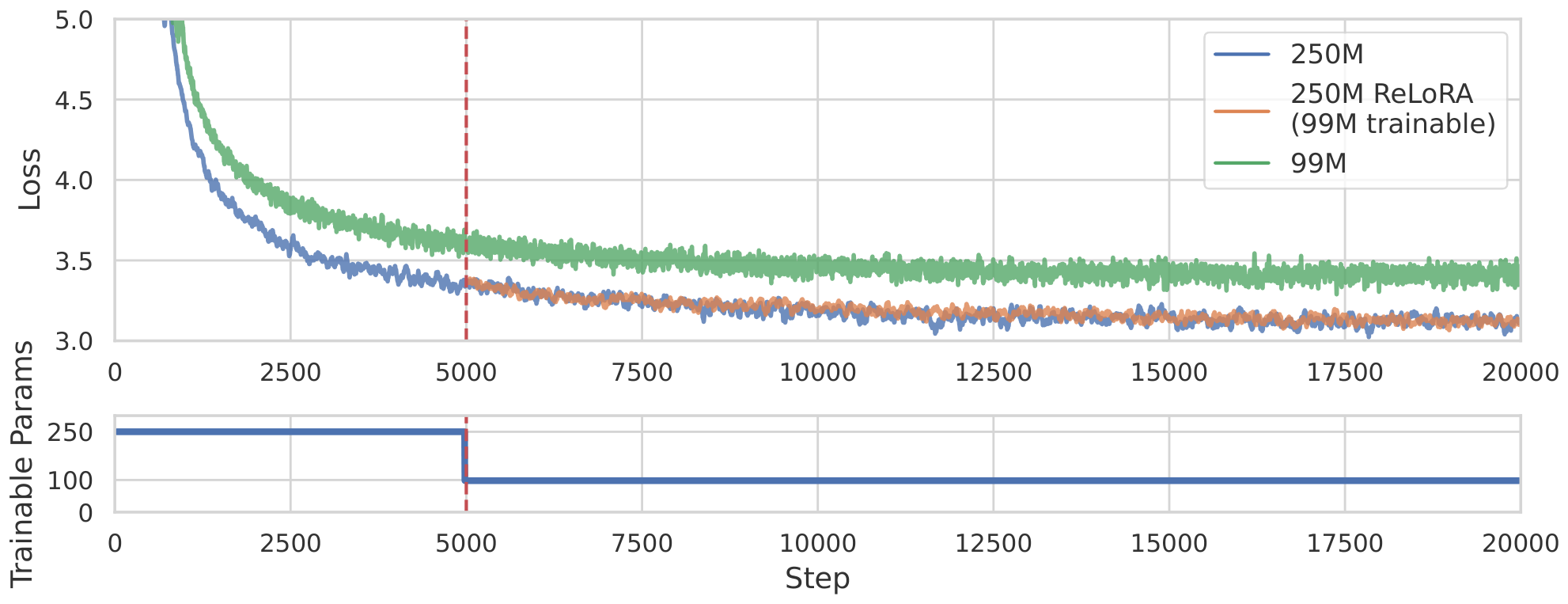
In this study, we introduce ReLoRA which uses individually low-rank updates that aggregate during the training process to train a high-rank network. We empirically demonstrate that ReLoRA performs a high-rank update and achieves performance similar to regular neural network training. The components of ReLoRA include initial full-rank training of the neural network (similar to [20]), LoRA training, restarts, a jagged learning rate schedule, and partial optimizer resets. We evaluate ReLoRA on transformer language models up to 1.3B parameters. Finally, we observe that the efficiency of ReLoRA increases with model size, making it a viable option for efficient training of multi-billion-parameter networks.
2. Method
Section Summary: ReLoRA extends the LoRA approach, in which a neural network weight update is formed as the product of two small low-rank matrices, by periodically merging those matrices into the base model and reinitializing fresh low-rank factors. Because continuing with the same optimizer state would keep the new factors aligned with the old subspace, the method also resets the Adam moment estimates through magnitude pruning and applies a short learning-rate warm-up after each merge, optionally preceded by a brief full-rank “warm-start” phase when training from scratch. The resulting sequence of low-rank increments can achieve a high effective rank while updating only a small number of parameters at any time, thereby reducing memory and enabling larger batches.
We are interested in the rank of the sum of two matrices: $\text{rank}(A + B) \leq \text{rank}(A) + \text{rank}(B)$. We know that for a matrix $\mathbf{A}, \text{rank}(\mathbf{A}) < dim(\mathbf{A})$, there exists a $\mathbf{B}$, $\text{rank}(\mathbf{B}) < dim(\mathbf{B})$ such that sum of them has a higher rank than either $\mathbf{A}$ or $\mathbf{B}$.
We want to exploit this property to make a flexible parameter-efficient training method. We start with LoRA [21] which is a parameter-efficient fine-tuning method based on the idea of low-rank updates. LoRA can be applied to any linear operation parametrized through $W \in \mathbb{R}^{m \times n}$. Specifically, LoRA decomposes the weight update $\delta W$ into a rank- $r$ product $W_A W_B$ as shown in Equation 1, where $s \in \mathbb{R}$ is a fixed scaling factor usually equal to $\frac{1}{r}$.
$ \begin{aligned} \delta W &= s W_A W_B \ W_A &\in \mathbb{R}^{\text{in} \times r}, W_B \in \mathbb{R}^{r \times \text{out}}\ \end{aligned}\tag{1} $
In practice, LoRA is usually implemented by adding new trainable parameters $W_A$ and $W_B$, which could be merged back into the original parameters after training. Thus, these implementations are restricted by the rank $r = \max_{W_A, W_B} \text{rank}(W_A W_B)$.
If we could restart LoRA, meaning we merge $W_A$ and $W_B$ during training and reset the values of these matrices, we could increase the total rank of the update. Doing this multiple times brings the total neural network update to:
![**Figure 2:** Jagged cosine scheduler used in ReLoRA. As a base for our scheduler we follow a standard cosine decay schedule as in [15]. On every optimizer reset, we set the learning rate to zero and perform a quick (50-100 steps) learning rate warm-up back to the cosine schedule.](https://ittowtnkqtyixxjxrhou.supabase.co/storage/v1/object/public/public-images/kvj54vsb/jagged_cosine_schedule.png)
$ \Delta W = \sum^{T_1}{t = 0} \delta W_t + \sum^{T_2}{t = T_1} \delta W_t + \dots + \sum^{T_N}{t = T{N - 1}} \delta W_t
s W_A^1 W_B^1 + s W_A^2 W_B^2 + \dots + s W_A^N W_B^N\tag{2} $
However, implementing restarts is not trivial in practice and requires several modifications to the optimization procedure. Unlike plain stochastic gradient descent, Adam [22] update is guided mainly by the first and second moments of the gradient accumulated over the previous steps. In practice, Adam's $\beta_1$ and $\beta_2$ are usually very high $0.9-0.999$. This means that after the merge-and-reinit, continuing to use old gradient moments for $W_A^2$ will guide it in the same direction as $W_A^1$ and optimize the same subspace.
To resolve this issue, ReLoRA performs a partial reset of the optimizer state during merge-and-reinit via magnitude pruning. To avoid loss diverging after an optimizer reset it also sets the learning rate to 0 with a subsequent warm-up (Figure 2). Our ablation studies (Table 6) show that both of these modifications are required to improve the performance over LoRA. Finally, in our experiments we found that in the case of training from scratch (random initialization) a short full-rank training is needed to "warm start" ReLoRA. All of this allows ReLoRA to achieve performance comparable to full-rank training, especially in large transformer networks, by only training a small set of parameters at a time. ReLoRA is described in Algorithm 1.
Enhancing computational efficiency
Unlike other low-rank training techniques [23, 24, 25], ReLoRA follows the LoRA approach by maintaining the frozen weights of the original network and adding new trainable parameters. At first glance, this may appear computationally inefficient; however, the differentiation between frozen and trainable parameters plays a crucial role in parameter-efficient fine-tuning [19].
By reducing the number of trainable parameters, ReLoRA significantly reduces the memory spent on the optimizer states and enables the utilization of larger batch sizes, maximizing hardware efficiency. Additionally, it reduces the bandwidth requirements in distributed setups, which are often the limiting factor in large-scale training. Furthermore, since the frozen parameters are not being updated between restarts, they can be kept in a low-precision quantized format [26], further reducing their memory and computational impact.
Locally Low-Rank Training: Intuition
Multiple studies suggest that neural network training is either completely low-rank or has multiple phrases with initially high-rank and subsequent low-rank training. For example, [27] show that as the model becomes larger or when it is pre-trained for longer, the rank of the update needed to learn a downstream task reduces. [28] finds that SGD is biased towards low-rank solutions. The existence of Lottery Tickets early in training [20] also partially supports this hypothesis, since training a lottery ticket network could effectively be seen as a low-rank approximation to the regular training process. Our empirical analysis (Section 4) shows that pre-trained neural networks exhibit high-rank updates over long trajectories (Figure 4). However, for a sufficiently small trajectory, the training can be effectively approximated by a low-rank update. Given the above results, we speculate that neural network training is locally low-rank, which directly motivates ReLoRA.
3. Experiments
Section Summary: The experiments evaluate ReLoRA by training transformer language models ranging from 60 million to 1.3 billion parameters on the C4 dataset for a single epoch, using data volumes chosen according to established scaling laws. The models follow a LLaMA-style architecture with standard optimizations, and ReLoRA is applied to linear layers after a brief full-rank warm start, with periodic resets of the low-rank updates every 5,000 steps. Results are compared against full training runs and a control model that has the same number of trainable parameters, including targeted tests at the 1.3B scale.
To evaluate the effectiveness of ReLoRA, we apply it to train a transformer language model on the C4 dataset [29] using various model sizes: 60M, 130M, 250M, 350M, and 1.3B.
In all experiments we train without data repetition (single epoch) on at least compute-optimal amount of data, estimated using Chinchilla Scaling Laws [12].
**Require:** θ, M, V, q, η
**for** t **in** warm start steps **do**
  Update θ, M, V, η // Regular training for warm start
**end for**
**for** layer in model layers **do**
  **if** layer **is** linear **then**
    layer ← ReLoRA (Wⁱ, Wⁱ(A), Wⁱ(B))
    Freeze Wⁱ
  **end if**
**end for**
**for** t in training steps **do**
  Update hat{θ}, M, V // Training step with ReLoRA
  **if** MOD (t, q) = 0 **then**
    **for** l in model layers **do**
      **if** l **is** linear **then**
        Wⁱ ← (Wⁱ + s Wⁱ(A) Wⁱ(B))
        Wⁱ(A) ← kaiming\_init(Wⁱ(A)); Wⁱ(B) ← 0
        M(Wⁱ(A)) ← prune (M(Wⁱ(A))); V(Wⁱ(A)) ← prune (V(Wⁱ(A)))
      **end if**
    **end for**
    Start η warmup
  **end if**
**end for**
**return** θ
: Table 1: Hyperparameters of the language models trained in this study. Batch size and data amount are specified in tokens.
| Params | Hidden | Heads | Layers | Learning rate | Batch size | Seq. len. | Data amount |
|---|---|---|---|---|---|---|---|
| 60M | 512 | 8 | 8 | 1e-3 | 122K | 256 | 1.2B |
| 130M | 768 | 12 | 12 | 1e-3 | 154K | 256 | 2.6B |
| 250M | 768 | 16 | 24 | 5e-4 | 590K | 512 | 6.8B |
| 350M | 1024 | 16 | 24 | 5e-4 | 590K | 512 | 6.8B |
| 1.3B | 2048 | 24 | 32 | 4e-4 | 786K | 512 | 23.1B |
Architecture and training hyperparameters
Our architecture is based on transformer [30] and closely resembles LLaMA [15]. Namely, we use pre-normalization, RMSNorm [31], SwiGLU activations [32], $\frac{8}{3}h$ fully-connected hidden state size [15], and rotary embeddings [33]. We select the number of pre-training tokens based on the Chinchilla scaling laws [12]. Architecture and training hyperparameters are presented in Table 1.
For all LoRA and ReLoRA experiments, we use rank $r=128$ as our initial experiments showed it to have the best perplexity/memory trade-off. You can find additional recommendations on ReLoRA hyperparameter selection in Appendix A. We perform additional experiments comparing different rank choices for the 1.3B model in Section 4.1. We use bfloat16 for all floating point operations and FlashAttention [34] for effective attention computation.
ReLoRA and baselines setup
In our experiments, ReLoRA replaces all attention and fully-connected network parameters, while updating the embeddings and normalization layers full-rank. Since ReLoRA-wrapped models have fewer trainable parameters than full-rank training, we include a Control baseline, which is a full-rank transformer with the same number of trainable parameters as ReLoRA.
We initialize ReLoRA from a checkpoint of full-rank training at 5, 000 update steps and reset it every 5, 000 steps thereafter, 3 times in total till we reach 20K steps. After each reset, 99% of the optimizer state is pruned based on magnitude, and the loss is warmed up for the next 100 iterations. ReLoRA parameters are reinitialized following LoRA best practices, Kaiming initialization [35] for $A$-matrix, and zeros for $B$-matrix.
Scaling up to 1.3B
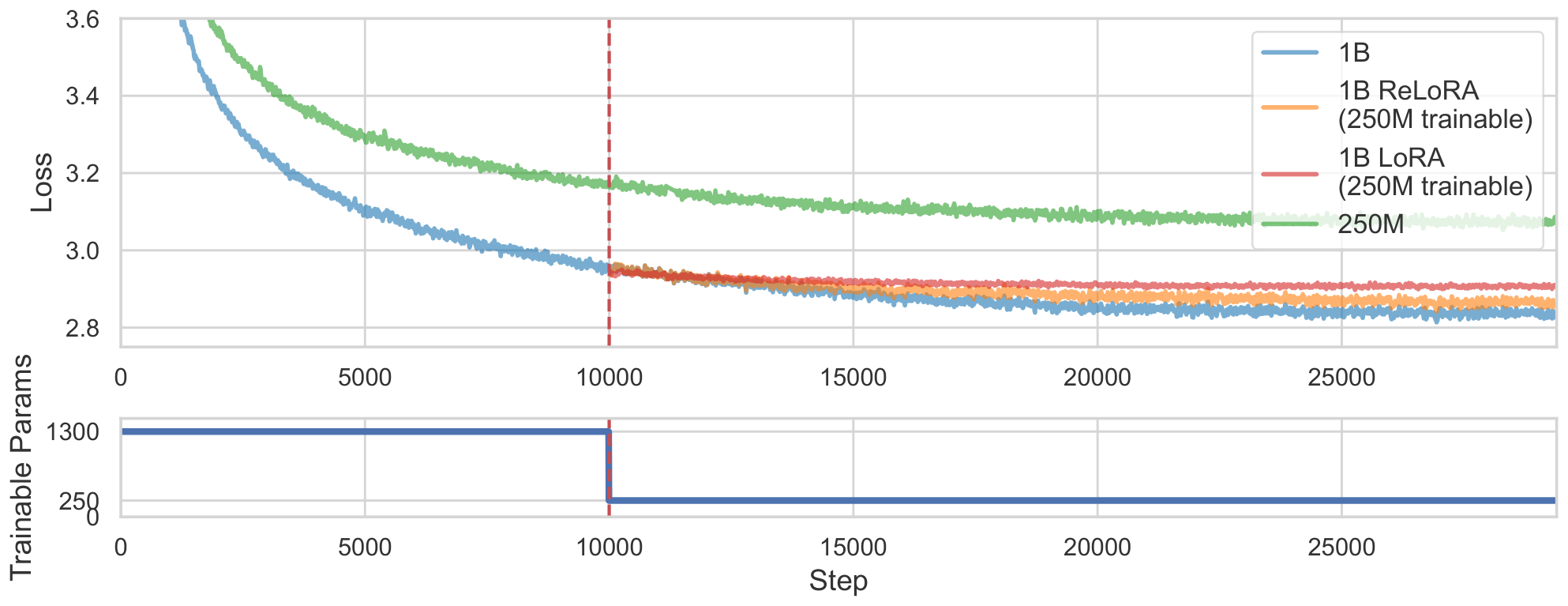
After initial results at 130M and 350M model sizes, we applied ReLoRA to train a 1.3B parameter language model. As a baseline, we pre-trained a 1.3B model from scratch on 23B tokens. We performed multiple ReLoRA runs starting from 2K, 5K, and 10K checkpoints. In most of the experiments, we continued using $r=128$ and our additional experiments show minimal difference between rank 128 and 512 (hidden size is 2048). Section 4.1 describes these experiments in detail.
4. Results
Section Summary: ReLoRA achieves much lower perplexity than standard LoRA when pre-training language models ranging from 60 million to 1.3 billion parameters, using only a small fraction of trainable weights, and reaches performance levels close to full-rank training on both pre-training loss and downstream tasks such as GLUE. Analysis of the learned weight updates shows that repeatedly merging low-rank adapters produces a broader distribution of singular values, more closely resembling full training than the near-zero values typical of plain LoRA. These advantages hold when scaling to the largest model tested, where ReLoRA narrows the gap to full training as the number of steps increases.
Parameter-efficient pre-training
Our results are presented in Table 2 and Figure 1. ReLoRA significantly outperforms LoRA training demonstrating the effectiveness of our proposed modifications (ablated in Section Table 6). Additional pre-training loss figures are available in Appendix C.
Furthermore, ReLoRA achieves similar performance to full-rank training in both upstream and downstream tasks (Table 3).[^2]
[^2]: Note that the absolute values of GLUE results are expected to be quite far from state-of-the-art, because our models were pre-trained on roughly 20 times less data than T5 or BERT.
\begin{tabular}{lccccc}
\toprule
& 60M & 130M & 250M & 350M & 1.3B \\
\midrule
Full training & 33.81 (60M) & 23.65 (130M) & 22.39 (250M) & 18.66 (350M) & 16.83 (250M) \\
Control & 36.52 (43M) & 27.30 (72M) & 25.43 (99M) & 23.65 (130M) & 21.73 (250M) \\
LoRA & 47.44 (43M) & 34.17 (72M) & 36.60 (99M) & 57.11 (125M) & - \\
LoRA + Warm Start & 34.73 (43M) & 25.46 (72M) & 22.86 (99M) & 19.73 (125M) & 18.23 (250M) \\
ReLoRA & \textbf{34.46} (43M) & \textbf{25.04} (72M) & \textbf{22.48} (99M) & \textbf{19.32} (125M) & \textbf{17.27} (250M) \\
\midrule
Training tokens & 1.2B & 2.6B & 6.8B & 6.8B & 23.1B \\
\bottomrule
\end{tabular}
: Table 3: Applying ReLoRA to fine-tune 350M models pre-trained full-rank and using ReLoRA. We observe minimal differences between the models.
| CoLA | STS-B | MRPC | RTE | SST2 | MNLI | QNLI | QQP | Avg | |
|---|---|---|---|---|---|---|---|---|---|
| Full-rank pretrained | 35.43 | 83.85 | 76.96 | 64.26 | 88.99 | 70.98 | 83.38 | 84.49 | 73.54 |
| Not pretrained | 7.59 | 22.73 | 67.00 | 51.15 | 82.61 | 60.04 | 67.92 | 78.40 | 54.68 |
| ReLoRA | 31.07 | 83.33 | 78.43 | 60.65 | 89.45 | 72.27 | 83.93 | 86.01 | 73.14 |
High-rank training through low-rank updates
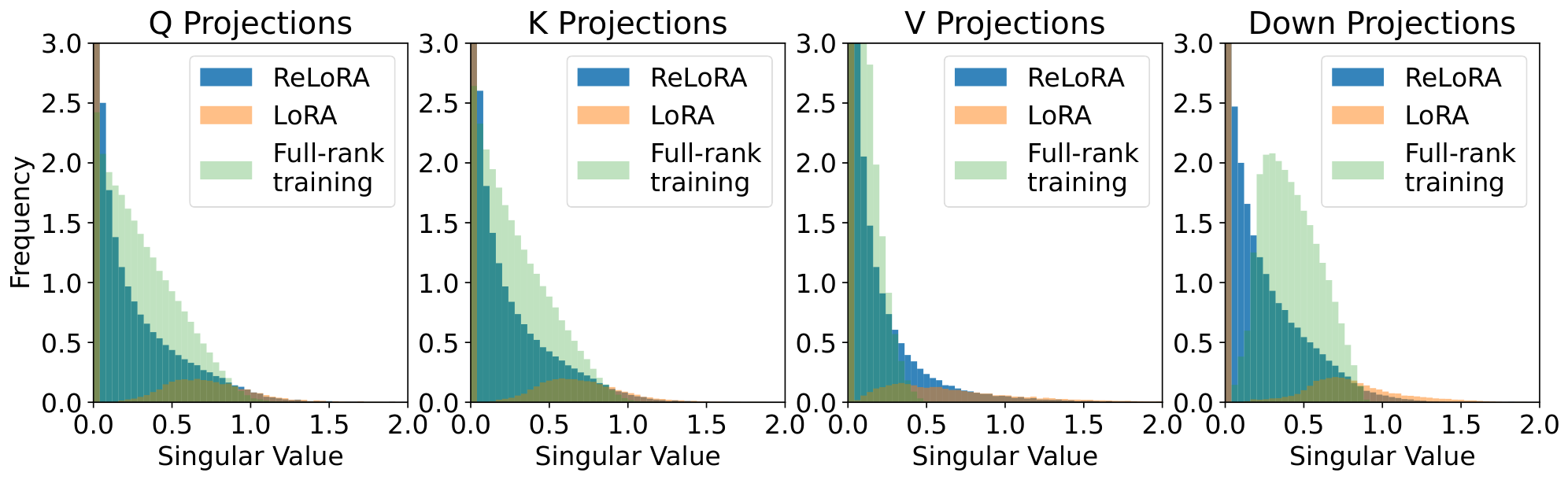
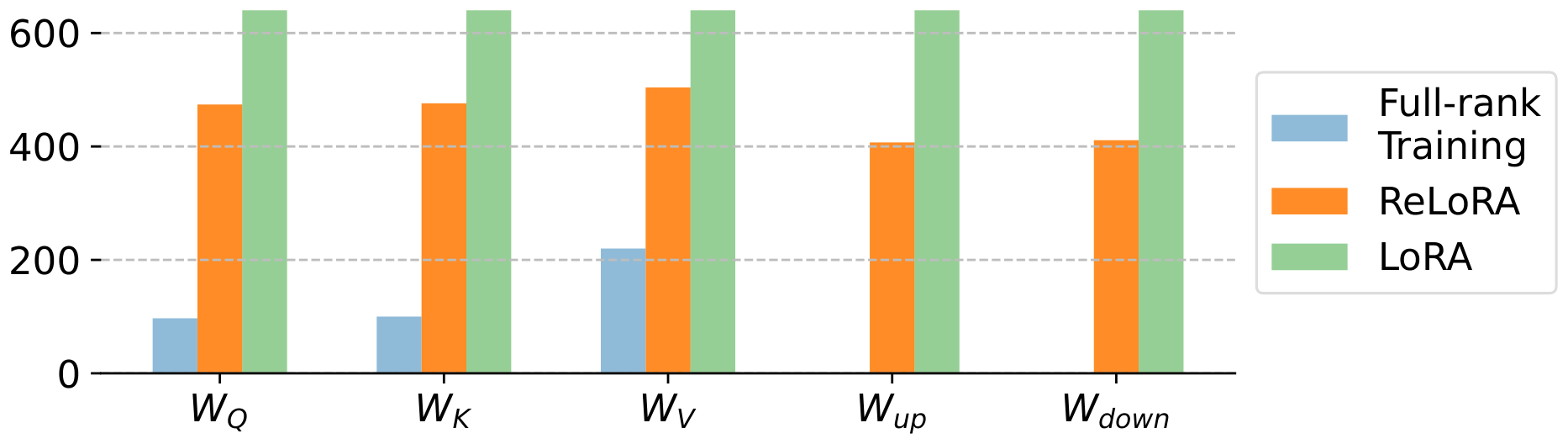
To determine whether ReLoRA performs a higher rank update than LoRA, we plot the singular value spectrum of the learned update to the warm-start weights. Specifically, the difference between warm-start weights and the final weights for ReLoRA, LoRA, and full-rank trained models. Figure 3 illustrates significant qualitative differences between LoRA and ReLoRA for the singular values of $\Delta W_Q$, $\Delta W_K$, $\Delta W_V$, and $\Delta W_{down}$. While most of the singular values for LoRA are zero (Figure 4) with a noticeable number of exceptionally high values above 1.5, ReLoRA exhibits a higher distribution mass between 0.1 and 1.0, reminiscent of full-rank training.
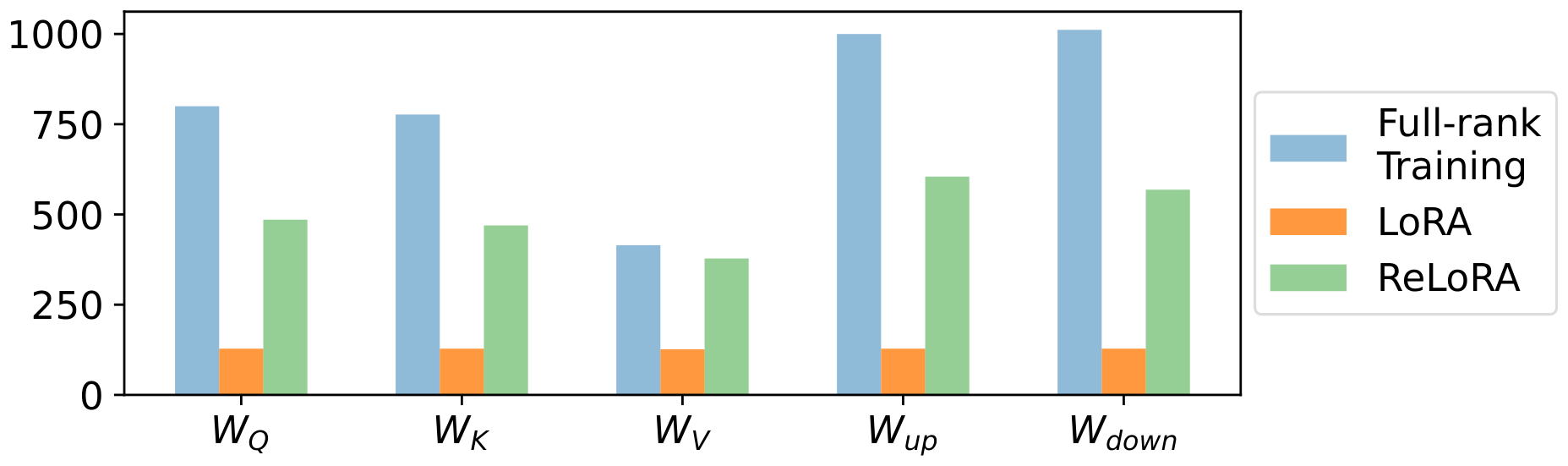
Additionally, we computed the number of singular values less than 0.1 for LoRA, ReLoRA, and full-rank training. Our results (Figure 4) show that ReLoRA has a much smaller number of near-zero singular values than LoRA, closer to full-rank training. This observation emphasizes the significance of high-rank updates and demonstrates that ReLoRA does accomplish a high-rank update by performing multiple low-rank updates. We also perform ReLoRA component ablation (Table 6) and discuss it in Section Table 6.
4.1 Scaling up to 1.3B
\begin{tabular}{lcccc}
  \toprule
  & 1.3B @15K steps & 1.3B @20K steps & 1.3B @30K steps \\
  \midrule
  Full training & 17.67 (250M) & 17.00 (250M) & 16.83 (250M) \\
  Control & 22.67 (250M) & 22.00 (250M) & 21.73 (250M) \\
  LoRA + Warm Start & \textbf{18.50} (250M) & \textbf{18.38} (250M) & \textbf{18.23} (250M) \\
  ReLoRA & \textbf{17.94} (250M) & \textbf{17.64} (250M) & \textbf{17.27} (250M) \\
  \midrule
  Training tokens (billions) & 11.8 & 15.7 & 23.1 \\
  \bottomrule
\end{tabular}
Our best run at this model size starts after a 10K step warm start ($33%$ of the total update steps). We train ReLoRA with rank $r=128$, learning rate 5e-4, 100 steps lr warmup, and 50 steps restarts warmup. The results are presented in the Figure 5 and Table 4. ReLoRA clearly outperforms LoRA throughout the training with the gap between the methods increasing from 0.56 at 15K steps to 0.96 at 30K steps. At the end of the training, ReLoRA is able to reach a perplexity of 17.24, only 0.44 higher than full-rank training. You can find additional recommendations on ReLoRA hyperparameter selection in Appendix A.
Varying ReLoRA rank
In this experiment we wanted to evaluate if $r=128$ is still applicable to the model of this size (hidden size $2048$) or if it needs to be increased. To do that, we used an early checkpoint for the warm start (5K out of 30K steps). This was beneficial for the comparison, as at this point loss changes quickly which makes any differences in training dynamics more evident. We train these models for additional 10K iterations. Unexpectedly, we found very little difference between ranks 128 (ppl. 19.16) and 512 (ppl. 19.00).
Negative results: Online ReLoRA
\begin{tabular}{lcc}
\toprule
 & 250M & 1.3B \\
 & (@15k steps) & (@25k steps) \\
\midrule
ReLoRA & 27.66 & 17.36 \\
Online ReLoRA & 29.31 & 17.80 \\
\bottomrule
\end{tabular}
Intuitively, more frequent ReLoRA resets can lead to better performance, as they, in principle, can learn a higher rank update. Usually, for every ReLoRA reset, we would also perform an optimizer reset and learning rate scheduler re-warmup (Algorithm 1). However, in our experiments we observed that very high ReLoRA reset rates lead to worse performance.
Online ReLoRA resolves this issue quite elegantly – it merges LoRA parameters very frequently (e.g., every 100 iterations) while keeping the optimizer reset rate at 2-5K iterations. Unexpectedly, we found that it performs worse than regular ReLoRA at both 250M and 1.3B scales (Table 5).
ReLoRA Training Speedup
Training ReLoRA took 440 A100-hours, saving 56 A100-hours compared to full-rank training. A part of the speedup was due to the ability to use two times larger microbatch size. When training with the same microbatch size, ReLoRA improved RAM consumption from 27.8Gb to 22.3Gb saving 5.5Gb of GPU RAM. Overall, in the 8xA100 setup, combining the warm start and ReLoRA training time, 1.3B-ReLoRA took 86 hours (wall clock) to train compared to 93.5 hours to train 1.3 model full-rank on the same amount of data. This yields a relative speed improvement of $9%$.
\begin{tabular}{cccccc}
\toprule
Restarts & Optimizer Reset & Jagged Schedule & Warm Start & Perplexity ($\downarrow$) \\
\midrule
$\times$ & $\times$ & $\times$ & $\times$ & 34.17 \\
$\checkmark$ & $\times$ & $\times$ & $\times$ & 34.25 \\
$\checkmark$ & $\checkmark$ & $\times$ & $\times$ & \textit{(diverged)} \\
$\checkmark$ & $\times$ & $\checkmark$ & $\times$ & 34.29 \\
$\checkmark$ & $\checkmark$ & $\checkmark$ & $\times$ & 29.77 \\
$\times$ & $\times$ & $\times$ & $\checkmark$ & 25.46 \\
$\checkmark$ & $\checkmark$ & $\checkmark$ & $\checkmark$ & 25.04 \\
\midrule
\multicolumn{4}{c}{Regular training} & 23.65 \\
\bottomrule
\end{tabular}
: Table 7: Performance metrics in different hardware configurations. Warm start adjustment assumes 33% of full-rank training before switching to ReLoRA.
| 8xA100 | 6xA6000 (Ada) | 2x3090 | |
|---|---|---|---|
| Full-rank throughput | 137 ex/sec | 84 ex/sec | 8.8 ex/sec |
| ReLoRA throughput | 157 ex/sec | 124 ex/sec | 17.8 ex/sec |
| Immediate speedup | 15% | 48% | 102% |
| Warm-start adjusted ReLoRA throughput | 149 ex/sec | 111 ex/sec | 14.8 ex/sec |
| Total speedup | 9% | 32% | 51% |
We additionally observed that ReLoRA speedup is significantly hardware-dependent (Table 7). In our early experiments on 2xRTX3090, we estimated the speedup of $42%$. In a more practical, but still relatively budget setup of 6xA6000 Ada, we estimated 152 hours of wall-clock training time for the 1B full-rank model and 119 hours for the ReLoRA model with $33%$ warm start. This saves 33 hours yielding a relative speedup of $21%$. We attribute the difference to the GPU memory speed. ReLoRA can more effectively utilize low-bandwidth memory as it has less trainable parameters.
4.2 Ablation studies
We conduct ablation studies on all four crucial components of ReLoRA: restarts, jagged schedule, optimizer resets, and warm starts, utilizing the 130M-sized model. The results are presented in Table 6. In this section, we will focus on and analyze certain combinations of these components.
LoRA
ReLoRA, without the aforementioned components, is essentially equivalent to training a low-rank network parameterized by LoRA. This approach yields remarkably high perplexity, indicating that a simple matrix decomposition has significantly different training dynamics from full-rank training.
Adding restarts and optimizer resets
ReLoRA, without a jagged schedule and optimizer reset, performs similarly to LoRA because old optimizer states force the newly initialized parameters into the same subspace as the prior weights, limiting the model's capacity. However, doing a naive optimizer reset with ReLoRA causes the model to diverge. A jagged schedule helps to stabilize training and has a positive impact on the mixture. In our initial experiments, we also observed that a combination of partial optimizer reset and jagged scheduler allows for a quicker warm-up, as low as 50 steps, instead of hundreds of steps required when the optimizer is initialized from scratch.
Warm start
The warm start shows the most significant improvement, dropping perplexity by almost 10 points. To investigate whether post-warmup training contributes to the loss, we measured the perplexity of the warmed-up network, which equals $27.03$. It outperforms all low-rank methods except for our final ReLoRA recipe but still demonstrates a significant difference from the final network. This demonstrates the importance of early training, similar to the concept of the lottery ticket hypothesis with rewinding [20]. In our experiments, unless specified otherwise, we performed warm start for about $1/4$ of the total training updates.
5. Related work
Section Summary: Research on neural network scaling has revealed strong performance gains from overparametrization and larger models, while also exploring ways to reduce unnecessary parameters without major losses, as suggested by ideas like the Lottery Ticket Hypothesis. Related work on fine-tuning shows that pre-training allows models to adapt to new tasks with minimal changes, inspiring efficient methods that update only low-rank components of the network. Efforts to train intrinsically low-rank networks for greater efficiency have been tested in various settings, but they often fail to match the results of full-rank models when applied to large transformers.
Scaling versus Efficiency
The relationship between overparametrization and neural network trainability and generalization has been extensively studied [36, 37, 38, 39, 40], yet it remains a mystery [11].
Moreover, scaling laws [3, 41, 12] demonstrate a simple and strong power-law dependence between network size and its performance across a variety of modalities. This finding not only supports overparametrization but also encourages the training of extraordinarily resource-intensive neural networks [6, 7, 8]. Nonetheless, the Lottery Ticket Hypothesis [20] suggests that overparametrization could, in principle, be minimized.
Parameter-efficient fine-tuning
[27] found that pre-training reduces the amount of change to the network required to learn a new task through fine-tuning. I.e., larger networks or networks pre-trained on more data require smaller modifications in terms of the rank of the range to learn a new task. This explains the success of parameter-efficient fine-tuning methods [19] and has also motivated the development of low-rank fine-tuning methods such as LoRA [21] and Compacter [42].
Low-rank neural network training
Training low-rank representations has been explored in the context of CNN compression, regularization, and efficient training [43, 44, 24, 23, 45, 46, 47]. However, most of these methods are either specific to CNNs, do not scale well, or have not been evaluated on large transformers [30] with hundreds of millions of parameters, which can benefit greatly from efficient training. While transformers have been shown to have a low-rank internal dimensionality and representations [27, 48], the study by [49] demonstrated that the low rank of key and query projections in multi-head attention bottlenecks the performance of transformers. Our own experiments (Section Table 6) also demonstrate that low-rank transformers perform significantly worse compared to the full-rank baseline and ReLoRA.
6. Conclusion
Section Summary: The paper shows that standard low-rank adaptation methods can be modified for pre-training large language models by using repeated low-rank updates that are merged over time, along with an initial warm-up phase and periodic resets of the optimizer and learning rate. Experiments found that this ReLoRA approach trains models faster than regular methods, cutting wall-clock time by 9 percent on high-end hardware and even more on cheaper setups, while reaching comparable performance. The authors plan to refine the technique and test it on larger models and continued pre-training in future work.
In this paper, we demonstrate that parameter-efficient fine-tuning methods can be adapted for pre-training large language models. We first examined the limitations of a low-rank matrix factorization (LoRA) approach and observed that it struggles to effectively train high-performing transformer models. To address this issue, we proposed ReLoRA, which leverages the rank of sum property to train a high-rank network through multiple low-rank updates. Similar to the lottery ticket hypothesis with rewinding, ReLoRA employs a full-rank training warm start before transitioning to ReLoRA. During training, ReLoRA periodically merges its parameters into the main parameters of the network, performs optimizer reset and learning rate re-warmup.
We demonstrated that ReLoRA consistently outperforms LoRA for training large transformer models. Our largest experiment demonstrated $9%$ wall-clock time reduction in 8xA100 setup and much larger ($20-40%$) speed improvements on cheaper hardware. Further, our results show similar performance to regular training making ReLoRA a promising candidate for improving the efficiency of large model training. Our further studies will focus on improving ReLoRA performance, efficiency, applying it to larger models and applying it to continued pre-training of existing large language models.
Acknowledgments
This paper has been a journey and we are sincerely grateful to everyone who supported us. We would like to express our gratitude to Stability.ai, Eleuther.ai, and the Google Cloud for Research Program for providing computational resources essential for this research.
Eric Lehman and Artem Krivosheev, thank you for supporting this project from the very beginning.
Special thanks to Jason Phang, Hailey Schoelkopf, Enrico Shippole, and Stella Biderman for their technical advice and assistance with computational resources. Our experiments at billion-parameter scale wouldn't be possible without your support.
This work was funded in part by an Amazon Alexa AI research award to Anna Rumshisky.
Appendix
Section Summary: The appendix provides practical guidance on applying ReLoRA, including recommended ranks, higher learning rates than standard training, and reset intervals of a few thousand steps that reliably improve results over plain LoRA when updating all linear layers. It then reports fine-tuning experiments on T5 models for the GLUE benchmark, where ReLoRA performs similarly to or slightly below LoRA, along with ablations on rank, pruning percentage, and reset frequency. Additional material includes training-loss curves for models from 60M to 1.3B parameters, spectral analysis of smaller runs, and a short-warm-start pre-training test that further confirms the value of periodic resets.
A. A Practical guide to ReLoRA
In this section, we wanted to answer most common questions on hyperparameter selection. Especially how to select ReLoRA-specific hyperparameters to reliably get better performance than LoRA. In all of our experiments, we applied LoRA/ReLoRA to all of the linear layers in the model: kqv-projection layers, FFN layers and other projections, except for logits and embeddings.
We observed that $r \in {64, 128}$ works well for all of the networks, up to 1B. One small, but important hyperparameter change from full-rank training to ReLoRA-training that was crucial for the performance was increased learning rate. ReLoRA (and LoRA) requires $1.5-2$ times larger learning rate than regular training/fine-tuning to achieve similar performance.
When taking about ReLoRA-specific hyperparameters, we did not observe significant dependence on optimizer pruning percentage as long as it's larger than 90%. Larger pruning rates can lead to slightly better performance at the cost of possible loss instabilities during the reset. We tested several ReLoRA reset rates with 350M and 1.3B models and found that 2K iterations reset rate performed consistently well in both pre-training and fine-tuning experiments and always led to better performance than no resets. In general, we observed good results with reset rates 2K-5K.
B. ReLoRA for fine-tuning
We apply ReLoRA to fine-tune T5-base (220M parameters) and T5-large (770M parameters) on the GLUE benchmark. We use the same type of learning rate scheduler as in ReLoRA pre-training and prune 90% of the low magnitude optimizer states during each LoRA merge-and-reinit (restart). The batch size is equal to 128 examples and the learning rate is tuned (from 1e-4 to 5e-4) on each model and dataset combination. We perform additional ReLoRA ablation studies using the T5-Large model and QNLI dataset. Specifically, we explore different ReLoRA ranks, optimizer state pruning rates, and the total number of ReLoRA resets.
\begin{tabular}{lcccccccc|c}
  \toprule
  Method & SST-2 & MNLI & QNLI & QQP & RTE & STS-B & MRPC & CoLA & Avg \\
  \midrule
  Adapters$^{\dagger}$ & 94.2 & 86.4 & 93.1 & 88.9 & 75.1 & 91.1 & 88.9 & 64.4 & 85.3 \\
  Prompt Tuning$^{\dagger}$ & 90.3 & 82.5 & 92.5 & 88.5 & 59.5 & 90.1 & 74.6 & 0.0 & 72.2 \\
  Ladder Side Tuning$^{\dagger}$ & 94.1 & 85.6 & 93.3 & 88.8 & 71.9 & 90.7 & 90.4 & 58.1 & 84.1 \\
  Compacter$^{\textasteriskcentered}$ & 93.9 & 86.1 & 92.9 & 90.4 & 76.3 & 91.0 & 91.5 & 64.4 & 85.8 \\
  KronA$^{\textasteriskcentered}$ & 94.3 & 86.3 & 93.2 & 90.6 & 77.7 & 91.3 & 92.5 & 63.3 & 86.1 \\
  \midrule
  \midrule
  Full fine-tuning$^{\textasteriskcentered}$ & 93.6 & 86.2 & 92.8 & 91.7 & 74.8 & 90.1 & 92.7 & 63.4 & 85.7\\
  LoRA & 93.92 & 86.12 & 91.95 & 90.62 & 78.34 & 89.96 & 90.52 & 60.04 & 85.18 \\
  ReLoRA & 94.15 & 85.96 & 91.68 & 87.2 & 77.74 & 89.88 & 90.03 & 59.92 & 84.57 \\
  \midrule
  Full fine-tuning (T5-L) & 94.7 & 89.1 & 91.6 & 89.9 & 78.9 & 90.6 & 88.9 & 57.0 & 85.0 \\
  LoRA (T5-L) & 95.59 & 89.44 & 93.98 & 91.44 & 85.92 & 90.89 & 92.90 & 63.77 & 87.99 \\
  ReLoRA (T5-L) & 95.7 & 89.06 & 93.68 & 91.04 & 84.72 & 90.53 & 90.57 & 61.72 & 87.47 \\
  \bottomrule
  \end{tabular}
ReLoRA fine-tuning ablations
Table 9 shows the results of varying ReLoRA hyperparameters. A rank of 64 seems to provide the best performance. The results indicate that the model's performance remains largely unaffected even when 99% of the optimizer states are reset. Our analysis of the jagged cosine learning rate scheduler's impact on classification accuracy in the QNLI dataset suggests that two resets are adequate (reset rate 4000).
: Table 9: ReLoRA fine-tuning ablations. We apply ReLoRA to fine-tune T5-large on the QNLI dataset and vary LoRA rank ($r$), optimizer state pruning percentage, and reset frequency of ReLoRA. Reset rate means the number of iterations between ReLoRA resets.
| Rank | Acc. | Pruning | Acc. | Reset rate | #resets | Acc. |
|---|---|---|---|---|---|---|
| 16 | 94.05 | 85% | 94.51 | 6000 | 1 | 94.38 |
| 32 | 94.16 | 92% | 94.33 | 4000 | 2 | 94.73 |
| 64 | 94.55 | 95% | 94.31 | 2000 | 5 | 94.34 |
| 128 | 94.44 | 99% | 94.56 | 1000 | 11 | 94.33 |
C. Learning curves of models pre-trained in the study
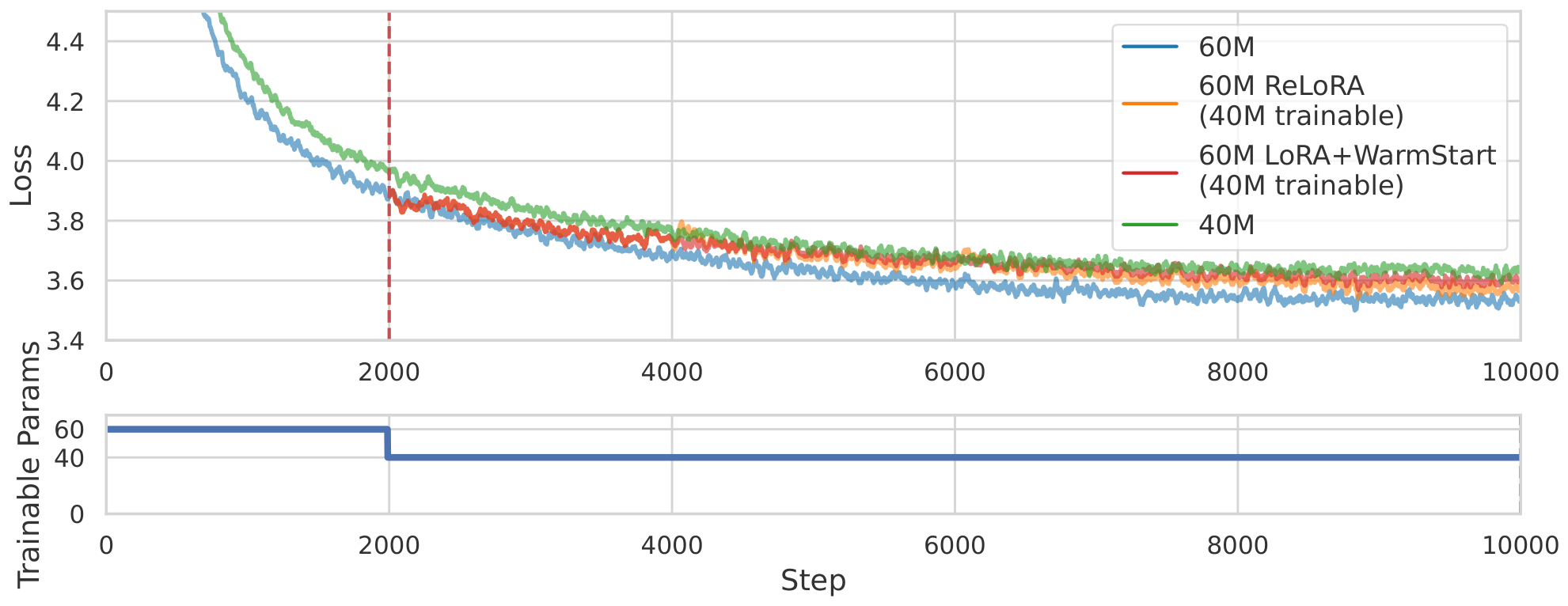
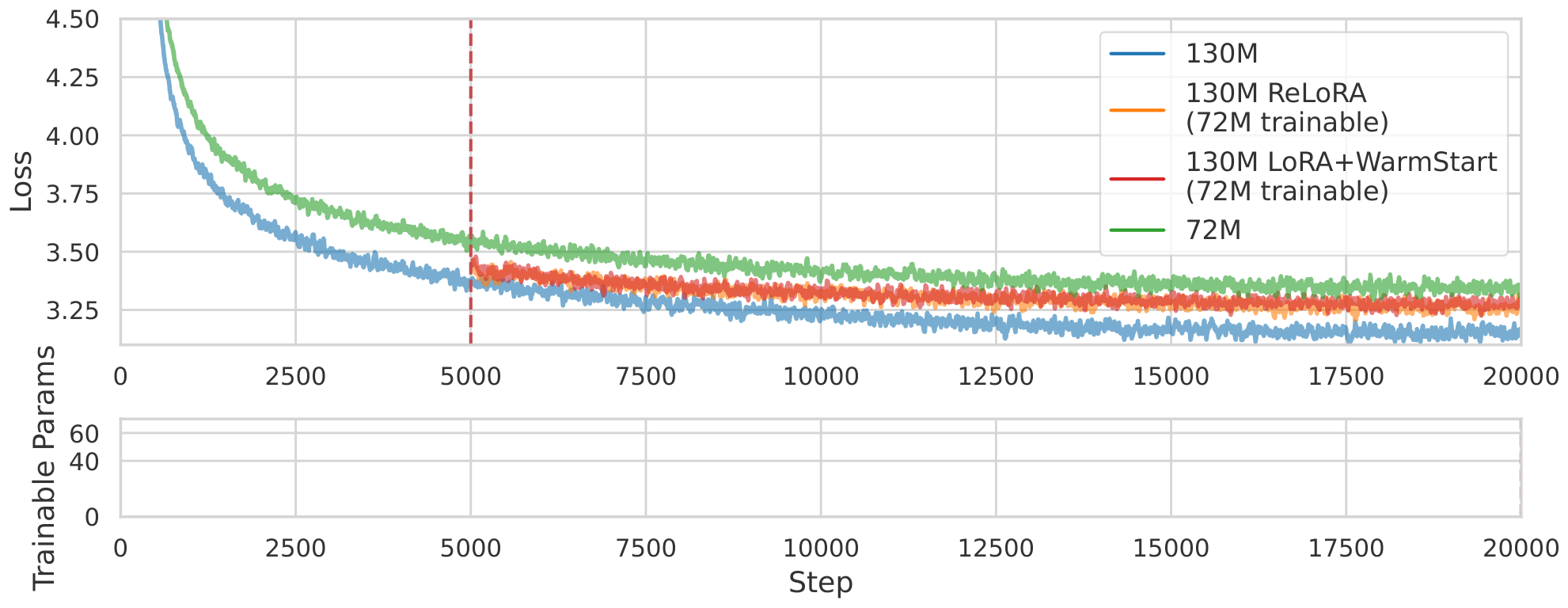
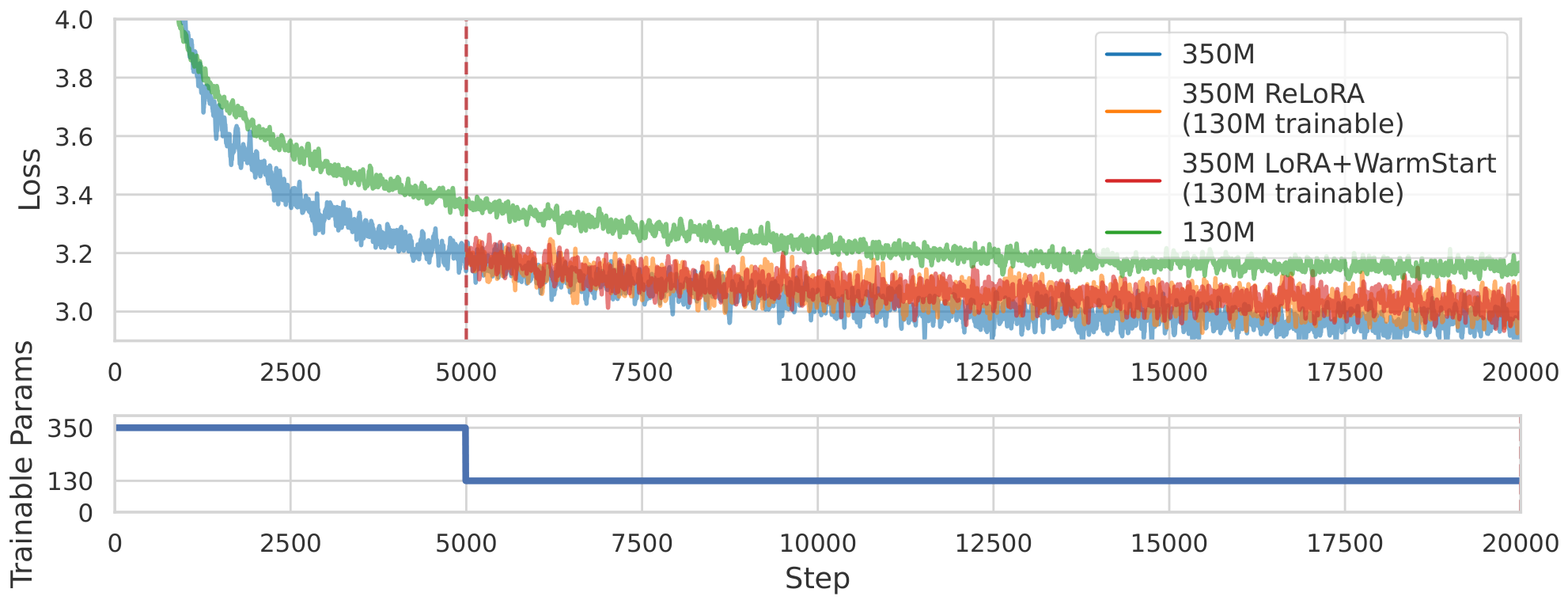
In this section we present additional training loss plots for all of the models from Table 2. 60M: Figure 6, 130M: Figure 7, 250M: Figure 8, 350M: Figure 9, 1.3B: Figure 10.
D. Ranks of 130M models
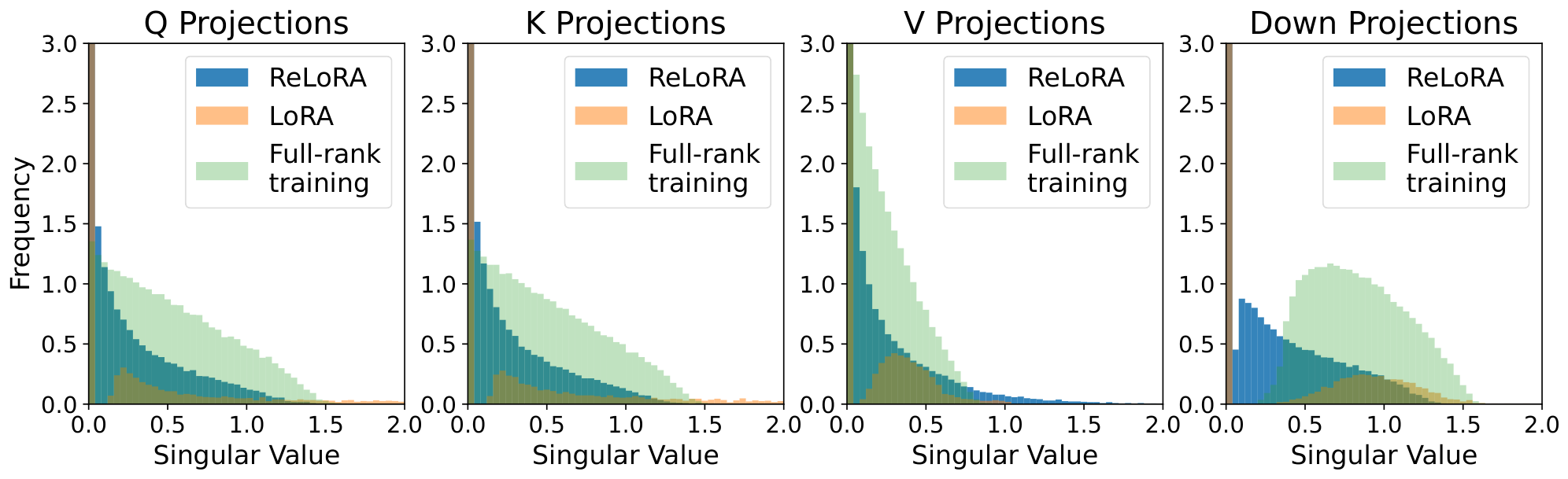
Figure 11 and Figure 12 show spectral properties for 130M model.
E. Smaller warm start period
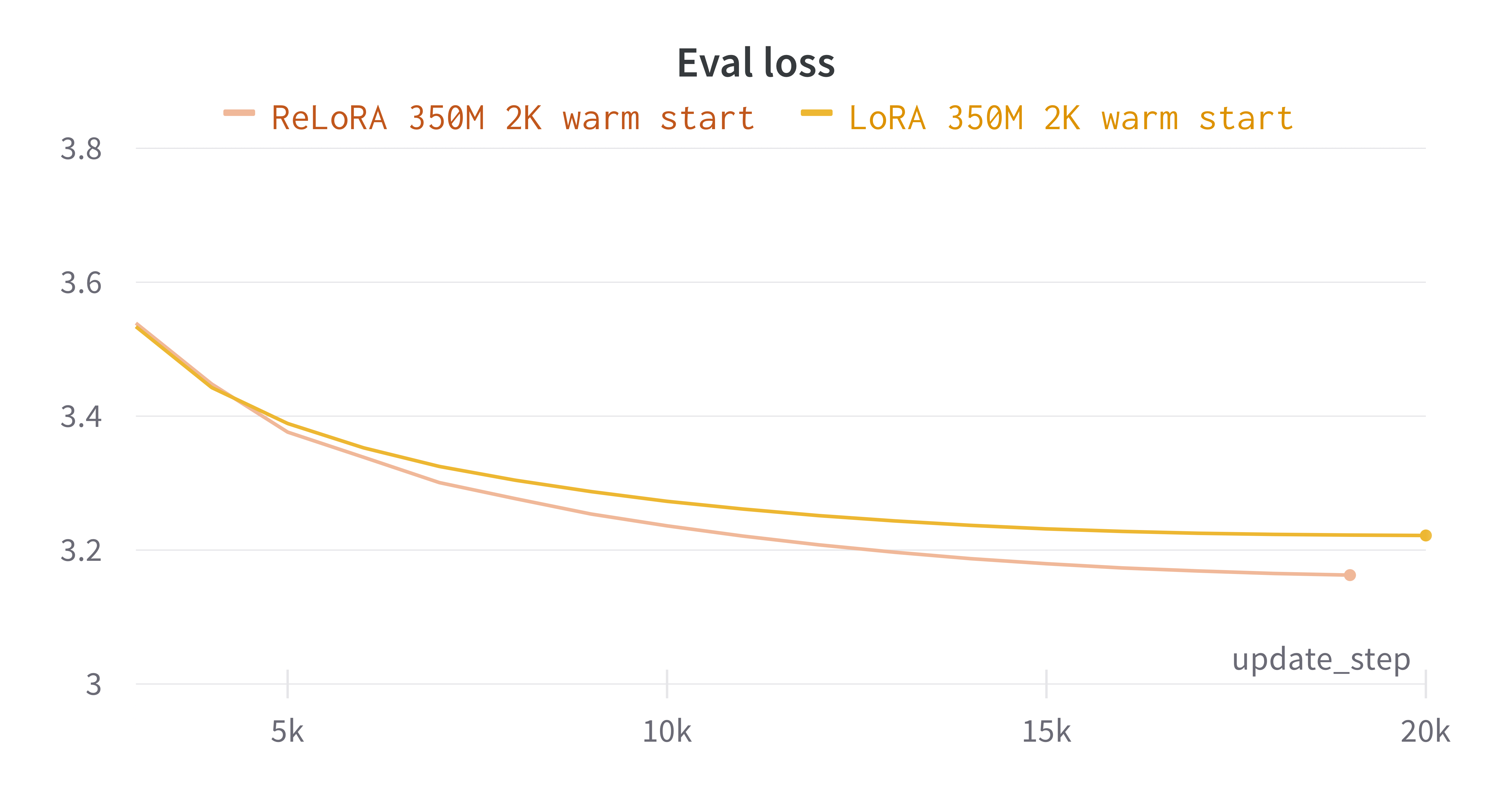
Table 2 demonstrates that ReLoRA consistently outperforms the warmed-started LoRA baseline. To provide a more contrasting example, we performed additional pre-training experiments starting from just 2K warm-started network. Figure 13 shows a significant performance gain with ReLoRA over LoRA by 1.4 ppl points (ppl 23.64 vs 25.08). While the absolute performance of ReLoRA is lower compared to full-rank training in this context, these experiments validate our initial hypothesis that LoRA restarts positively impact performance.
References
Section Summary: This section lists academic papers and technical reports that serve as key references for the work. They cover foundational advances in neural networks for images and language, studies on how model performance scales with size and data, and recent developments in efficient large language models. The citations include both empirical breakthroughs and theoretical analyses that underpin modern AI systems.
[1] A. Krizhevsky, I. Sutskever, and G. E. Hinton. Imagenet classification with deep convolutional neural networks. In F. Pereira, C. Burges, L. Bottou, and K. Weinberger, editors, Advances in Neural Information Processing Systems, volume 25. Curran Associates, Inc., 2012. URL https://proceedings.neurips.cc/paper_files/paper/2012/file/c399862d3b9d6b76c8436e924a68c45b-Paper.pdf.
[2] K. He, X. Zhang, S. Ren, and J. Sun. Deep residual learning for image recognition. 2016 IEEE Conference on Computer Vision and Pattern Recognition (CVPR), pages 770–778, 2016.
[3] J. Kaplan, S. McCandlish, T. J. Henighan, T. B. Brown, B. Chess, R. Child, S. Gray, A. Radford, J. Wu, and D. Amodei. Scaling laws for neural language models. ArXiv, abs/2001.08361, 2020.
[4] K. Simonyan and A. Zisserman. Very deep convolutional networks for large-scale image recognition. In Y. Bengio and Y. LeCun, editors, 3rd International Conference on Learning Representations, ICLR 2015, San Diego, CA, USA, May 7-9, 2015, Conference Track Proceedings, 2015. URL http://arxiv.org/abs/1409.1556.
[5] A. Radford, K. Narasimhan, T. Salimans, I. Sutskever, et al. Improving language understanding by generative pre-training. 2018.
[6] T. Brown, B. Mann, N. Ryder, M. Subbiah, J. D. Kaplan, P. Dhariwal, A. Neelakantan, P. Shyam, G. Sastry, A. Askell, S. Agarwal, A. Herbert-Voss, G. Krueger, T. Henighan, R. Child, A. Ramesh, D. Ziegler, J. Wu, C. Winter, C. Hesse, M. Chen, E. Sigler, M. Litwin, S. Gray, B. Chess, J. Clark, C. Berner, S. McCandlish, A. Radford, I. Sutskever, and D. Amodei. Language models are few-shot learners. In H. Larochelle, M. Ranzato, R. Hadsell, M. F. Balcan, and H. Lin, editors, Advances in Neural Information Processing Systems, volume 33, pages 1877–1901. Curran Associates, Inc., 2020. URL https://proceedings.neurips.cc/paper/2020/file/1457c0d6bfcb4967418bfb8ac142f64a-Paper.pdf.
[7] A. Chowdhery, S. Narang, J. Devlin, M. Bosma, G. Mishra, A. Roberts, P. Barham, H. W. Chung, C. Sutton, S. Gehrmann, P. Schuh, K. Shi, S. Tsvyashchenko, J. Maynez, A. Rao, P. Barnes, Y. Tay, N. M. Shazeer, V. Prabhakaran, E. Reif, N. Du, B. C. Hutchinson, R. Pope, J. Bradbury, J. Austin, M. Isard, G. Gur-Ari, P. Yin, T. Duke, A. Levskaya, S. Ghemawat, S. Dev, H. Michalewski, X. García, V. Misra, K. Robinson, L. Fedus, D. Zhou, D. Ippolito, D. Luan, H. Lim, B. Zoph, A. Spiridonov, R. Sepassi, D. Dohan, S. Agrawal, M. Omernick, A. M. Dai, T. S. Pillai, M. Pellat, A. Lewkowycz, E. Moreira, R. Child, O. Polozov, K. Lee, Z. Zhou, X. Wang, B. Saeta, M. Díaz, O. Firat, M. Catasta, J. Wei, K. S. Meier-Hellstern, D. Eck, J. Dean, S. Petrov, and N. Fiedel. Palm: Scaling language modeling with pathways. ArXiv, abs/2204.02311, 2022.
[8] W. Fedus, B. Zoph, and N. Shazeer. Switch transformers: Scaling to trillion parameter models with simple and efficient sparsity. J. Mach. Learn. Res., 23(1), jan 2022. ISSN 1532-4435.
[9] A. Jacot, F. Gabriel, and C. Hongler. Neural tangent kernel: Convergence and generalization in neural networks. In Proceedings of the 32nd International Conference on Neural Information Processing Systems, NIPS'18, page 8580–8589, Red Hook, NY, USA, 2018. Curran Associates Inc.
[10] Z. Allen-Zhu, Y. Li, and Z. Song. A convergence theory for deep learning via over-parameterization. In K. Chaudhuri and R. Salakhutdinov, editors, Proceedings of the 36th International Conference on Machine Learning, volume 97 of Proceedings of Machine Learning Research, pages 242–252. PMLR, 09–15 Jun 2019. URL https://proceedings.mlr.press/v97/allen-zhu19a.html.
[11] C. Zhang, S. Bengio, M. Hardt, B. Recht, and O. Vinyals. Understanding deep learning (still) requires rethinking generalization. Communications of the ACM, 64:107 – 115, 2021.
[12] J. Hoffmann, S. Borgeaud, A. Mensch, E. Buchatskaya, T. Cai, E. Rutherford, D. de las Casas, L. A. Hendricks, J. Welbl, A. Clark, T. Hennigan, E. Noland, K. Millican, G. van den Driessche, B. Damoc, A. Guy, S. Osindero, K. Simonyan, E. Elsen, O. Vinyals, J. W. Rae, and L. Sifre. An empirical analysis of compute-optimal large language model training. In A. H. Oh, A. Agarwal, D. Belgrave, and K. Cho, editors, Advances in Neural Information Processing Systems, 2022. URL https://openreview.net/forum?id=iBBcRUlOAPR.
[13] U. Khandelwal, O. Levy, D. Jurafsky, L. Zettlemoyer, and M. Lewis. Generalization through memorization: Nearest neighbor language models. In International Conference on Learning Representations, 2020. URL https://openreview.net/forum?id=HklBjCEKvH.
[14] S. Borgeaud, A. Mensch, J. Hoffmann, T. Cai, E. Rutherford, K. Millican, G. B. Van Den Driessche, J.-B. Lespiau, B. Damoc, A. Clark, D. De Las Casas, A. Guy, J. Menick, R. Ring, T. Hennigan, S. Huang, L. Maggiore, C. Jones, A. Cassirer, A. Brock, M. Paganini, G. Irving, O. Vinyals, S. Osindero, K. Simonyan, J. Rae, E. Elsen, and L. Sifre. Improving language models by retrieving from trillions of tokens. In K. Chaudhuri, S. Jegelka, L. Song, C. Szepesvari, G. Niu, and S. Sabato, editors, Proceedings of the 39th International Conference on Machine Learning, volume 162 of Proceedings of Machine Learning Research, pages 2206–2240. PMLR, 17–23 Jul 2022. URL https://proceedings.mlr.press/v162/borgeaud22a.html.
[15] H. Touvron, T. Lavril, G. Izacard, X. Martinet, M.-A. Lachaux, T. Lacroix, B. Rozière, N. Goyal, E. Hambro, F. Azhar, A. Rodriguez, A. Joulin, E. Grave, and G. Lample. Llama: Open and efficient foundation language models. arXiv preprint arXiv:2302.13971, 2023.
[16] S. Rajbhandari, J. Rasley, O. Ruwase, and Y. He. Zero: Memory optimizations toward training trillion parameter models. In SC20: International Conference for High Performance Computing, Networking, Storage and Analysis, pages 1–16, 2020. doi:10.1109/SC41405.2020.00024.
[17] P. Micikevicius, S. Narang, J. Alben, G. Diamos, E. Elsen, D. Garcia, B. Ginsburg, M. Houston, O. Kuchaiev, G. Venkatesh, and H. Wu. Mixed precision training. In International Conference on Learning Representations, 2018. URL https://openreview.net/forum?id=r1gs9JgRZ.
[18] T. Dettmers, M. Lewis, Y. Belkada, and L. Zettlemoyer. GPT3.int8(): 8-bit matrix multiplication for transformers at scale. In A. H. Oh, A. Agarwal, D. Belgrave, and K. Cho, editors, Advances in Neural Information Processing Systems, 2022. URL https://openreview.net/forum?id=dXiGWqBoxaD.
[19] V. Lialin, V. Deshpande, and A. Rumshisky. Scaling down to scale up: A guide to parameter-efficient fine-tuning, 2023.
[20] J. Frankle, G. Karolina Dziugaite, D. M. Roy, and M. Carbin. Stabilizing the lottery ticket hypothesis. arXiv e-prints, pages arXiv–1903, 2019.
[21] E. J. Hu, yelong shen, P. Wallis, Z. Allen-Zhu, Y. Li, S. Wang, L. Wang, and W. Chen. LoRA: Low-rank adaptation of large language models. In International Conference on Learning Representations, 2022. URL https://openreview.net/forum?id=nZeVKeeFYf9.
[22] D. P. Kingma and J. Ba. Adam: A method for stochastic optimization. CoRR, abs/1412.6980, 2015.
[23] S. Schotthöfer, E. Zangrando, J. Kusch, G. Ceruti, and F. Tudisco. Low-rank lottery tickets: finding efficient low-rank neural networks via matrix differential equations. In S. Koyejo, S. Mohamed, A. Agarwal, D. Belgrave, K. Cho, and A. Oh, editors, Advances in Neural Information Processing Systems, volume 35, pages 20051–20063. Curran Associates, Inc., 2022. URL https://proceedings.neurips.cc/paper_files/paper/2022/file/7e98b00eeafcdaeb0c5661fb9355be3a-Paper-Conference.pdf.
[24] Y. Sui, M. Yin, W. Yang, Y. Gong, J. Xiao, H. Phan, D. Ding, X. Xu, S. Liu, Z. Chen, and B. Yuan. ELRT: Towards efficient low-rank training for compact neural networks, 2023. URL https://openreview.net/forum?id=TC39w69m8bB.
[25] S. R. Kamalakara, A. F. Locatelli, B. Venkitesh, J. Ba, Y. Gal, and A. N. Gomez. Exploring low rank training of deep neural networks. ArXiv, abs/2209.13569, 2022. URL https://api.semanticscholar.org/CorpusID:252545358.
[26] T. Dettmers, A. Pagnoni, A. Holtzman, and L. Zettlemoyer. Qlora: Efficient finetuning of quantized llms. ArXiv, abs/2305.14314, 2023. URL https://api.semanticscholar.org/CorpusID:258841328.
[27] A. Aghajanyan, S. Gupta, and L. Zettlemoyer. Intrinsic dimensionality explains the effectiveness of language model fine-tuning. In Proceedings of the 59th Annual Meeting of the Association for Computational Linguistics and the 11th International Joint Conference on Natural Language Processing (Volume 1: Long Papers), pages 7319–7328, Online, Aug. 2021. Association for Computational Linguistics. doi:10.18653/v1/2021.acl-long.568. URL https://aclanthology.org/2021.acl-long.568.
[28] S. Arora, N. Cohen, W. Hu, and Y. Luo. Implicit regularization in deep matrix factorization, 2019.
[29] C. Raffel, N. Shazeer, A. Roberts, K. Lee, S. Narang, M. Matena, Y. Zhou, W. Li, and P. J. Liu. Exploring the limits of transfer learning with a unified text-to-text transformer. Journal of Machine Learning Research, 21(140):1–67, 2020. URL http://jmlr.org/papers/v21/20-074.html.
[30] A. Vaswani, N. Shazeer, N. Parmar, J. Uszkoreit, L. Jones, A. N. Gomez, Ł. Kaiser, and I. Polosukhin. Attention is all you need. Advances in neural information processing systems, 30, 2017.
[31] B. Zhang and R. Sennrich. Root mean square layer normalization. In H. Wallach, H. Larochelle, A. Beygelzimer, F. $d'$ Alché-Buc, E. Fox, and R. Garnett, editors, Advances in Neural Information Processing Systems, volume 32. Curran Associates, Inc., 2019. URL https://proceedings.neurips.cc/paper_files/paper/2019/file/1e8a19426224ca89e83cef47f1e7f53b-Paper.pdf.
[32] N. Shazeer. Glu variants improve transformer, 2020.
[33] J. Su, Y. Lu, S. Pan, B. Wen, and Y. Liu. Roformer: Enhanced transformer with rotary position embedding. ArXiv, abs/2104.09864, 2021.
[34] T. Dao, D. Y. Fu, S. Ermon, A. Rudra, and C. Re. Flashattention: Fast and memory-efficient exact attention with IO-awareness. In A. H. Oh, A. Agarwal, D. Belgrave, and K. Cho, editors, Advances in Neural Information Processing Systems, 2022. URL https://openreview.net/forum?id=H4DqfPSibmx.
[35] K. He, X. Zhang, S. Ren, and J. Sun. Delving deep into rectifiers: Surpassing human-level performance on imagenet classification. CoRR, abs/1502.01852, 2015. URL http://arxiv.org/abs/1502.01852.
[36] C. Zhang, S. Bengio, M. Hardt, B. Recht, and O. Vinyals. Understanding deep learning requires rethinking generalization. In International Conference on Learning Representations, 2017. URL https://openreview.net/forum?id=Sy8gdB9xx.
[37] M. Belkin, D. J. Hsu, S. Ma, and S. Mandal. Reconciling modern machine-learning practice and the classical bias–variance trade-off. Proceedings of the National Academy of Sciences, 116:15849 – 15854, 2018.
[38] J. Frankle and M. Carbin. The lottery ticket hypothesis: Finding sparse, trainable neural networks. In International Conference on Learning Representations, 2019. URL https://openreview.net/forum?id=rJl-b3RcF7.
[39] P. Nakkiran, G. Kaplun, Y. Bansal, T. Yang, B. Barak, and I. Sutskever. Deep double descent: where bigger models and more data hurt. Journal of Statistical Mechanics: Theory and Experiment, 2021, 2019.
[40] S. P. Singh, G. Bachmann, and T. Hofmann. Analytic insights into structure and rank of neural network hessian maps. In A. Beygelzimer, Y. Dauphin, P. Liang, and J. W. Vaughan, editors, Advances in Neural Information Processing Systems, 2021. URL https://openreview.net/forum?id=otDgw7LM7Nn.
[41] B. Ghorbani, O. Firat, M. Freitag, A. Bapna, M. Krikun, X. García, C. Chelba, and C. Cherry. Scaling laws for neural machine translation. ArXiv, abs/2109.07740, 2021.
[42] R. K. mahabadi, J. Henderson, and S. Ruder. Compacter: Efficient low-rank hypercomplex adapter layers. In A. Beygelzimer, Y. Dauphin, P. Liang, and J. W. Vaughan, editors, Advances in Neural Information Processing Systems, 2021. URL https://openreview.net/forum?id=bqGK5PyI6-N.
[43] Y. Idelbayev and M. A. Carreira-Perpinan. Low-rank compression of neural nets: Learning the rank of each layer. In 2020 IEEE/CVF Conference on Computer Vision and Pattern Recognition (CVPR), pages 8046–8056, 2020. doi:10.1109/CVPR42600.2020.00807.
[44] M. Jaderberg, A. Vedaldi, and A. Zisserman. Speeding up convolutional neural networks with low rank expansions. In Proceedings of the British Machine Vision Conference. BMVA Press, 2014. doi:http://dx.doi.org/10.5244/C.28.88.
[45] R. Lin, C.-Y. Ko, Z. He, C. Chen, Y. Cheng, H. Yu, G. Chesi, and N. Wong. Hotcake: Higher order tucker articulated kernels for deeper cnn compression. In 2020 IEEE 15th International Conference on Solid-State & Integrated Circuit Technology (ICSICT), pages 1–4, 2020. doi:10.1109/ICSICT49897.2020.9278257.
[46] X. Yuan, P. H. P. Savarese, and M. Maire. Growing efficient deep networks by structured continuous sparsification. In International Conference on Learning Representations, 2021. URL https://openreview.net/forum?id=wb3wxCObbRT.
[47] J. Zhao, Y. Zhang, B. Chen, F. Schäfer, and A. Anandkumar. Inrank: Incremental low-rank learning. arXiv preprint arXiv:2306.11250, 2023.
[48] S. Wang, B. Z. Li, M. Khabsa, H. Fang, and H. Ma. Linformer: Self-attention with linear complexity. arXiv preprint arXiv:2006.04768, 2020.
[49] S. Bhojanapalli, C. Yun, A. S. Rawat, S. Reddi, and S. Kumar. Low-rank bottleneck in multi-head attention models. In International Conference on Machine Learning, pages 864–873. PMLR, 2020.
[50] Y.-L. Sung, J. Cho, and M. Bansal. Lst: Ladder side-tuning for parameter and memory efficient transfer learning. ArXiv, abs/2206.06522, 2022. URL https://api.semanticscholar.org/CorpusID:249642544.
[51] A. Edalati, M. S. Tahaei, I. Kobyzev, V. Nia, J. J. Clark, and M. Rezagholizadeh. Krona: Parameter efficient tuning with kronecker adapter. ArXiv, abs/2212.10650, 2022. URL https://api.semanticscholar.org/CorpusID:254926823.