Hierarchical Text-Conditional Image Generation with CLIP Latents
Aditya Ramesh$^{*}$
OpenAI[email protected]
Prafulla Dhariwal$^{*}$
OpenAI[email protected]
Alex Nichol$^{*}$
OpenAI[email protected]
Casey Chu$^{*}$
OpenAI[email protected]
Mark Chen
OpenAI[email protected]
Abstract
Contrastive models like CLIP have been shown to learn robust representations of images that capture both semantics and style. To leverage these representations for image generation, we propose a two-stage model: a prior that generates a CLIP image embedding given a text caption, and a decoder that generates an image conditioned on the image embedding. We show that explicitly generating image representations improves image diversity with minimal loss in photorealism and caption similarity. Our decoders conditioned on image representations can also produce variations of an image that preserve both its semantics and style, while varying the non-essential details absent from the image representation. Moreover, the joint embedding space of CLIP enables language-guided image manipulations in a zero-shot fashion. We use diffusion models for the decoder and experiment with both autoregressive and diffusion models for the prior, finding that the latter are computationally more efficient and produce higher-quality samples.
Executive Summary: The rapid advancement of AI tools for generating images from text descriptions, such as in digital art, advertising, and content creation, has highlighted a key challenge: balancing high-quality, realistic outputs with variety to avoid repetitive results. Current methods often sacrifice diversity for realism, limiting their usefulness in creative applications. This is especially pressing now, as these technologies scale up and integrate into everyday tools, demanding more flexible and reliable performance to meet user needs while minimizing risks like misleading content.
This document introduces unCLIP, a two-stage system designed to generate images from text by first creating an intermediate representation using CLIP—a model trained to align images and text—and then converting that into a final image. The goal is to improve image diversity and enable new editing features, like modifying images based on text prompts, while matching or exceeding the realism of prior systems.
Researchers developed unCLIP using diffusion models, which gradually refine noise into images, for the core components. They trained a "prior" model to produce CLIP image embeddings from text captions, testing both autoregressive (sequence-based) and diffusion versions on about 250 million captioned images from internet sources. A separate "decoder" model then turns these embeddings into images, with additional upsampling stages to reach high resolutions like 1024x1024 pixels. Key assumptions include CLIP's ability to capture core semantics reliably, and training focused on large-scale data to ensure zero-shot generalization—meaning the model works on unseen prompts without retraining. Experiments spanned months of computation on specialized hardware, emphasizing efficiency and human-aligned quality metrics.
The most critical findings show unCLIP delivers images with photorealism comparable to the leading GLIDE model—humans preferred GLIDE only 51-59% of the time—but with far greater diversity, winning 63-71% of comparisons. On the MS-COCO benchmark, unCLIP set a new record zero-shot score of 10.39 (lower is better, versus GLIDE's 12.24), indicating stronger alignment with real images. Diffusion-based priors outperformed autoregressive ones by 10-20% in quality metrics while using less compute. Beyond generation, unCLIP enables practical manipulations: it creates variations of an input image that preserve semantics but alter details (like shape or angle), blends between two images smoothly, and edits images via text differences (e.g., adding "sunny" to shift weather), all without retraining. Finally, unCLIP handles guidance—a technique to boost fidelity—better than direct methods, maintaining 20-30% more diversity at similar realism levels.
These results mean unCLIP advances text-to-image tools by decoupling core meaning (via CLIP) from stylistic details, reducing the common "mode collapse" where outputs become bland. This boosts performance in applications like design prototyping, where variety speeds iteration and cuts costs from manual edits. It also lowers risks in guidance-heavy workflows, as outputs stay diverse without over-relying on prompts. Compared to expectations from earlier CLIP uses, unCLIP exceeds in zero-shot tasks but underperforms slightly in precise attribute linking (e.g., assigning colors to specific objects), which matters for complex scenes but can be addressed. Overall, it enhances safety by making generations easier to control, though it raises concerns about indistinguishability from real photos, potentially aiding misinformation if unchecked.
Next steps should prioritize deploying unCLIP in controlled environments, such as creative software, with built-in safeguards like watermarking to flag AI outputs. To build on this, teams could refine the model for better attribute binding through targeted training data or hybrid architectures, test higher base resolutions to capture fine details, and conduct broader bias audits to ensure fair representations across demographics. Piloting in real workflows would validate scalability, weighing compute trade-offs against gains in user productivity.
While robust on benchmarks, limitations include occasional failures in rendering coherent text or binding traits to objects (e.g., mixing colors between items), stemming from CLIP's semantic focus over pixel-level precision. Data gaps in training sets may amplify biases from internet sources. Confidence in core generation and manipulation results is high, backed by human evaluations on thousands of samples and standard metrics, but caution is advised for niche prompts involving text or intricate compositions until further refinements.
1. Introduction
Section Summary: Recent advances in computer vision have relied on training large models with vast collections of internet images paired with captions, where CLIP stands out as a powerful tool for understanding images due to its robustness, ability to work without specific training on new tasks, and success in various image and language applications. At the same time, diffusion models have revolutionized image and video creation by generating high-quality results, though they often trade variety for realism using special guidance techniques. This paper merges these ideas into a new system called unCLIP for creating images from text descriptions: it trains a diffusion-based decoder to reverse CLIP's image processing, enabling features like editing images semantically with text, interpolating between images, and producing diverse, high-quality outputs that match or exceed competitors like DALL-E and GLIDE in variety while being more efficient.
Recent progress in computer vision has been driven by scaling models on large datasets of captioned images collected from the internet [1, 2, 3, 4, 5, 6]. Within this framework, CLIP [4] has emerged as a successful representation learner for images. CLIP embeddings have a number of desirable properties: they are robust to image distribution shift, have impressive zero-shot capabilities, and have been fine-tuned to achieve state-of-the-art results on a wide variety of vision and language tasks [7]. Concurrently, diffusion models [8, 9, 10] have emerged as a promising generative modeling framework, pushing the state-of-the-art on image and video generation tasks [11, 12, 13]. To achieve best results, diffusion models leverage a guidance technique [11, 13] which improves sample fidelity (for images, photorealism) at the cost of sample diversity.
In this work, we combine these two approaches for the problem of text-conditional image generation. We first train a diffusion decoder to invert the CLIP image encoder. Our inverter is non-deterministic, and can produce multiple images corresponding to a given image embedding. The presence of an encoder and its approximate inverse (the decoder) allows for capabilities beyond text-to-image translation. As in GAN inversion [14, 15], encoding and decoding an input image produces semantically similar output images (Figure 3). We can also interpolate between input images by inverting interpolations of their image embeddings (Figure 4). However, one notable advantage of using the CLIP latent space is the ability to semantically modify images by moving in the direction of any encoded text vector (Figure 5), whereas discovering these directions in GAN latent space involves
luck and diligent manual examination. Furthermore, encoding and decoding images also provides us with a tool for observing which features of the image are recognized or disregarded by CLIP.
To obtain a full generative model of images, we combine the CLIP image embedding decoder with a prior model, which generates possible CLIP image embeddings from a given text caption. We compare our text-to-image system with other systems such as DALL-E [16] and GLIDE [17], finding that our samples are comparable in quality to GLIDE, but with greater diversity in our generations. We also develop methods for training diffusion priors in latent space, and show that they achieve comparable performance to autoregressive priors, while being more compute-efficient. We refer to our full text-conditional image generation stack as unCLIP, since it generates images by inverting the CLIP image encoder.
2. Method
Section Summary: The method breaks down generating images from text captions into two main parts: a prior model that creates compact CLIP image embeddings from the caption, and a decoder that turns those embeddings back into full images, optionally using the caption for extra detail. The decoder relies on diffusion models, adapted from existing designs, which add CLIP information to guide the process and include upsampling steps to reach high resolutions like 1024x1024 pixels, with techniques to improve quality and stability. For the prior, they test two approaches—an autoregressive model that predicts discretized versions of the embeddings sequence by sequence, and a diffusion model that handles the continuous embeddings directly—both trained on captions and text embeddings with random dropouts to enhance sampling.
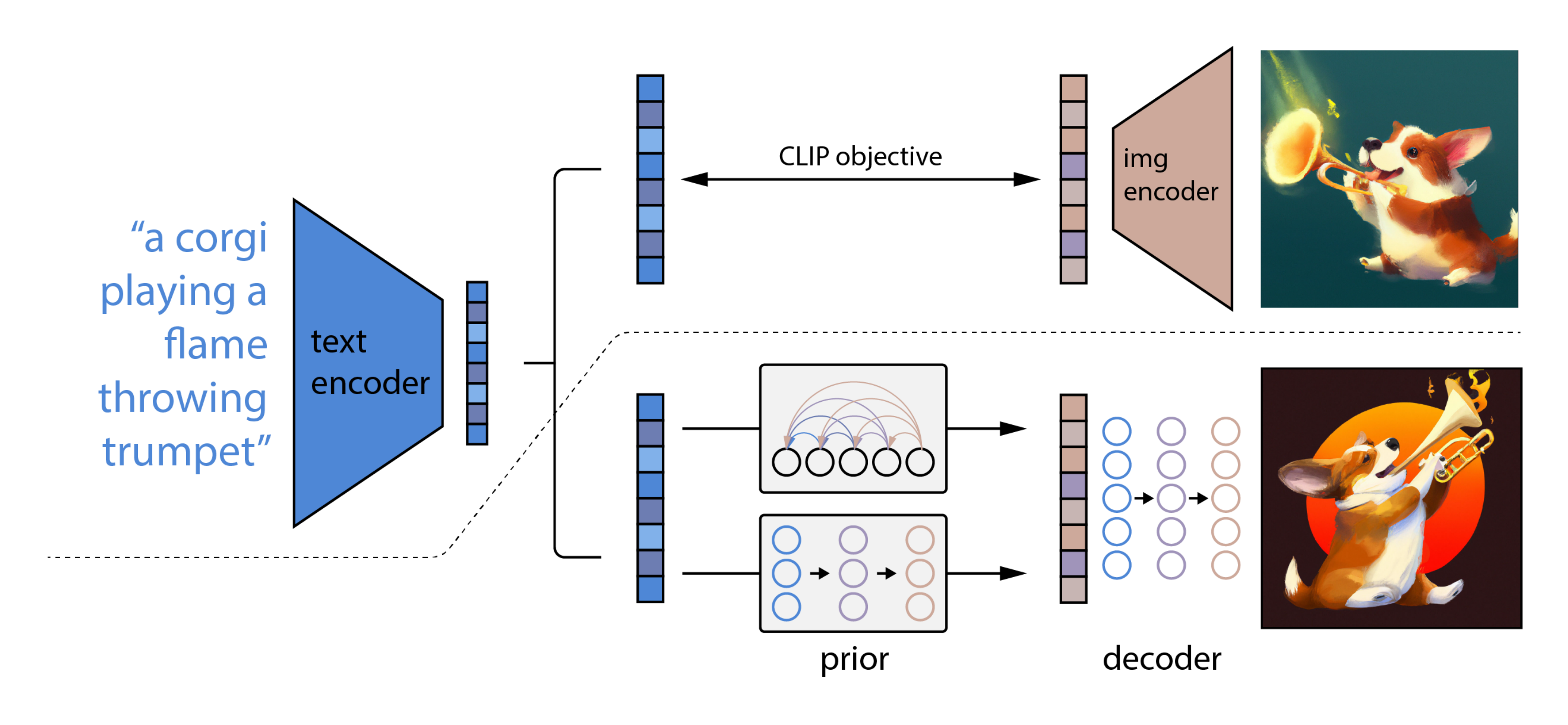
Our training dataset consists of pairs $(x, y)$ of images $x$ and their corresponding captions $y$. Given an image $x$, let $z_i$ and $z_t$ be its CLIP image and text embeddings, respectively. We design our generative stack to produce images from captions using two components:
- A prior $P(z_i|y)$ that produces CLIP image embeddings $z_i$ conditioned on captions $y$.
- A decoder $P(x|z_i, y)$ that produces images $x$ conditioned on CLIP image embeddings $z_i$ (and optionally text captions $y$).
The decoder allows us to invert images given their CLIP image embeddings, while the prior allows us to learn a generative model of the image embeddings themselves. Stacking these two components yields a generative model $P(x|y)$ of images $x$ given captions $y$:
$ P(x|y) = P(x, z_i|y) = P(x|z_i, y) P(z_i|y). $
The first equality holds because $z_i$ is a deterministic function of $x$. The second equality holds because of the chain rule. Thus, we can sample from the true conditional distribution $P(x|y)$ by first sampling $z_i$ using the prior, and then sampling $x$ using the decoder. In the following sections, we describe our decoder and prior stacks. For training details and hyperparameters, refer to Appendix C.
2.1 Decoder
We use diffusion models [10, 9] to produce images conditioned on CLIP image embeddings (and optionally text captions). Specifically, we modify the architecture described in [17] by projecting and adding CLIP embeddings to the existing timestep embedding, and by projecting CLIP embeddings into four extra tokens of context that are concatenated to the sequence of outputs from the GLIDE text encoder. We retained the text conditioning pathway present in the original GLIDE model, hypothesizing that it could allow the diffusion model to learn aspects of natural language that CLIP fails to capture (e.g. variable binding), but find that it offers little help in this regard (Section 7).
While we can sample from the conditional distribution of the decoder directly, past work using diffusion models shows using guidance on the conditioning information [11, 13, 17] improves sample quality a lot. We enable classifier-free guidance [13] by randomly setting the CLIP embeddings to zero (or a learned embedding) 10% of the time, and randomly dropping the text caption 50% of the time during training.
To generate high resolution images, we train two diffusion upsampler models [18, 19]: one to upsample images from $64 \times 64$ to $256 \times 256$ resolution, and another to further upsample those to $1024 \times 1024$ resolution. To improve the robustness of our upsamplers, we slightly corrupt the conditioning images during training. For the first upsampling stage, we use gaussian blur [19], and for the second, we use a more diverse BSR degradation [20, 21]. To reduce training compute and improve numerical stability, we follow [20] [[20]] and train on random crops of images that are one-fourth the target size. We use only spatial convolutions in the model (i.e., no attention layers) and at inference time directly apply the model at the target resolution, observing that it readily generalizes to the higher resolution. We found no benefit from conditioning the upsamplers on the caption, and use unconditional ADMNets [11] with no guidance.
2.2 Prior
While a decoder can invert CLIP image embeddings $z_i$ to produce images $x$, we need a prior model that produces $z_i$ from captions $y$ to enable image generations from text captions. We explore two different model classes for the prior model:
- Autoregressive (AR) prior: the CLIP image embedding $z_i$ is converted into a sequence of discrete codes and predicted autoregressively conditioned on the caption $y$.
- Diffusion prior: The continuous vector $z_i$ is directly modelled using a Gaussian diffusion model conditioned on the caption $y$.
In addition to the caption, we can condition the prior on the CLIP text embedding $z_t$ since it is a deterministic function of the caption. To improve sample quality we also enable sampling using classifier-free guidance for both the AR and diffusion prior, by randomly dropping this text conditioning information 10% of the time during training.
To train and sample from the AR prior more efficiently, we first reduce the dimensionality of the CLIP image embeddings $z_i$ by applying Principal Component Analysis (PCA) [22]. In particular, we find that the rank of the CLIP representation space is drastically reduced when training CLIP with SAM [23] while slightly improving evaluation metrics. We are able to preserve nearly all of the information[^1] by retaining only 319 principal components out of the original 1,024. After applying PCA, we order the principal components by decreasing eigenvalue magnitude, quantize each of the 319 dimensions into 1,024 discrete buckets, and predict the resulting sequence using a Transformer [24] model with a causal attention mask. This results in a threefold reduction in the number of tokens predicted during inference, and improves training stability.
[^1]: I.e., less than 1% average mean-squared error in reconstructing the image representations.
We condition the AR prior on the text caption and the CLIP text embedding by encoding them as a prefix to the sequence. Additionally, we prepend a token indicating the (quantized) dot product between the text embedding and image embedding, $z_i \cdot z_t$. This allows us to condition the model on a higher dot product, since higher text-image dot products correspond to captions which better describe the image. In practice, we find it beneficial to sample the dot product from the top half of the distribution.[^2]
[^2]: We swept over percentiles 50%, 70%, 85%, 95% and found 50% to be optimal in all experiments.
For the diffusion prior, we train a decoder-only Transformer with a causal attention mask on a sequence consisting of, in order: the encoded text, the CLIP text embedding, an embedding for the diffusion timestep, the noised CLIP image embedding, and a final embedding whose output from the Transformer is used to predict the unnoised CLIP image embedding. We choose not to condition the diffusion prior on $z_i \cdot z_t$ like in the AR prior; instead, we improve quality during sampling time by generating two samples of $z_i$ and selecting the one with a higher dot product with $z_t$. Instead of using the $\epsilon$-prediction formulation from [10] [[10]], we find it better to train our model to predict the unnoised $z_i$ directly, and use a mean-squared error loss on this prediction:
$ L_{\text{prior}} = \mathbb{E}{t \sim [1, T], z_i^{(t)} \sim q_t} \big[|f{\theta}(z_i^{(t)}, t, y) - z_i|^2\big] $
3. Image Manipulations
Section Summary: The method encodes images into a split representation that captures key recognizable features via a model called CLIP and additional details needed for accurate reconstruction, enabling various image edits. For variations, it generates similar images that keep the core content but alter aspects like shape or orientation by adding controlled randomness during decoding. It also supports blending two images through smooth transitions in their feature spaces or applying text-based changes by mixing image features with differences from descriptive captions.
Our approach allows us to encode any given image $x$ into a bipartite latent representation $(z_i, x_T)$ that is sufficient for the decoder to produce an accurate reconstruction. The latent $z_i$ describes the aspects of the image that are recognized by CLIP, while the latent $x_T$ encodes all of the residual information necessary for the decoder to reconstruct $x$. The former is obtained by simply encoding the image with the CLIP image encoder. The latter is obtained by applying DDIM inversion (Appendix F in [11]) to $x$ using the decoder, while conditioning on $z_i$. We describe three different kinds of manipulations that are enabled by this bipartite representation.
3.1 Variations
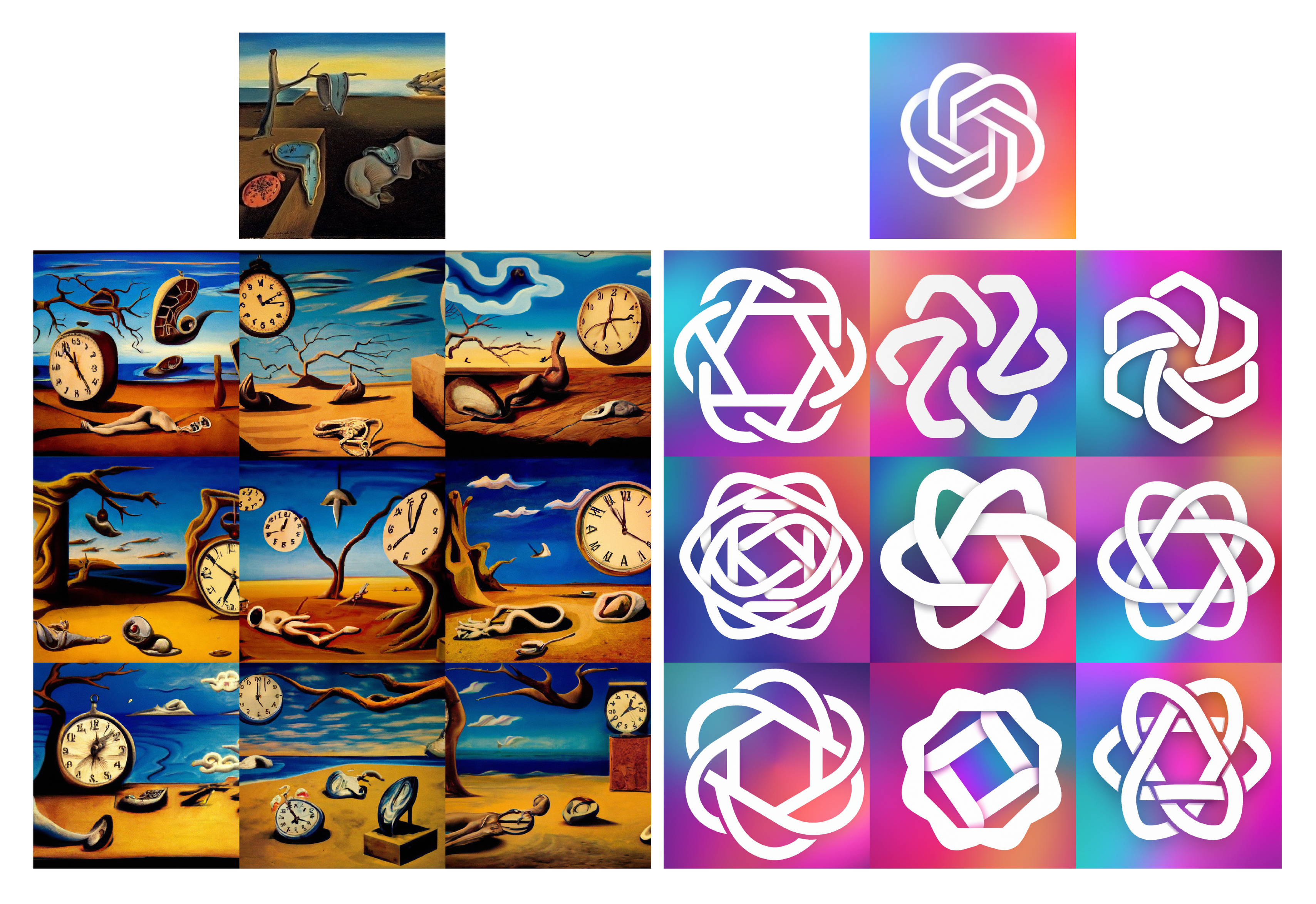
Given an image $x$, we can produce related images that share the same essential content but vary in other apects, such as shape and orientation (Figure 3). To do this, we apply the decoder to the bipartite representation $(z_i, x_T)$ using DDIM with $\eta > 0$ for sampling. With $\eta = 0$, the decoder becomes deterministic and will reconstruct the given image $x$. Larger values of $\eta$ introduce stochasticity into successive sampling steps, resulting in variations that are perceptually "centered" around the original image $x$. As $\eta$ increases, these variations tell us what information was captured in the CLIP image embedding (and thus is preserved across samples), and what was lost (and thus changes across the samples).
3.2 Interpolations
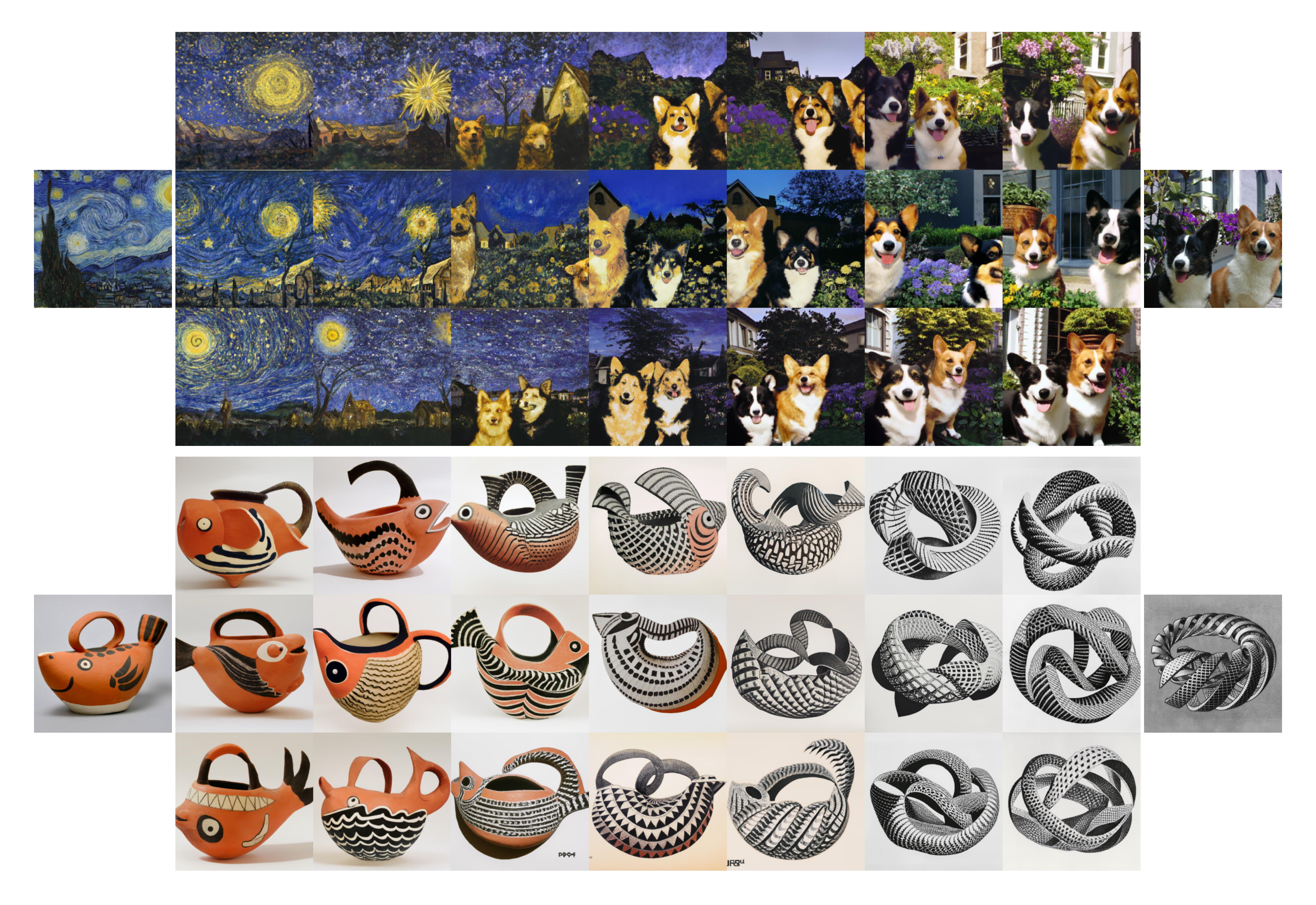
It is also possible to blend two images $x_1$ and $x_2$ for variations (Figure 4), traversing all of the concepts in CLIP's embedding space that occur between them. To do this, we rotate between their CLIP embeddings $z_{i_1}$ and $z_{i_2}$ using spherical interpolation, yielding intermediate CLIP representations $z_{i_\theta} = \text{slerp}(z_{i_1}, z_{i_2}, \theta)$ as $\theta$ is varied from 0 to 1. There are two options for producing the intermediate DDIM latents along the trajectory. The first option involves interpolating between their DDIM inverted latents $x_{T_1}$ and $x_{T_2}$ (by setting $x_{T_\theta} = \text{slerp}(x_{T_1}, x_{T_2}, \theta)$), which yields a single trajectory whose endpoints reconstruct $x_1$ and $x_2$. The second option involves fixing the DDIM latent to a randomly-sampled value for all interpolates in the trajectory. This results in an infinite number of trajectories between $x_1$ and $x_2$, though the endpoints of these trajectories will generally no longer coincide with the original images. We use this approach in Figure 4.
3.3 Text Diffs
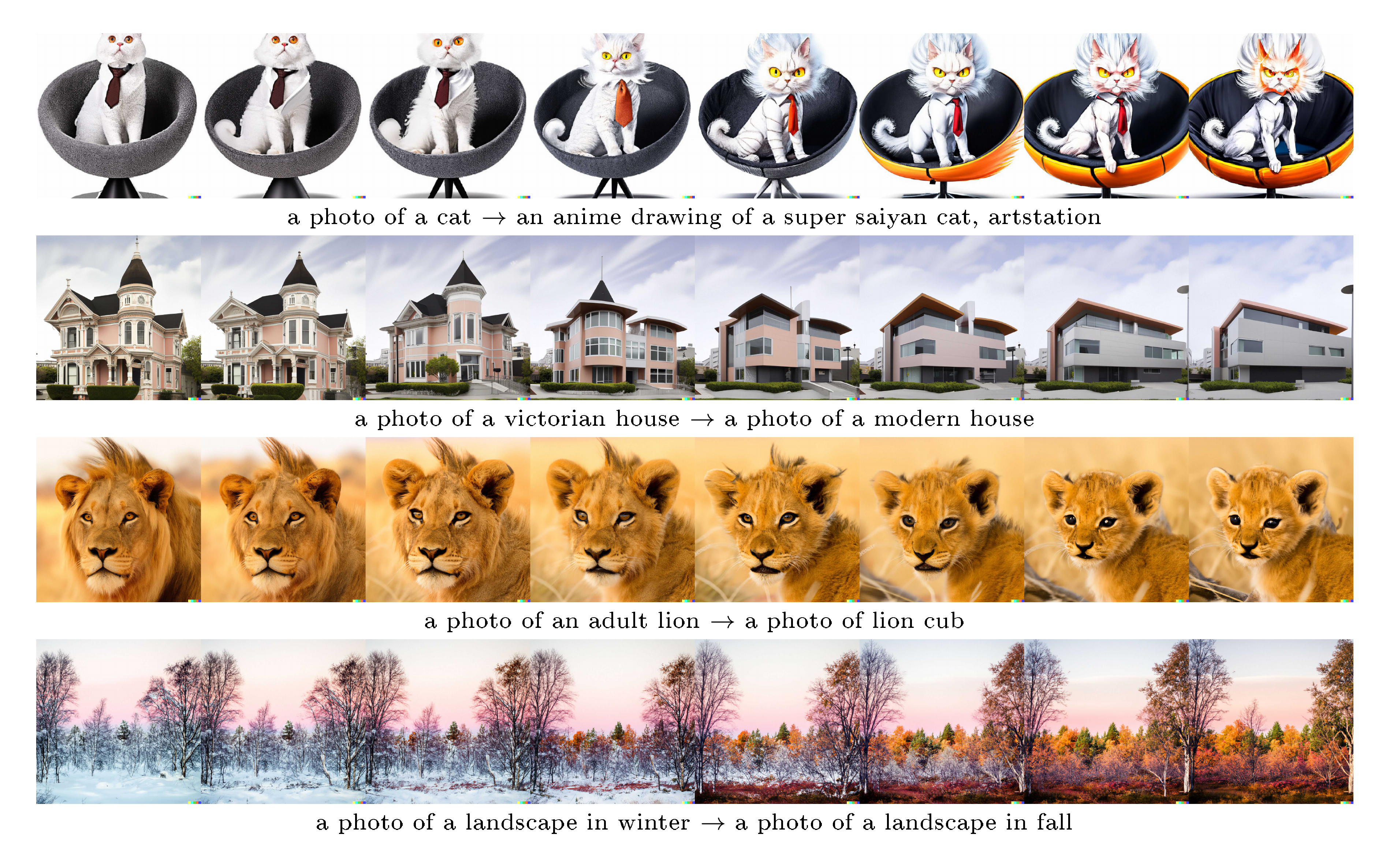
A key advantage of using CLIP compared to other models for image representations is that it embeds images and text to the same latent space, thus allowing us to apply language-guided image manipulations (i.e., text diffs), which we show in Figure 5. To modify the image to reflect a new text description $y$, we first obtain its CLIP text embedding $z_t$, as well as the CLIP text embedding $z_{t_0}$ of a caption describing the current image[^3]. We then compute a text diff vector $z_d = \text{norm}(z_t - z_{t_0})$ from these by taking their difference and normalizing. Now, we can rotate between the image CLIP embedding $z_i$ and the text diff vector $z_d$ using spherical interpolation, yielding intermediate CLIP representations $z_\theta = \text{slerp}(z_i, z_d, \theta)$, where $\theta$ is increased linearly from 0 to a maximum value that is typically in $[0.25, 0.50]$. We produce the final outputs by decoding the interpolates $z_\theta$, fixing the base DDIM noise to $x_T$ throughout the entire trajectory.
[^3]: Instead of a description of the current image, we also experimented with using a dummy caption like "a photo" for the baseline, or removing it altogether. These also worked well.
![**Figure 6:** Variations of images featuring typographic attacks [25] paired with the CLIP model's predicted probabilities across three labels. Surprisingly, the decoder still recovers Granny Smith apples even when the predicted probability for this label is near 0%. We also find that our CLIP model is slightly less susceptible to the "pizza" attack than the models investigated in [25].](https://ittowtnkqtyixxjxrhou.supabase.co/storage/v1/object/public/public-images/mu9aj8aq/complex_fig_08d978994f30.png)
4. Probing the CLIP Latent Space
Section Summary: The decoder model lets researchers peek inside CLIP's hidden image representations by turning them into visible pictures. For instance, in deceptive images where text overlays trick CLIP into mistaking an apple for an iPod, the decoder still reliably generates images of apples and never shows iPods, revealing hidden visual cues. Using PCA, the team reconstructs these representations step by step, showing that early components capture broad scene elements like food or containers, while later ones add specific details such as tomatoes or bottles.
Our decoder model provides a unique opportunity to explore CLIP latent space by allowing us to directly visualize what the CLIP image encoder is seeing. As an example use case, we can revisit cases where CLIP makes incorrect predictions, such as typographic attacks [25]. In these adversarial images, a piece of text is overlayed on top of an object, which causes CLIP to predict the object described by the text rather than the object depicted in the image. This piece of text essentially hides the original object in terms of output probabilities. In Figure 6, we show an example of this attack from [25], wherein an apple can be misclassified as an iPod. Surprisingly, we find that our decoder still generates pictures of apples with high probability even though the predicted probability of "Granny Smith" is near zero. Even more notable, the model never produces pictures of iPods, despite the very high relative predicted probability of this caption.
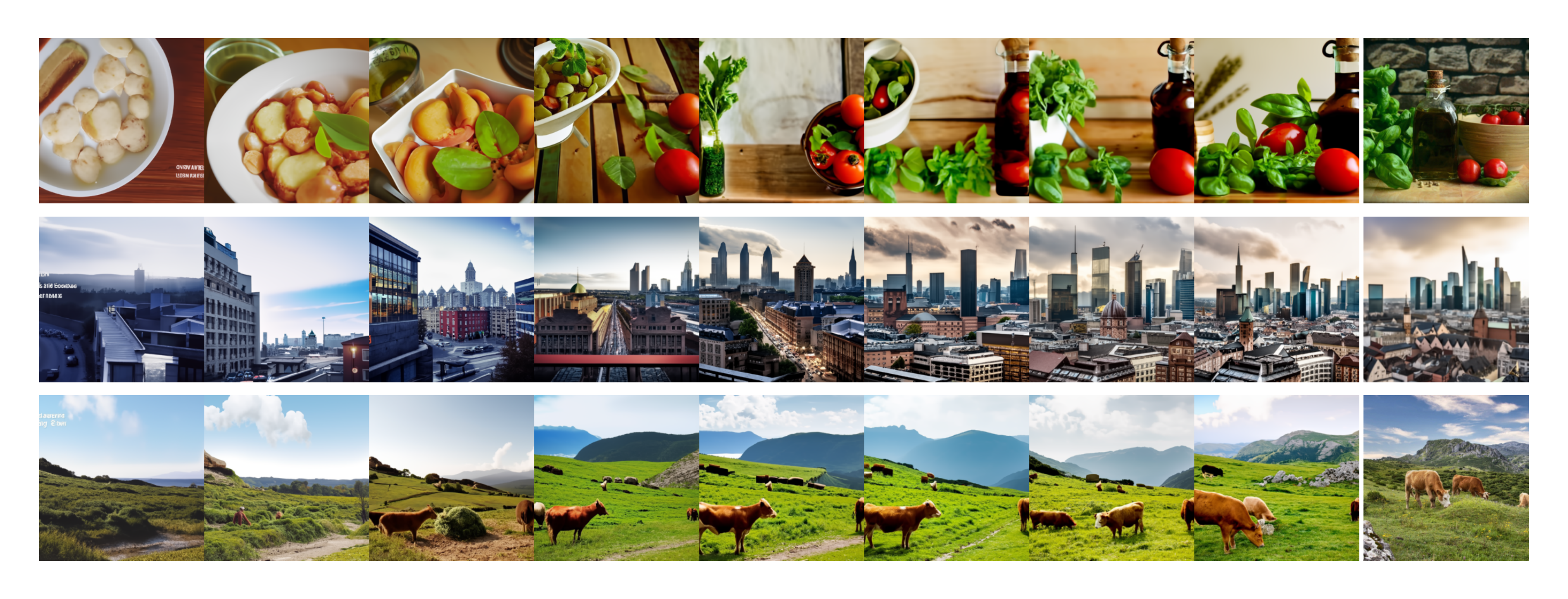
PCA reconstructions offer another tool for probing the structure of the CLIP latent space. In Figure 7, we take the CLIP image embeddings of a handful of source images and reconstruct them with progressively more PCA dimensions, and then visualize the reconstructed image embeddings using our decoder with DDIM on a fixed seed. This allows us to see what semantic information the different dimensions encode. We observe that the early PCA dimensions preserve coarse-grained semantic information such as what types of objects are in the scene, whereas the later PCA dimensions encode finer-grained detail such as the shapes and exact form of the objects. For example, in the first scene, the earlier dimensions seem to encode that there is food and perhaps a container present, whereas the later dimensions encode tomatoes and a bottle specifically. Figure 7 also serves as a visualization of what the AR prior is modeling, since the AR prior is trained to explicitly predict these principal components in this order.
5. Text-to-Image Generation
Section Summary: The section explains how unCLIP uses a special "prior" model to turn text captions into image-like data that helps create better pictures, even though it's possible to skip this step with simpler methods like GLIDE, which don't perform as well. Experiments show that this prior, especially the diffusion version, outperforms alternatives in quality measures like realism and how closely images match the text, while adding more variety to the outputs. Human judges found unCLIP images nearly as realistic as GLIDE's but preferred them for diversity and overall balance when adjusting for detail accuracy.
5.1 Importance of the Prior
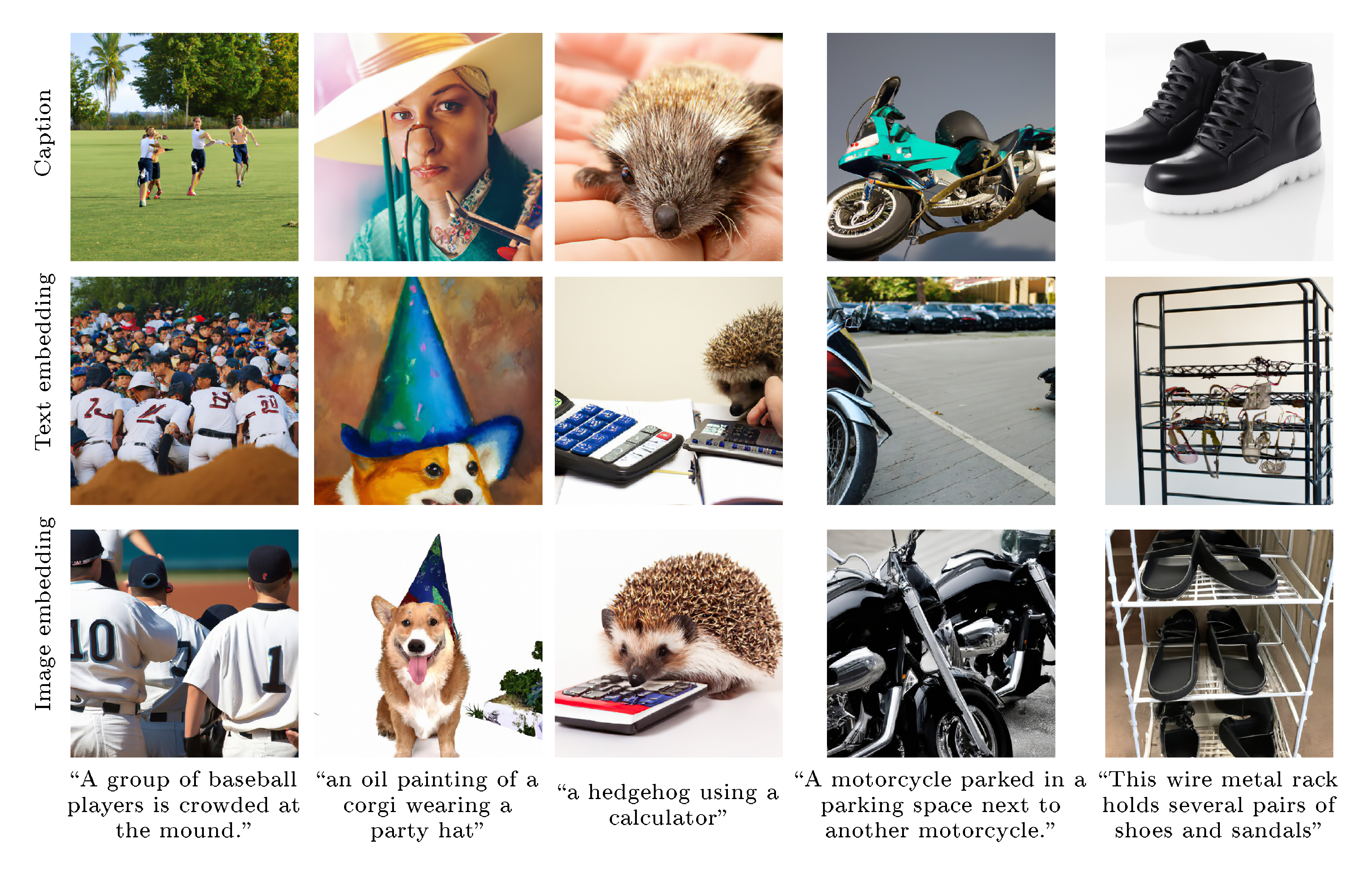
Although we train a prior to generate CLIP image embeddings from captions, the prior is not strictly necessary for caption-to-image generation. For instance, our decoder can condition on both CLIP image embeddings and captions, but the CLIP image embedding is dropped 5% of the time during training in order to enable classifier-free guidance. Therefore, at sampling time, we can condition on only the caption, although this underperforms a model trained fully in this way (this model is GLIDE, and we do a thorough comparison with GLIDE in Section 5.2 and Section 5.3). Another possibility is to feed the decoder the CLIP text embedding as if it were an image embedding, as previously observed [26, 27]. The first two rows of Figure 8 depicts samples obtained in these two ways; the third row depicts samples obtained with a prior. Conditioning the decoder on just the caption is clearly worst, but conditioning on text embeddings zero-shot does produce reasonable results. Building on this observation, another approach would be to train the decoder to condition on CLIP text embeddings [28] instead of CLIP image embeddings (although we would lose the capabilities mentioned in Section 4).
To quantify the effectiveness of these alternate approaches, we train two models: a small decoder conditioned on CLIP text embeddings, and a small unCLIP stack (diffusion prior and decoder). We then compare samples from the text-embedding decoder, samples from the unCLIP stack, and samples obtained from feeding text embeddings to the unCLIP decoder zero-shot, sweeping across guidance scales for all models. We find that these approaches respectively score FIDs of 9.16, 7.99, and 16.55 on a test set, suggesting the unCLIP approach is best. We also run human evaluations comparing the first two settings, sweeping over sampling hyperparameters for each using our human evaluation proxy model (Appendix A). We find that humans prefer the full unCLIP stack 57.0% $\pm$ 3.1% of the time for photorealism and 53.1% $\pm$ 3.1% of the time for caption similarity.
Given the importance of the prior, it is worth evaluating different approaches for training it. We compare both the AR and diffusion priors throughout our experiments. In all cases (Section 5.2, Section 5.4, and Section 5.5), we find that the diffusion prior outperforms the AR prior for comparable model size and reduced training compute.
5.2 Human Evaluations
:Table 1: Human evaluations comparing unCLIP to GLIDE. We compare to both the AR and diffusion prior for unCLIP. Reported figures are 95% confidence intervals of the probability that the unCLIP model specified by the row beats GLIDE. Sampling hyperparameters for all models were swept to optimize an automated proxy for human photorealism evaluations.
| unCLIP Prior | Photorealism | Caption Similarity | Diversity |
|---|---|---|---|
| AR | 47.1% $\pm$ 3.1% | 41.1% $\pm$ 3.0% | 62.6% $\pm$ 3.0% |
| Diffusion | 48.9% $\pm$ 3.1% | 45.3% $\pm$ 3.0% | 70.5% $\pm$ 2.8% |
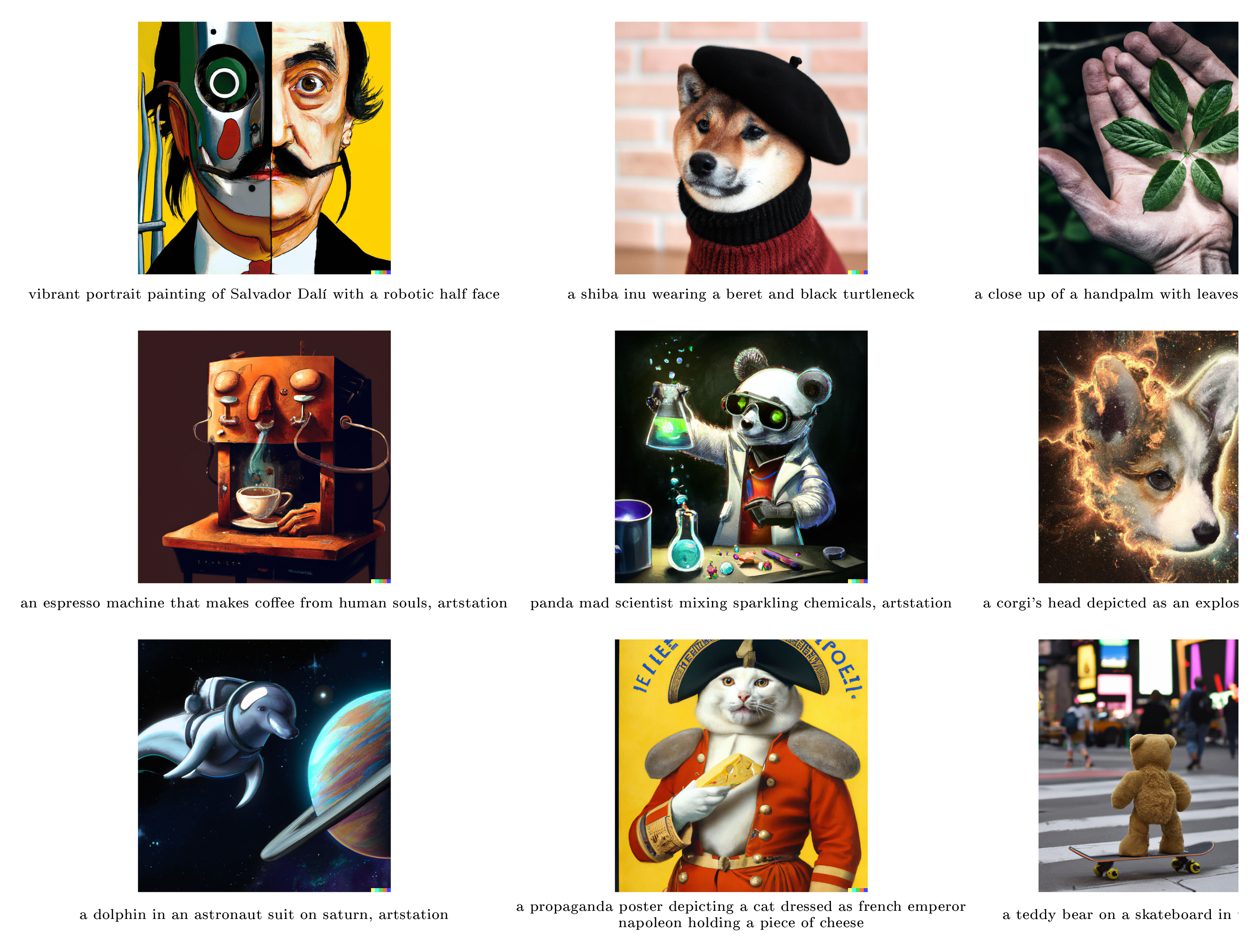
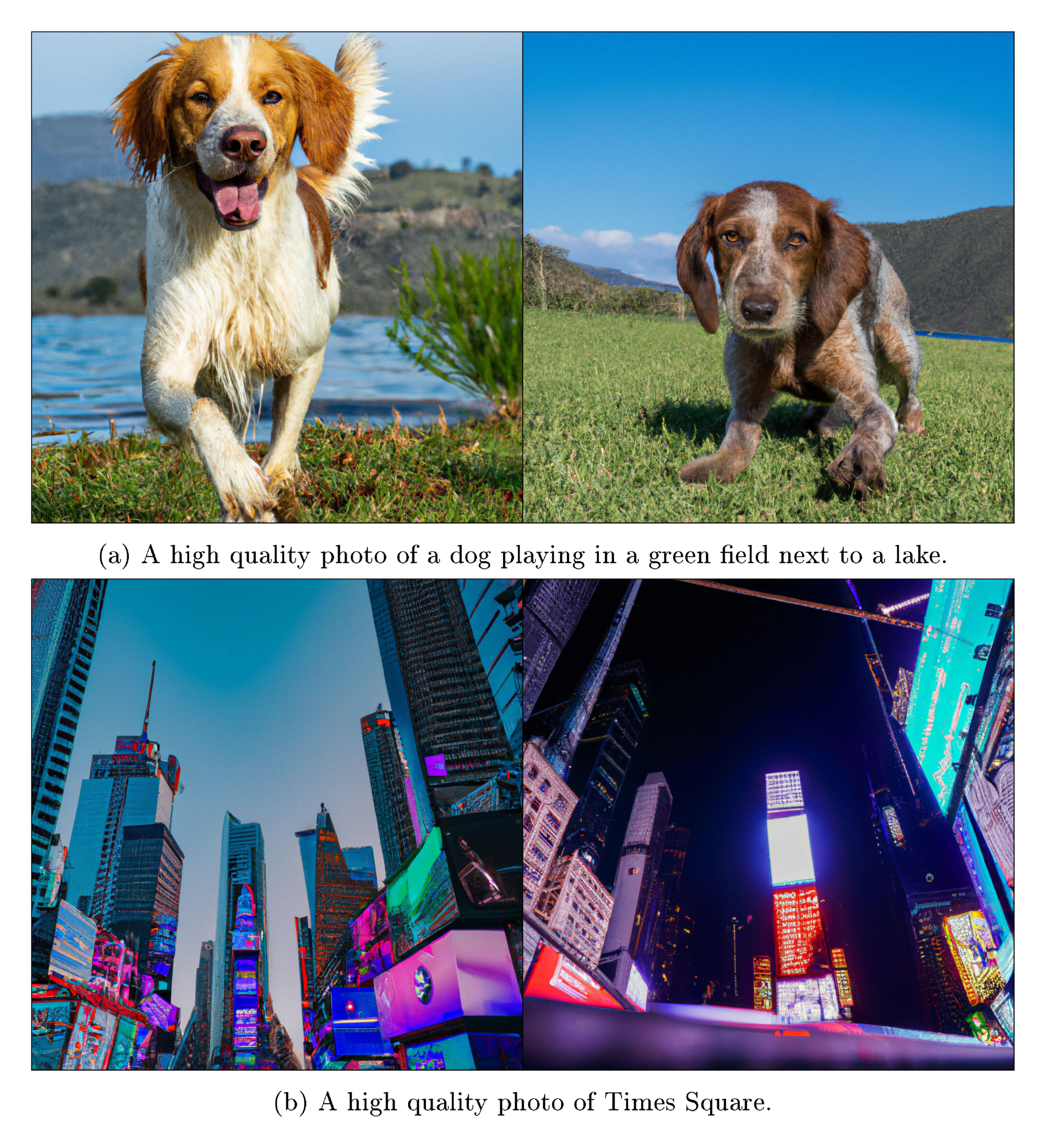
We observe in Figure 1 that unCLIP is capable of synthesizing complex, realistic images. While we can compare sample quality to past models using FID, it is not always aligned with human judgment. To better gauge the generation capabilities of our system, we conduct systematic human evaluations comparing unCLIP to GLIDE for photorealism, caption similarity, and sample diversity.
We follow the protocol of [16, 17] [[16, 17]] for the first two evaluations: for photorealism, users are presented with pairs of images and must choose which looks more photorealistic; for caption similarity, users are additionally prompted with a caption, and must choose which image better matches the caption. In both evaluations, there is a third "Not sure" option. For diversity, we propose a new evaluation protocol in which humans are presented with two $4 \times 4$ grids of samples and must choose which is more diverse (with a third option, "Not sure"). For this evaluation, we produce sample grids using 1,000 captions from the MS-COCO validation set, and always compare sample grids for the same caption. Before running human comparisons, we swept over sampling hyperparameters for each model using a CLIP linear probe trained to be a proxy for human photorealism evaluations (Appendix A). These hyperparameters are fixed across all three types of evaluation.
We present our results in Table 1. In general, the diffusion prior performs better than the AR prior in pairwise comparisons against GLIDE. We find that humans still slightly prefer GLIDE to unCLIP in terms of photorealism, but the gap is very small. Even with similar photorealism, unCLIP is strongly preferred over GLIDE in terms of diversity, highlighting one of its benefits.
5.3 Improved Diversity-Fidelity Trade-off with Guidance
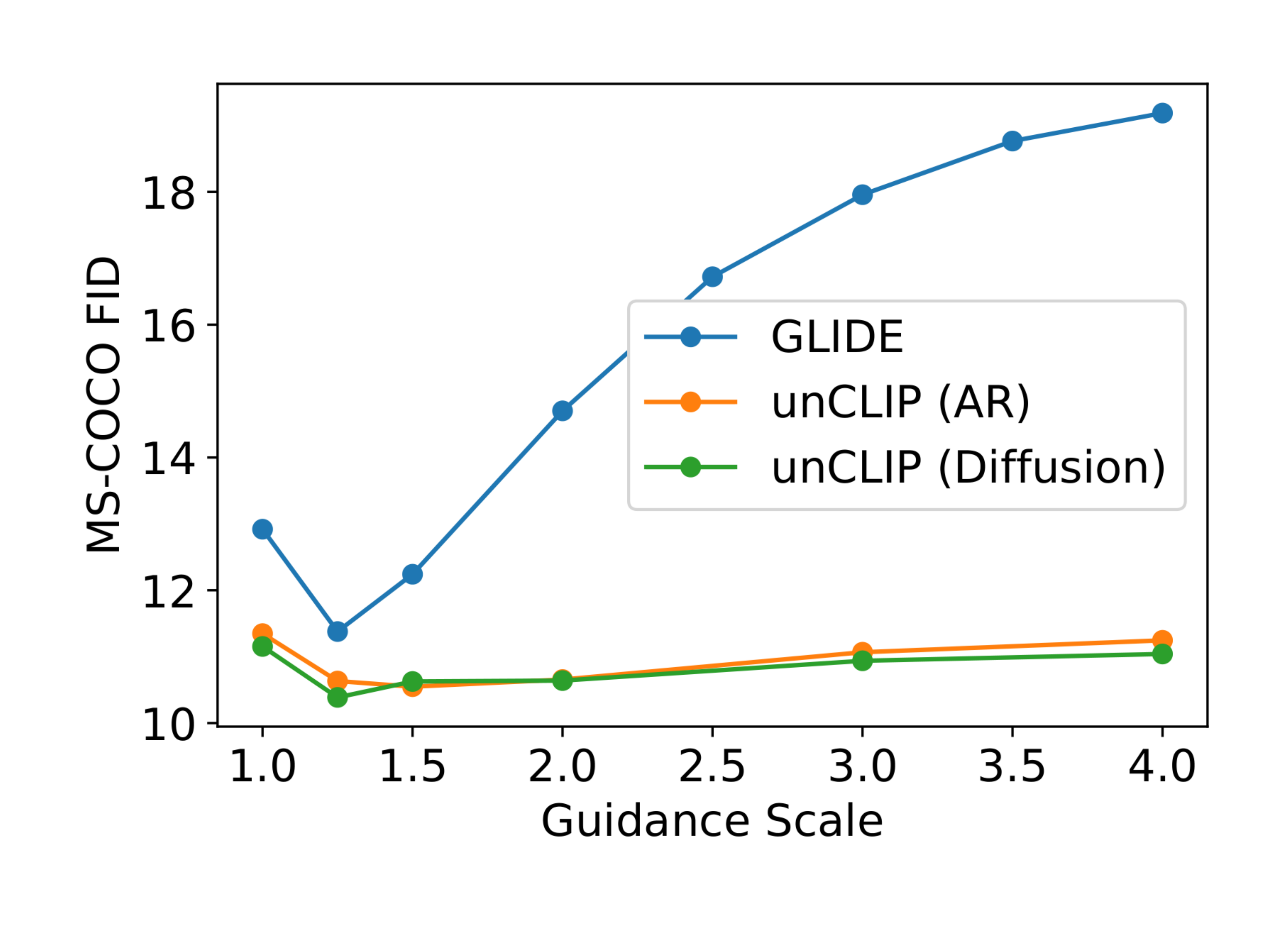
Compared to GLIDE, we qualitatively observe that unCLIP is able to generate more diverse images while leveraging the guidance technique to improve sample quality. To understand why, consider Figure 9 where we increase guidance scale for both GLIDE and unCLIP. For GLIDE, the semantics (camera angle, color, size) converge as we increase guidance scale, whereas for unCLIP the semantic information of the scene is frozen in the CLIP image embedding and therefore does not collapse when guiding the decoder.
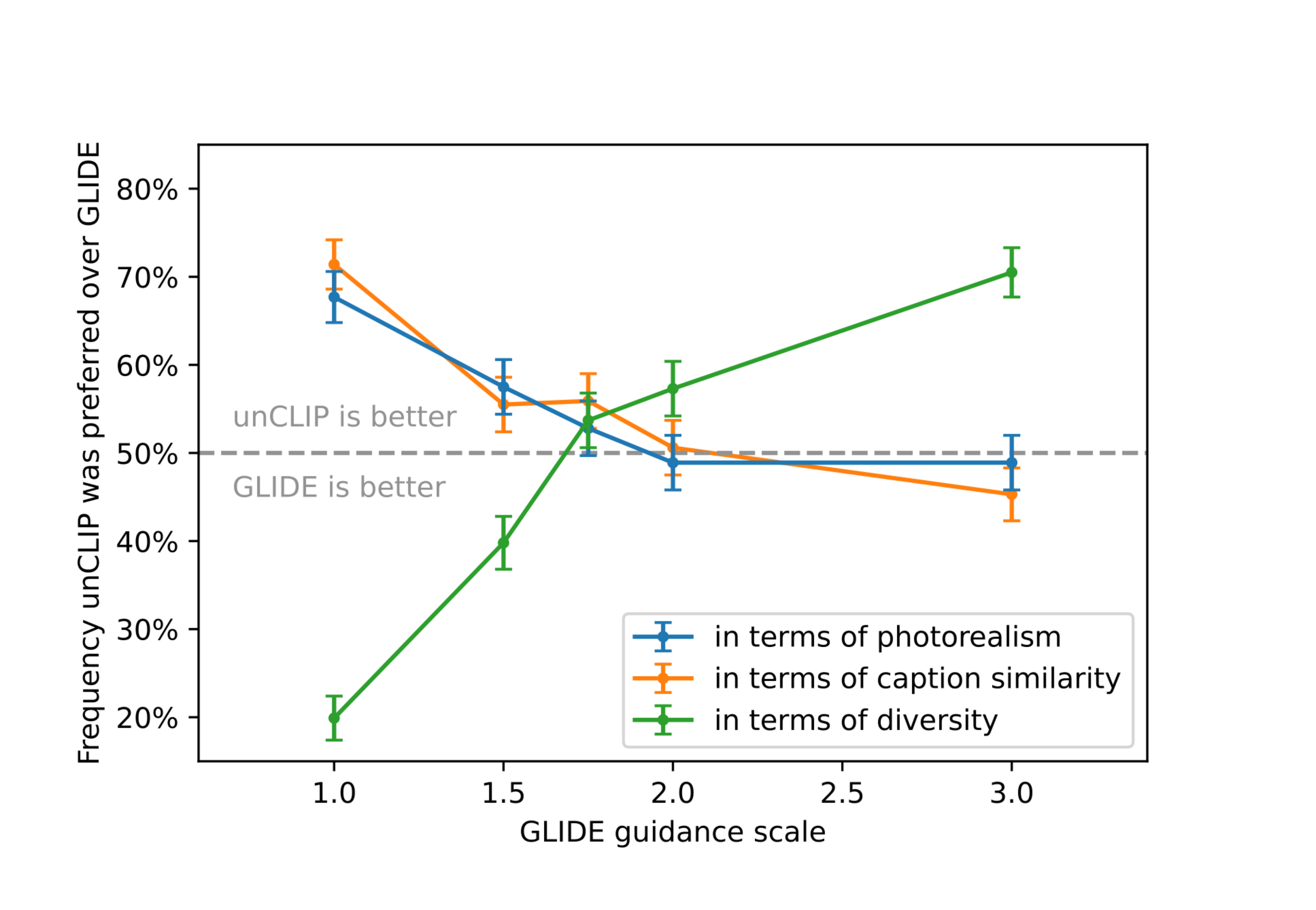
In Section 5.2, we observed that unCLIP achieves similar photorealism as GLIDE while maintaining more diversity, but that its caption matching capabilities were slightly worse. It is natural to ask whether GLIDE's guidance scale can be lowered to obtain the same diversity level as unCLIP while maintaining better caption matching. In Figure 10, we conduct a more careful study of this question by performing human evaluations across several GLIDE guidance scales. We find that GLIDE at guidance scale 2.0 is very close to the photorealism and caption similarity of unCLIP, while still producing less diverse samples.
Finally, in Figure 11 we compute MS-COCO zero-shot FID [29] while sweeping over guidance scale for both unCLIP and GLIDE, finding that guidance hurts the FID of unCLIP much less so than for GLIDE. In this evaluation, we fix the guidance scale of the unCLIP prior and only vary the guidance scale of the decoder. This is another indication that guidance hurts the diversity of GLIDE much more than unCLIP, since FID heavily penalizes non-diverse generations.
5.4 Comparison on MS-COCO
\begin{tabular}{cccc}
  \toprule
  Model & FID & Zero-shot FID & Zero-shot FID (filt) \\
  \midrule
  AttnGAN ([30]) & 35.49 & & \\
  DM-GAN ([31]) & 32.64 & & \\
  DF-GAN ([32]) & 21.42 & & \\
  DM-GAN + CL ([33]) & 20.79 & & \\
  XMC-GAN ([34]) & 9.33 & & \\
  LAFITE ([26]) & 8.12 & & \\
  Make-A-Scene ([35]) & \textbf{7.55} & & \\
  \midrule
  DALL-E ([16]) & & $\sim$ 28 & \\
  LAFITE ([26]) & & 26.94 & \\
  GLIDE ([17]) & & 12.24 & 12.89 \\
  Make-A-Scene ([35]) & & & 11.84 \\
  unCLIP (AR prior) & & 10.63 & 11.08 \\
  unCLIP (Diffusion prior) & & \textbf{10.39} & \textbf{10.87} \\
  \bottomrule
  \end{tabular}
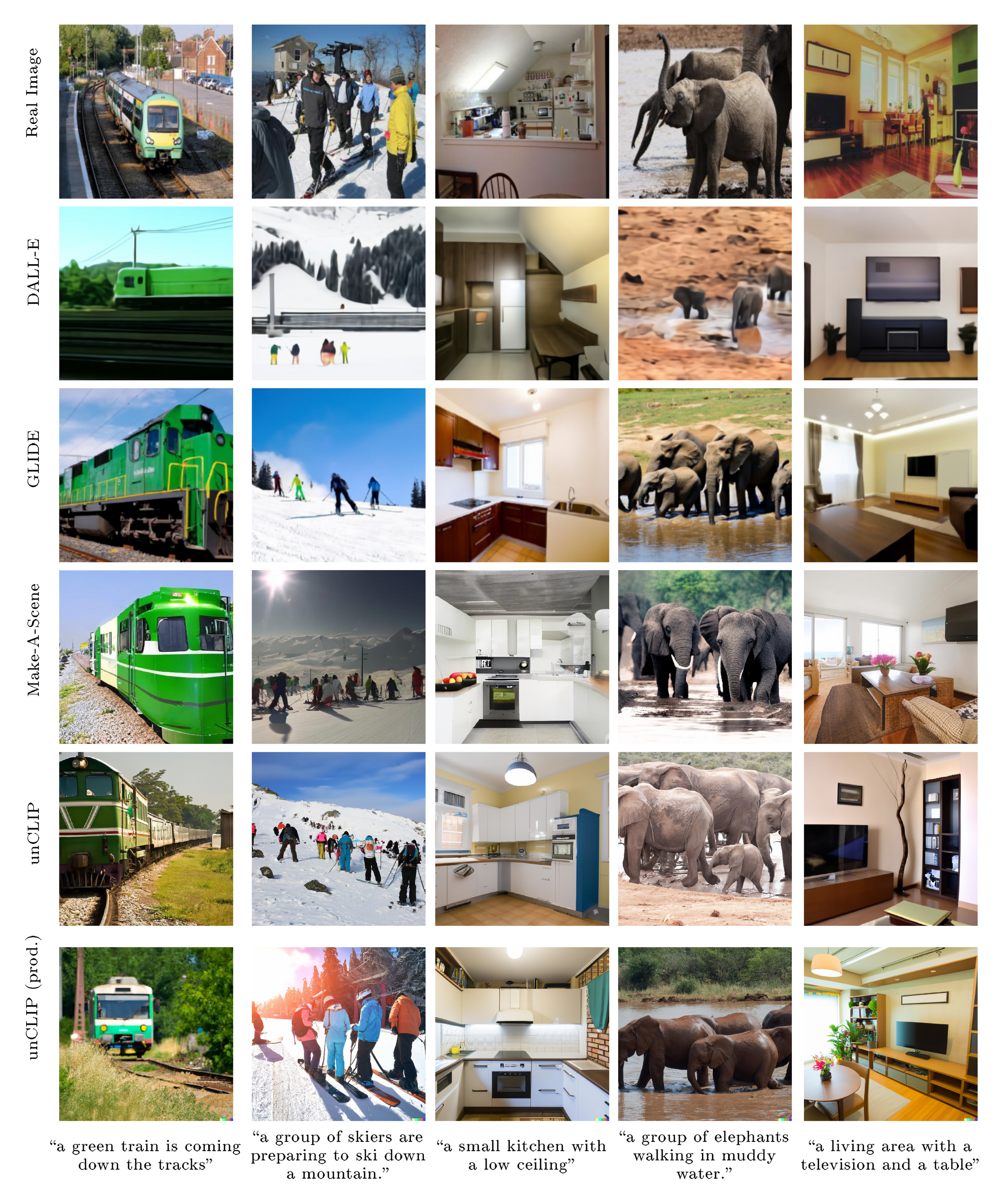
In the text-conditional image generation literature, it has become standard practice to evaluate FID on the MS-COCO [36] validation set. We present results on this benchmark in Table 2. Like GLIDE and DALL-E, unCLIP is not directly trained on the MS-COCO training set, but can still generalize to the validation set zero-shot. We find that, compared to these other zero-shot models, unCLIP achieves a new state-of-the-art FID of 10.39 when sampling with the diffusion prior. In Figure 12, we visually compare unCLIP to various recent text-conditional image generation models on several captions from MS-COCO. We find that, like the other methods, unCLIP produces realistic scenes that capture the text prompts.
5.5 Aesthetic Quality Comparison
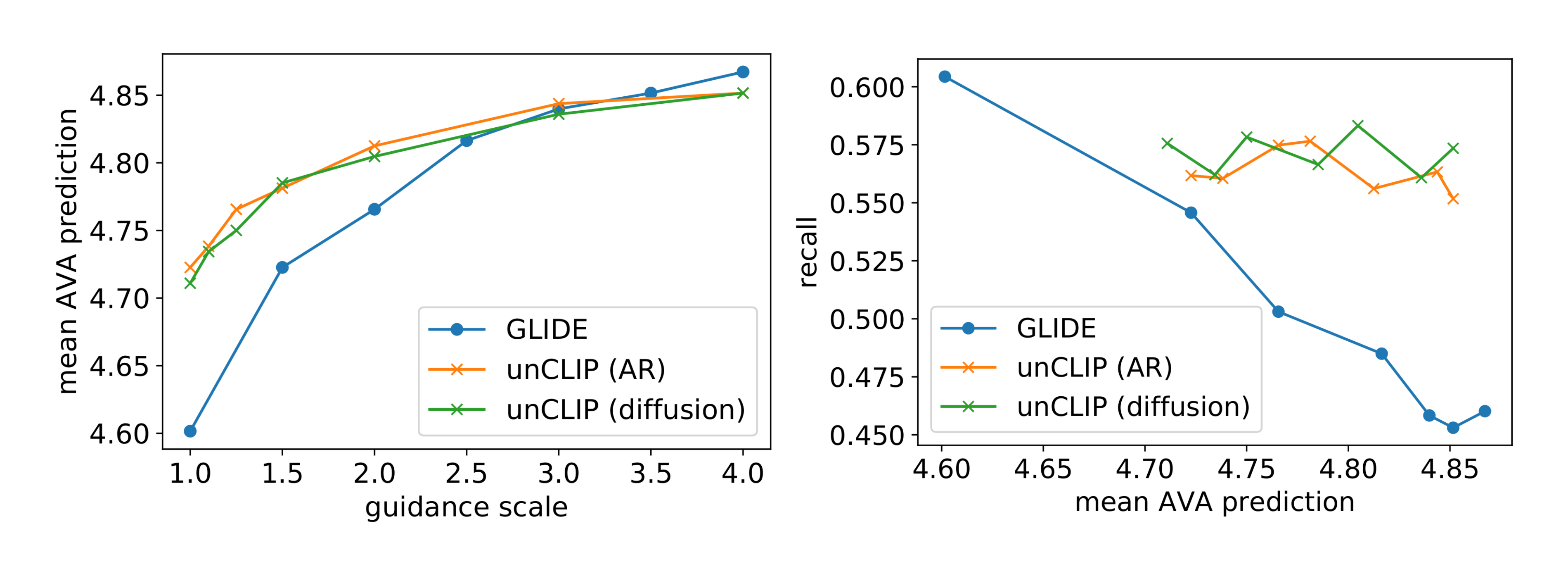
We additionally perform automated aesthetic quality evaluations comparing unCLIP to GLIDE. Our goal with this evaluation is to assess how well each model produces artistic illustrations and photographs. To this end, we generated 512 "artistic" captions using GPT-3 [37] by prompting it with captions for existing artwork (both real and AI generated). Next, we trained a CLIP linear probe to predict human aesthetic judgments using the AVA dataset [38] (Appendix A). For each model and set of sampling hyperparameters, we produce four images for each prompt, and report the mean predicted aesthetic judgment over the full batch of 2048 images.
In Figure 13, we present results on our aesthetic quality evaluation. We find that guidance improves aesthetic quality for both GLIDE and unCLIP. For unCLIP, we only guide the decoder (we found that guiding the prior hurt results). We also plot the aesthetic quality against Recall[^4], since guidance typically induces a trade-off
[^4]: Recall is computed with respect to the training dataset.
between fidelity and diversity. Interestingly, we find that guiding unCLIP does not decrease Recall while still improving aesthetic quality according to this metric.
6. Related Work
Section Summary: Researchers have long studied ways to generate synthetic images from text descriptions, adapting popular methods like GANs, which pit two neural networks against each other to create realistic images, along with VQ-VAE and diffusion models that gradually refine noisy images into clear ones based on text prompts. Many approaches use hierarchical processes to build images step-by-step, starting from coarse details to fine resolutions, and leverage latent spaces—compressed representations of data—for efficient computation, often incorporating tools like CLIP to align generated images closely with textual input through guidance techniques. While earlier works conditioned models directly on CLIP embeddings for text-to-image synthesis, related studies like one using contrastive representations for diffusion models share similarities with advanced techniques but differ by incorporating multimodal data and stronger text-conditioned priors for better results.
Synthetic image generation is a well studied problem, and most popular techniques for unconditional image generation have also been applied to the text-conditional setting. Many previous works have trained GANs [39] on publicly available image captioning datasets to produce text-conditional image samples [30, 31, 32, 34, 33]. Other works have adapted the VQ-VAE approach [40] to text-conditional image generation by training autoregressive transformers on sequences of text tokens followed by image tokens [16, 41, 42]. Finally, some works have applied diffusion models to the problem, training either continuous [17] or discrete [43] diffusion models with auxiliary text encoders to handle textual input.
Previous works have leveraged hierarchical generative processes to create high-quality synthetic images. [44] [[44]] trains a multi-layer discrete autoencoder, allowing them to first sample coarse-grained latent codes and then use this as conditioning information when sampling higher-resolution latent codes. [45, 46] [[45, 46]] generate images using VAEs with a hierarchy of latent codes that increase progressively with resolution. Concurrently with our work, [35] [[35]] conditions a generative image model on segmentation masks, allowing for a generative process that first samples a semantic map of an image and then conditions the generated image on this information.
The computational benefits of using diffusion to model a latent space has been noted by previous works. [47] [[47]] propose an autoencoder framework where diffusion models are used to render latent variables as images, and a second diffusion model is used to generate these latents (similar to our diffusion prior). [48] [[48]] use a score-based model for the latent space of a VAE, while [20] [[20]] use diffusion models on the latents obtained from a VQGAN [49] like autoencoder.
Since its release, CLIP [4] has been used extensively to steer generative image models towards text prompts. [50, 51, 52, 53] [[50, 51, 52, 53]] guide GANs using gradients from a CLIP model. For diffusion models, [11] [[11]] introduced classifier guidance as a way to use gradients from a classifier trained on noised images to steer the model towards higher quality generations. [17] [[17]] train a CLIP model on noised images and guide a text-conditional diffusion model, while [54, 55] [[54, 55]] use an unnoised CLIP model to guide unconditional or class-conditional diffusion models. [13] [[13]] introduced classifier-free guidance and showed that one can perform guidance implictly from the predictions of the model with and without the conditioning information, thus removing the need for a classifier. [17] [[17]] showed classifier-free guidance works more favorably than CLIP guidance for text conditional image generation.
Several previous works have trained generative image models that are directly conditioned on CLIP embeddings. [26] [[26]] condition GAN models on randomly perturbed CLIP image embeddings, finding that these models can generalize to CLIP text embeddings to produce text-conditional images. [28] [[28]] trained diffusion models conditioned on CLIP text embeddings, allowing for direct text-conditional image generation. [27] [[27]] train an autoregressive generative model conditioned on CLIP image embeddings, finding that it generalizes to CLIP text embeddings well enough to allow for text-conditional image synthesis.
[56] [[56]] train diffusion models conditioned on image representations from contrastive models. While the diffusion models themselves cannot generate images unconditionally, the authors experimented with a simple approach for two-stage image generation by employing Kernel Density Estimation to sample image representations. By feeding these generated representations to the diffusion model, they can generate images end-to-end in a way similar to our proposed technique. However, our work differs from this in two ways: first, we use multimodal contrastive representations rather than image-only representations; second, we employ much more powerful generative models for the first stage of the generation hierarchy, and these generative models are conditioned on text.
7. Limitations and Risks
Section Summary: While unCLIP enhances variety in generated images, it struggles with linking specific traits, like colors, to particular objects, such as cubes, and often mixes them up during the process, partly because the underlying CLIP system doesn't clearly connect these elements. It also has trouble creating clear, accurate text in images, likely due to how it encodes words, and performs poorly on fine details in busy scenes because it starts at a low resolution and scales up, though using a higher starting point could improve this at greater computational expense. Beyond these technical limits, unCLIP heightens risks of producing misleading or harmful images that are harder to spot as AI-made, potentially amplifying biases from training data, so its dangers must be evaluated based on how and where it's used, as explored in early deployments like DALL·E 2.
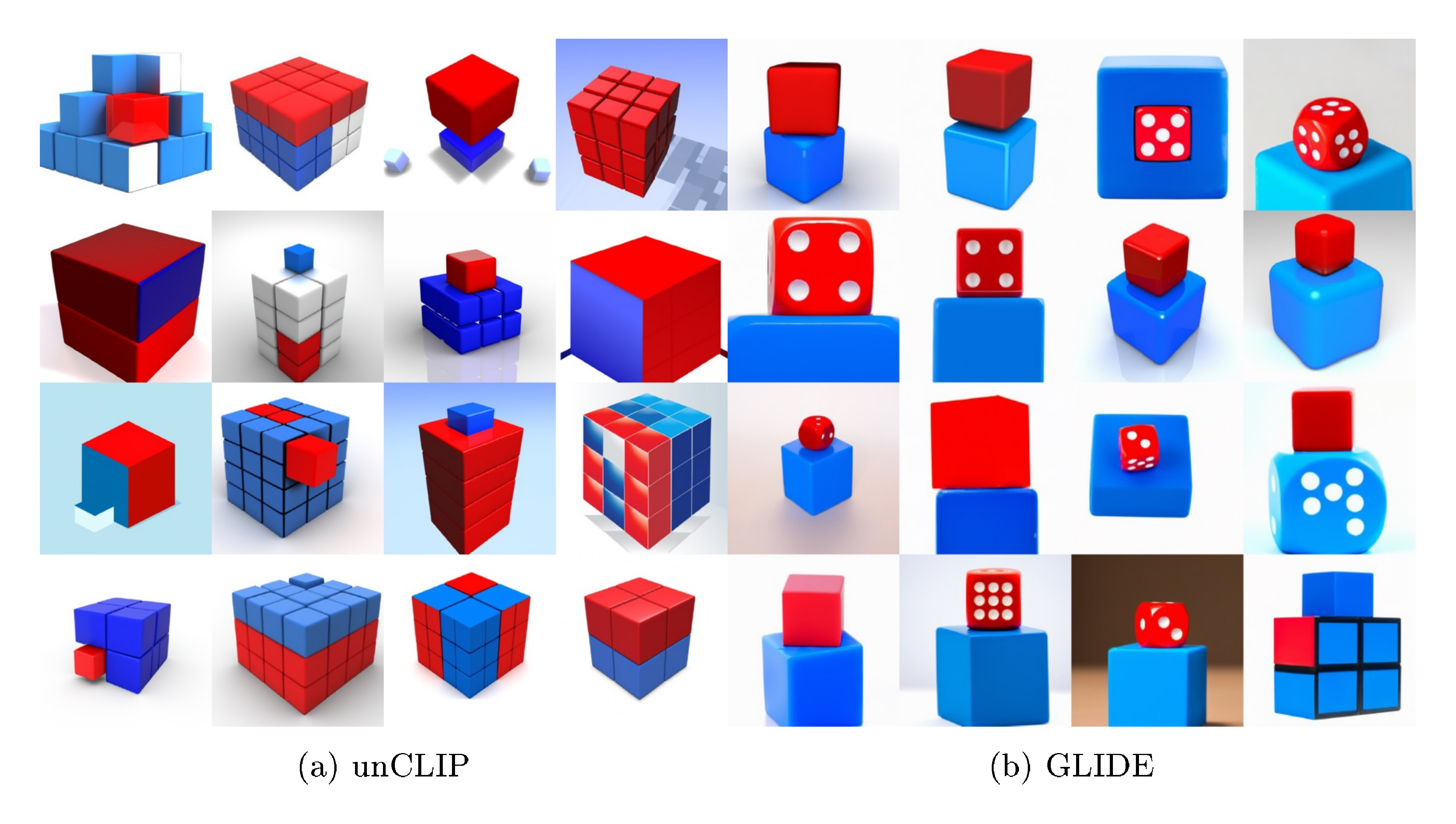
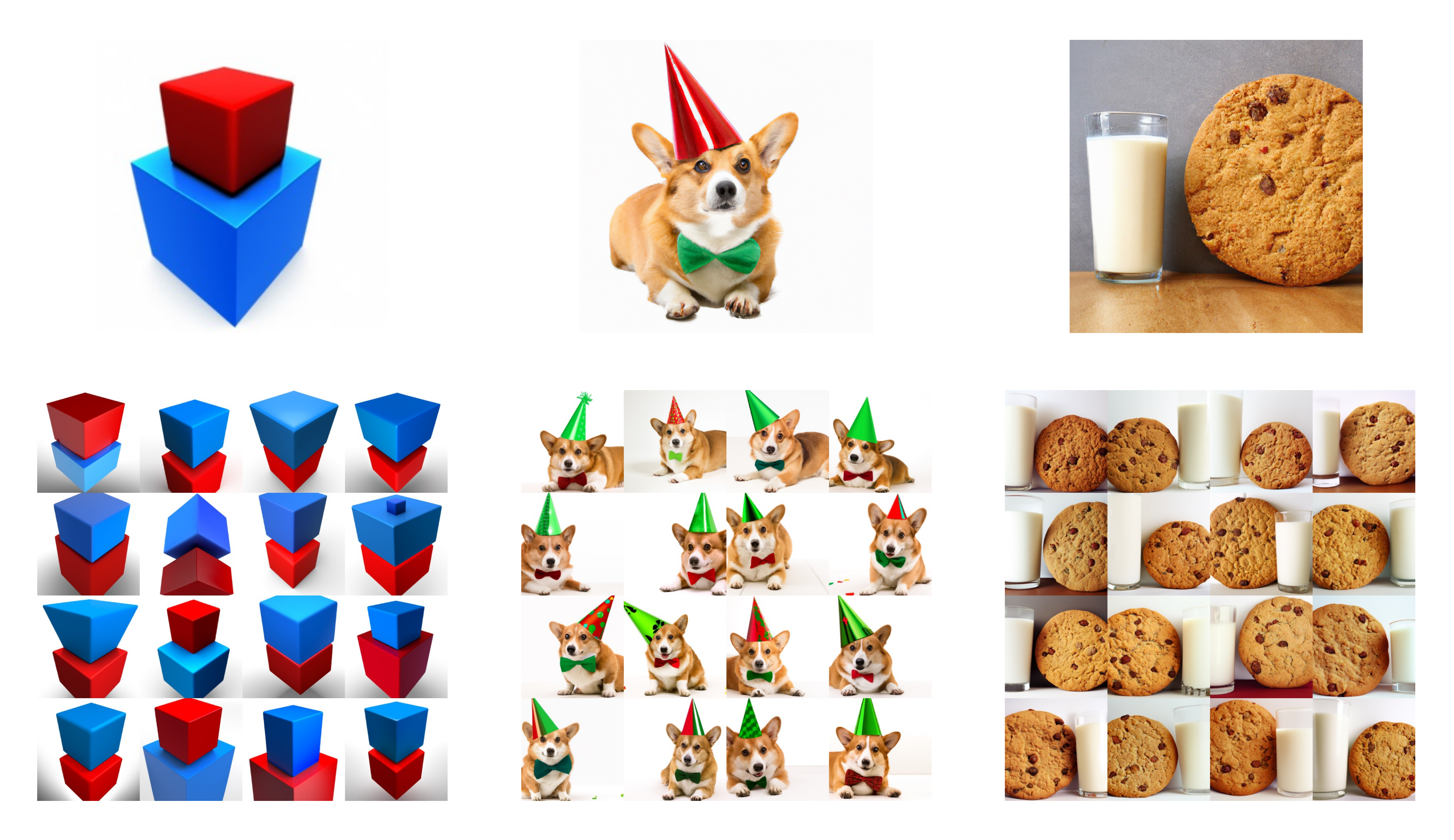
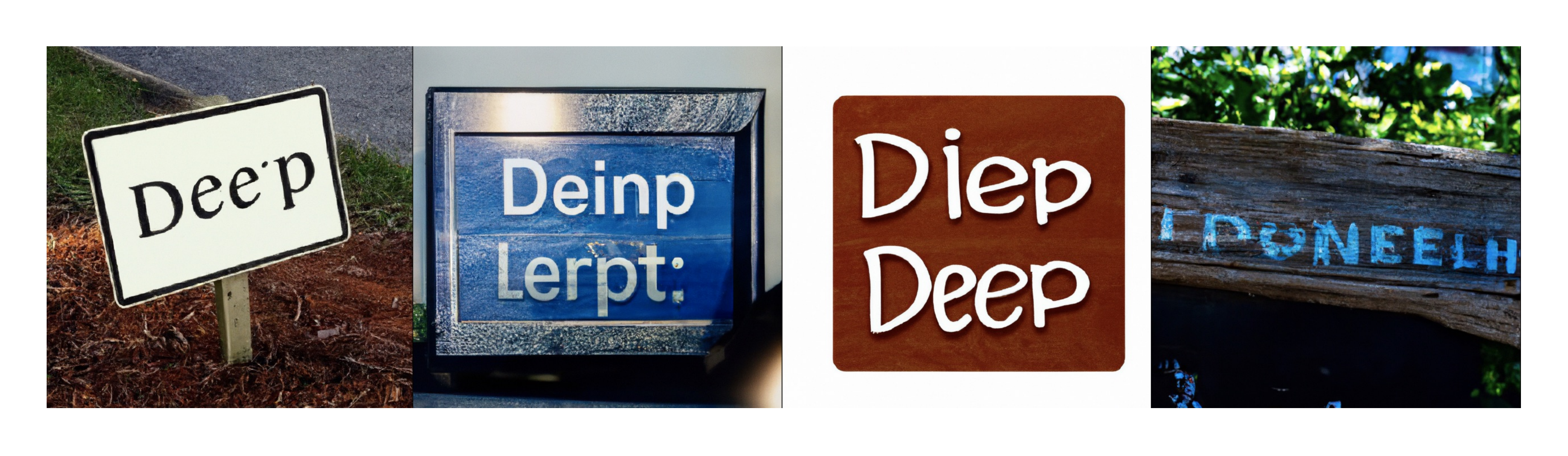
Although conditioning image generation on CLIP embeddings improves diversity, this choice does come with certain limitations. In particular, unCLIP is worse at binding attributes to objects than a corresponding GLIDE model. In Figure 14, we find that unCLIP struggles more than GLIDE with a prompt where it must bind two separate objects (cubes) to two separate attributes (colors). We hypothesize that this occurs because the CLIP embedding itself does not explicitly bind attributes to objects, and find that reconstructions from the decoder often mix up attributes and objects, as shown in Figure 15. A similar and likely related issue is that unCLIP struggles at producing coherent text, as illustrated in Figure 16; it is possible that the CLIP embedding does not precisely encode spelling information of rendered text. This issue is likely made worse because the BPE encoding we use obscures the spelling of the words in a caption from the model, so the model needs to have independently seen each token written out in the training images in order to learn to render it.
We also note that our stack still has a hard time producing details in complex scenes (Figure 17). We hypothesize that this is a limitation of our decoder hierarchy producing an image at a base resolution of $64 \times 64$ and then upsampling it. Training our unCLIP decoder at a higher base resolution should be able to alleviate this, at the cost of additional training and inference compute.
As discussed in the GLIDE paper, image generation models carry risks related to deceptive and otherwise harmful content. unCLIP's performance improvements also raise the risk profile over GLIDE. As the technology matures, it leaves fewer traces and indicators that outputs are AI-generated, making it easier to mistake generated images for authentic ones and vice versa. More research is also needed on how the change in architecture changes how the model learns biases in training data.
The risks of these models should be assessed in relation to the particular deployment context, which includes training data, guardrails in place, the deployment space, and who will have access. A preliminary analysis of these issues in the context of the DALL·E 2 Preview platform (the first deployment of an unCLIP model), can be found in [57] [[57]].
8. Acknowledgements
Section Summary: The acknowledgements section expresses gratitude to several researchers, including Jong Wook Kim, Hyeonwoo Noh, Alec Radford, Pranav Shyam, and Ilya Sutskever, for their helpful discussions and contributions to the project. It also thanks Yunxin Jiao for preparing multiple figures in the paper. Finally, appreciation is given to OpenAI's Acceleration and Supercomputing teams for providing the essential software and hardware infrastructure used in the work.
We’d like to thank Jong Wook Kim, Hyeonwoo Noh, Alec Radford, Pranav Shyam, and Ilya Sutskever for helpful discussions and contributions to our work. We'd also like to thank Yunxin Jiao for creating several figures used in the paper. We are grateful to the Acceleration and Supercomputing teams at OpenAI for their work on software and hardware infrastructure this project used.
References
Section Summary: This references section lists over two dozen academic papers and articles that form the foundational sources for research in artificial intelligence, particularly on how machines learn to understand and generate images using text descriptions. Many entries focus on techniques like contrastive learning to connect visual data with language, diffusion models for creating realistic images from scratch, and generative adversarial networks for image editing and synthesis, spanning from 2015 to 2022. These works, mostly from arXiv preprints and conferences, draw from pioneers in the field and highlight innovations in text-to-image generation and multimodal AI systems.
[1] Karan Desai and Justin Johnson. VirTex: Learning Visual Representations from Textual Annotations. arXiv:2006.06666, 2020.
[2] Mert Bulent Sariyildiz, Julien Perez, and Diane Larlus. Learning Visual Representations with Caption Annotations. arXiv:2008.01392, 2020.
[3] Yuhao Zhang, Hang Jiang, Yasuhide Miura, Christopher D. Manning, and Curtis P. Langlotz. Contrastive Learning of Medical Visual Representations from Paired Images and Text. arXiv:2010.00747, 2020.
[4] Alec Radford, Jong Wook Kim, Chris Hallacy, Aditya Ramesh, Gabriel Goh, Sandhini Agarwal, Girish Sastry, Amanda Askell, Pamela Mishkin, Jack Clark, Gretchen Krueger, and Ilya Sutskever. Learning Transferable Visual Models From Natural Language Supervision. arXiv:2103.00020, 2021.
[5] Norman Mu, Alexander Kirillov, David Wagner, and Saining Xie. SLIP: Self-supervision meets Language-Image Pre-training. arXiv:2112.12750, 2021.
[6] Andreas Fürst, Elisabeth Rumetshofer, Viet Thuong Tran, Hubert Ramsauer, Fei Tang, Johannes Lehner, D P Kreil, Michael K Kopp, Günter Klambauer, Angela Bitto-Nemling, and Sepp Hochreiter. CLOOB: Modern Hopfield Networks with InfoLOOB Outperform CLIP, 2022. URL https://openreview.net/forum?id=qw674L9PfQE.
[7] Sheng Shen, Liunian Harold Li, Hao Tan, Mohit Bansal, Anna Rohrbach, Kai-Wei Chang, Zhewei Yao, and Kurt Keutzer. How Much Can CLIP Benefit Vision-and-Language Tasks? arXiv:2107.06383, 2021.
[8] Jascha Sohl-Dickstein, Eric A. Weiss, Niru Maheswaranathan, and Surya Ganguli. Deep Unsupervised Learning using Nonequilibrium Thermodynamics. arXiv:1503.03585, 2015.
[9] Yang Song and Stefano Ermon. Improved Techniques for Training Score-Based Generative Models. arXiv:2006.09011, 2020.
[10] Jonathan Ho, Ajay Jain, and Pieter Abbeel. Denoising Diffusion Probabilistic Models. arXiv:2006.11239, 2020.
[11] Prafulla Dhariwal and Alex Nichol. Diffusion Models Beat GANs on Image Synthesis. arXiv:2105.05233, 2021.
[12] Jonathan Ho, Chitwan Saharia, William Chan, David J. Fleet, Mohammad Norouzi, and Tim Salimans. Cascaded Diffusion Models for High Fidelity Image Generation. arXiv:2106.15282, 2021.
[13] Jonathan Ho and Tim Salimans. Classifier-Free Diffusion Guidance. In NeurIPS 2021 Workshop on Deep Generative Models and Downstream Applications, 2021. URL https://openreview.net/forum?id=qw8AKxfYbI.
[14] Jun-Yan Zhu, Philipp Krähenbühl, Eli Shechtman, and Alexei A. Efros. Generative Visual Manipulation on the Natural Image Manifold. arXiv:1609.03552, 2016.
[15] Weihao Xia, Yulun Zhang, Yujiu Yang, Jing-Hao Xue, Bolei Zhou, and Ming-Hsuan Yang. GAN Inversion: A Survey. arXiv:2101.05278, 2021.
[16] Aditya Ramesh, Mikhail Pavlov, Gabriel Goh, Scott Gray, Chelsea Voss, Alec Radford, Mark Chen, and Ilya Sutskever. Zero-Shot Text-to-Image Generation. arXiv:2102.12092, 2021.
[17] Alex Nichol, Prafulla Dhariwal, Aditya Ramesh, Pranav Shyam, Pamela Mishkin, Bob McGrew, Ilya Sutskever, and Mark Chen. GLIDE: Towards Photorealistic Image Generation and Editing with Text-Guided Diffusion Models. arXiv:2112.10741, 2021.
[18] Alex Nichol and Prafulla Dhariwal. Improved Denoising Diffusion Probabilistic Models. arXiv:2102.09672, 2021.
[19] Chitwan Saharia, Jonathan Ho, William Chan, Tim Salimans, David J. Fleet, and Mohammad Norouzi. Image Super-Resolution via Iterative Refinement. arXiv:arXiv:2104.07636, 2021.
[20] Robin Rombach, Andreas Blattmann, Dominik Lorenz, Patrick Esser, and Björn Ommer. High-Resolution Image Synthesis with Latent Diffusion Models. arXiv:2112.10752, 2021.
[21] Kai Zhang, Jingyun Liang, Luc Van Gool, and Radu Timofte. Designing a Practical Degradation Model for Deep Blind Image Super-Resolution. 2021 IEEE/CVF International Conference on Computer Vision (ICCV), Oct 2021b. doi:10.1109/iccv48922.2021.00475. URL http://dx.doi.org/10.1109/ICCV48922.2021.00475.
[22] Karl Pearson. LIII. On lines and planes of closest fit to systems of points in space, November 1901. URL https://doi.org/10.1080/14786440109462720.
[23] Pierre Foret, Ariel Kleiner, Hossein Mobahi, and Behnam Neyshabur. Sharpness-Aware Minimization for Efficiently Improving Generalization. arXiv:2010.01412, 2020.
[24] Ashish Vaswani, Noam Shazeer, Niki Parmar, Jakob Uszkoreit, Llion Jones, Aidan N. Gomez, Lukasz Kaiser, and Illia Polosukhin. Attention Is All You Need. arXiv:1706.03762, 2017.
[25] Gabriel Goh, Nick Cammarata †, Chelsea Voss †, Shan Carter, Michael Petrov, Ludwig Schubert, Alec Radford, and Chris Olah. Multimodal Neurons in Artificial Neural Networks. Distill, 2021. doi:10.23915/distill.00030. https://distill.pub/2021/multimodal-neurons.
[26] Yufan Zhou, Ruiyi Zhang, Changyou Chen, Chunyuan Li, Chris Tensmeyer, Tong Yu, Jiuxiang Gu, Jinhui Xu, and Tong Sun. LAFITE: Towards Language-Free Training for Text-to-Image Generation. arXiv:2111.13792, 2021.
[27] Zihao Wang, Wei Liu, Qian He, Xinglong Wu, and Zili Yi. CLIP-GEN: Language-Free Training of a Text-to-Image Generator with CLIP. arXiv:2203.00386, 2022.
[28] Katherine Crowson. v-diffusion. https://github.com/crowsonkb/v-diffusion-pytorch, 2021d.
[29] Martin Heusel, Hubert Ramsauer, Thomas Unterthiner, Bernhard Nessler, and Sepp Hochreiter. GANs Trained by a Two Time-Scale Update Rule Converge to a Local Nash Equilibrium. Advances in Neural Information Processing Systems 30 (NIPS 2017), 2017.
[30] Tao Xu, Pengchuan Zhang, Qiuyuan Huang, Han Zhang, Zhe Gan, Xiaolei Huang, and Xiaodong He. AttnGAN: Fine-Grained Text to Image Generation with Attentional Generative Adversarial Networks. arXiv:1711.10485, 2017.
[31] Minfeng Zhu, Pingbo Pan, Wei Chen, and Yi Yang. DM-GAN: Dynamic Memory Generative Adversarial Networks for Text-to-Image Synthesis. arXiv:1904.01310, 2019.
[32] Ming Tao, Hao Tang, Songsong Wu, Nicu Sebe, Xiao-Yuan Jing, Fei Wu, and Bingkun Bao. DF-GAN: Deep Fusion Generative Adversarial Networks for Text-to-Image Synthesis. arXiv:2008.05865, 2020.
[33] Hui Ye, Xiulong Yang, Martin Takac, Rajshekhar Sunderraman, and Shihao Ji. Improving Text-to-Image Synthesis Using Contrastive Learning. arXiv:2107.02423, 2021.
[34] Han Zhang, Jing Yu Koh, Jason Baldridge, Honglak Lee, and Yinfei Yang. Cross-Modal Contrastive Learning for Text-to-Image Generation. arXiv:2101.04702, 2021a.
[35] Oran Gafni, Adam Polyak, Oron Ashual, Shelly Sheynin, Devi Parikh, and Yaniv Taigman. Make-A-Scene: Scene-Based Text-to-Image Generation with Human Priors. arXiv:2203.13131, 2022.
[36] Tsung-Yi Lin, Michael Maire, Serge Belongie, Lubomir Bourdev, Ross Girshick, James Hays, Pietro Perona, Deva Ramanan, C. Lawrence Zitnick, and Piotr Dollár. Microsoft COCO: Common Objects in Context. arXiv:1405.0312, 2014.
[37] Tom B. Brown, Benjamin Mann, Nick Ryder, Melanie Subbiah, Jared Kaplan, Prafulla Dhariwal, Arvind Neelakantan, Pranav Shyam, Girish Sastry, Amanda Askell, Sandhini Agarwal, Ariel Herbert-Voss, Gretchen Krueger, Tom Henighan, Rewon Child, Aditya Ramesh, Daniel M. Ziegler, Jeffrey Wu, Clemens Winter, Christopher Hesse, Mark Chen, Eric Sigler, Mateusz Litwin, Scott Gray, Benjamin Chess, Jack Clark, Christopher Berner, Sam McCandlish, Alec Radford, Ilya Sutskever, and Dario Amodei. Language Models are Few-Shot Learners. arXiv:2005.14165, 2020.
[38] Naila Murray, Luca Marchesotti, and Florent Perronnin. AVA: A large-scale database for aesthetic visual analysis. In 2012 IEEE Conference on Computer Vision and Pattern Recognition, pages 2408–2415, 2012. doi:10.1109/CVPR.2012.6247954.
[39] Ian J. Goodfellow, Jean Pouget-Abadie, Mehdi Mirza, Bing Xu, David Warde-Farley, Sherjil Ozair, Aaron Courville, and Yoshua Bengio. Generative Adversarial Networks. arXiv:1406.2661, 2014.
[40] Aaron van den Oord, Oriol Vinyals, and Koray Kavukcuoglu. Neural Discrete Representation Learning. arXiv:1711.00937, 2017.
[41] Ming Ding, Zhuoyi Yang, Wenyi Hong, Wendi Zheng, Chang Zhou, Da Yin, Junyang Lin, Xu Zou, Zhou Shao, Hongxia Yang, and Jie Tang. CogView: Mastering Text-to-Image Generation via Transformers. arXiv:2105.13290, 2021.
[42] Armen Aghajanyan, Bernie Huang, Candace Ross, Vladimir Karpukhin, Hu Xu, Naman Goyal, Dmytro Okhonko, Mandar Joshi, Gargi Ghosh, Mike Lewis, and Luke Zettlemoyer. CM3: A Causal Masked Multimodal Model of the Internet. arXiv:2201.07520, 2022.
[43] Shuyang Gu, Dong Chen, Jianmin Bao, Fang Wen, Bo Zhang, Dongdong Chen, Lu Yuan, and Baining Guo. Vector Quantized Diffusion Model for Text-to-Image Synthesis. arXiv:2111.14822, 2021.
[44] Ali Razavi, Aaron van den Oord, and Oriol Vinyals. Generating Diverse High-Fidelity Images with VQ-VAE-2. arXiv:1906.00446, 2019.
[45] Rewon Child. Very Deep VAEs Generalize Autoregressive Models and Can Outperform Them on Images. arXiv:2011.10650, 2021.
[46] Arash Vahdat and Jan Kautz. NVAE: A Deep Hierarchical Variational Autoencoder. arXiv:2007.03898, 2020.
[47] Konpat Preechakul, Nattanat Chatthee, Suttisak Wizadwongsa, and Supasorn Suwajanakorn. Diffusion Autoencoders: Toward a Meaningful and Decodable Representation. arXiv:2111.15640, 2021.
[48] Arash Vahdat, Karsten Kreis, and Jan Kautz. Score-based Generative Modeling in Latent Space. In Neural Information Processing Systems (NeurIPS), 2021.
[49] Patrick Esser, Robin Rombach, and Björn Ommer. Taming Transformers for High-Resolution Image Synthesis. arXiv:2012.09841, 2020.
[50] Federico A. Galatolo, Mario G. C. A. Cimino, and Gigliola Vaglini. Generating images from caption and vice versa via CLIP-Guided Generative Latent Space Search. arXiv:2102.01645, 2021.
[51] Or Patashnik, Zongze Wu, Eli Shechtman, Daniel Cohen-Or, and Dani Lischinski. StyleCLIP: Text-Driven Manipulation of StyleGAN Imagery. arXiv:2103.17249, 2021.
[52] Ryan Murdock. The Big Sleep. https://twitter.com/advadnoun/status/1351038053033406468, 2021.
[53] Rinon Gal, Or Patashnik, Haggai Maron, Gal Chechik, and Daniel Cohen-Or. StyleGAN-NADA: CLIP-Guided Domain Adaptation of Image Generators. arXiv:2108.00946, 2021.
[54] Katherine Crowson. CLIP guided diffusion HQ 256x256. https://colab.research.google.com/drive/12a_Wrfi2_gwwAuN3VvMTwVMz9TfqctNj, 2021b.
[55] Katherine Crowson. CLIP Guided Diffusion 512x512, Secondary Model Method. https://twitter.com/RiversHaveWings/status/1462859669454536711, 2021c.
[56] Florian Bordes, Randall Balestriero, and Pascal Vincent. High Fidelity Visualization of What Your Self-Supervised Representation Knows About. arXiv:2112.09164, 2021.
[57] Pamela Mishkin, Lama Ahmad, Miles Brundage, Gretchen Krueger, and Girish Sastry. DALL·E 2 Preview - Risks and Limitations. 2022. URL https://github.com/openai/dalle-2-preview/blob/main/system-card.md.
[58] Alexey Dosovitskiy, Lucas Beyer, Alexander Kolesnikov, Dirk Weissenborn, Xiaohua Zhai, Thomas Unterthiner, Mostafa Dehghani, Matthias Minderer, Georg Heigold, Sylvain Gelly, Jakob Uszkoreit, and Neil Houlsby. An Image is Worth 16x16 Words: Transformers for Image Recognition at Scale. arXiv:2010.11929, 2020.
[59] Katherine Crowson. AVA Linear Probe. https://twitter.com/RiversHaveWings/status/1472346186728173568?s=20&t=T-HRr3Gw5HRGjQaMDtRe3A, 2021a.
[60] Diederik P. Kingma and Jimmy Ba. Adam: A Method for Stochastic Optimization. arXiv:1412.6980, 2014.
[61] Ilya Loshchilov and Frank Hutter. Decoupled Weight Decay Regularization. arXiv:1711.05101, 2017.
[62] Jiaming Song, Chenlin Meng, and Stefano Ermon. Denoising Diffusion Implicit Models. arXiv:2010.02502, 2020.
[63] Fan Bao, Chongxuan Li, Jun Zhu, and Bo Zhang. Analytic-DPM: an Analytic Estimate of the Optimal Reverse Variance in Diffusion Probabilistic Models. CoRR, abs/2201.06503, 2022. URL https://arxiv.org/abs/2201.06503.
Appendix
Section Summary: This appendix outlines methods for evaluating image generation models, including linear probes trained on visual embeddings to assess aesthetic quality and predict human preferences from paired image comparisons using a large dataset of past evaluations. It also covers error calculations for human studies, relying on standard statistical approximations for reliable confidence intervals with sizable sample sizes. The bulk details the training setup for the unCLIP models, specifying architectures like transformers and diffusion processes, hyperparameters such as learning rates and batch sizes, and includes examples of random generated images from the production model.
A. Linear Probes for Evaluations
For our evaluations, we leverage two new linear probes on top of a CLIP ViT-L/14 [58] model. To automate aesthetic quality evaluations, we follow the procedure used by [59] [[59]], training a linear regression model on images and mean ratings from the AVA dataset [38]. To reduce the cost of hyperparameter sweeps before conducting human evaluations, we train a logistic regression model to predict win probabilities between pairs of images. To train this model, we used 15,000 pairwise image comparisons gathered from all of our previous human evaluations. For each comparison $i$, we computed CLIP image embeddings $x_i$ and $y_i$ for the two images in the pair. We then trained a linear model $f(x)$ such that $1 / (1+\exp{(f(x_i) - f(y_i))})$ approximates the probability that a human prefers the image for $y_i$. This can be reduced to a logistic regression problem with inputs equal to $y_i - x_i$.
B. Error Bars for Human Evaluation
When computing error bars for human evaluations, we use the normal approximation interval with $p=0.95$. We expect the normal approximation to be accurate for such a large sample size of $n=1000$.
C. Training Details
The unCLIP models used for the experiments in this paper were trained with the hyperparameters described below, unless otherwise noted. We additionally trained a production version of unCLIP using similarly sized models but with modified architectures and trained for longer; we include changes to accommodate product and safety requirements (e.g. inpainting, preventing unwanted memorization), and train on a larger dataset that is filtered for aesthetic quality and safety. We report model and training hyperparameters for the paper models in Table 3. All models were trained using Adam [60] with corrected weight decay [61] and momentum $\beta_1 = 0.9$.
Our CLIP model uses a ViT-H/16 [58] image encoder that consumes $256 \times 256$ resolution images, and has width 1280 with 32 Transformer [24] blocks. The text encoder also follows the architecture described in [4] [[4]]: it is a Transformer [24] with a causal attention mask, with width 1024 and 24 Transformer blocks. Both models are trained with learning rate $3\times10^{-4}$ and SAM [23] with $\rho = 0.1$, where the perturbations are applied independently by the replicas, each of which uses batch size 64. The remaining hyperparameters are the same as those reported in [4] [[4]].
When training the encoder, we sample from the CLIP [4] and DALL-E [16] datasets (approximately 650M images in total) with equal probability. When training the decoder, upsamplers, and prior, we use only the DALL-E dataset [16] (approximately 250M images). Incorporating the noisier CLIP dataset while training the generative stack negatively impacted sample quality in our initial evaluations.
Our decoder architecture is the 3.5 billion parameter GLIDE model, with the same architecture and diffusion hyperparameters as in [17] [[17]]. We train with learned sigma and sample with $250$ strided sampling steps as in [18] [[18]].
We use the ADMNet architecture [11] for the upsamplers. In the first upsampling stage, we use a cosine noising schedule, $320$ channels and a depth of $3$ resblocks per resolution inside the ADMNet. We also apply gaussian blur (kernel size $3$, sigma $0.6$) as described in [19] [[19]]. In the second upsampling stage, we use a linear noising schedule, $192$ channels, a depth of $2$ resblocks per resolution, and train with the BSR degradation from [20] [[20]]. Neither upsampler uses attention. To reduce inference time, we use DDIM [62] and manually tune the number of steps, with 27 steps for $256 \times 256$ model, and 15 steps for the $1024 \times 1024$ model.
For the AR prior, we use a Transformer text encoder with width $2048$ and 24 blocks and a decoder with a causal attention mask, width $1664$, and 24 blocks. For the diffusion prior, we use a Transformer with width $2048$ and 24 blocks, and sample with Analytic DPM [63] with 64 strided sampling steps. To reuse hyperparameters tuned for diffusion noise schedules on images from [11] [[11]], we scale the CLIP embedding inputs by $17.2$ to match the empirical variance of RGB pixel values of ImageNet images scaled to $[-1, 1]$.
:Table 3: Hyperparameters for the models
| AR prior | Diffusion prior | $64$ | $64 \rightarrow 256$ | $256 \rightarrow 1024$ | |
|---|---|---|---|---|---|
| Diffusion steps | - | 1000 | 1000 | 1000 | 1000 |
| Noise schedule | - | cosine | cosine | cosine | linear |
| Sampling steps | - | 64 | 250 | 27 | 15 |
| Crop fraction | - | - | - | 0.25 | 0.25 |
| Model size | 1B | 1B | 3.5B | 700M | 300M |
| Channels | - | - | 512 | 320 | 192 |
| Depth | - | - | 3 | 3 | 2 |
| Channels multiple | - | - | 1, 2, 3, 4 | 1, 2, 3, 4 | 1, 1, 2, 2, 4, 4 |
| Heads channels | - | - | 64 | - | - |
| Attention resolution | - | - | 32, 16, 8 | - | - |
| Text encoder context | 256 | 256 | 256 | - | - |
| Text encoder width | 2048 | 2048 | 2048 | - | - |
| Text encoder depth | 24 | 24 | 24 | - | - |
| Text encoder heads | 32 | 32 | 32 | - | - |
| Latent decoder context | 384 | - | - | - | - |
| Latent decoder width | 1664 | - | - | - | - |
| Latent decoder depth | 24 | - | - | - | - |
| Latent decoder heads | 26 | - | - | - | - |
| Dropout | - | - | 0.1 | 0.1 | - |
| Weight decay | 4.0e-2 | 6.0e-2 | - | - | - |
| Batch size | 4096 | 4096 | 2048 | 1024 | 512 |
| Iterations | 1M | 600K | 800K | 1M | 1M |
| Learning rate | 1.6e-4 | 1.1e-4 | 1.2e-4 | 1.2e-4 | 1.0e-4 |
| Adam $\beta_2$ | 0.91 | 0.96 | 0.999 | 0.999 | 0.999 |
| Adam $\epsilon$ | 1.0e-10 | 1.0e-6 | 1.0e-8 | 1.0e-8 | 1.0e-8 |
| EMA decay | 0.999 | 0.9999 | 0.9999 | 0.9999 | 0.9999 |
D. Random samples
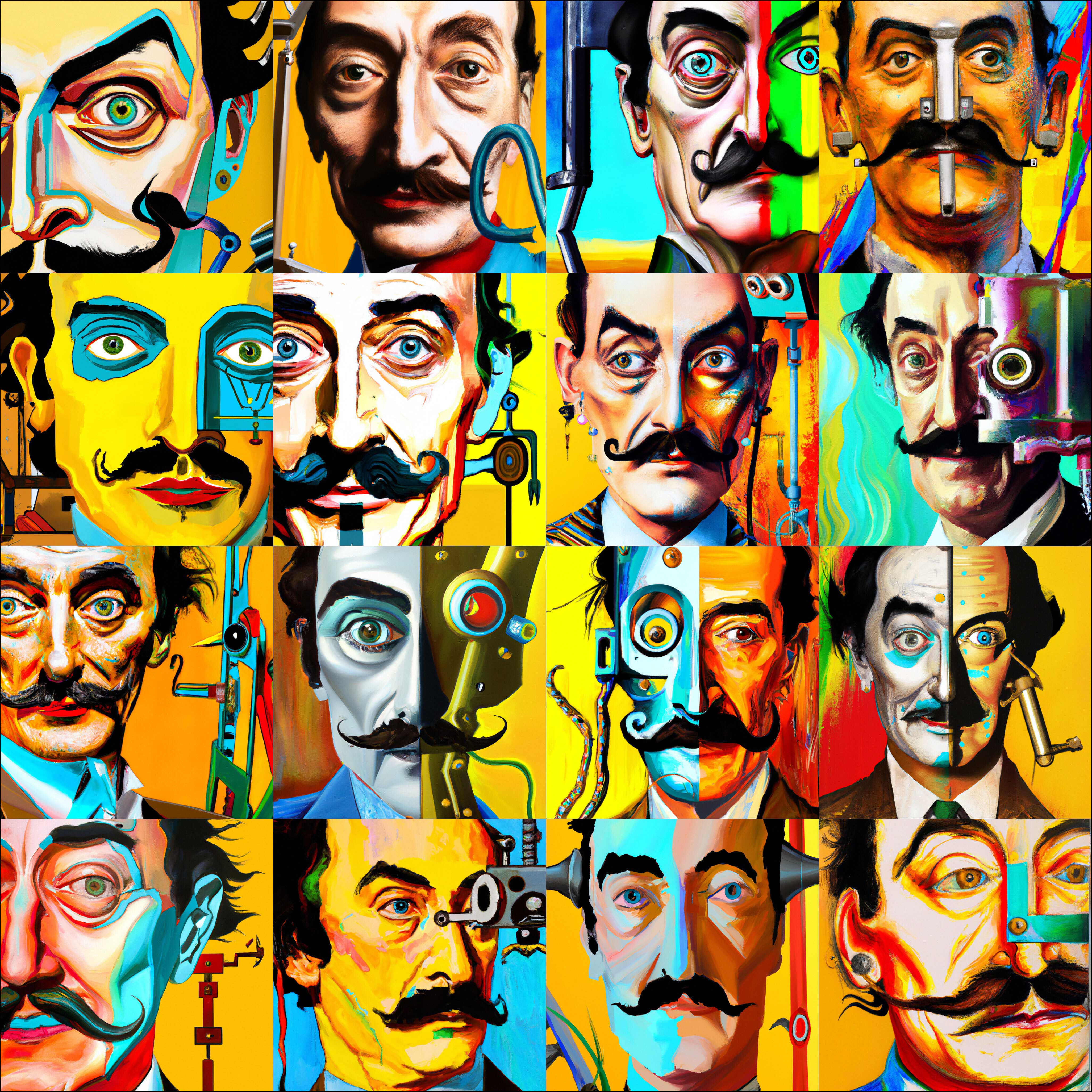
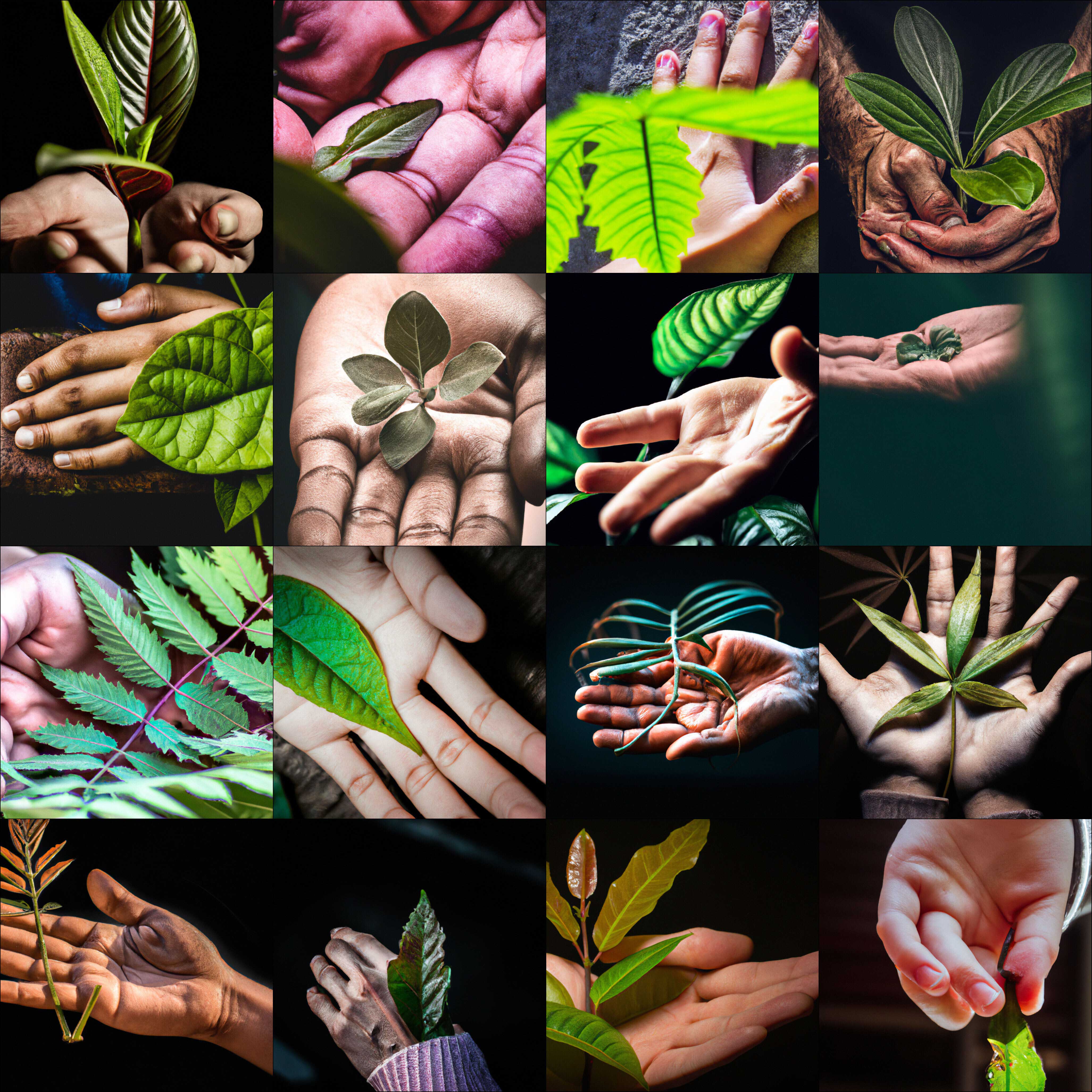
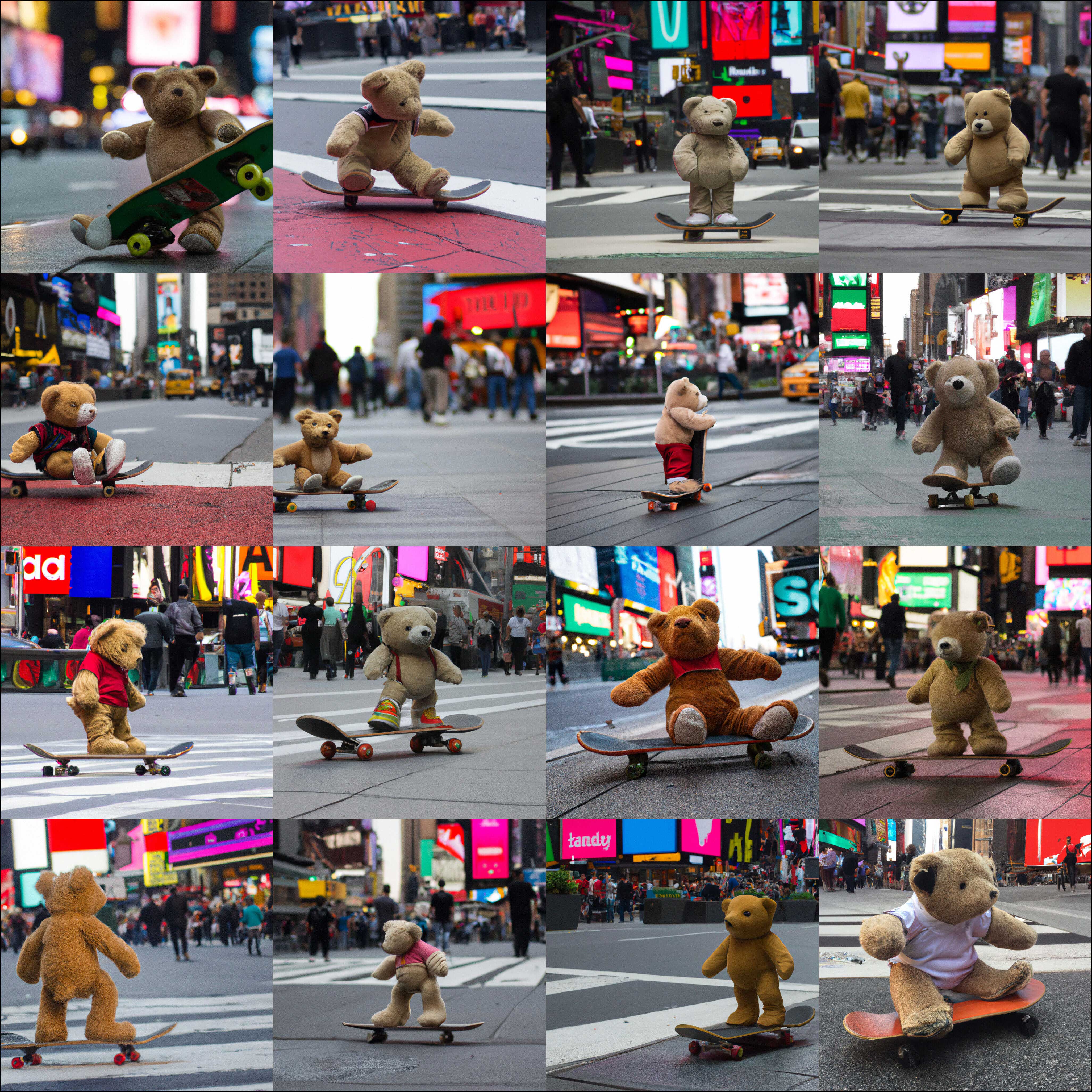
In Figure 18, Figure 19 and Figure 20 we show random samples from our production model for some of the prompts from Figure 1.