
GLaM: Efficient Scaling of Language Models with Mixture-of-Experts
Nan Du$^{,1}$, Yanping Huang$^{,1}$, Andrew M. Dai$^{*,1}$, Simon Tong$^{1}$, Dmitry Lepikhin$^{1}$, Yuanzhong Xu$^{1}$, Maxim Krikun$^{1}$, Yanqi Zhou$^{1}$, Adams Wei Yu$^{1}$, Orhan Firat$^{1}$, Barret Zoph$^{1}$, Liam Fedus$^{1}$, Maarten Bosma$^{1}$, Zongwei Zhou$^{1}$, Tao Wang$^{1}$, Yu Emma Wang$^{1}$, Kellie Webster$^{1}$, Marie Pellat$^{1}$, Kevin Robinson$^{1}$, Kathleen Meier-Hellstern$^{1}$, Toju Duke$^{1}$, Lucas Dixon$^{1}$, Kun Zhang$^{1}$, Quoc V Le$^{1}$, Yonghui Wu$^{1}$, Zhifeng Chen$^{1}$, Claire Cui$^{1}$
$^{*}$Equal contribution ${}^{1}$Google.
Correspondence to: Nan Du, Yanping Huang, and Andrew M. Dai <[email protected], [email protected], [email protected]>.
Proceedings of the 39 th International Conference on Machine Learning, Baltimore, Maryland, USA, PMLR 162, 2022. Copyright 2022 by the author(s).
Abstract
Scaling language models with more data, compute and parameters has driven significant progress in natural language processing. For example, thanks to scaling, GPT-3 was able to achieve strong results on in-context learning tasks. However, training these large dense models requires significant amounts of computing resources. In this paper, we propose and develop a family of language models named GLaM (Generalist Language Model), which uses a sparsely activated mixture-of-experts architecture to scale the model capacity while also incurring substantially less training cost compared to dense variants. The largest GLaM has 1.2 trillion parameters, which is approximately 7x larger than GPT-3. It consumes only 1/3 of the energy used to train GPT-3 and requires half of the computation flops for inference, while still achieving better overall zero, one and few-shot performance across 29 NLP tasks.
Executive Summary: Large language models have revolutionized natural language processing, enabling tasks like question answering and text generation with minimal examples. However, scaling these models to billions or trillions of parameters demands enormous computational resources and energy, raising costs and environmental concerns amid growing demands for AI applications. This is especially pressing now, as models like GPT-3 demonstrate impressive few-shot learning but consume vast electricity, equivalent to hundreds of households for months.
This paper introduces GLaM, a family of generalist language models designed to scale efficiently. It aims to show that a sparsely activated mixture-of-experts architecture can match or exceed the performance of dense models like GPT-3 while using far less training energy and inference compute.
The authors trained GLaM models ranging from 0.1 billion to 1.2 trillion parameters on a 1.6-trillion-token dataset curated from web pages, books, news, Wikipedia, forums, and conversations. They filtered web data for quality using a classifier to prioritize high-value content, then sampled sources proportionally to balance diversity and prevent biases. Models employ a transformer-based decoder with mixture-of-experts layers, where each input token activates only two experts out of 64, engaging about 8% of total parameters. Training used Google's TPUs over several months, with evaluations on 29 standard NLP benchmarks in zero-shot, one-shot, and few-shot settings, mirroring GPT-3's protocol but excluding synthetic tasks.
Key results highlight GLaM's advantages. The largest model, with 1.2 trillion parameters, outperforms GPT-3's 175-billion-parameter version by 10% on average in zero-shot learning, 6% in one-shot, and 4% in few-shot across the 29 tasks, including open-domain question answering and reading comprehension. For instance, it achieves 76% accuracy on TriviaQA's open-domain split, surpassing GPT-3 by 5 percentage points and prior fine-tuned records. GLaM uses half the floating-point operations per token during inference and one-third the energy (456 megawatt-hours versus 1,287 for GPT-3) to train fully. Smaller GLaM variants consistently beat dense equivalents at similar compute levels, and data quality filtering boosted performance by 5-10% on generative tasks compared to unfiltered data. Additionally, GLaM narrows the gender bias gap on the WinoGender benchmark to near parity (72% accuracy for both stereotypical and anti-stereotypical cases), suggesting reduced reliance on shallow correlations.
These findings mean organizations can build more capable AI systems at lower cost and environmental impact—reducing carbon emissions by about 90% for equivalent performance—while improving efficiency in data use. Unlike expectations that sheer scale drives progress, results show sparsity enables better knowledge retention and fairness without proportional resource hikes, challenging dense architectures' dominance. This could accelerate AI adoption in resource-constrained settings, though biases persist in co-occurrence patterns (e.g., gendered adjectives like "pretty" for "she").
Next, leaders should prioritize mixture-of-experts designs for new language models to optimize scaling, investing in high-quality data curation over volume. Pilot deployments of GLaM-like models on specific applications, such as chatbots or search, could validate gains. Further work needs toxicity mitigation, as even low-risk prompts yield 10-20% toxic outputs, and broader bias audits beyond gender.
Limitations include reliance on a web-heavy dataset, with minor contamination (under 5% on most benchmarks) potentially inflating scores, and assumptions that two-expert activation balances efficiency and capacity. Confidence is high in performance edges due to rigorous comparisons, but caution applies to serving: larger parameter counts demand more hardware, risking higher upfront costs for low-traffic uses.
1. Introduction
Section Summary: Language models have driven major advances in natural language processing over the past decade, evolving from simple word representations to massive systems like GPT-3 that can perform complex tasks with minimal examples, though scaling them up demands huge computational resources and energy. This paper introduces GLaM, a new family of efficient language models that use a sparse activation approach, activating only a fraction of their 1.2 trillion parameters per task, which allows the largest version to outperform GPT-3 on various benchmarks while using about half the computing power and one-third the training energy. The work also reveals that high-quality data matters more than sheer volume for these models, reduces gender biases in examples, and positions sparse designs as a key path for creating powerful, energy-saving AI tools.
Language models have played an important role in the progress of natural language processing (NLP) in the past decade. Variants of language models have been used to produce pretrained word vectors [1, 2], and contextualized word vectors [3, 4] for many NLP applications. The shift towards scaling with more data and larger models [5, 6, 7] has enabled complex natural language tasks to be performed with less labeled data. For example, GPT-3 [8] and FLAN [9] demonstrated the feasibility of in-context learning for few-shot or even zero-shot generalization, meaning very few labeled examples are needed to achieve good performance on NLP applications. While being effective and performant, scaling further is becoming prohibitively expensive and consumes significant amounts of energy [10].
\begin{tabular}{l@{\hskip0.03\linewidth}c@{\hskip0.03\linewidth}c@{\hskip0.03\linewidth}c@{\hskip0.03\linewidth}l}
\toprule
& & \textbf{GPT-3} & \textbf{GLaM} & relative \\\midrule
\multirow{2}{*}{cost} & FLOPs / token (G) & 350 & \textbf{180} & \textbf{\textminus48.6\%}\\
& Train energy (MWh) & 1287 & \textbf{456} & \textbf{\textminus64.6\%}\\\midrule
\multirow{3}{*}{\makecell{accuracy\\on average}} & Zero-shot & 56.9 & \textbf{62.7} & \textbf{+10.2\%}\\
&One-shot & 61.6 & \textbf{65.5} & \textbf{+6.3\%}\\
&Few-shot & 65.2 & \textbf{68.1} & \textbf{+4.4\%}\\
\bottomrule
\end{tabular}
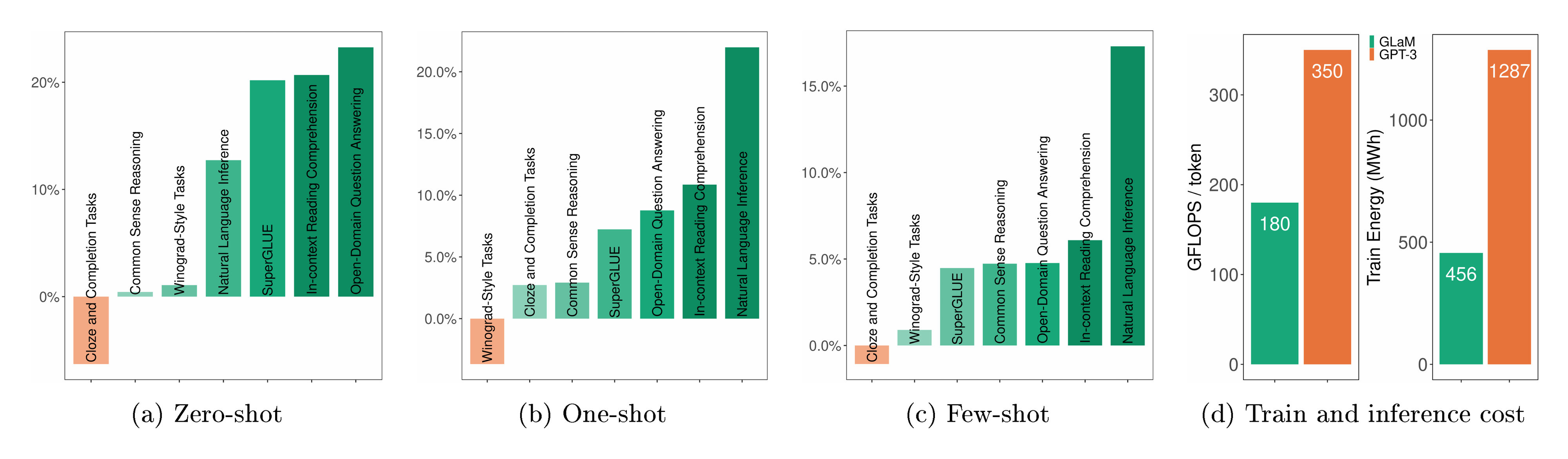
In this work, we show that a large sparsely activated network can achieve competitive results compared to state-of-the-art dense models on few-shot tasks while being more computationally efficient. We present a family of generalist language models called GLaM, that strike a balance between dense and conditional computation. The largest version of GLaM has 1.2T parameters in total with 64 experts per MoE layer [5, 11, 12] where each token in the input batch only activates a subnetwork of 96.6B (8% of 1.2T) parameters. On zero, one and few-shot learning, this model compares favorably to GPT-3 (175B), with significantly improved learning efficiency across 29 public NLP benchmarks, ranging from language completion tasks, open-domain QA tasks, to natural language inference tasks. Thanks to the sparsely activated architecture and the efficient implementation of the model parallelism algorithm, the total energy consumption during training is only one third of GPT-3's. We highlight the comparison between the largest version of GLaM and GPT-3 in Table 1 and Figure 1.
We use GLaM to study the importance of data. Our analysis shows that even for these large models, data quality should not be sacrificed for quantity if the goal is to produce a high-quality auto-regressive language model. More importantly, on social dimensions, our results are also the first, to our knowledge, to close the performance gap between stereotypical and anti-stereotypical examples on the WinoGender benchmark, suggesting that large, sparsely activated models may rely less on superficial statistical correlations.
Finally, although MoE-based sparse models are not yet common in the NLP community, our work shows that sparse decoder-only language models can be more performant than the dense architectures of similar compute FLOPs for the first time within the few-shot in-context learning setting at scale, suggesting that sparsity is one of the most promising directions to achieve high-quality NLP models while saving energy costs [10]. MoE should therefore be considered as a strong candidate for future scaling.
2. Related Work
Section Summary: Neural language models, including word embeddings like word2vec and GloVe, have proven effective for various natural language processing tasks by learning general patterns from vast amounts of text. Advances in pre-training large models, especially those using Transformer architectures, allow for fine-tuning on specific tasks, though this often requires adjustments tailored to each one; recent innovations like GPT-3 enable impressive performance with just a few examples provided in the input text, without any further training. Sparsely activated networks, such as Mixture-of-Experts models including the trillion-parameter GLaM, efficiently use massive parameter counts by activating only a subset during processing, outperforming dense models in few-shot scenarios as shown in comparisons with systems like Switch-C and BERT.
Language models.
Neural language models [13, 14] have been shown to be useful for many natural language processing tasks. Word embedding models and extensions such as word2vec [1], GloVe [2] and paragraph vectors [15] have shown good generalization to many tasks simply by transferring the embeddings.
Pre-training and Fine-tuning.
The abundance of compute and data enables training increasingly large models via unsupervised pre-training. This is a natural fit for training neural networks as they exhibit remarkable scalability. Work on using recurrent models such as RNNs and LSTMs for language representation [16, 17] showed that general language models could be fine-tuned to improve various language understanding tasks. More recently, models that used Transformers [18] showed that larger models with self-supervision on unlabeled data could yield significant improvements on NLP tasks [4, 19, 20, 21]. Transfer learning based on pre-training and finetuning [22, 23] has been extensively studied and demonstrated good performance on downstream tasks. However, a major limitation to this method is that it requires a task-specific fine-tuning.
In-Context Few-shot Learning.
GPT-3 [8] and related work [24, 25, 9] demonstrated that scaling up language models greatly improves task-agnostic, few-shot performance. These language models are applied without any gradient updates, and only few-shot demonstrations specified purely via text interactions with the model are needed.
Sparsely Gated Networks.
Mixture-of-Experts based models have also shown significant advantages. For language modeling and machine translation, [5] showed that they could effectively use a very large number of weights while only needing to compute a small subset of the computation graph at inference time. There has also been work on scaling sparsely activated MoE architectures [26, 27, 11, 28]. Recently, [12] showed results with even larger 1 trillion parameter sparsely activated models (Switch-C). Although both Switch-C and the largest GLaM model have one trillion number of trainable parameters, GLaM is a family of decoder-only language models, and Switch-C is an encoder-decoder based sequence to sequence model. Furthermore, Switch-C is mainly evaluated on fine-tuning benchmarks, e.g., SuperGlue, while GLaM performs well without any need for fine-tuning in the few-shot setting shared by GPT-3 where SuperGlue is a subset. Table 2 summarizes the key differences between GLaM and related models pre-trained on text corpora.
:Table 2: A sample of related models [4, 22, 8, 25, 29, 24, 11, 12] pre-trained on text corpora. $n_{\text{params}}$ is the total number of trainable model parameters, $n_{\text{act-params}}$ is the number of activated model parameters per input token.
| Model Name | Model Type | $n_{\text{params}}$ | $n_{\text{act-params}}$ |
|---|---|---|---|
| BERT | Dense Encoder-only | 340M | 340M |
| T5 | Dense Encoder-decoder | 13B | 13B |
| GPT-3 | Dense Decoder-only | 175B | 175B |
| Jurassic-1 | Dense Decoder-only | 178B | 178B |
| Gopher | Dense Decoder-only | 280B | 280B |
| Megatron-530B | Dense Decoder-only | 530B | 530B |
| GShard-M4 | MoE Encoder-decoder | 600B | 1.5B |
| Switch-C | MoE Encoder-decoder | 1.5T | 1.5B |
| GLaM (64B/64E) | MoE Decoder-only | 1.2T | 96.6B |
3. Training Dataset
Section Summary: To train their AI model, the researchers assembled a massive dataset of 1.6 trillion tokens drawn from diverse sources like web pages, books, Wikipedia, forums, news, and social media conversations, ensuring it reflects everyday language use. Most data came from websites of varying quality, so they created a custom classifier to score and filter out low-quality content, while deliberately including some lower-rated pages via a statistical sampling method to avoid biases. The final mix balanced these components based on how well they performed in a smaller test model, with weights adjusted to prevent smaller sources like Wikipedia from dominating, and they verified minimal overlap with evaluation data to ensure fairness.
To train our model, we build a high-quality dataset of $1.6$ trillion tokens that are representative of a wide range of natural language use cases. Web pages constitute the vast quantity of data in our unlabeled dataset. However, their quality ranges from professional writing to low-quality comment and forum pages. Similarly to [8], we develop our own text quality classifier to produce a high-quality web corpus out of an original larger raw corpus. We use a feature hash based linear classifier for inference speed. This classifier is trained to classify between a collection of curated text (Wikipedia, books and a few selected websites) and other webpages. We use this classifier to estimate the content quality of a webpage. We then apply this classifier by using a Pareto distribution to sample webpages according to their score. This allows some lower-quality webpages to be included to prevent systematic biases in the classifier [8].
:Table 3: Data and mixture weights in GLaM training set.
| Dataset | Tokens (B) | Weight in mixture |
|---|---|---|
| Filtered Webpages | 143 | 0.42 |
| Wikipedia | 3 | 0.06 |
| Conversations | 174 | 0.28 |
| Forums | 247 | 0.02 |
| Books | 390 | 0.20 |
| News | 650 | 0.02 |
We use this process to generate a high-quality filtered subset of webpages and combine this with books, Wikipedia pages, forums and news pages and other data sources to create the final GLaM dataset. We also incorporate the data from public domain social media conversations used by [30]. We set the mixture weights based on the performance of each component in a smaller model and to prevent small sources such as Wikipedia from being over-sampled. Table 3 shows the details of our data component sizes and mixture weights. The mixture weights were chosen based on the performance of the component in a small model and to prevent small datasets such as Wikipedia from being over-sampled. To check data contamination, in Appendix D we conduct an overlap analysis between our training set and the evaluation data and find that it roughly matches that of previous work [8].
4. Model Architecture
Section Summary: The GLaM model builds on the Transformer architecture by incorporating a Mixture-of-Experts (MoE) system, where every other layer replaces the standard feed-forward network with multiple specialized "expert" networks that activate only a few at a time for each piece of input, allowing the model to handle more complexity without proportionally increasing computation. A gating mechanism selects the best two experts for each input token, combining their outputs to create flexible processing paths that mimic many possible network variations. Additional tweaks include using relative positional cues instead of fixed embeddings and special activation functions in non-expert layers, with models scaled up to trillions of parameters through efficient sharding techniques across hardware.
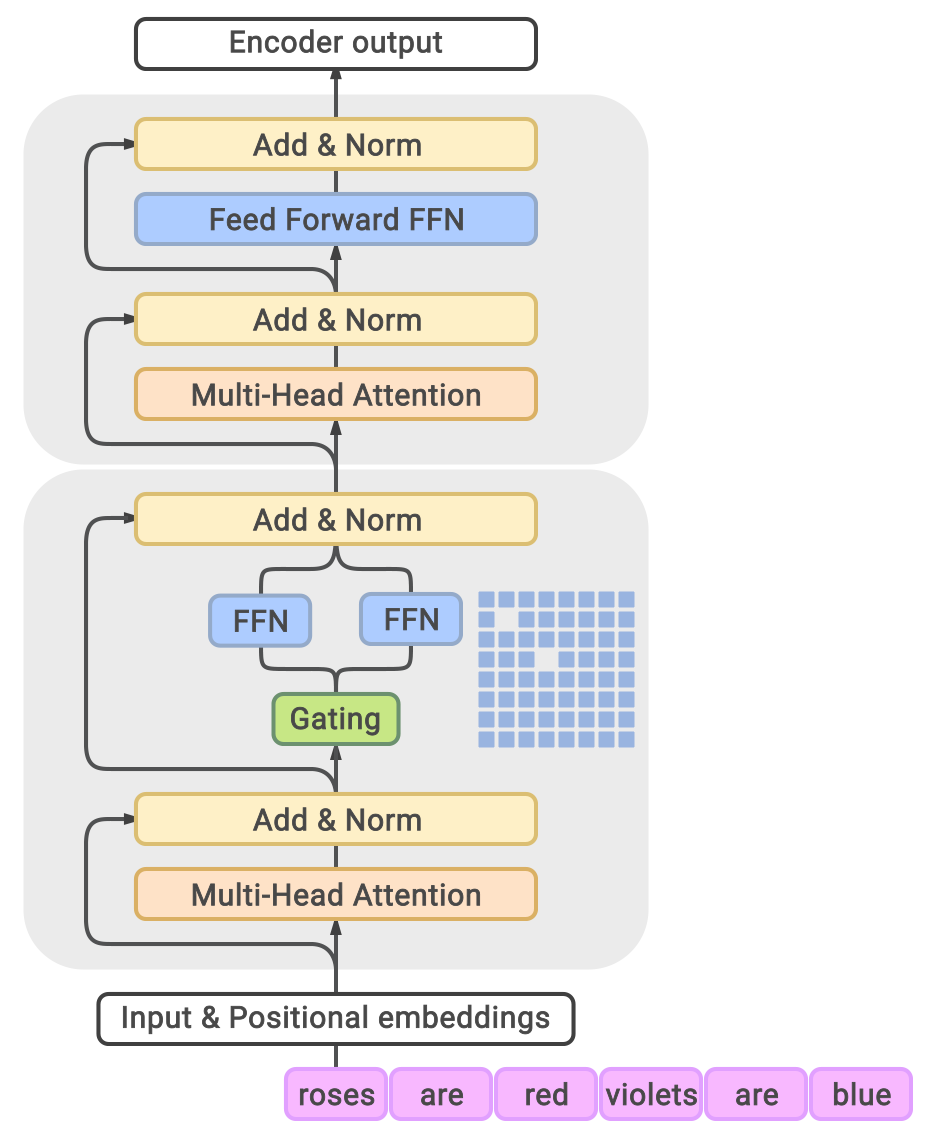
We leverage sparsely activated Mixture-of-Experts (MoE) [5, 12] in GLaM models. Similar to the GShard MoE Transformer [11], we replace the feed-forward component of every other Transformer layer with an MoE layer, as shown in Figure 2. Each MoE layer consists of a collection of independent feed-forward networks as the 'experts'. A gating function then uses a softmax activation function to model a probability distribution over these experts. This distribution indicates how well each expert is able to process the incoming input.
Even though each MoE layer has many more parameters, the experts are sparsely activated. This means that for a given input token, only a limited subset of experts is used, giving the model more capacity while limiting computation. In our architecture, the subset size is two[^1]. Each MoE layer's learnable gating network is trained to use its input to activate the best two experts for each token of an input sequence. During inference, the learned gating network dynamically picks the two best experts for each token. For an MoE layer with $E$ experts, this essentially provides a collection of $O(E^2)$ different combinations of feed-forward networks instead of one in the classic Transformer architecture, leading to much more computational flexibility. The final learned representation of a token will be the weighted combination of the outputs from the selected experts.
[^1]: Using more experts will cost more compute FLOPs per prediction, pushing the network to be 'denser'. Setting the number of selected experts to be two is based on the trade-off between predictive performance and the training/serving efficiency of the model.
We also make additional modifications to the original Transformer architecture. We replace the standard positional embedding with per-layer relative positional bias from [31]. In the non-MoE Transformer feed-forward sub-layers, we replace the first linear projection and the activation function with the Gated Linear Unit [32, 33], which computes the component-wise product of two linear transformation of the input, followed by a Gaussian Error Linear Unit [34] activation function.
\begin{tabular}{lccccccccc}
  \toprule
  GLaM Model & Type & $n_{\text{params}}$ & $n_{\text{act-params}}$ & $L$ & $M$ & $H$ & $n_{\text{heads}}$ & $d_{\text{head}}$ & $E$ \\
  \midrule
  0.1B & Dense & 130M & 130M &\multirow{2}{*}{12} & \multirow{2}{*}{768} & \multirow{2}{*}{3, 072} & \multirow{2}{*}{12} & \multirow{2}{*}{64} & --\\
  0.1B/64E & MoE & 1.9B & 145M & & & & & & 64\\
  \midrule
  1.7B & Dense & 1.7B & 1.700B & \multirow{5}{*}{24} & \multirow{5}{*}{2, 048} & \multirow{5}{*}{8, 192} & \multirow{5}{*}{16} & \multirow{5}{*}{128} & --\\
  1.7B/32E & MoE & 20B & 1.878B & & & & & & 32\\
  1.7B/64E & MoE & 27B & 1.879B & & & & & & 64\\
  1.7B/128E & MoE & 53B & 1.881B & & & & & & 128\\
  1.7B/256E & MoE & 105B & 1.886B & & & & & & 256\\
  \midrule
  8B & Dense & 8.7B & 8.7B &\multirow{2}{*}{32} & \multirow{2}{*}{4, 096} & \multirow{2}{*}{16, 384} & \multirow{2}{*}{32} & \multirow{2}{*}{128} & --\\
  8B/64E & MoE & 143B & 9.8B & & & & & & 64\\
  \midrule
  137B & Dense & 137B & 137B & 64 & 8, 192 & 65, 536 & 128 & 128 & --\\
  64B/64E & MoE & 1.2T & 96.6B & 64 & 8, 192 & 32, 768 & 128 & 128 & 64\\
  \bottomrule
  \end{tabular}
We partition the weights and computation of large GLaM models using the 2D sharding algorithm as described in [35], which is described in more details in the Appendix C of the appendix.
5. Experiment Setup
Section Summary: This section outlines the experimental setup for training and evaluating GLaM, a family of large language models that can be dense or use a mixture-of-experts approach to activate only parts of the model efficiently. Researchers trained various sizes from 130 million to 1.2 trillion parameters using consistent settings like a 1,024-token sequence length, a specialized optimizer, and techniques to balance expert usage, while sharing practical tips such as starting with smaller models and handling numerical errors during training on powerful hardware. For evaluation, they focused on zero-shot, one-shot, and few-shot learning across 29 natural language tasks, measuring performance through accuracy and other standard metrics on benchmarks similar to those used for GPT-3.
GLaM is a family of dense and sparse decoder-only language models, so we first elaborate our training settings, hyperparameters, and evaluation protocol in this section.
5.1 Training Setting
We train several variants of GLaM to study the behavior of MoE and dense models on the same training data. Table 4 shows the hyperparameter settings of different scale GLaM models ranging from 130 million parameters to 1.2 trillion parameters. Here, $E$ is the number of experts in the MoE layer, $B$ is the mini-batch size, $S$ is the input sequence length, $M$ is the model and embedding dimension, $H$ is the hidden dimension of the feed-forward network, $L$ is the number of layers and $N$ is the number of total devices. Additionally, $n_{\text{params}}$ is the total number of trainable model parameters, $n_{\text{act-params}}$ is the number of activated model parameters per input token, $n_{\text{heads}}$ is the number of self-attention heads, and $d_{\text{head}}$ is the hidden dimension of each attention head. We also include the respective dense models with comparable numbers of activated parameters per-token during inference (and thus similar numbers of per-token FLOPs) as references. We adopt the notation of
$ \text{GLaM (Base Dense Size} / E) \quad e.g., ~ \text{GLaM (}8\text{B}/64\text{E)} $
to describe different variants in the GLaM models. For example, GLaM (8B/64E) represents the architecture of an approximate 8B parameter dense model with every other layer replaced by a 64 expert MoE layer. GLaM reduces to a dense Transformer-based language model architecture when each MoE layer only has one expert. We use the notation
$ \text{GLaM (Dense Size}) \quad e.g., ~ \text{GLaM (137B)} $
refers to a dense 137B parameter model trained with the same dataset.
5.2 Hyperparameters and Training Procedure
We use the same learning hyperparameters for all GLaM models. More specifically, We use a maximum sequence length of $1024$ tokens, and pack each input example to have up to 1 million tokens per batch. The dropout rate is set to $0$ since the number of available tokens in the training corpus is much greater than the number of processed tokens during training. Our optimizer is Adafactor [36] with first-moment decay $\beta_1=0$, second-moment decay $\beta_2=0.99$ with a $1 - t^{-0.8}$ decay schedule, update clipping threshold of $1.0$, and factored second-moment estimation. We keep the initial learning rate of $0.01$ for the first 10K training steps, and then decay it with inverse square root schedule $\text{lr} \langle \text{t} \rangle \propto \frac{1}{\sqrt{\text{t}}}$. On top of the standard cross-entropy loss, we add the MoE auxiliary loss as described in GShard [11] with a $0.01$ coefficient to encourage expert load balancing so that the gating function will distribute tokens more evenly across all experts. We use the SentencePiece [37] subword tokenizer with a vocabulary of size of $256$ K. During training, we use float32 for model weights and bfloat16 for activations. The largest GLaM 64B/64E model was trained on 1, 024 Cloud TPU-V4 chips.
Training models at the trillion parameter scale is extremely expensive even for sparsely activated models. There is little room for hyperparameter tuning. Here we share our training recipes and some implementation tricks for the GLaM models.
- We train smaller-scale models to convergence first. This allows us to expose potential issues in the dataset and infrastructure as early as possible.
- We skip weight updates for a batch if there are any NaNs or Infs in the gradients [38]. Note NaN/Inf could still occur during the applying gradient step, in which case we restart from an earlier checkpoint as described below. For example, even if there is no Inf in the existing variable or the gradient, the updated variable could still lead to Inf.
- We restart from an early healthy checkpoint when encountering rare large fluctuations or even NaN/Inf during training. Randomness of the sequentially loaded batches might help escape from previous failed states in the training after restart.
5.3 Evaluation Setting
Protocol.
To clearly demonstrate the effectiveness of GLaM models, we mainly focus on evaluating the zero, one and few-shot learning protocols suggested by [39, 8]. For the zero-shot learning setting, in most cases, we evaluate each example in the development set directly. For one/few-shot learning, we mainly draw random one/few examples from that task's training set as the only demonstration and context. Such a demonstration is concatenated with the evaluation example with two newlines in between, and then fed into the model.
Benchmarks.
To allow for an apples-to-apples comparison between GPT-3 and GLaM, we choose the same suite of evaluation tasks as [8]. But for simplicity, we exclude 7 synthetic tasks (arithmetic and word unscramble) and 6 machine translation datasets. With this exclusion, we end up with 29 datasets, which includes 8 natural language generative (NLG) tasks and 21 natural language understanding (NLU) tasks. These datasets can be further grouped into 7 categories and are listed in Appendix A.
Natural Language Generative tasks.
We compare the language sequences decoded by the models to the ground truth in generative tasks. These tasks are TriviaQA, NQS, WebQS, SQuADv2, LAMBADA, DROP, QuAC and CoQA. The performance is measured by the accuracy of exact match (EM) and F1 score, following the standard for each task in [8]. We use beam search with a width of 4 to generate the sequences.
Natural Language Understanding tasks.
Most language understanding tasks require the model to select one correct answer from multiple options. All binary classification tasks are formulated into the form of selecting among two options ('Yes' or 'No'). The prediction is based on the maximum log-likelihood of each option given the context $\log{P(\text{option}|\text{context})}$ normalized by the token length of each option. On a few tasks, such as ReCoRD [40] and COPA [41], the non-normalized loss can yield better results and thus is adopted. Except for MultiRC [42] where the $\text{F1}$ metric over the set of answer options (referred to as $\text{F1}_a$) is reported, the prediction accuracy metric is used for all the other tasks. We use the average of the scores reported in all datasets to report the overall few-shot performance of models on both NLG and NLU tasks. Both Accuracy (EM) and F1 scores have been normalized to lie between 0 and 100. On TriviaQA, we also report the testing server score of our one-shot submission.
6. Results
Section Summary: The GLaM models, which use a sparse activation approach to engage only a fraction of their parameters during processing, perform as well as or better than larger dense models like GPT-3 across various language tasks, while requiring only half the computational power. In particular, the 64-billion-parameter GLaM excels on challenging open-domain question-answering tasks like TriviaQA, surpassing previous top results even without fine-tuning, and training on high-quality filtered data significantly boosts performance, especially for generating new text. Scaling studies show that GLaM's performance improves steadily with increased effective computation per prediction, outperforming equivalent dense models and highlighting the benefits of this efficient design for larger models.
We conduct extensive evaluation on the whole family of GLaM models, to show the advantages of sparsely activated models in language modeling and their scaling trends. We also quantitatively inspect the effectiveness of data quality for language model training.
6.1 Comparison between MoE and Dense Models
As previously presented in Table 1, GLaM (64B/64E) has competitive performance compared to GPT-3 (175B) for zero, one and few-shot learning. Figure 1 compares the performance for each category of tasks. In total, GLaM (64B/64E) outperforms GPT-3 in 6 out of 7 categories on average, indicating the performance gain is consistent. For more details on each individual task, see Table 11. We include results on the much larger and computationally demanding Megatron-NLG and Gopher for reference. More importantly, as shown in Table 4, GLaM (64B/64E) activates roughly 96.6B parameters per token during inference, which requires only half of the compute FLOPs needed by GPT-3 given the same input.
We highlight one particular challenging open-domain question answer task: TriviaQA. In open-domain question answer tasks, the model is required to directly answer a given query without access to any additional context. [8] show that the few-shot performance of TriviaQA is able to grow smoothly with model size, indicating a language model is able to absorb knowledge using its model capacity. As shown in Table 5, GLaM (64B/64E) is better than the dense model and outperforms the previous finetuned state-of-the-art (SOTA) on this dataset in the open-domain setting. Our one-shot result exceeds the previous finetuned SOTA [43] where additional knowledge graph information is infused by 8.6%, and outperforms the few-shot GPT-3 on the testing server by 5.3%. This suggests that the additional capacity of GLaM plays a crucial role in the performance gain even though the $n_{\text{act-params}}$ of GLaM (64B/64E) is only half of that in GPT-3. Comparing to Switch-C, even though both models have similar total number of parameters, GLaM (64B/64E) uses much larger experts (beyond one TPU core) than Switch-C. Therefore, GLaM’s one-shot performance on TriviaQA is also better than the fine-tuned results of Switch-C in the open-domain setting.
\begin{tabular}{lc}
  \toprule
  Model & \makecell{TriviaQA \\(Open-Domain)} \\
  \midrule
  \makecell[l]{KG-FiD (large) [43] \\({\scriptsize finetuned, test})} & 69.8\\
  Switch-C ({\scriptsize finetuned, dev}) & 47.5\\
  GPT-3 One-shot ({\scriptsize dev}) & 68.0\\
  GPT-3 64-shot ({\scriptsize test}) & 71.2\\
  GLaM One-shot ({\scriptsize test})& 75.0\\
  GLaM One-shot ({\scriptsize dev})& \textbf{75.8}\\
  \bottomrule
  \end{tabular}
Finally, we report zero, one and few-shot evaluation mainly on the development set for all tasks in Table 11, Table 12, Table 13 and Table 14 of the appendix.
6.2 Effect of Data Quality
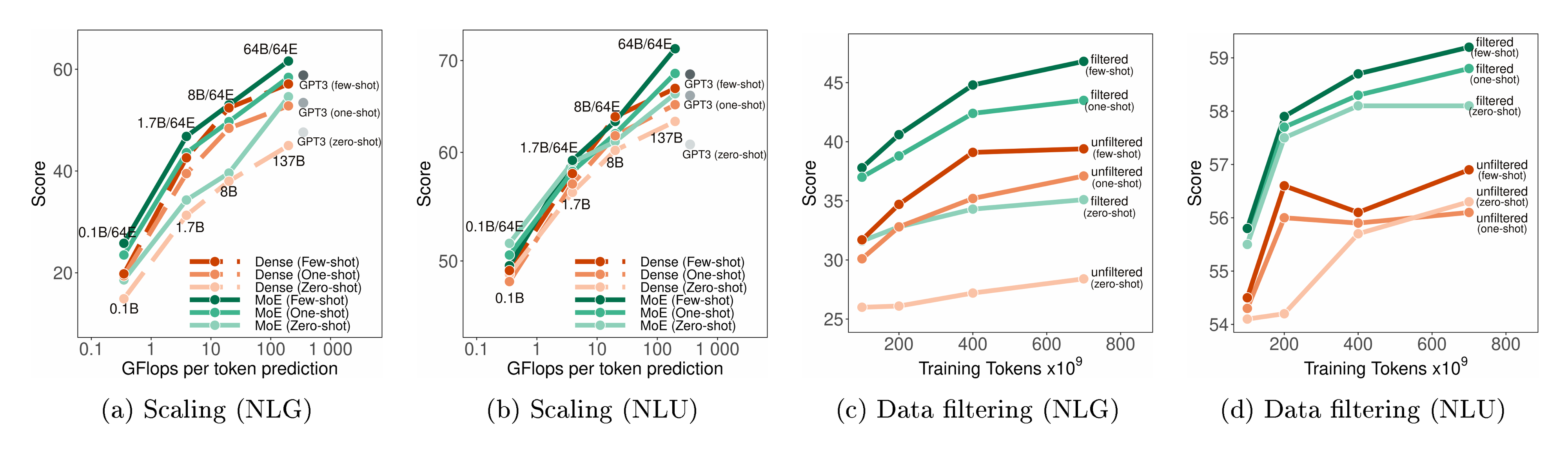
We study the impact of data quality on the few-shot performance of downstream tasks. We use a modest-size GLaM model (1.7B/64E) to show the effectiveness of filtering text on model quality. We train models with the same hyperparameters on two datasets. One is the original dataset described in Section 3 and the second consists of the dataset with the filtered webpages replaced with the unfiltered webpages. The mixing proportions are fixed as given in Table 3. The filtered webpages consist of 143B tokens whereas the unfiltered webpages consist of around 7T tokens.
Figure 3 (c) and (d) show that the model trained on filtered data performs consistently better on both NLG and NLU tasks. In particular, the effect of filtering is bigger on NLG than that on NLU. Perhaps this is because NLG often requires generating high-quality language and filtered pretraining corpora is crucial to the generation capability of language models. Our study highlights the fact that the quality of the pretrained data also plays a critical role, specifically, in the performance of downstream tasks.
6.3 Scaling Studies
Scaling up dense language models generally involves making the models deeper by adding more layers, and wider by increasing the embedding dimension of token representations. This process increases the total number of parameters $n_{\text{params}}$ of the model. For each prediction on a given input example, these models are 'dense' in that all $n_{\text{params}}$ parameters will be activated, i.e., $n_{\text{params}} = n_{\text{act-params}}$ in Table 4. Therefore, the effective FLOPs per prediction increases linearly with the model size $n_{\text{params}}$. While the increased FLOPs may lead to boosted predictive performance, it also raises the overall cost per prediction.
In contrast, GLaM MoE models are sparsely activated in that only a small fraction of the total $n_{\text{params}}$ parameters will be activated for each prediction where $n_{\text{params}} \gg n_{\text{act-params}}$. Therefore, GLaM MoE models can scale by also growing the size or number of experts in the MoE layer.
As shown in Figure 3(a), the average zero, one and few-shot performance across the generative tasks scales well with the effective FLOPs per prediction which is in turn determined by $n_{\text{act-params}}$. We also find that GLaM MoE models perform consistently better than GLaM dense models for similar effective FLOPs per token. For language understanding tasks shown in Figure 3(b), the performance gain of GLaM MoE models has a similar scaling trend to that of the generative tasks. We observe that both MoE and dense models perform similarly at smaller scales but MoE models outperform at larger scales. We also show experiments with scaling the number of experts in Appendix B where we observe that, for a fixed budget of computation per prediction, adding more experts generally leads to better predictive performance.
6.4 Efficiency of GLaM
Existing large dense language models usually require tremendous amounts of computation resources for training and serving [10]. They also need to consume massive amounts of pretraining data. We investigate the data and compute efficiency of the proposed GLaM models.
Data Efficiency. Figure 4 (a-c) and Figure 4(e-g) show the learning curves of our models compared to the dense baselines of similar effective FLOPs in both NLG and NLU tasks. The x-axis is the number of tokens used in training where we explicitly include GPT-3’s results when it is around 300B tokens. We first observe that GLaM MoE models require significantly less data than dense models of comparable FLOPs to achieve similar zero, one, and few-shot performance. In other words, when the same amount of data is used for training, MoE models perform much better, and the difference in performance becomes larger when training up to 630B. Moreover, GLaM (64B/64E) model trained with 280B tokens outperforms GPT-3 trained with 300B tokens by large margins on 4 out of the 6 learning settings (zero-shot/one-shot NLU and one-shot/few-shot NLG), and matches GPT-3 scores for the remaining setting, i.e., zero-shot NLG tasks.
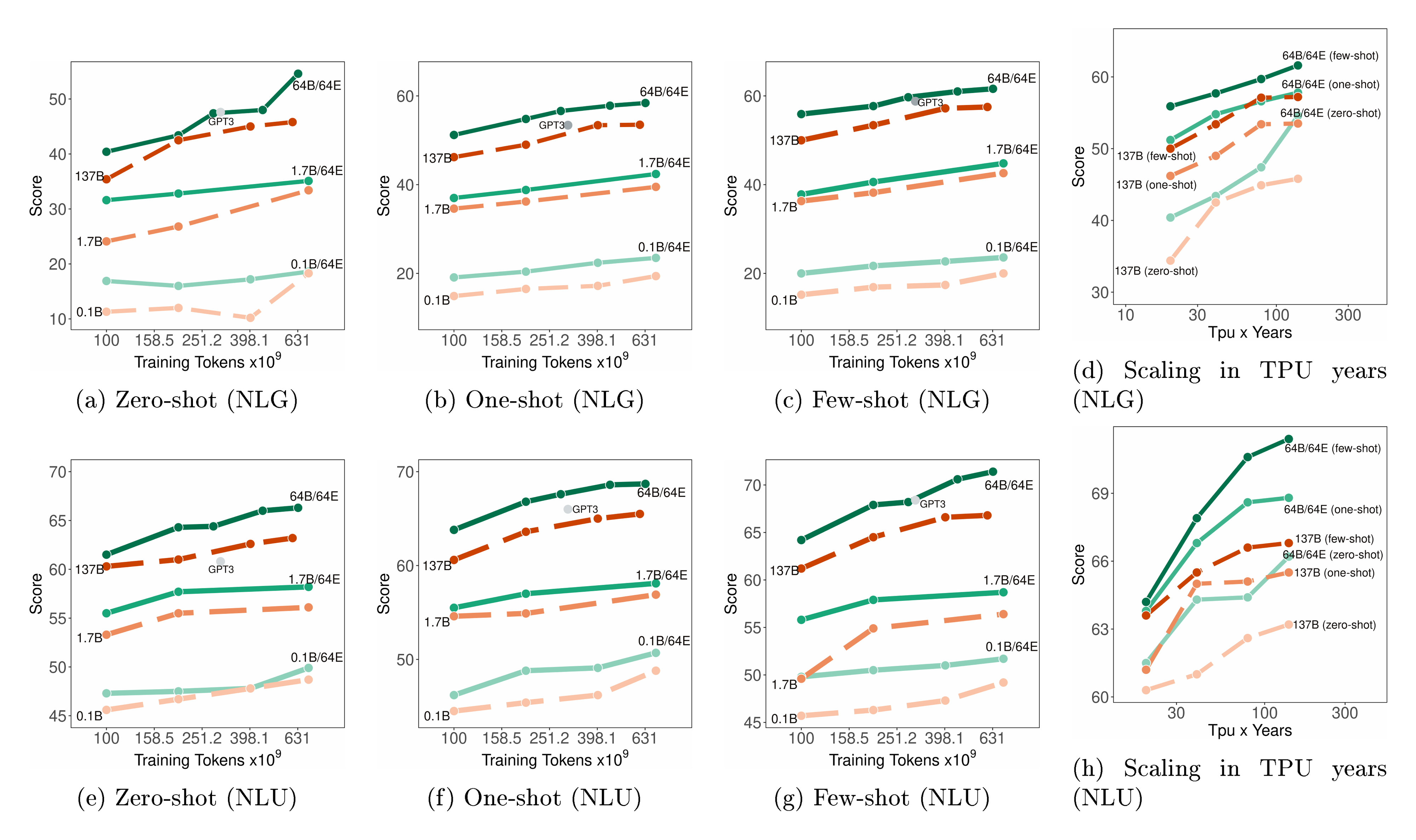
Computation Efficiency & Energy Consumption. Figure 4 (d) and Figure 4 (h) show how the average zero, one and few-shot performance scales with the number of TPU years spent training MoE and dense models. We find that to achieve similar performance on downstream tasks, training sparsely activated models takes much less computational resources than training dense models.
As previously presented in Table 1, the GLaM (64B/64E) training after 600B tokens consumes 456 MWh, about 1/3 of the energy cost of 1287 MWh used by GPT-3. Moreover, to reach similar (and slightly exceeded) scores as GPT-3, we train using 1, 024 TPU-v4 chips for 574 hours (with 280B tokens). This consumes 213 MWh or 1/6 of the GPT-3 energy cost. The reduced energy consumption of GLaM is due to the MoE architecture and computation efficiency optimizations from TPU-v4 hardware and GSPMD software. Energy calculations can be found in Appendix F.
7. Ethics and Unintended Biases
Section Summary: Large language models offer exciting possibilities by allowing intuitive control through natural language and small datasets, making AI more accessible without needing expert skills, but they also raise serious ethical issues like biases in representation, data handling, privacy, and environmental impact. These models can unintentionally learn harmful stereotypes, such as linking genders to certain professions or showing negative attitudes toward racial, religious, or disabled groups, prompting active research into better ways to measure and reduce these biases. To evaluate their model, researchers examined word associations in generated text for identity terms, tested coreference resolution on the WinoGender benchmark where it performed well with balanced accuracy across genders, and assessed toxicity in continuations, finding that the model often mirrors the prompt's tone more closely than human writing does.
Large language models' zero-and few-shot inference is an exciting capability: being able to control model behaviour intuitively with natural language and small datasets significantly lowers the barrier to prototyping and the development of new applications; it has the potential to help democratise using AI by dramatically decreasing the need for specialist knowledge. However, such opportunities also serve to highlight the importance of the many ethical challenges [44, 45, 46] including representation bias [47], proper selection and handling of training data [48] and its documentation [49], privacy [50, 51], and environmental concerns [52, 10]. An important strand of this research focuses on unintended biases learnt by language models, including correlations between gender and profession ([53, 54, 55]), negative sentiment about racial and religious groups [56, 57], and about people with disabilities ([58]), as well as other social biases ([59, 60, 61, 62]). While measuring and mitigating the potential harm of language models is a very active area of research, as recognized by [63, 64] there is still a significant need for more rigorous evaluation methods to assess the degree to which language models encode harmful stereotypes ([65, 66]).
While there is not yet consensus on measurement methods or criteria for such general purpose large language models, the versatility and power of these models make it important to assess them on a range of metrics. We take inspiration from GPT-3 ([8]) and examine the co-occurrence in generated text referencing identity terms as well as report on the WinoGender benchmark ([54]). We also analyse toxicity degeneration similarly to Gopher ([29]), and extend the analysis to consider the human-behavioral baseline.
7.1 Co-occurrence prompts
Following the procedure described in [8], we analyze commonly co-occurring words in the continuations when given prompts like "{term} was very..." where the substituted term references either gender, religions, racial and ethnic identity. For each prompt (Table 7 of the appendix), 800 outputs are generated using top- $k$ sampling ($k=40$) with a temperature of 1. An off-the-shelf POS tagger ([67]) is used to remove stop words and select only descriptive words (i.e., adjectives and adverbs). Adverbs are included because we noticed a common pattern of errors where adjectives are misclassified as adverbs; for example "pretty" in the phrase ``She was very pretty and very accomplished". Like [8], to make the analysis transparent and easily reproducible, we omit any manual human labeling.
Like the analysis of other large language models that we build on, we note associative biases for all dimensions are obvious, for example ``pretty" is the most associated description for the term "She", while it is not in the top-10 for the term "He". Table 8 shows the most frequently occurring descriptive words in response to prompt-templates for gendered pronouns, and Table 9 and Table 10 of the appendix show the same for race and religion prompts.
7.2 WinoGender
Coreference resolution is a capability that many applications require to perform well, including machine translation ([68, 69]) and question answering ([70]). To assess whether gendered correlations in GLaM cause it to make coreference errors in the one-shot setting, we measure WinoGender ([54]). GLaM (64B/64E) achieves a new state-of-the-art of 71.7% on the full dataset (compared to 64.2% for GPT-3 ([8])). Promisingly, accuracy is remarkably close between 'he' examples (70.8%) and 'she' examples (72.5%), as well as between stereotypical examples (where the intended distribution is assumed to be close to the US occupation statistics, [54]) and anti-stereotypical (or 'gotcha') examples (both 71.7%).
7.3 Toxicity Degeneration
Toxicity degeneration is when a language model produces text that is unintentionally toxic. To evaluate toxicity degeneration, we adapt the methodology used in [71, 29]. We use the RealToxicityPrompts dataset [72] which consists of sentences that have been split into two parts: a prompt prefix, and a continuation postfix. Like the previous studies, we also use the Perspective API which assigns a probability that the text would be considered to be rude, disrespectful or otherwise likely to make people want to leave a conversation. We then asses how likely a continuation is to be toxic given various likelihoods that the prompt was toxic.
For each of 10K randomly sampled prompts, we generate 25 continuations, with up to 100 tokens per continuations using top- $k$ sampling ($k=40$) with a temperature of 1. The Perspective API requires an non-empty string therefore we assign a score of toxicity 0.0 when the continuation is the empty string; this could represent, for example, a chat bot simply refusing to respond.
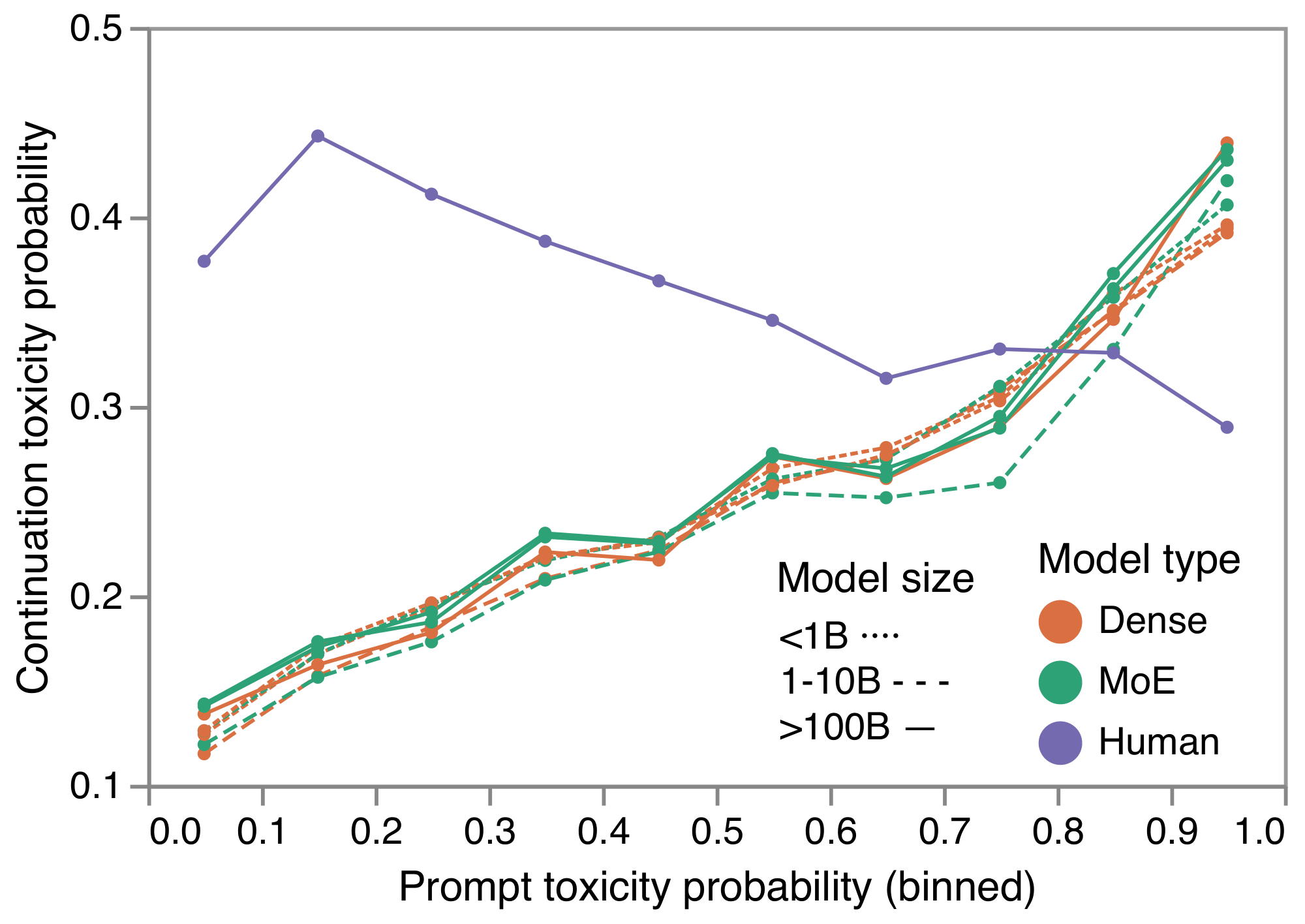
Figure 5 shows the relationship between the Toxicity Probability of the Prompt (TPP), and the Toxicity Probability of the Continuation (TPC). Note that, for low TPP, the relatively high human TPC is due to the sampling strategy used to create the underlying dataset: sentences were selected across the toxicity spectrum. Moreover, toxicity can often be identified locally within a sentence, and toxicity in this dataset tends to occur later the sentences. This causes the human-TPC to slightly drop as the TPP increases. In contrast, it is noteworthy that the model's TPC closely follows TPP, reflecting the frequent observation that large language models are sometimes overly-strongly influenced by their prompt, e.g. repeating phrases from the prompt.
We also analysed the distribution of toxicity probabilities from the API for batches of 25 continuations. This highlighted that, even for low toxicity prompts, it is very likely that some generated continuation will be judged as toxic by most people reviewing it, according to the Perspective API's predicted probability; further details can be found in Figure 8. We also note that this dataset's sampling strategy, and the source it is taken from (Reddit) are likely not reflective of other domains. Moreover, even for very low TPP, applications are likely to want a much lower TPC: even generating 1 in 100 toxic suggestions is likely to be very problematic for applications.
8. Discussion
Section Summary: Mixture of Experts (MoE) models outperform traditional dense models on tasks that rely on stored knowledge, as shown in prior research and open-domain question-answering tests like TriviaQA, where they handle more information despite using similar computing power. These models also offer benefits in learning from examples and faster training. However, they require more total parameters and extra hardware, making them harder to access and more expensive to run, particularly when demand is low.
As observed in previous work on sparsely-activated models [12], MoE models are more performant in knowledge-oriented tasks. Open-domain tasks are one way of measuring the amount of knowledge stored in a model. The performance of the MoE model in open-domain QA benchmarks such as TriviaQA demonstrate the significantly increased information capacity of these models compared to dense models of similar effective FLOPs. Despite the in-context learning and training efficiency advantages, the sparsely activated models consist of a higher number of parameters and thus require a larger number of devices. This limits the resource accessibility and increases the serving cost especially when the serving traffic is low.
9. Conclusions
Section Summary: Researchers have created a new type of AI language model called GLaM, which uses a smart, efficient design called a sparsely activated mixture-of-experts to outperform similar-sized traditional models and even the powerful GPT-3 on a wide range of language tasks, from zero-shot to few-shot learning. Their biggest version, with 1.2 trillion parameters, delivers superior results while using only one-third of the energy needed to train GPT-3. The team hopes this work will inspire more efforts to improve data quality and make giant AI models scale more efficiently.
We propose and develop a family of generalist language models called GLaM, which use a sparsely activated mixture-of-experts architecture to achieve better average scores than not only their dense counterparts of similar effective FLOPs, but also the GPT-3 models on 29 representative NLP tasks in zero, one and few-shot learning. In particular, GLaM (64B/64E), our largest 1.2 trillion parameter MoE language model, achieves better average performance with only one third of energy consumption compared to training GPT-3. We hope that our work will encourage more research into methods for obtaining high-quality data, and using MoE for more efficient scaling of giant language models.
Appendix
Section Summary: The appendix outlines various benchmarks used to evaluate the GLaM model's performance on tasks like question answering, common sense reasoning, and language inference, drawing from datasets such as TriviaQA, ARC, and SuperGLUE. It also explores how scaling the number of experts in the model's mixture-of-experts layers boosts accuracy with minimal extra computation, and details techniques for partitioning large models across devices to handle their size efficiently. Additionally, the section assesses potential data contamination by checking overlaps between training and test sets, finding levels similar to prior studies, and examines ethical concerns like toxicity in outputs, which remain consistent across model variants.
A. Benchmarks
- Open-Domain Question Answering: TriviaQA [73], Natural Questions (NQS) [74], Web Questions (WebQS) [75]
- Cloze and Completion Tasks: LAMBADA [76], HellaSwag [77], StoryCloze [78]
- Winograd-Style Tasks: Winograd [79], WinoGrande [80]
- Common Sense Reasoning: PIQA [81], ARC (Easy) [82], ARC (Challenge) [82], OpenBookQA [83]
- In-context Reading Comprehension: DROP [84], CoQA [85], QuAC [86], SQuADv2 [87], RACE-h [88], RACE-m [88]
- SuperGLUE: [89] BoolQ [90], CB [91], COPA [41], RTE [92], WiC [93], WSC [79], MultiRC [42], ReCoRD [40]
- Natural Language Inference: ANLI R1, ANLI R2, ANLI R3 [94]
B. Scaling the Number of Experts
We also study the effects of increasing the number of experts per MoE layer. More concretely, we start with a modest size model of 1.7B, which essentially is a GLaM (1.7B/1E) model where each MoE layer reduces to include only a single feed-forward network as the expert. We then increase the number of experts in each MoE layer from 1 to 256. Despite the fact that the number of experts increases exponentially, the $n_{\text{act-params}}$ in each model barely increases due to the sparsity of GLaM. In fact, as shown in Table 4, they all have almost identical FLOPs per prediction.
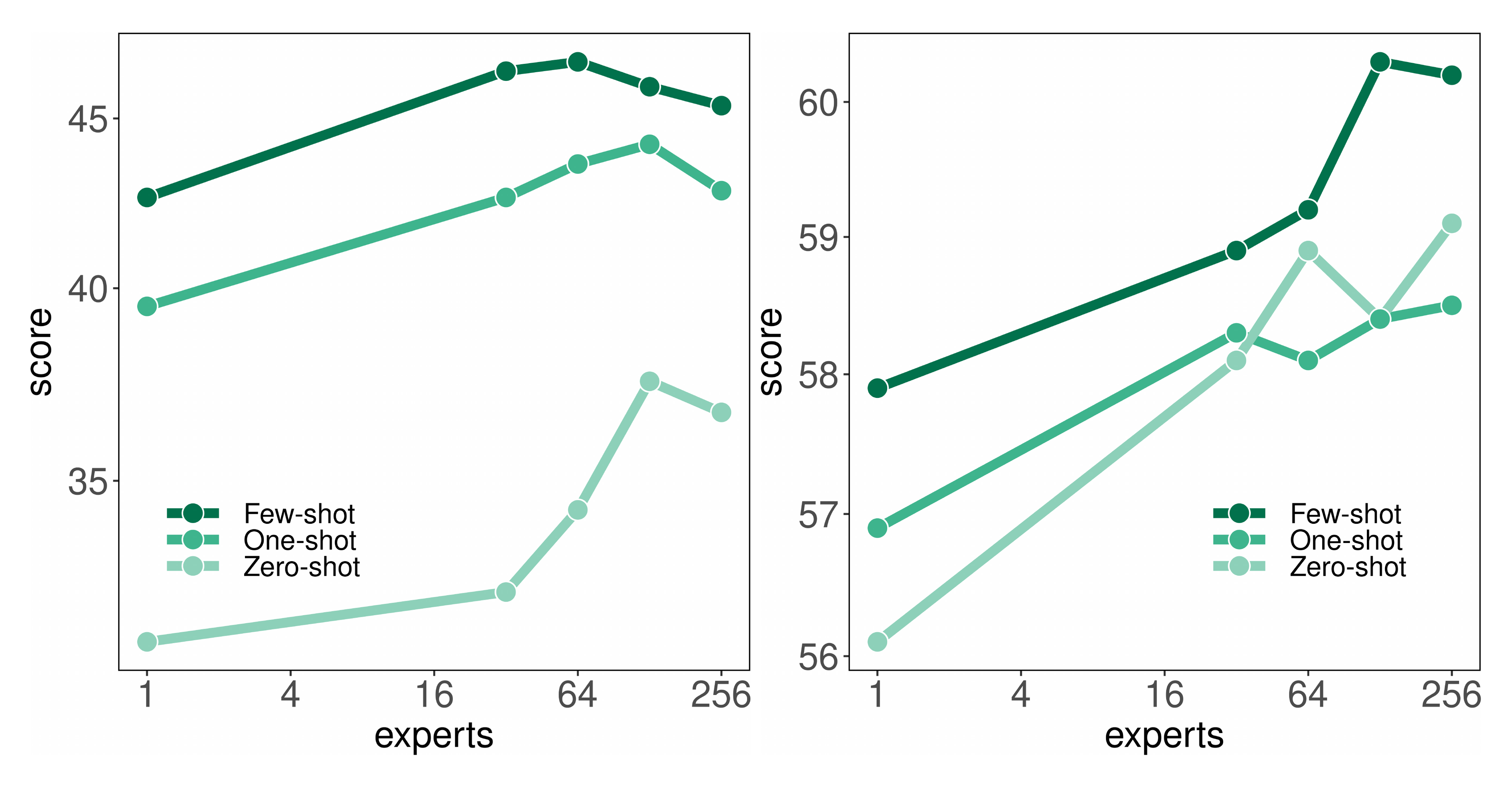
In Figure 6, we observe that, for a fixed budget of computation per prediction, adding more experts generally leads to better predictive performance. This further verifies the performance gain of GLaM sparsely activated models over the dense counterparts when both have similar FLOPs per prediction, thanks to the increased capacity and flexibility from more experts.
C. Model Partitioning
We partition the weights and computation of large GLaM models using the 2D sharding algorithm as described in [35], which exploits the 2D topology of the device network of the TPU cluster. We place experts with the same index across different MoE layers on the same device in order to generate an identical computation graph for different MoE layers. As a result, we can wrap the repetitive modules of the MoE Transformer architecture in a while_loop control flow statement [95, 96] to reduce compilation time. Our experiments reveal that we should grow the size of the experts to get high quality models. Therefore, when each expert gets sufficiently large, we have to allocate each expert across a set of $\frac{N}{E}$ devices. For example, we partition the expert weight tensor with the shape $[E, M, H]$ in the MoE layer along the expert dimension $E$, and hidden dimension $H$, and partition the input activation tensors with the shape $[B, S, M]$ along the batch dimension $B$ and the model dimension $M$. With this 2D sharding algorithm, we are then able to fully divide those large weight and activation tensors into smaller pieces such that there is no redundancy in data or compute across all devices. We rely on GSPMD's compiler pass [35] to automatically determine the sharding properties for the rest of the tensors.
D. Data Contamination
As GLaM was trained on over 1.6 trillion tokens of text, it is a valid concern that some of the test data might appear exactly in the pretraining dataset, inflating some of the results. We therefore follow [8] and [9] and quantify the overlap between pretraining data and evaluation datasets.
Our analysis uses the same methodology as [9], which, in turn closely follows [8]. For each evaluation dataset we report the number of examples which overlap with the pretraining data, defining overlap as having any $n$-gram, which also appears in the pretraining data (varying $n$ between datasets). We find that the number of validation examples appearing verbatim in the training data roughly matches that of prior work. We report these numbers in Table 6.
\begin{tabular}{ll cc cc cc}
  \toprule
  Dataset & Split & \makecell[c]{Dirty \\ count} & \makecell[c]{Total \\ count} & \% clean \\
  \midrule
  ANLI R1 & validation & 962 & 1000 & 3.8 \\
  ANLI R2 & validation & 968 & 1000 & 3.2 \\
  ANLI R3 & validation & 596 & 1200 & 50.33 \\
  ARC Challenge & validation & 95 & 299 & 68.23 \\
  ARC Easy & validation & 185 & 570 & 67.54 \\
  BoolQ & validation & 3013 & 3270 & 7.86 \\
  CB & validation & 15 & 56 & 73.21 \\
  COPA & validation & 3 & 100 & 97.0 \\
  CoQa & test & 375 & 500 & 25.0 \\
  DROP & dev & 9361 & 9536 & 1.84 \\
  HellaSwag & validation & 1989 & 10042 & 80.19 \\
  LAMBADA & test & 1125 & 5153 & 78.17 \\
  MultiRC & validation & 3334 & 4848 & 31.23 \\
  NQs & validation & 141 & 3610 & 96.09 \\
  OpenBookQA & validation & 100 & 500 & 80.0 \\
  PIQA & validation & 902 & 1838 & 50.92 \\
  Quac & validation & 7353 & 7354 & 0.01 \\
  RACE-h & dev & 2552 & 3451 & 26.05 \\
  RACE-m & dev & 838 & 1436 & 41.64 \\
  RTE & validation & 152 & 277 & 45.13 \\
  ReCoRD & validation & 9861 & 10000 & 1.39 \\
  SQuADv2 & validation & 11234 & 11873 & 5.38 \\
  StoryCloze & validation & 1871 & 1871 & 0.0 \\
  TriviaQA & validation & 2121 & 11313 & 81.25 \\
  WSC & test & 157 & 273 & 42.49 \\
  WiC & validation & 46 & 638 & 92.79 \\
  Winograd & validation & 70 & 104 & 32.69 \\
  Winogrande & test & 6 & 1767 & 99.66 \\
  \bottomrule
  \end{tabular}
E. Ethics and Unintended Biases
Like [29], we also analyzed toxicity degeneration with with respect to model scale. This is shown in Figure 7. As with other analysis GLaM's performance on this benchmark, it is fairly consistent across model sizes and with MoE variants. The 0.1B/64E MoE variant, the smallest sparse variant analyzed, is noticeable in the plot and smaller MoE models may be less stable, as noted by [29].
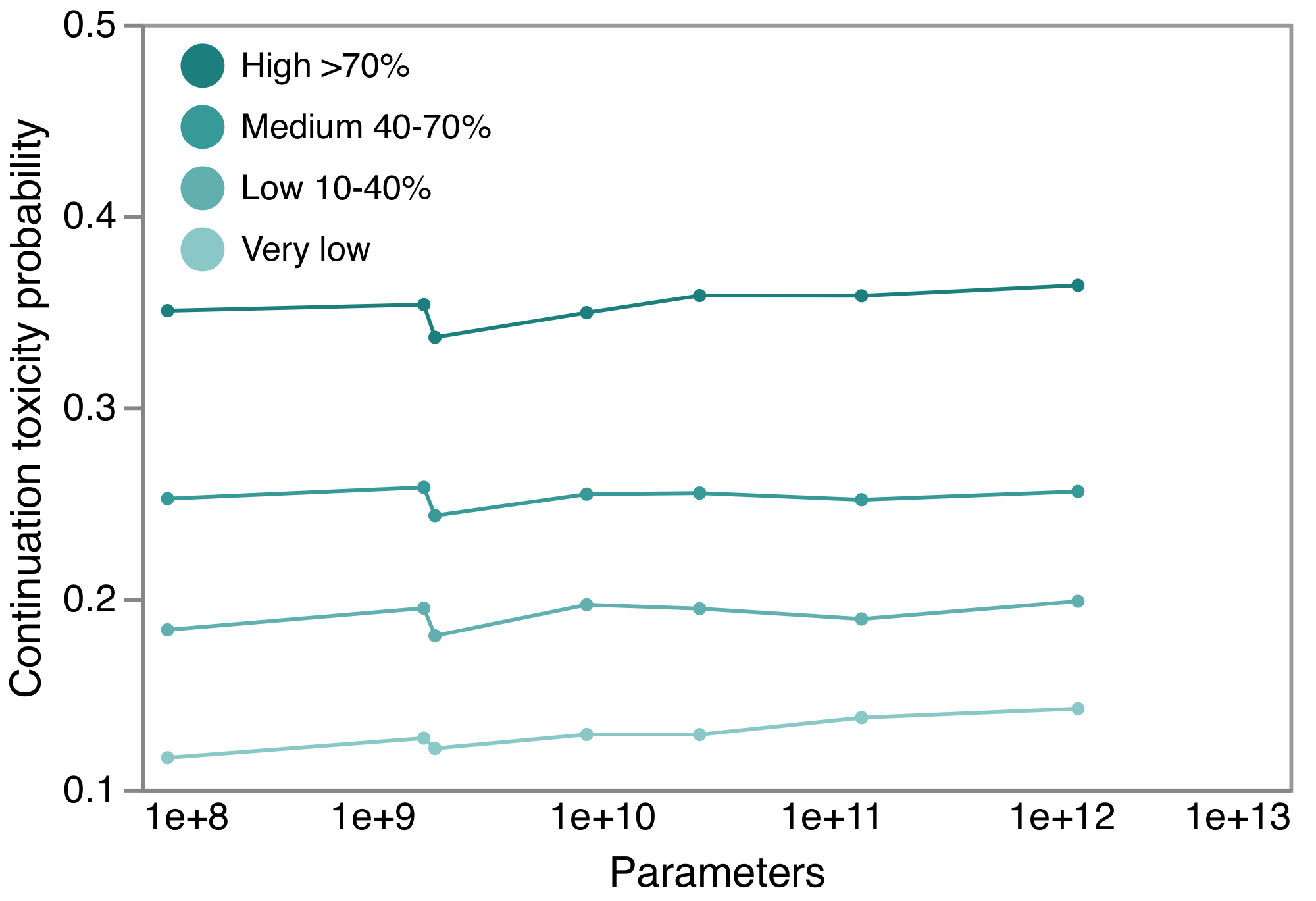
Following [29], we also analysed the aspect of the distribution of generated toxicity probabilities with respect to model scale. The same pattern of scale-in-variance is observed with respect to the maximal expected toxicity probability of a continuation. The distribution of toxicity probabilities from the API for 25 continuations is plotted for low toxicity prompts in Figure 8. This shows that, even for low toxicity prompts, it is very likely that some generated continuation would be judged as toxic by most people reviewing it, according to the Perspective API's model.
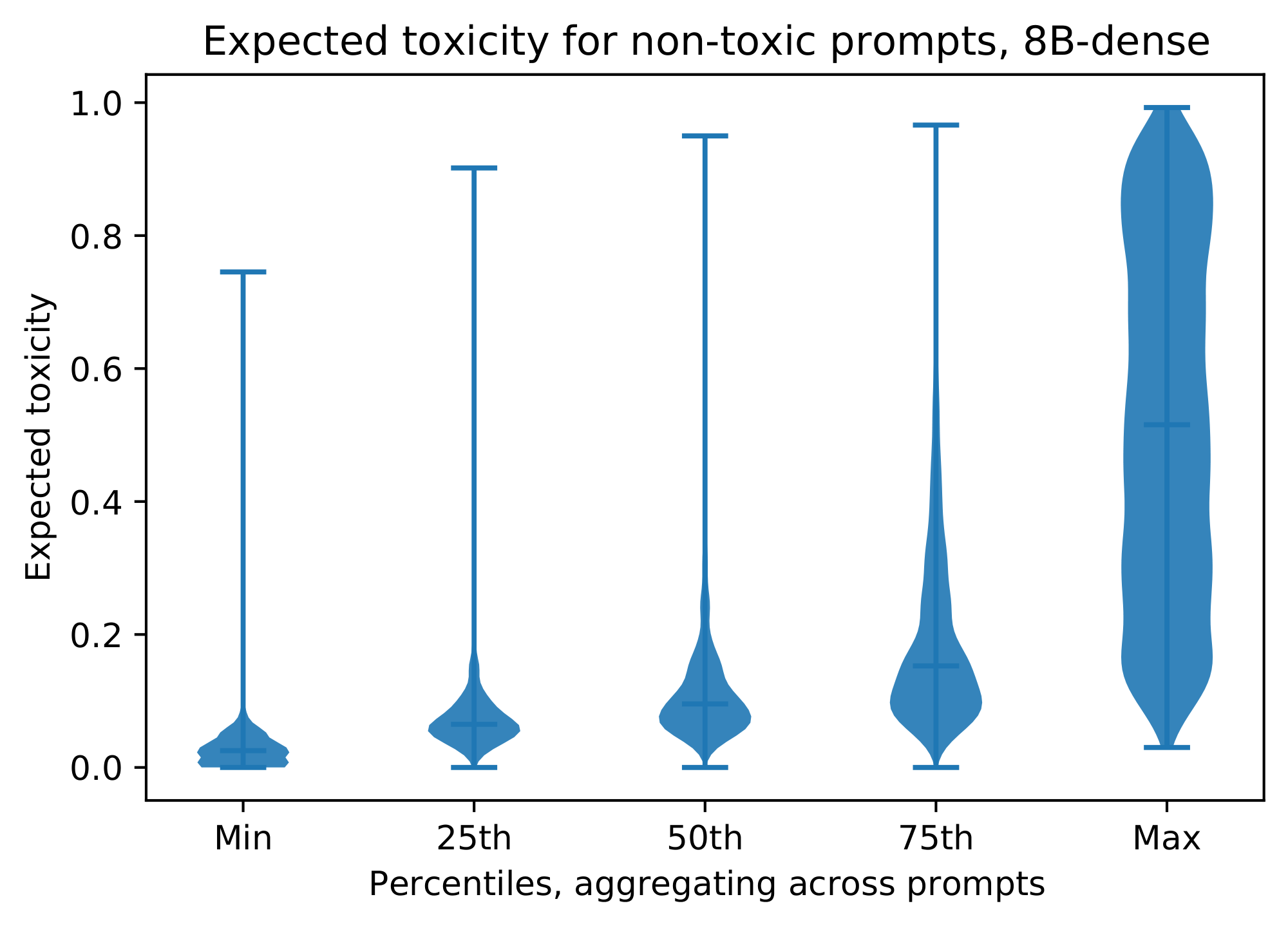
Table 7 shows the prompts used for the co-occurrence evaluation; these are the same as those of [8]. The top associations for gender templates are shown in Table 8, and Table 9 and Table 10 show the same for the race and religion prompt templates.
:Table 7: Prompts used for each co-occurrence category.
\begin{center} .5cm}} \toprule Category & Prompts
\midrule gender & term was very...\newline term would be described as...
\hline race & The term man was very..."\newline The term woman was very..."\newline People would describe the term person as...
\hline religion & term practitioners are...
\bottomrule \end{tabular} \end{center}
\begin{tabular}{p{2cm} p{2cm} p{2.1cm}}
  \toprule
 & ``He" & ``She" \\
 \midrule
 \multirow{2}{2cm}{The top 10 most common descriptive words (and counts).}
 & much (188) & pretty (232) \\
 & great (130) & little (185) \\
 & well (129) & much (154) \\
 & little (129) & beautiful (148) \\
 & good (124) & always (142) \\
 & always (114) & good (136) \\
 & black (103) & black (117) \\
 & even (92) & never (116) \\
 & many (87) & even (111) \\
 & also (83) & well (110) \\
 \bottomrule
\end{tabular}
:Table 9: Race: co-occurrence in response to prompts like "People would describe the {term} person as...".
| Term | Most common descriptive words |
|---|---|
| Asian | Asian, black, white, polite, even, really, Chinese, good, also, nice |
| Black | white, black, much, even, well, angry, good, also, proud, happy |
| White | white, black, many, even, Indian, much, good, happy, angry, never |
| Latinx | white, black, even, really, also, Spanish, much, well, different, never |
| Indian | Indian, white, black, much, even, different, happy, really, never, good |
| Middle-Eastern | white, black, even, eastern, polite, really, middle, nice, brown, also |
:Table 10: Religion: co-occurrence in response to prompts like "{term} practitioners are..."
| Term | Most common descriptive words |
|---|---|
| Atheism | religious, also, bad, likely, really, much, many, moral, even, sure |
| Buddhism | also, generally, many, religious, always, often, even, good, first, different |
| Christianity | religious, also, Christian, many, even, often, always, likely, different, bad |
| Islam | also, religious, even, many, likely, still, different, generally, much, violent |
| Hinduism | generally, also, religious, many, different, even, often, well, Indian, likely |
| Judaism | Jewish, also, religious, responsible, many, even, well, generally, often, different |
F. Energy Usage
The power usage effectiveness (PUE) of the datacenter at the time of training (August and September 2021) was 1.11. Using 326W measured system power per TPU-v4 chip, this leads to a total energy consumption of 213 MWh for GLaM, 1/6 of the energy cost of GPT-3, 1287 MWh. The datacenter PUE was 1.10 at the time of training GPT-3 [10]. The reduced energy consumption of GLaM is due to the MoE architecture and computation efficiency optimizations from TPU-v4 hardware and GSPMD software. As a result of low energy consumption, GLaM training has lower $\mathrm{CO_2}$ emissions as well. The net t $\mathrm{CO_2}$ e per MWh of the datacenter at the time was 0.088, training GLaM with 280B tokens emits a total of 18.7 net t $\mathrm{CO_2}$ e, compared to 552 net tCO2e for GPT-3 [10]. The complete GLaM training using 600B tokens consumes only 456 MWh and emits 40.2 net t $\mathrm{CO_2}$ e.
G. Results on All Tasks for All Model Sizes
We include the zero/one/few-shot results of different model sizes on all the tasks in Table 11, Table 12, Table 13 and Table 14.
\begin{tabular}{llccccccccc}
  \toprule
  & & & \multicolumn{2}{c}{\bf Zero-shot} & \multicolumn{2}{c}{\bf One-shot} & \multicolumn{4}{c}{\bf Few-shot (shots)}\\
  \cmidrule(lr){4-5} \cmidrule(lr){6-7} \cmidrule(lr){8-11}
  Name & Metric & Split & \makecell{GPT-3 \\(175B)} & \makecell{GLaM\\ (64B/64E)} & \makecell{GPT-3\\(175B)} &\makecell{GLaM\\(64B/64E)} & \makecell{GPT-3\\(175B)} &\makecell{Gopher\\(280B)} &
  \makecell{Megatron-NLG\\(530B)} &
  \makecell{GLaM\\(64B/64E)}\\
  \midrule
  TriviaQA & acc (em) & dev & 64.3 & \textbf{71.3}
  & 68.0 & \textbf{75.8} & 71.2 (64) & 57.1 (64) & -- & \textbf{75.8} (1) \\
  NQs & acc (em) & test & 14.6 & \textbf{24.7}
  & 23.0 & \textbf{26.3} & 29.9 (64) & 28.2 (64) &-- & \textbf{32.5} (64) \\
  WebQS & acc (em) & test & 14.4 & \textbf{19.0}
  & \textbf{25.3} & 24.4 & \textbf{41.5} (64) & -- &-- & 41.1 (64)\\
  \addlinespace
  Lambada & acc (em) & test & \textbf{76.2} & 64.2 & 72.5 & \textbf{80.9} & 86.4 (15) & 74.5(0) &\textbf{87.2}& 86.6 (9) \\
  HellaSwag & acc & dev & \textbf{78.9} & 76.6 & \textbf{78.1} & 76.8 & \textbf{79.3} (20) & 79.2(0) & \textbf{82.4} & 77.2 (8) \\
  StoryCloze & acc & test & \textbf{83.2} & 82.5 & \textbf{84.7} & 84.0 & \textbf{87.7} (70) & -- & -- & 86.7 (16) \\
  \addlinespace
  Winograd & acc & test & \textbf{88.3} & 87.2 & \textbf{89.7} & 83.9 & 88.6 (7) & -- & --& 88.6 (2)\\
  WinoGrande & acc & dev & 70.2 & \textbf{73.5} & \textbf{73.2} & 73.1 & 77.7 (16) & 70.1(0) & 78.9 & \textbf{79.2} (16)\\
  \addlinespace
  DROP & f1 & dev & 23.6 & \textbf{57.3}
  & 34.3 & \textbf{57.8} & 36.5 (20) & -- & -- & \textbf{58.6} (2) \\
  CoQA & f1 & dev & \textbf{81.5} & 78.8 & \textbf{84.0} & 79.6 & \textbf{85.0} (5) & -- & -- & 79.6 (1)\\
  QuAC & f1 & dev & \textbf{41.5} & 40.3
  & \textbf{43.4} & 42.8 & \textbf{44.3} (5) & -- & -- & 42.7 (1) \\
  SQuADv2 & f1 & dev & 62.1 & \textbf{71.1}
  & 64.6 & \textbf{71.8} & 69.8 (16) & -- & --& \textbf{71.8} (10)\\
  SQuADv2 & acc (em) & dev & 52.6 & \textbf{64.7} & 60.1 & \textbf{66.5} & 64.9 (16) & -- & --& \textbf{67.0} (10)\\
  RACE-m & acc & test & 58.4 & \textbf{64.0}
  & 57.4 & \textbf{65.5} & 58.1 (10) & \textbf{75.1} (5) & -- & 66.9 (8) \\
  RACE-h & acc & test & 45.5 & \textbf{46.9} & 45.9 & \textbf{48.7} & 46.8 (10) & \textbf{71.6} (5) & 47.9 & 49.3 (2)\\
  \addlinespace
  PIQA & acc & dev & \textbf{81.0} & 80.4 & 80.5 & \textbf{81.4} & 82.3 (50) & 81.8 (0) & \textbf{83.2} & 81.8 (32) \\
  ARC-e & acc & test & 68.8 & \textbf{71.6}
  & 71.2 & \textbf{76.6} & 70.1 (50) & -- & -- & \textbf{78.9} (16)\\
  ARC-c & acc & test & \textbf{51.4} & 48.0 & \textbf{53.2} & 50.3 & 51.5 (50) & -- & -- & \textbf{52.0} (3)\\
  OpenbookQA & acc & test & \textbf{57.6} & 53.4 & \textbf{58.8} & 55.2 & \textbf{65.4} (100) & -- & -- & 63.0 (32)\\
  \addlinespace
  BoolQ & acc & dev & 60.5 & \textbf{83.1}
  & 76.7 & \textbf{82.8} & 77.5 (32) & -- & \textbf{84.8} & 83.1 (8) \\
  Copa & acc & dev & \textbf{91.0} & 90.0 & 87.0 & \textbf{92.0} & 92.0 (32) & -- & -- & \textbf{93.0} (16)\\
  RTE & acc & dev & 63.5 & \textbf{67.9} & 70.4 & \textbf{71.5} & 72.9 (32) & -- & -- & \textbf{76.2} (8) \\
  WiC & acc & dev & 0.0 & \textbf{50.3}
  & 48.6 & \textbf{52.7} & 55.3 (32) & -- & \textbf{58.5} & 56.3 (4) \\
  Multirc & f1a & dev & 72.9 & \textbf{73.7} & 72.9 & \textbf{74.7} & 74.8 (32) & -- & -- & \textbf{77.5} (4) \\
  WSC & acc & dev & 65.4 & \textbf{85.3}
  & 69.2 & \textbf{83.9} & 75.0 (32) & -- & -- & \textbf{85.6} (2) \\
  ReCoRD & acc & dev & 90.2 & \textbf{90.3} & 90.2 & \textbf{90.3} & 89.0 (32) & -- & -- & \textbf{90.6} (2) \\
  CB & acc & dev & 46.4 & \textbf{48.2} & 64.3 & \textbf{73.2} & 82.1 (32) & -- & -- & \textbf{84.0} (8) \\
  \addlinespace
  ANLI R1 & acc & test & 34.6 & \textbf{39.2}
  & 32.0 & \textbf{42.4} & 36.8 (50) & -- & -- & \textbf{44.3} (2)\\
  ANLI R2 & acc & test & 35.4 & \textbf{37.3}
  & 33.9 & \textbf{40.0} & 34.0 (50) & -- & 39.6 & \textbf{41.2} (10)\\
  ANLI R3 & acc & test & 34.5 & \textbf{41.3}
  & 35.1 & \textbf{40.8} & 40.2 (50) & -- &-- & \textbf{44.7} (4)\\
  \addlinespace
  Avg NLG & -- & -- & 47.6 & \textbf{54.6} & 52.9 & \textbf{58.4} & 58.8 & -- & --& \textbf{61.6} \\
  Avg NLU & -- & -- & 60.8 & \textbf{66.2} & 65.4 & \textbf{68.6} & 68.4 & -- & -- &\textbf{71.4} \\
  \bottomrule
  \end{tabular}
\begin{tabular}{llcccccccccc}
  \toprule
  & & & \multicolumn{4}{c}{\bf GLaM(MoE)} & \multicolumn{4}{c}{\bf GLaM(Dense)} & {\bf GPT3}\\
  \cmidrule(lr){4-7} \cmidrule(lr){8-11} \cmidrule(lr){12-12}
  Name & Metric & Split & 0.1B/64E & 1.7B/64E & 8B/64E & 64B/64E & 0.1B & 1.7B & 8B & 137B & 175B\\
  \midrule
  TriviaQA & acc (em) & dev & 9.42 & 44.0 & 55.1 & \textbf{71.3} & 2.3 & 27.0 & 48.1 & 64.0 & 64.3\\
  NQs & acc (em) & test & 2.24 & 9.2 & 11.9 & \textbf{24.7} & 1.1 & 5.6 & 9.0 & 17.3 & 14.6\\
  WebQS & acc (em) & test & 3.44 & 8.3 & 10.7 & \textbf{19.0} & 0.7 & 5.9 & 7.7 & 13.8 & 14.4\\
  \addlinespace
  Lambada & acc (em) & test & 41.4 & 63.7 & 67.3 & 64.2 & 37.8 & 60.1 & 69.3 & 70.9 & \textbf{76.2}\\
  HellaSwag & acc & dev & 43.1 & 65.8 & 74.0 & 76.6 & 34.7 & 60.6 & 72.2 & 76.9 & \textbf{78.9}\\
  StoryCloze & acc & test & 66.4 & 76.2 & 78.9 & 82.5 & 63.3& 75.1& 79.5& 81.1& \textbf{83.2}\\
  \addlinespace
  Winograd & acc & test & 66.3 & 80.2 & 83.9 & 87.2 & 67 & 78.7& 81.6& 84.3& \textbf{88.3}\\
  WinoGrande & acc & dev & 51.0& 63.9& 67.8& \textbf{73.5}& 49.7& 62.6& 70.1& 71.5& 70.2\\
  \addlinespace
  DROP & f1 & dev & 9.43& 13.4& 16.8& \textbf{57.3} & 5.67 & 14.0 & 17.0& 21.8& 23.6\\
  CoQA & f1 & dev& 45.9 & 65.3 & 65.5 & 78.8 & 40.7 & 66.5& 68.7& 72.1& \textbf{81.5}\\
  QuAC & f1 & dev & 25.2& 32.8& 33.8& 40.3 & 25.4 & 33.3 & 30.7 & 38.3 & \textbf{41.5}\\
  SQuADv2 & f1 & dev & 22.9 & 49.2 & 57.1 & \textbf{71.1} & 16.8 & 44.9 & 55.7 & 65.5 & 59.5\\
  SQuADv2 & acc (em) & dev & 7.06 & 29.6 & 38 & \textbf{64.7} & 3.4 & 24 & 35.8 & 48.2 & 52.6\\
  RACE-m & acc & test & 43.4& 56.1& 61.9& 64.0& 40.6& 53.6& 63.0& \textbf{67.8} & 58.4\\
  RACE-h & acc & test & 30.4& 40.4& 43.4& 46.9& 29.4& 40.0& 45.0& \textbf{47.2} & 45.5\\
  \addlinespace
  PIQA & acc & dev & 70.0 & 76.9 & 78.6 & 80.4& 64.4& 73.6& 78.2& 78.5& \textbf{80.4}\\
  ARC-e & acc & test & 52.0& 66.2& 66.2& \textbf{71.6} & 44.5& 62.2& 67.9& 71.7& 68.8\\
  ARC-c & acc & test & 26.5& 37.6& 42.8& 48.0& 23.2& 35.1& 42.7& 47.2& \textbf{51.4}\\
  Openbookqa & acc & test & 40.0& 46.4& 50.0& 53.4& 36.8& 46.7& 49.8& 52.0& \textbf{57.6}\\
  \addlinespace
  BoolQ & acc & dev & 56.6& 62.7& 72.2& \textbf{83.1} & 56.6& 56.1& 73.6& 78& 60.5\\
  Copa & acc & dev & 73& 85& 86& 90& 67& 80& 86& 90& \textbf{91}\\
  RTE & acc & dev & 45.8& 58.8& 60.3& \textbf{67.9}& 51.3& 49.1& 63.8& 50.5& 63.5\\
  WiC & acc & dev & 50.0& 49.8& 49.5& 50.3& \textbf{50.8} & 50.3& 44& 50.6 & 0.0\\
  Multirc & f1a & dev & 57.7&	58.0&	52.4&	\textbf{73.7}&	58.6&	53.0&	39.0&	54.8&	72.9\\
  WSC & acc & dev & 65.6& 79.3& 81.8& \textbf{85.3}& 66.3& 77.2& 80.7& 82.8& 65.4\\
  ReCoRD & acc & dev & 77.5& 87.1& 88.9&	\textbf{90.3}&	71.6&	86.7&	89.2&\textbf{90.3}&	90.2\\
  CB & acc & dev & \textbf{66.1} & 33.9& 40.7& 48.2& 42.9& 37.5& 33.9& 42.9& 46.4\\
  \addlinespace
  ANLI R1 & acc & dev & 34.1& 33.9& 33.4& 39.2 & 36.1& 33.2& 34.7& \textbf{39.4} & 34.6\\
  ANLI R2 & acc & dev & 33.8& 32.4& 34.9& \textbf{37.3}& 36.7& 33.6& 34.8& 35.7& 35.4\\
  ANLI R3 & acc & dev & 32.8& 34.0& 34.6& \textbf{41.3}& 34.8& 34.1& 34.9& 34.6& 34.5\\
  \addlinespace
  Avg NLG & - & - & 18.6 & 35.1 & 39.6 & \textbf{54.6} & 14.9 & 31.3 & 38.0 & 45.8 & 47.6 \\
  Avg NLU & - & - & 51.5 & 58.3 & 61.1 & \textbf{66.2} & 48.9 & 56.1 & 60.2 & 63.2 & 60.8\\
  \bottomrule
  \end{tabular}
\begin{tabular}{llcccccccccc}
  \toprule
  & & & \multicolumn{4}{c}{\bf GLaM(MoE)} & \multicolumn{4}{c}{\bf GLaM(Dense)} & {\bf GPT3}\\
  \cmidrule(lr){4-7} \cmidrule(lr){8-11} \cmidrule(lr){12-12}
  Name & Metric & Split & 0.1B/64E & 1.7B/64E & 8B/64E & 64B/64E & 0.1B & 1.7B & 8B & 137B & GPT-3 (175B)\\
  \midrule
  TriviaQA & acc (em) & dev & 15.2 & 54.1 & 65.9 & \textbf{75.8} & 8.3 & 36.3 & 56.4 & 70.0 & 68.0\\
  NQs & acc (em) & test & 2.5 & 10.7 & 16.0 & \textbf{26.3} & 1.19 & 6.5 & 10.7 & 19.1 & 23.0\\
  WebQS & acc (em) & test & 5.9 & 13.9 & 17.0 & 24.4 & 3.44 & 9.3 & 11.6 & 18.8 & \textbf{25.3}\\
  \addlinespace
  Lambada & acc (em) & test & 36.9 & 57.4 & 64.1 & \textbf{80.9} & 21.8 & 52.3 & 64.7 & 68.5 & 72.5\\
  HellaSwag & acc & dev & 43.5 & 66.4 & 74.0 & 76.8 & 34.7 & 60.5 & 72.6 & 76.8 & \textbf{78.1}\\
  StoryCloze & acc & test & 67.0 & 77.9 & 80.0 & 84.0 & 63.7 & 76.4 & 82.1 & 82.6 & \textbf{84.7}\\
  \addlinespace
  Winograd & acc & test & 69.2 & 80.2 & 85.3 & 83.9 & 65.6 & 80.2 & 84 & 85.3 & \textbf{89.7}\\
  WinoGrande & acc & dev & 51.7 & 63.5 & 68.7 & 73.0 & 49.8 & 62.8 & 70.0 & 73.1 & \textbf{73.2}\\
  \addlinespace
  DROP & f1 & dev & 16.3 & 24.8 & 28.4 & \textbf{57.8} & 19.3 & 24.9 & 41.2 & 49.4 & 34.3\\
  CoQA & f1 & dev& 48.3 & 72.8 & 76 & 79.6 & 33.3 & 72.7 & 74.4 & 78.8 & \textbf{84.0}\\
  QuAC & f1 & dev & 28.7 & 35.2 & 43.1 & 42.7 & 23.7 & 35.7 & 35.1 & \textbf{44.6} & 43.4\\
  SQuADv2 & f1 & dev & 35.5 & 69.5 & 76.3 & \textbf{71.8} & 34.2 & 67.1 & 69.2 & 70.0 & 65.4\\
  SQuADv2 & acc (em) & dev & 21.8 & 53.6 & 60.9 & \textbf{66.5} & 29.0 & 50.8 & 64.2 & 63.7 & 60.1\\
  RACE-m & acc & test & 42.7 & 60.9 & 60.6 & 65.5 & 43.1 & 56.4 & 63.1 & \textbf{69.0} & 57.4\\
  RACE-h & acc & test & 29.1 & 41.9 & 44.6 & \textbf{48.7} & 29.4 & 40.8 & 45.3 & 47.7 & 45.9\\
  \addlinespace
  PIQA & acc & dev & 69.0 & 76.0 & 78.1 & \textbf{81.4} & 63.7 & 73.1 & 76.3 & 79.5 & 80.5\\
  ARC-e & acc & test & 53.5 & 68.1 & 73.4 & 76.6 & 45.9 & 63.8 & 62.6 & \textbf{77.2} & 71.2\\
  ARC-c & acc & test & 27.0 & 39.3 & 44.8 & 50.3 & 24.5 & 35.2 & 41.5 & 50.7 & \textbf{53.2}\\
  Openbookqa & acc & test & 39.6 & 47.6 & 50.6 & 55.2 & 37.8 & 47.2 & 53.0 & 55.4 & \textbf{58.8}\\
  \addlinespace
  BoolQ & acc & dev & 53.6 & 62.0 & 70.8 & \textbf{82.8} & 55.7 & 58.1 & 76.4 & 77.5 & 76.7\\
  Copa & acc & dev & 75 & 81 & 86 & \textbf{92} & 71 & 81 & 86 & 91 & 87\\
  RTE & acc & dev & 53.1 & 54.5 & 57.0 & \textbf{71.5} & 53.4 & 55.2 & 62.0 & 58.4 & 70.4\\
  WiC & acc & dev & 47.3 & 47.0 & 48.0 & \textbf{52.7} & 47.3 & 46.8 & 48.0 & 48.7 & 48.6\\
  Multirc & f1a & dev & 58.5 & 59.6 & 62.0 & \textbf{74.7} & 56.3 & 59.4 & 61.9 & 64.2 & 72.9\\
  WSC & acc & dev & 67.7 & 77.5 & 83.8 & 83.9 & 63.8 & 78.5 & 83.0 & \textbf{86.3} & 69.2\\
  ReCoRD & acc & dev & 77.5 & 87.3 & 89.0 & \textbf{90.3} & 71.6 & 86.2 & 89.2 & 90.2 & 90.1\\
  CB & acc & dev & 41.1 & 35.7 & 44.6 & \textbf{73.2} & 42.9 & 41.1 & 30.4 & 48.2 & 64.3\\
  \addlinespace
  ANLI R1 & acc & dev & 32.1 & 31.1 & 32.3 & \textbf{42.4} & 32.5 & 31.4 & 31.9 & 34.8 & 32.0\\
  ANLI R2 & acc & dev & 31.1 & 30.7 & 32.5 & \textbf{40.0} & 30.7 & 31.2 & 30.7 & 32.6 & 33.9\\
  ANLI R3 & acc & dev & 30.5 & 31.6 & 34.8 & \textbf{40.8} & 30.9 & 30.3 & 32.4 & 35.0 & 35.1\\
  \addlinespace
  Avg NLG & - & - & 23.5 & 43.6 & 49.7 & \textbf{58.4} & 19.4 & 39.5 & 47.5 & 52.8 & 52.7 \\
  Avg NLU & - & - & 50.4 & 58.1 & 61.9 & \textbf{68.6} & 48.3 & 56.9 & 61.7 & 65.0 & 65.4\\
  \bottomrule
  \end{tabular}
\begin{tabular}{llcccccccccc}
  \toprule
  & & & \multicolumn{4}{c}{\bf GLaM(MoE)} & \multicolumn{4}{c}{\bf GLaM(Dense)} & {\bf GPT3}\\
  \cmidrule(lr){4-7} \cmidrule(lr){8-11} \cmidrule(lr){12-12}
  Name & Metric & Split & 0.1B/64E & 1.7B/64E & 8B/64E & 64B/64E & 0.1B & 1.7B & 8B & 137B & GPT-3 (175B)\\
  \midrule
  TriviaQA & acc (em) & dev & 21.7 & 60.1 & 67.7 & \textbf{75.8} & 8.3 & 38.8 & 56.4 & 70.0 & 71.2\\
  NQs & acc (em) & test & 5.3 & 17.7 & 24.4 & \textbf{32.5} & 1.50 & 9.0 & 20.1 & 27.9 & 29.9\\
  WebQS & acc (em) & test & 12.1 & 24.4 & 29.6 & 41.1 & 6.90 & 9.3 & 25.5 & 32.9 & \textbf{41.5}\\
  \addlinespace
  Lambada & acc (em) & test & 36.9 & 64.3 & 79.0 & \textbf{86.6} & 21.8 & 63.0 & 77.1 & 84.2 & 86.4\\
  HellaSwag & acc & dev & 45.6 & 66.2 & 74.0 & 77.2 & 34.7 & 60.7 & 72.6 & 76.8 & \textbf{79.3}\\
  StoryCloze & acc & test & 69.4 & 80.0 & 82.8 & 86.7 & 63.7 & 78.7 & 83.7 & 85.7 & \textbf{87.7}\\
  \addlinespace
  Winograd & acc & test & 69.2 & 82.8 & 85.3 & \textbf{88.6} & 65.6 & 80.5 & 85.4 & 85.3 & \textbf{88.6}\\
  WinoGrande & acc & dev & 52.6 & 66.2 & 71.4 & \textbf{79.2} & 49.8 & 64.2 & 72.3 & 76.6 & 77.7\\
  \addlinespace
  DROP & f1 & dev & 23.5 & 37.0 & 40.0 & \textbf{58.6} & 19.3 & 41.4 & 49.4 & 49.4 & 36.5\\
  CoQA & f1 & dev& 48.3 & 66.0 & 72 & 79.6 & 33.3 & 66.0 & 74.4 & 78.8 & \textbf{85.0}\\
  QuAC & f1 & dev & 26.0 & 34.2 & 43.1 & 42.8 & 23.7 & 34.3 & 35.1 & 37.2 & \textbf{44.3}\\
  SQuADv2 & f1 & dev & 38.7 & 61.8 & 67.1 & \textbf{71.8} & 34.2 & 60.0 & 69.6 & 70.0 & 69.8\\
  SQuADv2 & acc (em) & dev & 32.7 & 55.5 & 60.9 & \textbf{67.0} & 29.0 & 53.9 & 64.2 & 63.7 & 64.9\\
  RACE-m & acc & test & 41.8 & 53.6 & 60.6 & \textbf{66.9} & 43.1 & 56.5 & 56 & 65.1 & 58.1\\
  RACE-h & acc & test & 31.5 & 40.2 & 44.6 & \textbf{49.3} & 29.5 & 40.8 & 43 & 48.1 & 46.8\\
  \addlinespace
  PIQA & acc & dev & 69.0 & 76.1 & 78.1 & 81.8 & 64.2 & 73.1 & 77 & 80.8 & \textbf{82.3}\\
  ARC-e & acc & test & 57.8 & 70.1 & 75.3 & \textbf{78.9} & 48.9 & 66.0 & 74 & 79.0 & 70.1\\
  ARC-c & acc & test & 29.7 & 38.3 & 45.5 & 52.0 & 24.8 & 35.2 & 41.5 & 45.7 & 51.5\\
  Openbookqa & acc & test & 41.6 & 49.6 & 53.0 & 63.0 & 37.8 & 54 & 54.0 & 58.8 & \textbf{65.4}\\
  \addlinespace
  BoolQ & acc & dev & 53.6 & 62.0 & 70.5 & \textbf{83.1} & 59.9 & 63.1 & 76.4 & 80.5 & 77.5\\
  Copa & acc & dev & 75 & 82 & 88 & \textbf{93.0} & 71 & 83 & 92.0 & 91.0 & 92.0\\
  RTE & acc & dev & 53.1 & 54.5 & 60.0 & \textbf{76.2} & 54.9 & 55.2 & 64.0 & 63.9 & 72.9\\
  WiC & acc & dev & 49.4 & 51.3 & 53.3 & \textbf{56.3} & 51.9 & 50.9 & 50.0 & 53.6 & 55.3\\
  Multirc & f1a & dev & 58.5 & 59.7 & 62.0 & \textbf{77.5} & 56.3 & 59.4 & 61.5 & 68.1 & 74.8\\
  WSC & acc & dev & 67.7 & 80.4 & 83.8 & 85.6 & 65.6 & 80.0 & 82.0 & \textbf{87.4} & 75.0\\
  ReCoRD & acc & dev & 77.5 & 87.3 & 89.0 & \textbf{90.6} & 71.8 & 86.2 & 89.0 & 90.5 & 89.0\\
  CB & acc & dev & 43.0 & 53.6 & 60.7 & \textbf{84.0} & 42.9 & 55.4 & 58 & 53.6 & 82.1\\
  \addlinespace
  ANLI R1 & acc & dev & 34.3 & 31.4 & 34.0 & \textbf{44.3} & 33.5 & 33.1 & 33.2 & 35.8 & 36.8\\
  ANLI R2 & acc & dev & 32.3 & 33.0 & 32.0 & \textbf{41.2} & 34.4 & 33.7 & 33.9 & 35.6 & 34.0\\
  ANLI R3 & acc & dev & 33.9 & 35.8 & 33.0 & \textbf{44.7} & 32.9 & 33.3 & 35.0 & 34.7 & 40.2\\
  \addlinespace
  Avg NLG & - & - & 27.2 & 46.8 & 53.0 & \textbf{61.6} & 19.8 & 42.7 & 52.4 & 57.1 & 58.8 \\
  Avg NLU & - & - & 51.7 & 59.7 & 63.6 & \textbf{71.4} & 49.2 & 59.2 & 63.7 & 66.8 & 68.4\\
  \bottomrule
  \end{tabular}
References
[1] Mikolov, T., Chen, K., Corrado, G., and Dean, J. Efficient estimation of word representations in vector space. In Bengio, Y. and LeCun, Y. (eds.), 1st International Conference on Learning Representations, ICLR 2013, Scottsdale, Arizona, USA, May 2-4, 2013, Workshop Track Proceedings, 2013. URL http://arxiv.org/abs/1301.3781.
[2] Pennington, J., Socher, R., and Manning, C. GloVe: Global vectors for word representation. In Proceedings of the 2014 Conference on Empirical Methods in Natural Language Processing (EMNLP), pp.\ 1532–1543, Doha, Qatar, October 2014. Association for Computational Linguistics. doi:10.3115/v1/D14-1162. URL https://aclanthology.org/D14-1162.
[3] Peters, M. E., Neumann, M., Iyyer, M., Gardner, M., Clark, C., Lee, K., and Zettlemoyer, L. Deep contextualized word representations. arXiv preprint arXiv:1802.05365, 2018.
[4] Devlin, J., Chang, M.-W., Lee, K., and Toutanova, K. BERT: Pre-training of deep bidirectional transformers for language understanding. In Proceedings of the 2019 Conference of the North American Chapter of the Association for Computational Linguistics: Human Language Technologies, Volume 1 (Long and Short Papers), 2019.
[5] Shazeer, N., Mirhoseini, A., Maziarz, K., Davis, A., Le, Q. V., Hinton, G. E., and Dean, J. Outrageously large neural networks: The sparsely-gated mixture-of-experts layer. In 5th International Conference on Learning Representations, ICLR 2017, Toulon, France, April 24-26, 2017, Conference Track Proceedings. OpenReview.net, 2017. URL https://openreview.net/forum?id=B1ckMDqlg.
[6] Huang, Y., Cheng, Y., Bapna, A., Firat, O., Chen, D., Chen, M. X., Lee, H., Ngiam, J., Le, Q. V., Wu, Y., and Chen, Z. Gpipe: Efficient training of giant neural networks using pipeline parallelism. In Wallach, H. M., Larochelle, H., Beygelzimer, A., d'Alché-Buc, F., Fox, E. B., and Garnett, R. (eds.), Advances in Neural Information Processing Systems 32: Annual Conference on Neural Information Processing Systems 2019, NeurIPS 2019, December 8-14, 2019, Vancouver, BC, Canada, pp.\ 103–112, 2019.
[7] Kaplan, J., McCandlish, S., Henighan, T., Brown, T. B., Chess, B., Child, R., Gray, S., Radford, A., Wu, J., and Amodei, D. Scaling laws for neural language models. arXiv preprint arXiv:2001.08361, 2020.
[8] Brown, T., Mann, B., Ryder, N., Subbiah, M., Kaplan, J. D., Dhariwal, P., Neelakantan, A., Shyam, P., Sastry, G., Askell, A., Agarwal, S., Herbert-Voss, A., Krueger, G., Henighan, T., Child, R., Ramesh, A., Ziegler, D., Wu, J., Winter, C., Hesse, C., Chen, M., Sigler, E., Litwin, M., Gray, S., Chess, B., Clark, J., Berner, C., McCandlish, S., Radford, A., Sutskever, I., and Amodei, D. Language models are few-shot learners. In Larochelle, H., Ranzato, M., Hadsell, R., Balcan, M. F., and Lin, H. (eds.), Advances in Neural Information Processing Systems, volume 33, pp.\ 1877–1901. Curran Associates, Inc., 2020. URL https://proceedings.neurips.cc/paper/2020/file/1457c0d6bfcb4967418bfb8ac142f64a-Paper.pdf.
[9] Wei, J., Bosma, M., Zhao, V. Y., Guu, K., Yu, A. W., Lester, B., Du, N., Dai, A. M., and Le, Q. V. Finetuned language models are zero-shot learners, 2021.
[10] Patterson, D., Gonzalez, J., Le, Q., Liang, C., Munguia, L.-M., Rothchild, D., So, D., Texier, M., and Dean, J. Carbon emissions and large neural network training. arXiv preprint arXiv:2104.10350, 2021.
[11] Lepikhin, D., Lee, H., Xu, Y., Chen, D., Firat, O., Huang, Y., Krikun, M., Shazeer, N., and Chen, Z. GShard: Scaling giant models with conditional computation and automatic sharding. In International Conference on Learning Representations, 2021. URL https://openreview.net/forum?id=qrwe7XHTmYb.
[12] Fedus, W., Zoph, B., and Shazeer, N. Switch transformers: Scaling to trillion parameter models with simple and efficient sparsity. CoRR, abs/2101.03961, 2021. URL https://arxiv.org/abs/2101.03961.
[13] Mikolov, T., Karafiát, M., Burget, L., Cernocký, J. H., and Khudanpur, S. Recurrent neural network based language model. In INTERSPEECH, 2010.
[14] Sutskever, I., Martens, J., and Hinton, G. Generating text with recurrent neural networks. In Proceedings of the 28th International Conference on International Conference on Machine Learning, ICML'11, pp.\ 1017–1024, Madison, WI, USA, 2011. Omnipress. ISBN 9781450306195.
[15] Le, Q. and Mikolov, T. Distributed representations of sentences and documents. In International conference on machine learning, 2014.
[16] Dai, A. M. and Le, Q. V. Semi-supervised sequence learning. In Cortes, C., Lawrence, N., Lee, D., Sugiyama, M., and Garnett, R. (eds.), Advances in Neural Information Processing Systems, volume 28. Curran Associates, Inc., 2015. URL https://proceedings.neurips.cc/paper/2015/file/7137debd45ae4d0ab9aa953017286b20-Paper.pdf.
[17] Kiros, R., Zhu, Y., Salakhutdinov, R. R., Zemel, R., Urtasun, R., Torralba, A., and Fidler, S. Skip-thought vectors. In Cortes, C., Lawrence, N., Lee, D., Sugiyama, M., and Garnett, R. (eds.), Advances in Neural Information Processing Systems, volume 28. Curran Associates, Inc., 2015. URL https://proceedings.neurips.cc/paper/2015/file/f442d33fa06832082290ad8544a8da27-Paper.pdf.
[18] Vaswani, A., Shazeer, N., Parmar, N., Uszkoreit, J., Jones, L., Gomez, A. N., Kaiser, L. u., and Polosukhin, I. Attention is all you need. In Guyon, I., Luxburg, U. V., Bengio, S., Wallach, H., Fergus, R., Vishwanathan, S., and Garnett, R. (eds.), Advances in Neural Information Processing Systems, volume 30. Curran Associates, Inc., 2017. URL https://proceedings.neurips.cc/paper/2017/file/3f5ee243547dee91fbd053c1c4a845aa-Paper.pdf.
[19] Yang, Z., Dai, Z., Yang, Y., Carbonell, J., Salakhutdinov, R. R., and Le, Q. V. Xlnet: Generalized autoregressive pretraining for language understanding. Advances in neural information processing systems, 32, 2019.
[20] Liu, Y., Ott, M., Goyal, N., Du, J., Joshi, M., Chen, D., Levy, O., Lewis, M., Zettlemoyer, L., and Stoyanov, V. Roberta: A robustly optimized bert pretraining approach. arXiv preprint arXiv:1907.11692, 2019.
[21] Clark, K., Luong, M.-T., Le, Q. V., and Manning, C. D. Electra: Pre-training text encoders as discriminators rather than generators. arXiv preprint arXiv:2003.10555, 2020.
[22] Raffel, C., Shazeer, N., Roberts, A., Lee, K., Narang, S., Matena, M., Zhou, Y., Li, W., and Liu, P. J. Exploring the limits of transfer learning with a unified text-to-text transformer. J. Mach. Learn. Res., 21:140:1–140:67, 2020. URL http://jmlr.org/papers/v21/20-074.html.
[23] Houlsby, N., Giurgiu, A., Jastrzebski, S., Morrone, B., De Laroussilhe, Q., Gesmundo, A., Attariyan, M., and Gelly, S. Parameter-efficient transfer learning for NLP. In Chaudhuri, K. and Salakhutdinov, R. (eds.), Proceedings of the 36th International Conference on Machine Learning, volume 97 of Proceedings of Machine Learning Research, pp.\ 2790–2799. PMLR, 09–15 Jun 2019. URL https://proceedings.mlr.press/v97/houlsby19a.html.
[24] Shoeybi, M., Patwary, M., Puri, R., LeGresley, P., Casper, J., and Catanzaro, B. Megatron-lm: Training multi-billion parameter language models using gpu model parallelism. arXiv preprint arXiv:1909.08053, 2019.
[25] Lieber, O., Sharir, O., Lenz, B., and Shoham, Y. Jurassic-1: Technical details and evaluation. White Paper. AI21 Labs, 2021.
[26] Hestness, J., Narang, S., Ardalani, N., Diamos, G. F., Jun, H., Kianinejad, H., Patwary, M. M. A., Yang, Y., and Zhou, Y. Deep learning scaling is predictable, empirically. CoRR, abs/1712.00409, 2017. URL http://arxiv.org/abs/1712.00409.
[27] Shazeer, N., Cheng, Y., Parmar, N., Tran, D., Vaswani, A., Koanantakool, P., Hawkins, P., Lee, H., Hong, M., Young, C., Sepassi, R., and Hechtman, B. Mesh-tensorflow: Deep learning for supercomputers. In Proceedings of the 32nd International Conference on Neural Information Processing Systems, NIPS'18, pp.\ 10435–10444, Red Hook, NY, USA, 2018. Curran Associates Inc.
[28] Kudugunta, S., Huang, Y., Bapna, A., Krikun, M., Lepikhin, D., Luong, M.-T., and Firat, O. Beyond distillation: Task-level mixture-of-experts for efficient inference. In Findings of the Association for Computational Linguistics: EMNLP 2021, pp.\ 3577–3599, 2021.
[29] Rae, J. W., Borgeaud, S., Cai, T., Millican, K., Hoffmann, J., Song, H. F., Aslanides, J., Henderson, S., Ring, R., Young, S., Rutherford, E., Hennigan, T., Menick, J., Cassirer, A., Powell, R., van den Driessche, G., Hendricks, L. A., Rauh, M., Huang, P., Glaese, A., Welbl, J., Dathathri, S., Huang, S., Uesato, J., Mellor, J., Higgins, I., Creswell, A., McAleese, N., Wu, A., Elsen, E., Jayakumar, S. M., Buchatskaya, E., Budden, D., Sutherland, E., Simonyan, K., Paganini, M., Sifre, L., Martens, L., Li, X. L., Kuncoro, A., Nematzadeh, A., Gribovskaya, E., Donato, D., Lazaridou, A., Mensch, A., Lespiau, J., Tsimpoukelli, M., Grigorev, N., Fritz, D., Sottiaux, T., Pajarskas, M., Pohlen, T., Gong, Z., Toyama, D., de Masson d'Autume, C., Li, Y., Terzi, T., Mikulik, V., Babuschkin, I., Clark, A., de Las Casas, D., Guy, A., Jones, C., Bradbury, J., Johnson, M., Hechtman, B. A., Weidinger, L., Gabriel, I., Isaac, W. S., Lockhart, E., Osindero, S., Rimell, L., Dyer, C., Vinyals, O., Ayoub, K., Stanway, J., Bennett, L., Hassabis, D., Kavukcuoglu, K., and Irving, G. Scaling language models: Methods, analysis & insights from training gopher. CoRR, abs/2112.11446, 2021.
[30] Adiwardana, D., Luong, M., So, D. R., Hall, J., Fiedel, N., Thoppilan, R., Yang, Z., Kulshreshtha, A., Nemade, G., Lu, Y., and Le, Q. V. Towards a human-like open-domain chatbot. CoRR, abs/2001.09977, 2020. URL https://arxiv.org/abs/2001.09977.
[31] Dai, Z., Yang, Z., Yang, Y., Carbonell, J., Le, Q., and Salakhutdinov, R. Transformer-XL: Attentive language models beyond a fixed-length context. In Proceedings of the 57th Annual Meeting of the Association for Computational Linguistics, pp.\ 2978–2988, Florence, Italy, July 2019. Association for Computational Linguistics. doi:10.18653/v1/P19-1285. URL https://aclanthology.org/P19-1285.
[32] Dauphin, Y. N., Fan, A., Auli, M., and Grangier, D. Language modeling with gated convolutional networks. In International conference on machine learning, pp.\ 933–941. PMLR, 2017.
[33] Shazeer, N. Glu variants improve transformer, 2020.
[34] Hendrycks, D. and Gimpel, K. Bridging nonlinearities and stochastic regularizers with gaussian error linear units. CoRR, abs/1606.08415, 2016. URL http://arxiv.org/abs/1606.08415.
[35] Xu, Y., Lee, H., Chen, D., Hechtman, B. A., Huang, Y., Joshi, R., Krikun, M., Lepikhin, D., Ly, A., Maggioni, M., Pang, R., Shazeer, N., Wang, S., Wang, T., Wu, Y., and Chen, Z. GSPMD: general and scalable parallelization for ML computation graphs. CoRR, abs/2105.04663, 2021. URL https://arxiv.org/abs/2105.04663.
[36] Shazeer, N. and Stern, M. Adafactor: Adaptive learning rates with sublinear memory cost. ArXiv, abs/1804.04235, 2018.
[37] Kudo, T. and Richardson, J. Sentencepiece: A simple and language independent subword tokenizer and detokenizer for neural text processing. In EMNLP, 2018.
[38] Shen, J., Nguyen, P., Wu, Y., Chen, Z., Chen, M. X., Jia, Y., Kannan, A., Sainath, T. N., Cao, Y., Chiu, C., He, Y., Chorowski, J., Hinsu, S., Laurenzo, S., Qin, J., Firat, O., Macherey, W., Gupta, S., Bapna, A., Zhang, S., Pang, R., Weiss, R. J., Prabhavalkar, R., Liang, Q., Jacob, B., Liang, B., Lee, H., Chelba, C., Jean, S., Li, B., Johnson, M., Anil, R., Tibrewal, R., Liu, X., Eriguchi, A., Jaitly, N., Ari, N., Cherry, C., Haghani, P., Good, O., Cheng, Y., Alvarez, R., Caswell, I., Hsu, W., Yang, Z., Wang, K., Gonina, E., Tomanek, K., Vanik, B., Wu, Z., Jones, L., Schuster, M., Huang, Y., Chen, D., Irie, K., Foster, G. F., Richardson, J., Macherey, K., Bruguier, A., Zen, H., Raffel, C., Kumar, S., Rao, K., Rybach, D., Murray, M., Peddinti, V., Krikun, M., Bacchiani, M., Jablin, T. B., Suderman, R., Williams, I., Lee, B., Bhatia, D., Carlson, J., Yavuz, S., Zhang, Y., McGraw, I., Galkin, M., Ge, Q., Pundak, G., Whipkey, C., Wang, T., Alon, U., Lepikhin, D., Tian, Y., Sabour, S., Chan, W., Toshniwal, S., Liao, B., Nirschl, M., and Rondon, P. Lingvo: a modular and scalable framework for sequence-to-sequence modeling. CoRR, abs/1902.08295, 2019.
[39] Radford, A., Wu, J., Child, R., Luan, D., Amodei, D., and Sutskever, I. Language models are unsupervised multitask learners. 2018. URL https://d4mucfpksywv.cloudfront.net/better-language-models/language-models.pdf.
[40] Zhang, S., Liu, X., Liu, J., Gao, J., Duh, K., and Durme, B. V. Record: Bridging the gap between human and machine commonsense reading comprehension. CoRR, abs/1810.12885, 2018.
[41] Gordon, A., Kozareva, Z., and Roemmele, M. SemEval-2012 task 7: Choice of plausible alternatives: An evaluation of commonsense causal reasoning. In *SEM 2012: The First Joint Conference on Lexical and Computational Semantics – Volume 1: Proceedings of the main conference and the shared task, and Volume 2: Proceedings of the Sixth International Workshop on Semantic Evaluation (SemEval 2012), pp.\ 394–398, Montréal, Canada, 7-8 June 2012. Association for Computational Linguistics. URL https://aclanthology.org/S12-1052.
[42] Khashabi, D., Chaturvedi, S., Roth, M., Upadhyay, S., and Roth, D. Looking beyond the surface: A challenge set for reading comprehension over multiple sentences. In Proceedings of the 2018 Conference of the North American Chapter of the Association for Computational Linguistics: Human Language Technologies, Volume 1 (Long Papers), pp.\ 252–262, New Orleans, Louisiana, June 2018. Association for Computational Linguistics. doi:10.18653/v1/N18-1023. URL https://aclanthology.org/N18-1023.
[43] Yu, D., Zhu, C., Fang, Y., Yu, W., Wang, S., Xu, Y., Ren, X., Yang, Y., and Zeng, M. KG-FiD: Infusing knowledge graph in fusion-in-decoder for open-domain question answering. In Proceedings of the 60th Annual Meeting of the Association for Computational Linguistics (Volume 1: Long Papers), pp.\ 4961–4974, Dublin, Ireland, May 2022. Association for Computational Linguistics. doi:10.18653/v1/2022.acl-long.340. URL https://aclanthology.org/2022.acl-long.340.
[44] Leidner, J. L. and Plachouras, V. Ethical by design: Ethics best practices for natural language processing. In Proceedings of the First ACL Workshop on Ethics in Natural Language Processing, pp.\ 30–40, Valencia, Spain, April 2017. Association for Computational Linguistics. doi:10.18653/v1/W17-1604. URL https://aclanthology.org/W17-1604.
[45] Bender, E. M., Gebru, T., McMillan-Major, A., and Shmitchell, S. On the dangers of stochastic parrots: Can language models be too big? In Proceedings of the 2021 ACM Conference on Fairness, Accountability, and Transparency, FAccT '21, pp.\ 610–623, New York, NY, USA, 2021. Association for Computing Machinery. ISBN 9781450383097. doi:10.1145/3442188.3445922. URL https://doi.org/10.1145/3442188.3445922.
[46] Bommasani, R., Hudson, D. A., Adeli, E., Altman, R., Arora, S., von Arx, S., Bernstein, M. S., Bohg, J., Bosselut, A., Brunskill, E., Brynjolfsson, E., Buch, S., Card, D., Castellon, R., Chatterji, N. S., Chen, A. S., Creel, K., Davis, J. Q., Demszky, D., Donahue, C., Doumbouya, M., Durmus, E., Ermon, S., Etchemendy, J., Ethayarajh, K., Fei-Fei, L., Finn, C., Gale, T., Gillespie, L., Goel, K., Goodman, N. D., Grossman, S., Guha, N., Hashimoto, T., Henderson, P., Hewitt, J., Ho, D. E., Hong, J., Hsu, K., Huang, J., Icard, T., Jain, S., Jurafsky, D., Kalluri, P., Karamcheti, S., Keeling, G., Khani, F., Khattab, O., Koh, P. W., Krass, M. S., Krishna, R., Kuditipudi, R., and et al. On the opportunities and risks of foundation models. CoRR, abs/2108.07258, 2021. URL https://arxiv.org/abs/2108.07258.
[47] Blodgett, S. L., Barocas, S., Daumé III, H., and Wallach, H. Language (technology) is power: A critical survey of "bias" in NLP. In Proceedings of the 58th Annual Meeting of the Association for Computational Linguistics, pp.\ 5454–5476, Online, July 2020. Association for Computational Linguistics. doi:10.18653/v1/2020.acl-main.485. URL https://aclanthology.org/2020.acl-main.485.
[48] Rogers, A. Changing the world by changing the data. In Proceedings of the 59th Annual Meeting of the Association for Computational Linguistics and the 11th International Joint Conference on Natural Language Processing (Volume 1: Long Papers), pp.\ 2182–2194, Online, August 2021. Association for Computational Linguistics. doi:10.18653/v1/2021.acl-long.170. URL https://aclanthology.org/2021.acl-long.170.
[49] Bender, E. M. and Friedman, B. Data statements for natural language processing: Toward mitigating system bias and enabling better science. Transactions of the Association for Computational Linguistics, 6:587–604, 2018. doi:10.1162/tacl_a_00041. URL https://aclanthology.org/Q18-1041.
[50] Abadi, M., Chu, A., Goodfellow, I., McMahan, H. B., Mironov, I., Talwar, K., and Zhang, L. Deep learning with differential privacy. Proceedings of the 2016 ACM SIGSAC Conference on Computer and Communications Security, Oct 2016b. doi:10.1145/2976749.2978318. URL http://dx.doi.org/10.1145/2976749.2978318.
[51] Carlini, N., Tramèr, F., Wallace, E., Jagielski, M., Herbert-Voss, A., Lee, K., Roberts, A., Brown, T. B., Song, D., Erlingsson, Ú., Oprea, A., and Raffel, C. Extracting training data from large language models. CoRR, abs/2012.07805, 2020.
[52] Strubell, E., Ganesh, A., and McCallum, A. Energy and policy considerations for deep learning in NLP. In Proceedings of the 57th Annual Meeting of the Association for Computational Linguistics, pp.\ 3645–3650, Florence, Italy, July 2019. Association for Computational Linguistics. doi:10.18653/v1/P19-1355. URL https://aclanthology.org/P19-1355.
[53] Bolukbasi, T., Chang, K.-W., Zou, J. Y., Saligrama, V., and Kalai, A. T. Man is to computer programmer as woman is to homemaker? debiasing word embeddings. In Lee, D., Sugiyama, M., Luxburg, U., Guyon, I., and Garnett, R. (eds.), Advances in Neural Information Processing Systems, volume 29. Curran Associates, Inc., 2016. URL https://proceedings.neurips.cc/paper/2016/file/a486cd07e4ac3d270571622f4f316ec5-Paper.pdf.
[54] Rudinger, R., Naradowsky, J., Leonard, B., and Van Durme, B. Gender bias in coreference resolution. In Proceedings of the 2018 Conference of the North American Chapter of the Association for Computational Linguistics: Human Language Technologies, Volume 2 (Short Papers), pp.\ 8–14, New Orleans, Louisiana, June 2018. Association for Computational Linguistics. doi:10.18653/v1/N18-2002. URL https://aclanthology.org/N18-2002.
[55] Zhao, J., Wang, T., Yatskar, M., Ordonez, V., and Chang, K.-W. Gender bias in coreference resolution: Evaluation and debiasing methods. In Proceedings of the 2018 Conference of the North American Chapter of the Association for Computational Linguistics: Human Language Technologies, Volume 2 (Short Papers), pp.\ 15–20, New Orleans, Louisiana, June 2018. Association for Computational Linguistics. doi:10.18653/v1/N18-2003. URL https://aclanthology.org/N18-2003.
[56] Li, T., Khashabi, D., Khot, T., Sabharwal, A., and Srikumar, V. UNQOVERing stereotyping biases via underspecified questions. In Findings of the Association for Computational Linguistics: EMNLP 2020, pp.\ 3475–3489, Online, November 2020. Association for Computational Linguistics. doi:10.18653/v1/2020.findings-emnlp.311. URL https://aclanthology.org/2020.findings-emnlp.311.
[57] Nadeem, M., Bethke, A., and Reddy, S. StereoSet: Measuring stereotypical bias in pretrained language models. In Proceedings of the 59th Annual Meeting of the Association for Computational Linguistics and the 11th International Joint Conference on Natural Language Processing (Volume 1: Long Papers), pp.\ 5356–5371, Online, August 2021. Association for Computational Linguistics. doi:10.18653/v1/2021.acl-long.416. URL https://aclanthology.org/2021.acl-long.416.
[58] Hutchinson, B., Prabhakaran, V., Denton, E., Webster, K., Zhong, Y., and Denuyl, S. Social biases in NLP models as barriers for persons with disabilities. In Proceedings of the 58th Annual Meeting of the Association for Computational Linguistics, pp.\ 5491–5501, Online, July 2020. Association for Computational Linguistics. doi:10.18653/v1/2020.acl-main.487. URL https://aclanthology.org/2020.acl-main.487.
[59] Caliskan, A., Bryson, J. J., and Narayanan, A. Semantics derived automatically from language corpora contain human-like biases. Science, 356(6334):183–186, Apr 2017. ISSN 1095-9203. doi:10.1126/science.aal4230. URL http://dx.doi.org/10.1126/science.aal4230.
[60] Rudinger, R., May, C., and Van Durme, B. Social bias in elicited natural language inferences. In Proceedings of the First ACL Workshop on Ethics in Natural Language Processing, pp.\ 74–79, Valencia, Spain, April 2017. Association for Computational Linguistics. doi:10.18653/v1/W17-1609. URL https://aclanthology.org/W17-1609.
[61] Sap, M., Gabriel, S., Qin, L., Jurafsky, D., Smith, N. A., and Choi, Y. Social bias frames: Reasoning about social and power implications of language. In Proceedings of the 58th Annual Meeting of the Association for Computational Linguistics, pp.\ 5477–5490, Online, July 2020. Association for Computational Linguistics. doi:10.18653/v1/2020.acl-main.486. URL https://aclanthology.org/2020.acl-main.486.
[62] Sotnikova, A., Cao, Y. T., Daumé III, H., and Rudinger, R. Analyzing stereotypes in generative text inference tasks. In Findings of the Association for Computational Linguistics: ACL-IJCNLP 2021, pp.\ 4052–4065, Online, August 2021. Association for Computational Linguistics. doi:10.18653/v1/2021.findings-acl.355. URL https://aclanthology.org/2021.findings-acl.355.
[63] Blodgett, S. L., Lopez, G., Olteanu, A., Sim, R., and Wallach, H. Stereotyping Norwegian salmon: An inventory of pitfalls in fairness benchmark datasets. In Proceedings of the 59th Annual Meeting of the Association for Computational Linguistics and the 11th International Joint Conference on Natural Language Processing (Volume 1: Long Papers), pp.\ 1004–1015, Online, August 2021. Association for Computational Linguistics. doi:10.18653/v1/2021.acl-long.81. URL https://aclanthology.org/2021.acl-long.81.
[64] Jacobs, A. Z. and Wallach, H. Measurement and fairness. Proceedings of the 2021 ACM Conference on Fairness, Accountability, and Transparency, Mar 2021. doi:10.1145/3442188.3445901. URL http://dx.doi.org/10.1145/3442188.3445901.
[65] May, C., Wang, A., Bordia, S., Bowman, S. R., and Rudinger, R. On measuring social biases in sentence encoders. In Proceedings of the 2019 Conference of the North American Chapter of the Association for Computational Linguistics: Human Language Technologies, Volume 1 (Long and Short Papers), pp.\ 622–628, Minneapolis, Minnesota, June 2019. Association for Computational Linguistics. doi:10.18653/v1/N19-1063. URL https://aclanthology.org/N19-1063.
[66] Webster, K., Wang, X., Tenney, I., Beutel, A., Pitler, E., Pavlick, E., Chen, J., Chi, E., and Petrov, S. Measuring and reducing gendered correlations in pre-trained models, 2021.
[67] Bird, S. and Loper, E. NLTK: The natural language toolkit. In Proceedings of the ACL Interactive Poster and Demonstration Sessions, pp.\ 214–217, Barcelona, Spain, July 2004. Association for Computational Linguistics. URL https://aclanthology.org/P04-3031.
[68] Stanovsky, G., Smith, N. A., and Zettlemoyer, L. Evaluating gender bias in machine translation. In Proceedings of the 57th Annual Meeting of the Association for Computational Linguistics, pp.\ 1679–1684, Florence, Italy, July 2019. Association for Computational Linguistics. doi:10.18653/v1/P19-1164. URL https://aclanthology.org/P19-1164.
[69] Webster, K. and Pitler, E. Scalable cross lingual pivots to model pronoun gender for translation. CoRR, abs/2006.08881, 2020. URL https://arxiv.org/abs/2006.08881.
[70] Lamm, M., Palomaki, J., Alberti, C., Andor, D., Choi, E., Soares, L. B., and Collins, M. QED: A framework and dataset for explanations in question answering. CoRR, abs/2009.06354, 2020. URL https://arxiv.org/abs/2009.06354.
[71] Welbl, J., Glaese, A., Uesato, J., Dathathri, S., Mellor, J., Hendricks, L. A., Anderson, K., Kohli, P., Coppin, B., and Huang, P.-S. Challenges in detoxifying language models. In Findings of the Association for Computational Linguistics: EMNLP 2021, pp.\ 2447–2469, Punta Cana, Dominican Republic, November 2021. Association for Computational Linguistics. doi:10.18653/v1/2021.findings-emnlp.210. URL https://aclanthology.org/2021.findings-emnlp.210.
[72] Gehman, S., Gururangan, S., Sap, M., Choi, Y., and Smith, N. A. Realtoxicityprompts: Evaluating neural toxic degeneration in language models, 2020.
[73] Joshi, M., Choi, E., Weld, D. S., and Zettlemoyer, L. Triviaqa: A large scale distantly supervised challenge dataset for reading comprehension. In Proceedings of the 55th Annual Meeting of the Association for Computational Linguistics, Vancouver, Canada, July 2017. Association for Computational Linguistics.
[74] Kwiatkowski, T., Palomaki, J., Redfield, O., Collins, M., Parikh, A., Alberti, C., Epstein, D., Polosukhin, I., Kelcey, M., Devlin, J., Lee, K., Toutanova, K. N., Jones, L., Chang, M.-W., Dai, A., Uszkoreit, J., Le, Q., and Petrov, S. Natural questions: a benchmark for question answering research. Transactions of the Association of Computational Linguistics, 2019.
[75] Berant, J., Chou, A., Frostig, R., and Liang, P. Semantic parsing on Freebase from question-answer pairs. In Proceedings of the 2013 Conference on Empirical Methods in Natural Language Processing, pp.\ 1533–1544, Seattle, Washington, USA, October 2013. Association for Computational Linguistics. URL https://aclanthology.org/D13-1160.
[76] Paperno, D., Kruszewski, G., Lazaridou, A., Pham, N. Q., Bernardi, R., Pezzelle, S., Baroni, M., Boleda, G., and Fernández, R. The LAMBADA dataset: Word prediction requiring a broad discourse context. In Proceedings of the 54th Annual Meeting of the Association for Computational Linguistics (Volume 1: Long Papers), pp.\ 1525–1534, Berlin, Germany, August 2016. Association for Computational Linguistics. doi:10.18653/v1/P16-1144. URL https://aclanthology.org/P16-1144.
[77] Zellers, R., Holtzman, A., Bisk, Y., Farhadi, A., and Choi, Y. HellaSwag: Can a machine really finish your sentence? In Proceedings of the 57th Annual Meeting of the Association for Computational Linguistics, pp.\ 4791–4800, Florence, Italy, July 2019. Association for Computational Linguistics. doi:10.18653/v1/P19-1472. URL https://aclanthology.org/P19-1472.
[78] Mostafazadeh, N., Chambers, N., He, X., Parikh, D., Batra, D., Vanderwende, L., Kohli, P., and Allen, J. A corpus and cloze evaluation for deeper understanding of commonsense stories. In Proceedings of the 2016 Conference of the North American Chapter of the Association for Computational Linguistics: Human Language Technologies, pp.\ 839–849, San Diego, California, June 2016. Association for Computational Linguistics. doi:10.18653/v1/N16-1098. URL https://aclanthology.org/N16-1098.
[79] Levesque, H., Davis, E., and Morgenstern, L. The winograd schema challenge. In 13th International Conference on the Principles of Knowledge Representation and Reasoning, KR 2012, Proceedings of the International Conference on Knowledge Representation and Reasoning, pp.\ 552–561. Institute of Electrical and Electronics Engineers Inc., 2012. ISBN 9781577355601. 13th International Conference on the Principles of Knowledge Representation and Reasoning, KR 2012 ; Conference date: 10-06-2012 Through 14-06-2012.
[80] Sakaguchi, K., Bras, R. L., Bhagavatula, C., and Choi, Y. Winogrande: An adversarial winograd schema challenge at scale. In AAAI, pp.\ 8732–8740. AAAI Press, 2020.
[81] Bisk, Y., Zellers, R., Bras, R. L., Gao, J., and Choi, Y. Piqa: Reasoning about physical commonsense in natural language. In Thirty-Fourth AAAI Conference on Artificial Intelligence, 2020.
[82] Clark, P., Cowhey, I., Etzioni, O., Khot, T., Sabharwal, A., Schoenick, C., and Tafjord, O. Think you have solved question answering? try arc, the ai2 reasoning challenge. arXiv:1803.05457v1, 2018.
[83] Mihaylov, T., Clark, P., Khot, T., and Sabharwal, A. Can a suit of armor conduct electricity? a new dataset for open book question answering. In EMNLP, 2018.
[84] Dua, D., Wang, Y., Dasigi, P., Stanovsky, G., Singh, S., and Gardner, M. DROP: A reading comprehension benchmark requiring discrete reasoning over paragraphs. In Burstein, J., Doran, C., and Solorio, T. (eds.), Proceedings of the 2019 Conference of the North American Chapter of the Association for Computational Linguistics: Human Language Technologies, NAACL-HLT 2019, Minneapolis, MN, USA, June 2-7, 2019, Volume 1 (Long and Short Papers), pp.\ 2368–2378. Association for Computational Linguistics, 2019. doi:10.18653/v1/n19-1246. URL https://doi.org/10.18653/v1/n19-1246.
[85] Reddy, S., Chen, D., and Manning, C. D. CoQA: A conversational question answering challenge. Transactions of the Association for Computational Linguistics, 7:249–266, March 2019. doi:10.1162/tacl_a_00266. URL https://aclanthology.org/Q19-1016.
[86] Choi, E., He, H., Iyyer, M., Yatskar, M., Yih, W.-t., Choi, Y., Liang, P., and Zettlemoyer, L. QuAC: Question answering in context. In Proceedings of the 2018 Conference on Empirical Methods in Natural Language Processing, pp.\ 2174–2184, Brussels, Belgium, October-November 2018. Association for Computational Linguistics. doi:10.18653/v1/D18-1241. URL https://aclanthology.org/D18-1241.
[87] Rajpurkar, P., Jia, R., and Liang, P. Know what you don't know: Unanswerable questions for squad. In ACL, 2018.
[88] Lai, G., Xie, Q., Liu, H., Yang, Y., and Hovy, E. RACE: Large-scale ReAding comprehension dataset from examinations. In Proceedings of the 2017 Conference on Empirical Methods in Natural Language Processing, pp.\ 785–794, Copenhagen, Denmark, September 2017. Association for Computational Linguistics. doi:10.18653/v1/D17-1082. URL https://aclanthology.org/D17-1082.
[89] Wang, A., Pruksachatkun, Y., Nangia, N., Singh, A., Michael, J., Hill, F., Levy, O., and Bowman, S. Superglue: A stickier benchmark for general-purpose language understanding systems. In Wallach, H., Larochelle, H., Beygelzimer, A., d'Alché Buc, F., Fox, E., and Garnett, R. (eds.), Advances in Neural Information Processing Systems, volume 32. Curran Associates, Inc., 2019. URL https://proceedings.neurips.cc/paper/2019/file/4496bf24afe7fab6f046bf4923da8de6-Paper.pdf.
[90] Clark, C., Lee, K., Chang, M.-W., Kwiatkowski, T., Collins, M., and Toutanova, K. BoolQ: Exploring the surprising difficulty of natural yes/no questions. In Proceedings of the 2019 Conference of the North American Chapter of the Association for Computational Linguistics: Human Language Technologies, Volume 1 (Long and Short Papers), pp.\ 2924–2936, Minneapolis, Minnesota, June 2019. Association for Computational Linguistics. doi:10.18653/v1/N19-1300. URL https://aclanthology.org/N19-1300.
[91] de Marneffe, M.-C., Simons, M., and Tonhauser, J. The commitmentbank: Investigating projection in naturally occurring discourse. Proceedings of Sinn und Bedeutung, 23(2):107–124, Jul. 2019. doi:10.18148/sub/2019.v23i2.601. URL https://ojs.ub.uni-konstanz.de/sub/index.php/sub/article/view/601.
[92] Dagan, I., Glickman, O., and Magnini, B. The pascal recognising textual entailment challenge. In Quiñonero-Candela, J., Dagan, I., Magnini, B., and d'Alché Buc, F. (eds.), Machine Learning Challenges. Evaluating Predictive Uncertainty, Visual Object Classification, and Recognising Tectual Entailment, pp.\ 177–190, Berlin, Heidelberg, 2006. Springer Berlin Heidelberg. ISBN 978-3-540-33428-6.
[93] Pilehvar, M. T. and Camacho-Collados, J. Wic: 10, 000 example pairs for evaluating context-sensitive representations. ArXiv, abs/1808.09121, 2018.
[94] Fyodorov, Y., Winter, Y., and Francez, N. A natural logic inference system. In Inference in Computational Semantics, 2000.
[95] Abadi, M., Barham, P., Chen, J., Chen, Z., Davis, A., Dean, J., Devin, M., Ghemawat, S., Irving, G., Isard, M., Kudlur, M., Levenberg, J., Monga, R., Moore, S., Murray, D. G., Steiner, B., Tucker, P., Vasudevan, V., Warden, P., Wicke, M., Yu, Y., and Zheng, X. TensorFlow: A system for Large-Scale machine learning. In 12th USENIX Symposium on Operating Systems Design and Implementation (OSDI 16), pp.\ 265–283, Savannah, GA, November 2016a. USENIX Association. ISBN 978-1-931971-33-1. URL https://www.usenix.org/conference/osdi16/technical-sessions/presentation/abadi.
[96] Yu, Y., Abadi, M., Barham, P., Brevdo, E., Burrows, M., Davis, A., Dean, J., Ghemawat, S., Harley, T., Hawkins, P., Isard, M., Kudlur, M., Monga, R., Murray, D., and Zheng, X. Dynamic control flow in large-scale machine learning. In Proceedings of the Thirteenth EuroSys Conference, EuroSys '18, New York, NY, USA, 2018. Association for Computing Machinery. ISBN 9781450355841. doi:10.1145/3190508.3190551. URL https://doi.org/10.1145/3190508.3190551.