
Detecting and Correcting for Label Shift with Black Box Predictors
Zachary C. Lipton$^{*12}$ Yu-Xiang Wang$^{*23}$ Alexander J. Smola$^{2}$
$^{*}$Equal contribution $^{1}$Carnegie Mellon University, Pittsburgh, PA $^{2}$Amazon AI, Palo Alto, CA $^{3}$UC Santa Barbara, CA. Correspondence to: Zachary C. Lipton [email protected], Yu-Xiang Wang [email protected], Alexander J. Smola [email protected].
Proceedings of the 35$^{th}$ International Conference on Machine Learning, Stockholm, Sweden, PMLR 80, 2018. Copyright 2018 by the author(s).
Abstract
Faced with distribution shift between training and test set, we wish to detect and quantify the shift, and to correct our classifiers without test set labels. Motivated by medical diagnosis, where diseases (targets), cause symptoms (observations), we focus on label shift, where the label marginal $p(y)$ changes but the conditional $p(\boldsymbol x| y)$ does not. We propose Black Box Shift Estimation ($\textsc{BBSE}$) to estimate the test distribution $p(y)$. $\textsc{BBSE}$ exploits arbitrary black box predictors to reduce dimensionality prior to shift correction. While better predictors give tighter estimates, $\textsc{BBSE}$ works even when predictors are biased, inaccurate, or uncalibrated, so long as their confusion matrices are invertible. We prove $\textsc{BBSE}$ 's consistency, bound its error, and introduce a statistical test that uses $\textsc{BBSE}$ to detect shift. We also leverage $\textsc{BBSE}$ to correct classifiers. Experiments demonstrate accurate estimates and improved prediction, even on high-dimensional datasets of natural images.
Executive Summary: In machine learning models trained on historical data, performance often degrades when deployed in real-world settings where the data distribution changes over time. A common issue is label shift, where the prevalence of categories—like disease rates in medical images—increases or decreases, but the relationship between features (such as symptoms or image patterns) and those categories remains stable. This problem is pressing now as machine learning expands into dynamic fields like healthcare, finance, and autonomous systems, where outdated models can lead to inaccurate predictions, higher costs, or safety risks. For instance, a pneumonia detection tool trained on low-prevalence data might underestimate cases during an outbreak, affecting patient care.
This document introduces a method called Black Box Shift Estimation (BBSE) to detect, measure, and correct for label shift. The goal is to estimate the new label distribution and adjust classifiers without needing labels on the new data, relying only on existing labeled training examples and unlabeled test examples.
The approach uses any pre-trained classifier—a "black box" model that predicts labels from features—as a tool to simplify the problem. Researchers estimate the shift by calculating the classifier's confusion rates (how often it misclassifies each true label) on the training data and comparing predicted label frequencies on the test data. This forms a linear equation solved to recover the shifted label proportions. They prove the method's reliability mathematically, including consistency as data grows and error bounds tied to sample size and classifier quality. For detection, they test if predicted labels match between training and test sets. For correction, they reweight the training data to mimic the new label distribution and retrain. Experiments drew from standard datasets like MNIST (handwritten digits) and CIFAR-10 (natural images), simulating shifts by altering label frequencies in splits of up to 60,000 examples, using simple neural networks as black box predictors.
The core findings highlight BBSE's effectiveness. First, it accurately estimates label shifts, with mean squared errors dropping to near zero as training size increases, outperforming kernel-based methods that scale poorly with data volume or dimensions—on MNIST, BBSE achieved errors about 50-70% lower than competitors for moderate shifts. Second, for detection, BBSE controls false positives well (Type I error near the target 5%) and detects mild shifts (e.g., knocking out 20-50% of one class) with 80-95% power, surpassing kernel tests on high-dimensional images by reducing the problem to low-dimensional predictions. Third, correction boosts accuracy: on CIFAR-10 under strong shifts (e.g., one class boosted to 70% prevalence), BBSE improved test accuracy by 10-20% over unadjusted models. Fourth, better classifiers yield tighter estimates, but even imperfect ones work if they distinguish classes reasonably. Finally, error bounds show estimation precision improves with more data, scaling as 1 over sample size, modulated by shift magnitude and classifier strength.
These results matter because they enable robust machine learning in shifting environments without expensive relabeling or full retraining, potentially cutting risks in applications like diagnostics (e.g., adapting to seasonal disease spikes) or monitoring (e.g., fraud detection amid economic changes). Unlike prior techniques reliant on high-dimensional matching, BBSE leverages modern classifiers for efficiency, making it practical for large-scale systems and aligning with advances in deep learning. It challenges the assumption of stable data, showing that unaddressed shifts can halve model performance, but simple corrections restore it.
Next steps include adopting BBSE as a standard diagnostic in deployment pipelines: routinely apply detection to flag shifts, then estimate and correct via reweighted training. For options, use soft predictions from probabilistic classifiers if hard ones fail due to rare classes; merge similar classes if needed to ensure invertibility. In sporadic shift scenarios, like financial markets, condition corrections on detection thresholds to avoid unnecessary adjustments. Further work should test on streaming data, where shifts evolve gradually, balancing recent samples against larger historical ones for fresher estimates.
Key limitations are the reliance on label shift holding true—violations from unobserved factors could bias results, though post-hoc tests can check this—and the need for a classifier whose predictions per true label are linearly independent, which fails for very poor models. Data gaps, like training missing target classes, also undermine it. Confidence is high: theoretical proofs and experiments on diverse, high-dimensional data confirm reliability for typical cases, but caution applies in untested domains or extreme shifts, warranting pilots before full rollout.
1. Introduction
Section Summary: A pneumonia prediction model trained on last year's chest X-rays accurately flags about 0.1% of cases as positive, but months later, it suddenly predicts 5% positives on new data, signaling a shift in patient distributions that could make the model unreliable and hide the true pneumonia rate. To address this, the paper tackles detecting, measuring, and fixing such shifts using only old labeled data and new unlabeled data, focusing on "label shift" where disease symptoms stay linked to diagnoses but overall disease rates change, as in outbreaks. It introduces Black Box Shift Estimation (BBSE), a method that uses any existing predictor to estimate these changes via a simple linear equation, offering reliable corrections and outperforming other techniques by working with imperfect models regardless of data complexity.
Assume that in August we train a pneumonia predictor. Our features consist of chest X-rays administered in the previous year (distribution $P$) and the labels binary indicators of whether a physician diagnoses the patient with pneumonia. We train a model $f$ to predict pneumonia given an X-ray image. Assume that in the training set $.1%$ of patients have pneumonia. We deploy $f$ in the clinic and for several months, it reliably predicts roughly $.1%$ positive.
Fast-forward to January (distribution $Q$): Running $f$ on the last week's data, we find that $5%$ of patients are predicted to have pneumonia! Because $f$ remains fixed, the shift must owe to a change in the marginal $p(\boldsymbol x)$, violating the familiar iid assumption. Absent familiar guarantees, we wonder: Is $f$ still accurate? What's the real current rate of pneumonia? Shouldn't our classifier, trained under an obsolete prior, underestimate pneumonia when uncertain? Thus, we might suspect that the real prevalence is greater than $5%$.
Given only labeled training data, and unlabeled test data, we desire to: (i) detect distribution shift, (ii) quantify it, and (iii) correct our model to perform well on the new data. Absent assumptions on how $p(y, \boldsymbol x)$ changes, the task is impossible. However, under assumptions about what P and Q have in common, we can still make headway. Two candidates are covariate shift (where $p(y| \boldsymbol x)$ does not change) and label shift (where $p(\boldsymbol x | y)$ does not change). [1] observe that covariate shift corresponds to causal learning (predicting effects), and label shift to anticausal learning (predicting causes).
We focus on label shift, motivated by diagnosis (diseases cause symptoms) and recognition tasks (objects cause sensory observations). During a pneumonia outbreak, $p(y| \boldsymbol x)$ (e.g. flu given cough) might rise but the manifestations of the disease $p(\boldsymbol x |y)$ might not change. Formally, under label shift, we can factorize the target distribution as
$ q(y, \boldsymbol x) = q(y) p(\boldsymbol x | y). $
By contrast, under the covariate shift assumption, $ q(y, \boldsymbol x) = q(\boldsymbol x) p(y | \boldsymbol x)$, e.g. the distribution of radiologic findings $p(\boldsymbol x)$ changes, but the conditional probability of pneumonia $p(y| \boldsymbol x)$ remains constant. To see how this can go wrong, consider: what if our only feature were cough? Normally, cough may not (strongly) indicate pneumonia. But during an epidemic, $\mathbb{P}(\text{pneumonia}|\text{cough})$ might go up substantially. Despite its importance, label shift is comparatively under-investigated, perhaps because given samples from both $p(\boldsymbol x)$ and $q(\boldsymbol x)$, quantifying $q(\boldsymbol x)/p(\boldsymbol x)$ is more intuitive.
We introduce Black Box Shift Estimation ($\textsc{BBSE}$) to estimate label shift using a black box predictor $f$. $\textsc{BBSE}$ estimates the ratios $w_l = q(y_l)/p(y_l)$ for each label $l$, requiring only that the expected confusion matrix is invertible [^1]. We estimate $\hat{\boldsymbol w}$ by solving a linear system $A \boldsymbol x = b$ where $A$ is the confusion matrix of $f$ estimated on training data (from P) and $b$ is the average output of $f$ calculated on test samples (from Q). We make the following contributions:
[^1]: For degenerate confusion matrices, a variant using soft predictions may be preferable.
- Consistency and error bounds for $\textsc{BBSE}$.
- Applications of $\textsc{BBSE}$ to statistical tests for detecting distribution label shift
- Model correction through importance-weighted Empirical Risk Minimization.
- A comprehensive empirical validation of $\textsc{BBSE}$.
Compared to approaches based on Kernel Mean Matching (KMM) ([2]), EM ([3]), and Bayesian inference ([4]), $\textsc{BBSE}$ offers the following advantages: (i) Accuracy does not depend on data dimensionality; (ii) Works with arbitrary black box predictors, even biased, uncalibrated, or inaccurate models; (iii) Exploits advances in deep learning while retaining theoretical guarantees: better predictors provably lower sample complexity; and (iv) Due to generality, could be a standard diagnostic / corrective tool for arbitrary ML models.
2. Prior Work
Section Summary: Previous research on learning under label shift, where the distribution of labels changes between training and testing data but remains unknown, is surprisingly limited and often struggles with high-dimensional data, as methods typically require estimating complex probabilities or densities that are hard to compute. Related problems like covariate shift, a shift in the distribution of input features, have been more thoroughly explored through techniques such as re-weighting training examples to match the new data distribution. Earlier work from econometrics addresses biases in non-random samples and connects to fields like cognitive science, while recent studies in epidemiology offer similar ideas but lack strong theoretical backing and adaptations for modern machine learning challenges involving very high-dimensional inputs.
Despite its wide applicability, learning under label shift with unknown $q(y)$ remains curiously under-explored. Noting the difficulty of the problem, [4] proposes placing a (meta-)prior over $p(y)$ and inferring the posterior distribution from unlabeled test data. Their approach requires explicitly estimating $p(\boldsymbol x|y)$, which may not be feasible in high-dimensional datasets. [3] infer $q(y)$ using EM but their method also requires estimating $p(\boldsymbol x|y)$. [1] articulates connections between label shift and anti-causal learning and [2] extend the kernel mean matching approach due to [5] to the label shift problem. When $q(y)$ is known, label shift simplifies to the problem of changing base rates [6, 7]. Previous methods require estimating $q(\boldsymbol x)$, $q(\boldsymbol x)/p(\boldsymbol x)$, or $p(\boldsymbol x |y)$, often relying on kernel methods, which scale poorly with dataset size and underperform on high-dimensional data.
Covariate shift, also called sample selection bias, is well-studied ([8, 9, 10, 5]). [11] proposed correcting models via weighting examples in ERM by $q(\boldsymbol x)/p(\boldsymbol x)$. Later works estimate importance weights from the available data, e.g., [5] propose kernel mean matching to re-weight training points.
The earliest relevant work to ours comes from econometrics and addresses the use of non-random samples to estimate behavior. [12] addresses sample selection bias, while [13] investigates estimating parameters under choice-based and endogenous stratified sampling, cases analogous to a shift in the label distribution. Also related, [14] introduce propensity scoring to design unbiased experiments. Finally, we note a connection to cognitive science work showing that humans classify items differently depending on other items they appear alongside ([15]).
Post-submission, we learned of antecedents for our estimator in epidemiology ([16]) and revisited by [17, 18]. These papers do not develop our theoretical guarantees or explore the modern ML setting where $\boldsymbol x$ is massively higher-dimensional than $y$, bolstering the value of dimensionality reduction.
3. Problem setup
Section Summary: In supervised learning, models are typically trained on labeled data from a source distribution, but in domain adaptation, the goal is to apply them effectively to unlabeled data from a different target distribution. To make this feasible, the setup assumes that the relationship between features and labels remains the same across distributions (label shift), that all possible target labels appear in the source data, and that a reliable predictor exists whose error patterns can be analyzed via an invertible confusion matrix. The main aim is to estimate how the label frequencies differ between source and target, enabling adjusted training to improve predictions on new data.
We use $\boldsymbol x\in \mathcal{X} = \mathbb{R}^d$ and $y\in \mathcal{Y}$ to denote the feature and label variables. For simplicity, we assume that $\mathcal{Y}$ is a discrete domain equivalent to ${1, 2, ..., k}$. Let $P, Q$ be the source and target distributions defined on $\mathcal{X}\times \mathcal{Y}$. We use $p, q$ to denote the probability density function (pdf) or probability mass function (pmf) associated with $P$ and $Q$ respectively. The random variable of interest is clear from context. For example, $p(y)$ is the p.m.f. of $y\sim P$ and $q(\boldsymbol x)$ is the p.d.f. of $\boldsymbol x\sim Q$. Moreover, $p(y=i)$ and $q(y=i)$ are short for $\mathbb{P}_P(y = i)$ and $\mathbb{P}_Q(y=i)$ respectively, where $\mathbb{P}(S) := \mathbb{E}[\mathbf{1}(S)]$ denotes the probability of an event $S$ and $\mathbb{E}[\cdot]$ denotes the expectation. Subscripts $P$ and $Q$ on these operators make the referenced distribution clear.
In standard supervised learning, the learner observes training data $(\boldsymbol x_1, y_1), (\boldsymbol x_2, y_2), ..., (\boldsymbol x_n, y_n)$ drawn iid from a training (or source) distribution $P$. We denote the collection of feature vectors by $X\in \mathbb{R}^{n\times d}$ and the label by $\boldsymbol y$. Under Domain Adaptation (DA), the learner additionally observes a collection of samples $X' = [\boldsymbol x'_1; ... ; \boldsymbol x'_m]$ drawn iid from a test (or target) distribution $Q$. Our objective in DA is to predict well for samples drawn from $Q$.
In general, this task is impossible – $P$ and $Q$ might not share support. This paper considers $3$ extra assumptions:
A.1 The label shift (also known as target shift) assumption
$ p(\boldsymbol x|y) = q(\boldsymbol x|y) \quad \forall ;x \in \mathcal{X}, ; y\in \mathcal{Y}. $
A.2 For every $y\in \mathcal{Y}$ with $q(y)>0$ we require $p(y)>0$. (Assumes the absolute continuity of the (hidden) target label's distribution with respect to the source's, i.e. $dq(y)/dp(y)$ exists.)
A.3 Access to a black box predictor $f: \mathcal{X}\rightarrow \mathcal{Y}$ where the expected confusion matrix $\mathbf C_p(f)$ is invertible.
$ \mathbf C_P(f) := p(f(\boldsymbol x), y) \in \mathbb{R}^{| \mathcal{Y}|\times | \mathcal{Y}|} $
We now comment on the assumptions. A.1 corresponds to anti-causal learning. This assumption is strong but reasonable in many practical situations, including medical diagnosis, where diseases cause symptoms. It also applies when classifiers are trained on non-representative class distributions: Note that while visions systems are commonly trained with balanced classes [19], the true class distribution for real tasks is rarely uniform.
Assumption A.2 addresses identifiability, requiring that the target label distribution's support be a subset of training distribution's. For discrete $\mathcal{Y}$, this simply means that the training data should contain examples from every class.
Assumption A.3 requires that the expected predictor outputs for each class be linearly independent. This assumption holds in the typical case where the classifier predicts class $y_i$ more often given images actually belong to $y_i$ than given images from any other class $y_j$. In practice, $f$ could be a neural network, a boosted decision-tree or any other classifier trained on a holdout training data set. We can verify at training time that the empirical estimated normalized confusion matrix is invertible. Assumption A.3 generalizes naturally to soft-classifiers, where $f$ outputs a probability distribution supported on $\mathcal{Y}$. Thus $\textsc{BBSE}$ can be applied even when the confusion matrix is degenerate.
We wish to estimate $w(y):= q(y)/p(y)$ for every $y\in \mathcal{Y}$ with training data, unlabeled test data and a predictor $f$. This estimate enables DA techniques under the importance-weighted ERM framework, which solves $\min \sum_{i=1}^n w_i \ell(y_i, \boldsymbol x_i)$, using $w_i = q(\boldsymbol x_i, y_i)/p(\boldsymbol x_i, y_i)$. Under the label shift assumption, the importance weight $w_i = q(y_i)/ p(y_i)$. This task isn't straightforward because we don't observe samples from $q(y)$.
4. Main results
Section Summary: This section outlines methods to estimate the shifted label distribution q(y) and importance weights w(y) between a source data distribution and a target one, using a pre-trained classifier to predict labels from features. The approach relies on a novel technique that combines probabilities from labeled source data with predictions on unlabeled target data, leading to consistent estimators for these quantities as datasets grow larger. It also provides error bounds showing how accuracy improves with more data, worsens with greater distribution shifts, and depends on the classifier's reliability.
We now derive the main results for estimating $w(y)$ and $q(y)$. Assumption A.1 has the following implication:
########## {caption="Lemma 1"}
Denote by $\hat{y} = f(\boldsymbol x)$ the output of a fixed function $f: \mathcal{X} \rightarrow \mathcal{Y}$. If Assumption A.1 holds, then
$ q(\hat{y} | y) = p(\hat{y}| y). $
The proof is simple: recall that $\hat{y}$ depends on $y$ only via $\boldsymbol x$. By A.1, $p(\boldsymbol x|y) = q(\boldsymbol x|y)$ and thus $q(\hat{y} | y) = p(\hat{y}| y)$.
Next, combine the law of total probability and Lemma 1 and we arrive at
$ \begin{align} q(\hat{y}) = & \sum_{y\in \mathcal{Y}} q(\hat{y} | y) q(y) \nonumber \ = & \sum_{y\in \mathcal{Y}} p(\hat{y} | y) q(y) = \sum_{y\in \mathcal{Y}} p(\hat{y}, y) \frac{q(y)}{p(y)}. \end{align}\tag{1} $
We estimate $p(\hat{y}|y)$ and $p(\hat{y}, y)$ using $f$ and data from source distribution $P$, and $q(\hat{y})$ with unlabeled test data drawn from target distribution $Q$. This leads to a novel method-of-moments approach for consistent estimation of the shifted label distribution $q(y)$ and the weights $w(y)$.
Without loss of generality, we assume $\mathcal{Y} ={1, 2, ..., k}$. Denote by $\boldsymbol \nu_y, \boldsymbol \nu_{\hat{y}}, \hat{\boldsymbol \nu}{\hat{y}}, \boldsymbol \mu_y, \boldsymbol \mu{\hat{y}}, \hat{\boldsymbol \mu}_{\hat{y}}, \boldsymbol w \in \mathbb{R}^k$ moments of $p$, $q$, and their plug-in estimates, defined via
$ \begin{align*} [\boldsymbol \nu_y] _i & = p(y=i)& [\boldsymbol \mu_y] _i & = q(y=i) \ i & = p(f(\boldsymbol x)=i) & [\boldsymbol \mu{\hat{y}}] _i & = q(f(\boldsymbol x)=i) \ i & = \frac{\sum_j \mathbb{1} {f(\boldsymbol x_j)=i}}{n} & [\hat{\boldsymbol \mu}{\hat{y}}] _i & = \frac{\sum_j \mathbb{1} {f(\boldsymbol x_j')=i}}{m} \end{align*} $
and $[\boldsymbol w] i = q(y=i)/p(y=i)$. Lastly define the covariance matrices $\mathbf C{\hat{y}, y}, \mathbf C_{\hat{y}|y}$ and $\hat{\mathbf C}_{\hat{y}, y}$ in $\mathbb{R}^{k \times k}$ via
$ \begin{align*} [\mathbf C_{\hat{y}, y}] _{ij} & = p(f(\boldsymbol x)=i, y=j)\ _{ij} & = p(f(\boldsymbol x)=i | y=j)\ {ij} & = \frac{1}{n} \sum{l} \mathbb{1} {f(\boldsymbol x_l) = i \text{ and } y_l = j} \end{align*} $
We can now rewrite Equation 1 in matrix form:
$ \begin{align*} \boldsymbol \mu_{\hat{y}} = {\mathbf C}{\hat{y} | y}\boldsymbol \mu_y = \mathbf C{\hat{y}, y} \boldsymbol w \end{align*} $
Using plug-in maximum likelihood estimates of the above quantities yields the estimators
$ \hat{\boldsymbol w} = \hat{\mathbf C}{\hat{y}, y}^{-1} \hat{\boldsymbol \mu}{\hat{y}} \text{ and } \hat{\boldsymbol \mu}_{y} = \mathrm{diag}(\hat{\boldsymbol \nu}_y) \hat{\boldsymbol w}, $
where $\hat{\boldsymbol \nu}_y$ is the plug-in estimator of $\boldsymbol \nu_y$.
Next, we establish that the estimators are consistent.
########## {caption="Proposition 2: Consistency"}
If Assumption A.1, A.2, A.3 are true, then as $ n, m\rightarrow \infty$, $\hat{\boldsymbol w} \overset{\text{a.s.}}{\longrightarrow} \boldsymbol w$ and $\hat{\boldsymbol \mu}_{y} \overset{\text{a.s.}}{\longrightarrow} \boldsymbol \mu_y.$
The proof (see Appendix B) uses the First Borel-Cantelli Lemma to show that the probability that the entire sequence of empirical confusion matrices with data size $n+1, ..., \infty$ are simultaneously invertible converges to $1$, thereby enabling us to use the continuous mapping theorem after applying the strong law of large numbers to each component.
We now address our estimators' convergence rates.
########## {caption="Theorem 3: Error bounds"}
Assume that A.3 holds robustly. Let $\sigma_{\min}$ be the smallest eigenvalue of ${\mathbf C}{\hat{y}, y}$. There exists a constant $C > 0$ such that for all $n>80\log(n) \sigma{\min}^{-2}$, with probability at least $1-3kn^{-10} - 2km^{-10} $ we have
$ \begin{align} \tag{a} |\hat{\boldsymbol w} - \boldsymbol w|2^2 & \leq \frac{C}{\sigma{\min}^2}\left(\frac{| \boldsymbol w|^2\log n}{n}+\frac{k\log m}{m}\right) \ \tag{b} |\hat{\boldsymbol \mu}y - \boldsymbol \mu_y|^2 & \leq \frac{C| \boldsymbol w|^2\log n}{n} + | \boldsymbol \nu_y|{\infty}^2 |\hat{\boldsymbol w} - \boldsymbol w|_2^2 \end{align} $
The bounds give practical insights (explored more in Section 7). In Equation 2a, the square error depends on the sample size and is proportional to $1/n$ (or $1/m$). There is also a $| \boldsymbol w|^2$ term that reflects how different the source and target distributions are. In addition, $\sigma_{\min}$ reflects the quality of the given classifier $f$. For example, if $f$ is a perfect classifier, then $\sigma_{\min} = \min_{y\in \mathcal{Y}} p(y)$. If $f$ cannot distinguish between certain classes at all, then ${\mathbf C}{\hat{y}, y}$ will be low-rank, $\sigma{\min} = 0$, and the technique is invalid, as expected.
We now parse the error bound of $\hat{\boldsymbol \mu}y$ in Equation 2b. The first term $| \boldsymbol w|^2/n$ is required even if we observe the importance weight $\boldsymbol w$ exactly. The second term captures the additional error due to the fact that we estimate $\boldsymbol w$ with predictor $f$. Note that $| \boldsymbol \nu_y|{\infty}^2 \leq 1$ and can be as small as $1/k^2$ when $p(y)$ is uniform. Note that when $f$ correctly classifies each class with the same probability, e.g. $0.5$, then $| \boldsymbol \nu_y|^2/\sigma_{\min}^2$ is a constant and the bound cannot be improved.
Proof of Theorem 3: Assumption A.2 ensures that $\boldsymbol w < \infty$.
$ \begin{align*} \hat{\boldsymbol w} &= \hat {\mathbf C}{\hat{y}, y}^{-1} \hat{\boldsymbol \mu}{\hat{y}} = ({\mathbf C}{\hat{y}, y}+E_1)^{-1}(\boldsymbol \mu{\hat{y}} + E_2)\ &= \boldsymbol w + [({\mathbf C}{\hat{y}, y}+E_1)^{-1} - {\mathbf C}{\hat{y}, y}^{-1}] \boldsymbol \mu_{\hat{y}} + ({\mathbf C}_{\hat{y}, y}+E_1)^{-1}E_2 \end{align*} $
By completing the square and Cauchy-Schwartz inequality,
$ \begin{align*} | \hat{\boldsymbol w} - \boldsymbol w |^2 &\leq 2 \boldsymbol \mu_{\hat{y}}^T[({\mathbf C}{\hat{y}, y}+E_1)^{-1}\ &- {\mathbf C}{\hat{y}, y}^{-1}]^T[({\mathbf C}{\hat{y}, y}+E_1)^{-1} - {\mathbf C}{\hat{y}, y}^{-1}] \boldsymbol \mu_{\hat{y}} \ &+ 2 E_2 [({\mathbf C}{\hat{y}, y}+E_1)^{-1}]^T({\mathbf C}{\hat{y}, y}+E_1)^{-1}E_2. \end{align*} $
By Woodbury matrix identity, we get that
$ \hat {\mathbf C}{\hat{y}, y}^{-1} = {\mathbf C}{\hat{y}, y}^{-1} + {\mathbf C}{\hat{y}, y}^{-1} [E_1^{-1} + {\mathbf C}{\hat{y}, y}^{-1}]^{-1} {\mathbf C}_{\hat{y}, y}^{-1}. $
Substitute into the above inequality and use Equation 1 we get
$ \begin{align} |\hat{\boldsymbol w} - \boldsymbol w |^2 \leq & 2 \boldsymbol w \left{[E_1^{-1} + {\mathbf C}{\hat{y}, y}^{-1}]^{-1}\right}^T [{\mathbf C}{\hat{y}, y}^{-1}]^T \times \ \nonumber & {\mathbf C}{\hat{y}, y}^{-1}[E_1^{-1} + {\mathbf C}{\hat{y}, y}^{-1}]^{-1} \boldsymbol w \ \nonumber &+ 2 E_2^T [({\mathbf C}{\hat{y}, y}+E_1)^{-1}]^T({\mathbf C}{\hat{y}, y}+E_1)^{-1}E_2 \end{align}\tag{3} $
We now provide a high probability bound on the Euclidean norm of $E_2$, the operator norm of $E_1$, which will give us an operator norm bound of $[E_1^{-1} + {\mathbf C}{\hat{y}, y}^{-1}]^{-1}$ and $({\mathbf C}{\hat{y}, y}+E_1)^{-1}$ under our assumption on $n$, and these will yield a high probability bound on the square estimation error.
Operator norm of $E_1$. Note that $\hat {\mathbf C}{\hat{y}, y} = \frac{1}{n} \sum{i=1}^n \boldsymbol e_{f(x_i)} \boldsymbol e_{y_i}^T $, where $\boldsymbol e_y$ is the standard basis with $1$ at the index of $y\in \mathcal{Y}$ and $0$ elsewhere. Clearly, $\mathbb{E} \boldsymbol e_{f(x_i)} \boldsymbol e_{y_i}^T = {\mathbf C}{\hat{y}, y} $. Denote $\mathbf Z_i := \boldsymbol e{f(x_i)} \boldsymbol e_{y_i}^T - {\mathbf C}_{\hat{y}, y} $. Check that $| \mathbf Z_i|_2 \leq | \mathbf Z_i|F \leq | \mathbf Z_i|{1, 1} \leq 2$, $\max{| \mathbb{E} [\mathbf Z_i \mathbf Z_i^T]|, | \mathbb{E} [\mathbf Z_i^T \mathbf Z_i]|} \leq 1$, by matrix Bernstein inequality (Lemma 4) we have for all $t\geq 0$:
$ \mathbb{P}(|E_1| \geq t/n) \leq 2k e^{-\frac{t^2}{n + 2t/3} }. $
Take $t = \sqrt{20n\log n}$ and use the assumption that $n\geq 4\log n / 9$ (which holds under our assumption on $n$ since $\sigma_{\min} < 1$). Then with probability at least $1-2kn^{-10}$
$ |E_1|\leq \sqrt{\frac{20\log n}{n}}. $
Using the assumption on $n$, we have $|E_1| \leq \sigma_{\min}/2$
$ | [E_1^{-1} + {\mathbf C}_{\hat{y}, y}^{-1}]^{-1} | \leq 2|E_1|\leq \frac{2\sqrt{20\log n}}{\sqrt{n}}. $
Also, we have $|({\mathbf C}{\hat{y}, y}+E_1)^{-1}| \leq \frac{2}{\sigma{\min}}$.
Euclidean norm of $E_2$. Note that $[E_2] l = \frac{1}{m}\sum{i=1}^m \mathbf{1}(f(\boldsymbol x_i')=l) - q(f(\boldsymbol x_i')=l)$. By the standard Hoeffding's inequality and union bound argument, we have that with probability larger than $1-2km^{-10}$
$ |E_2| = | \boldsymbol \mu_{\hat{y}} - \hat{\boldsymbol \mu}_{\hat{y} }|_2 \leq \frac{\sqrt{10k \log m}}{\sqrt{m}} $
Substitute into Equation 3, we get
$ | \hat{\boldsymbol w} - \boldsymbol w |^2 \leq \frac{80\log n}{\sigma_{\min}^2 n} | \boldsymbol w|^2 + \frac{80k\log m}{\sigma_{\min}^2 m },\tag{4} $
which holds with probability $1-2kn^{-10} - 2km^{-10}$. We now turn to $\hat{\boldsymbol \mu}_y$. Recall that $\hat{\boldsymbol \mu}_y = \mathrm{diag}(\hat{\boldsymbol \nu}_y) \hat{\boldsymbol w}$. Let the estimation error of $\hat{\boldsymbol \nu}_y$ be $E_0.$
$ \begin{align*} \hat{\boldsymbol \mu}_y =& \boldsymbol \mu_y + \mathrm{diag}(E_0)\boldsymbol w + \mathrm{diag}(\boldsymbol \nu_y)(\hat{\boldsymbol w} - \boldsymbol w) \ &+ \mathrm{diag}(E_0)(\hat{\boldsymbol w} - \boldsymbol w). \end{align*} $
By Hoeffding's inequality $|E_0|_\infty \leq \sqrt{\frac{20\log n}{n}}$ with probability larger than $1-kn^{-10}$. Combining with Equation 4 yields
$ |\hat{\boldsymbol \mu}y - \boldsymbol \mu_y |^2 \leq \frac{20| \boldsymbol w|^2\log n}{n} + | \boldsymbol \nu_y|\infty^2 | \hat{\boldsymbol w} - \boldsymbol w |^2 + O(\frac{1}{n^2}) $
which holds with probability $1-3kn^{-10} - 2km^{-10}$.
5. Application of the results
Section Summary: The section explains how to apply the method for detecting and fixing label shifts in data, where the labels' distribution changes between training and testing sets, without needing direct access to the labels. It describes a detection technique that uses a trained classifier's predicted labels from both source and target data to perform simple statistical tests, outperforming alternatives in high-dimensional scenarios like image data on MNIST. For correction, an algorithm estimates adjustment weights from the classifier's confusion patterns and applies them to retrain the model, making it robust even for other types of data shifts and serving as a practical tool for domain adaptation.
![**Figure 1:** Label-shift detection on MNIST. Pane Figure 1a illustrates that Type I error is correctly controlled absent label shift. Pane Figure 1b illustrates high power under mild label-shift. Pane Figure 1c shows increased power for better classifiers. We compare to kernel two-sample tests ([20]) and an (infeasible) oracle two sample test that directly tests $p(y) = q(y)$ with samples from each. The proposed test beats directly testing in high-dimensions and nearly matches the oracle.](https://ittowtnkqtyixxjxrhou.supabase.co/storage/v1/object/public/public-images/hzbb3s38/complex_fig_ec439d4ce558.png)
5.1 Black Box Shift Detection (BBSD)
Formally, detection can be cast as a hypothesis testing problem where the null hypothesis is $\mathbf{H}_0: q(y) = p(y)$ and the alternative hypothesis is that $\mathbf{H}_1: q(y) \neq p(y).$ Recall that we observe neither $q(y)$ nor any samples from it. However, we do observe unlabeled data from the target distribution and our predictor $f$.
########## {caption="Proposition: Detecting label-shift"}
Under Assumption A.1, A.2 and for each classifier $f$ satisfying A.3 we have that $q(y) = p(y)$ if and only if $p(\hat{y}) = q(\hat{y})$.
Proof: Plug $P$ and $Q$ into Equation 1 and apply Lemma 1 with assumption A.1. The result follows directly from our analysis in the proof of Proposition 2 that shows $p(\hat{y}, y)$ is invertible under the assumptions A.2 and A.3.
Thus, under weak assumptions, we can test $\mathbf{H}_0$ by running two-sample tests on readily available samples from $p(\hat{y})$ and $q(\hat{y})$. Examples include the Kolmogorov-Smirnoff test, Anderson-Darling or the Maximum Mean Discrepancy. In all tests, asymptotic distributions are known and we can almost perfectly control the Type I error. The power of the test ($1$-Type II error) depends on the classifier's performance on distribution $P$, thereby allowing us to leverage recent progress in deep learning to attack the classic problem of detecting non-stationarity in the data distribution.
One could also test whether $p(x) = q(x)$. Under the label-shift assumption this is implied by $q(y) = p(y)$. The advantage of testing the distribution of $f(\boldsymbol x)$ instead of $\boldsymbol x$ is that we only need to deal with a one-dimensional distribution. Per theory and experiments in [21] two-sample tests in high dimensions are exponentially harder.
One surprising byproduct is that we can sometimes use this approach to detect covariate-shift, concept-shift, and more general forms of nonstationarity.
########## {caption="Proposition: Detecting general nonstationarity"}
For any fixed measurable $f: \mathcal{X} \rightarrow \mathcal{Y}$
$ P=Q \implies p(x) = q(x) \implies p(\hat{y}) = q(\hat{y}). $
This follows directly from the measurability of $f$.
While the converse is not true in general, $p(\hat{y}) = q(\hat{y})$ does imply that for every measurable $\mathcal{S}\subset \mathcal{Y}$,
$ q(x\in f^{-1}(\mathcal{S})) = p(x\in f^{-1}(\mathcal{S})). $
This suggests that testing $\hat{\mathbf{H}}_0: p(\hat{y}) = q(\hat{y})$ may help us to determine if there's sufficient statistical evidence that domain adaptation techniques are required.
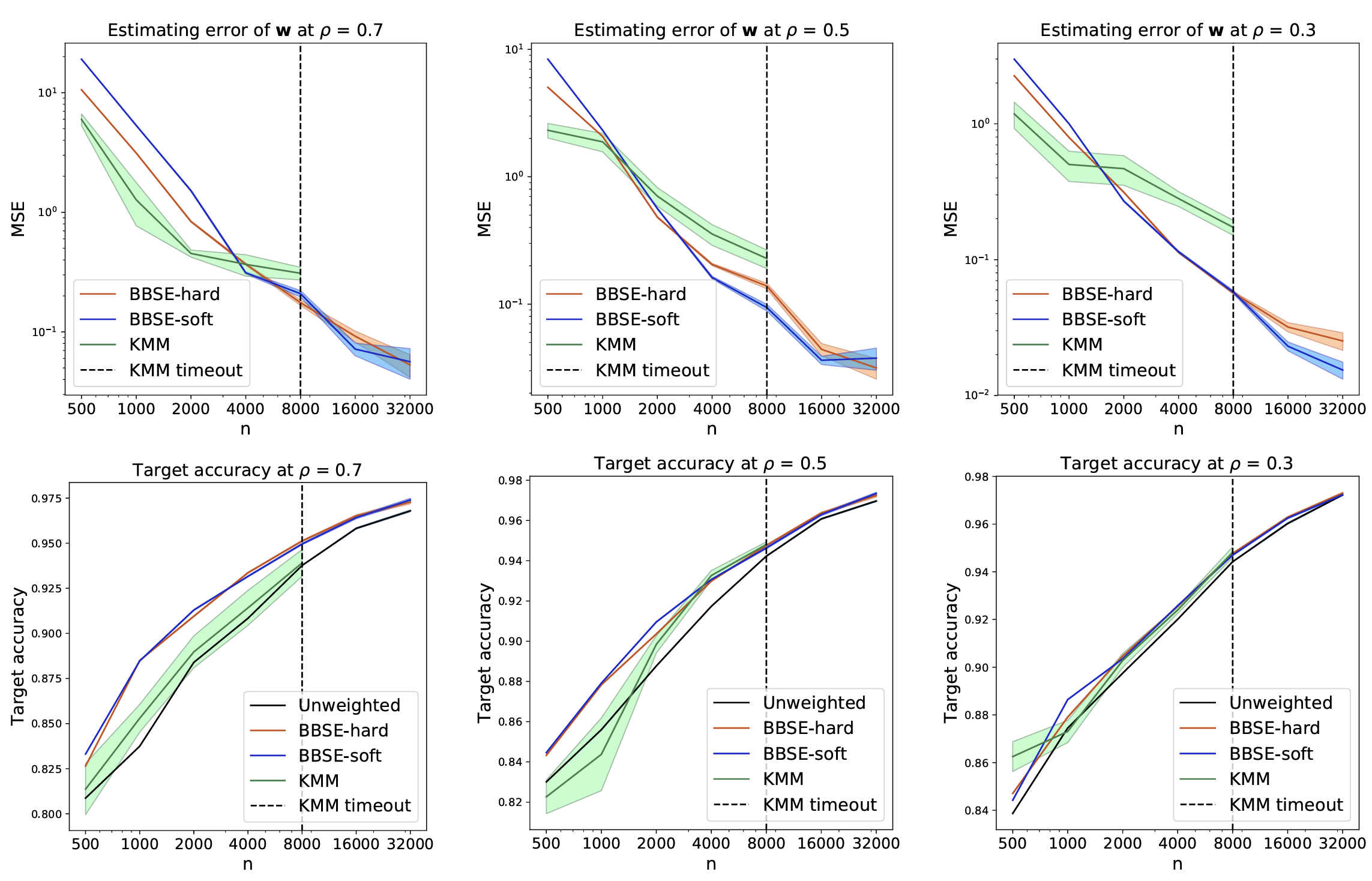
![**Figure 2:** Estimation error (top row) and correction accuracy (bottom row) vs dataset size on MNIST data compared to KMM ([2]) under Dirichlet shift (left to right) with $\alpha = \{.1, 1.0, 10.0\}$ (smaller $\alpha$ means larger shift). $\textsc{BBSE}$ confidence interval on $20$ runs, KMM on $5$ runs due to computation; $n=8000$ is largest feasible KMM experiment.](https://ittowtnkqtyixxjxrhou.supabase.co/storage/v1/object/public/public-images/hzbb3s38/complex_fig_ef20a1208b14.png)
5.2 Black Box Shift Correction (BBSC)
Our estimator also points to a systematic method of correcting for label-shift via importance-weighted ERM. Specifically, we propose the following algorithm:
**Input:** Samples from source distribution $X$, $\mathbf{y}$. Unlabeled data from target distribution $X'$. A class of classifiers $\mathcal{F}$. Hyperparameter $0<\delta<1/k$.
1. Randomly split the training data into two $X_1,X_2 \in \mathbb{R}^{n/2\times d}$ and $\boldsymbol  y_1, \boldsymbol  y_2 \mathbb{R}^{n/2}$.
2. Use $X_1, \boldsymbol  y_1$ to train the classifier and obtain $f\in \mathcal{F}$.
3. On the hold-out data set $X_2, \boldsymbol  y_2$, calculate the confusion matrix $\hat{\mathbf C}_{\hat{y},y}$. If ,
**if** $\sigma_{\min}\left(\hat{\mathbf C}_{\hat{y},y}\right)\leq \delta$ **then**
  Set $\hat{\boldsymbol  w} = \boldsymbol  1$.
**else**
  Estimate $\hat{\boldsymbol  w} =  \hat{\mathbf C}_{\hat{y},y}^{-1} \hat{\boldsymbol  \mu}_{\hat{y} }$ .
**end if**
4. Solve the importance weighted ERM on the $X_1, \boldsymbol  y_1$ with $\max(\hat{\boldsymbol  w}, \boldsymbol  0)$ and obtain $\tilde{f}$.
**Output:** $\tilde{f}$
Note that for classes that occur rarely in the test set, $\textsc{BBSE}$ may produce negative importance weights. During ERM, a flipped sign would cause us to maximize loss, which is unbounded above. Thus, we clip negative weights to $0$.
Owing to its efficacy and generality, our approach can serve as a default tool to deal with domain adaptation. It is one of the first things to try even when the label-shift assumption doesn't hold. By contrast, the heuristic method of using logistic-regression to construct importance weights ([22]) lacks theoretical justification that the estimated weights are correct.
Even in the simpler problem of average treatment effect (ATE) estimation, it's known that using estimated propensity can lead to estimators with large variance ([23]). The same issue applies in supervised learning. We may prefer to live with the biased solution from the unweighted ERM rather than suffer high variance from an unbiased weighted ERM. Our proposed approach offers a consistent low-variance estimator under label shift.
6. Experiments
Section Summary: Researchers tested their BBSE method, which detects and corrects shifts in data labels, using real datasets like MNIST for handwritten digits and CIFAR-10 for images, while simulating various label shifts such as removing certain classes, tweaking class probabilities, or drawing from a Dirichlet distribution. They evaluated shift detection with a two-sample test that outperformed standard kernel methods, especially on MNIST, and assessed weight estimation and classifier correction by comparing prediction accuracy against baselines like unweighted models and kernel mean matching on both datasets. Overall, BBSE showed strong performance, improving accuracy under shifts and requiring less data than competitors.
We experimentally demonstrate the power of $\textsc{BBSE}$ with real data and simulated label shift. We organize results into three categories — shift detection with BBSD, weight estimation with $\textsc{BBSE}$, and classifier correction with BBSC. BBSE-hard denotes our method where $f$ yields classifications. In BBSE-soft, $f$ outputs probabilities.
Label Shift Simulation To simulate distribution shift in our experiments, we adopt the following protocols: First, we split the original data into train, validation, and test sets. Then, given distributions $p(y)$ and $q(y)$, we generate each set by sampling with replacement from the appropriate split. In knock-out shift, we knock out a fraction $\delta$ of data points from a given class from training and validation sets. In tweak-one shift, we assign a probability $\rho$ to one of the classes, the rest of the mass is spread evenly among the other classes. In Dirichlet shift, we draw $p(y)$ from a Dirichlet distribution with concentration parameter $\alpha$. With uniform $p(y)$, Dirichlet shift is bigger for smaller $\alpha$.
Label-shift detection We conduct nonparametric two-sample tests as described in Section 5.1 using the MNIST handwritten digits data set. To simulate the label-shift, we randomly split the training data into a training set, a validating set and a test set, each with 20, 000 data points, and apply knock-out shift on class $y=5$ [^2]. Note that $p(y)$ and $q(y)$ differ increasingly as $\delta$ grows large, making shift detection easier. We obtain $f$ by training a two-layer ReLU-activated Multilayer Perceptron (MLP) with 256 neurons on the training set for five epochs. We conduct a two-sample test of whether the distribution of $f(\text{Validation Set})$ and $f(\text{Test Set})$ are the same using the Kolmogorov-Smirnov test. The results, summarized in Figure 1, demonstrate that BBSD (1) produces a $p$-value that distributes uniformly when $\delta=0$ [^3] (2) provides more power (less Type II error) than the state-of-the-art kernel two-sample test that discriminates $p(\boldsymbol x)$ and $q(\boldsymbol x)$ at $\delta=0.5$, and (3) gets better as we train the black-box predictor even more.
[^2]: Random choice for illustration, method works on all classes.
[^3]: Thus we can control Type I error at any significance level.
Weight estimation and label-shift correction We evaluate $\textsc{BBSE}$ on MNIST by simulating label shift and datasets of various sizes. Specifically, we split the training data set randomly in two, using first half to train $f$ and the second half to estimate $\boldsymbol w$. We use then use the full training set for weighted ERM. As before, $f$ is a two-layer MLP. For fair comparisons with baselines, the full training data set is used throughout (since they do not need $f$ without data splitting). We evaluate our estimator $\hat{\boldsymbol w}$ against the ground truth $\boldsymbol w$ and by the prediction accuracy of BBSC on the test set. To cover a variety of different types of label-shift, we take $p(y)$ as a uniform distribution and generate $q(y)$ with Dirichlet shift for $\alpha=0.1, 1.0, 10.0$ (Figure 2).
:::: {cols="1"}
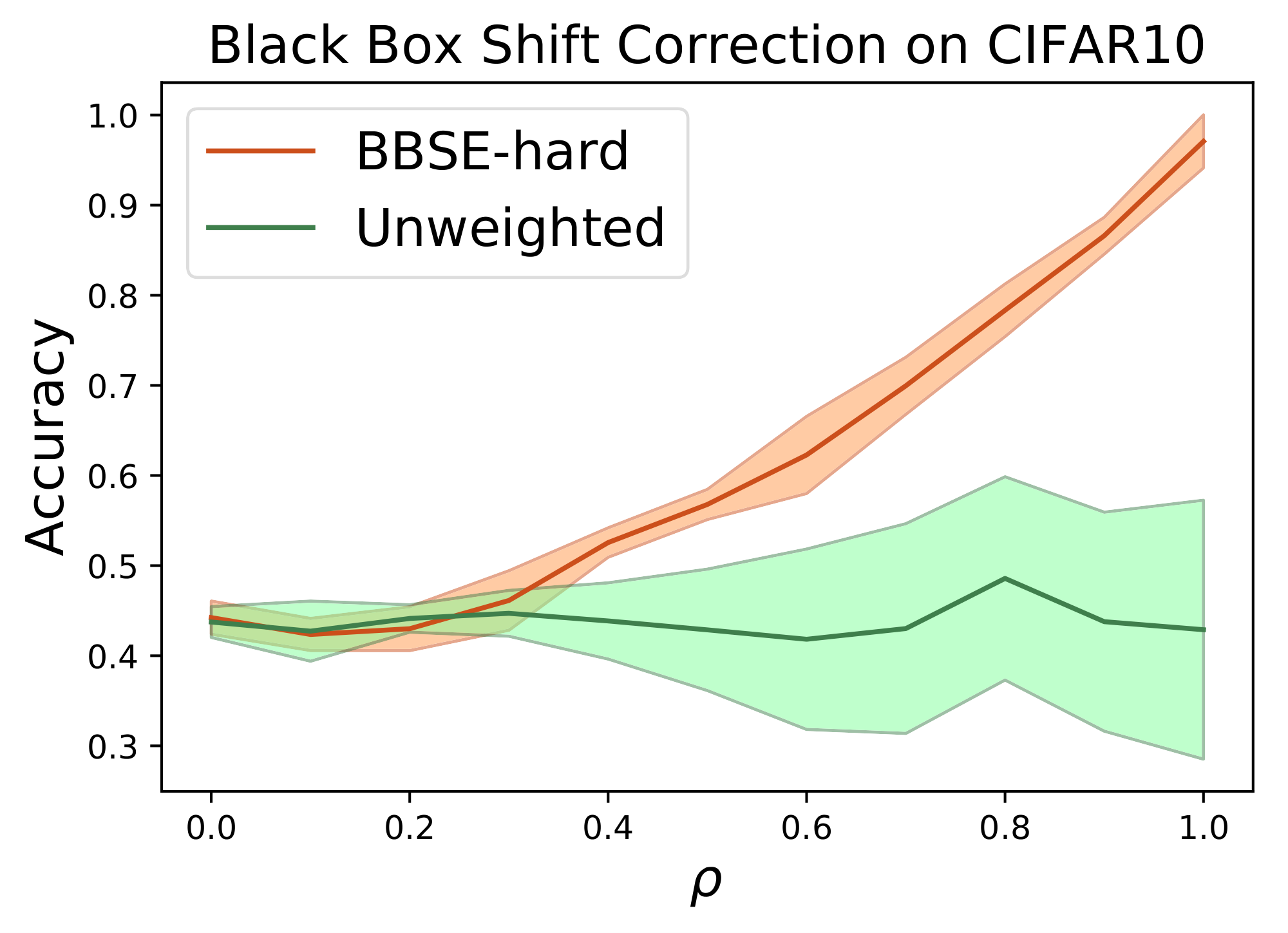
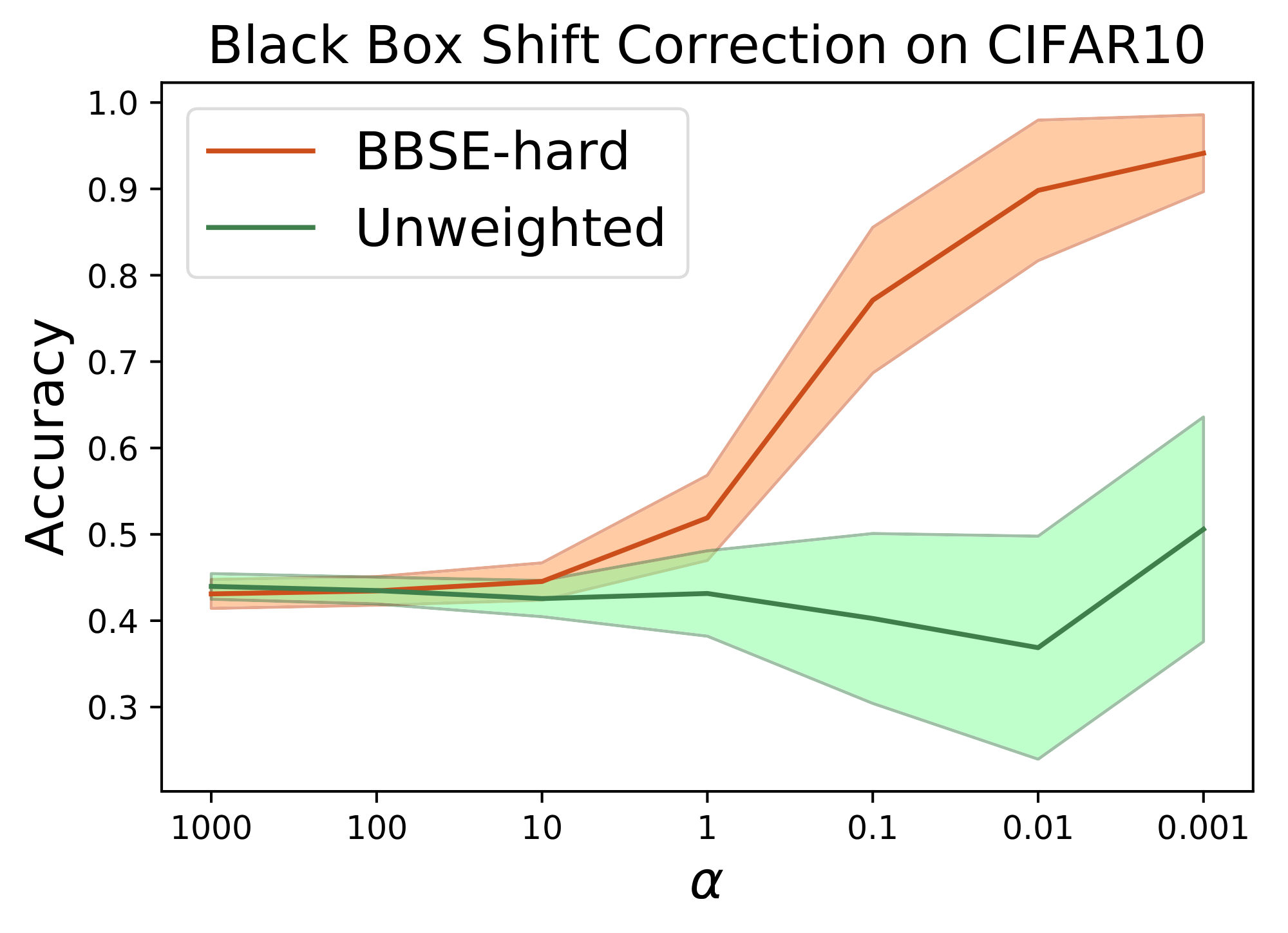
Figure 4: Accuracy of BBSC on CIFAR 10 with (top) tweak-one shift and (bottom) Dirichlet shift. ::::
Label-shift correction for CIFAR10 Next, we extend our experiments to the CIFAR dataset, using the same MLP and this time allowing it to train for 10 epochs. We consider both tweak-one and Dirichlet shift, and compare $\textsc{BBSE}$ to the unweighted classifier under varying degrees of shift (Figure 4). For the tweak-one experiment, we try $\rho \in {0.0, 0.1, ..., 1.0}$, averaging results over all 10 choices of the tweaked label, and plotting the variance. For the Dirichlet experiments, we sample $20$ $q(y)$ for every choice of $\alpha$ in the range 1000, 100, ..., .001. Because kernel-based baselines cannot handle datasets this large or high-dimensional, we compare only to unweighted ERM.
Kernel mean matching (KMM) baselines We compare $\textsc{BBSE}$ to the state-of-the-art kernel mean matching (KMM) methods. For the detection experiments (Figure 1), our baseline is the kernel B-test ([20]), an extension of the kernel max mean discrepancy (MMD) test due to [24] that boasts nearly linear-time computation and little loss in power. We compare $\textsc{BBSE}$ to a KMM approach [2], that solves
$ \min_{\boldsymbol w} | \mathbf C_{\boldsymbol x| y} (\boldsymbol \nu_{y}\circ \boldsymbol w) - \boldsymbol \mu_{\boldsymbol x}|_{\mathcal{H}}^2, $
where we use operator $\mathbf C_{\boldsymbol x| y} := \mathbb{E}[\phi(\boldsymbol x) | \psi(y)]$ and function $\boldsymbol \mu_{x} := \mathbb{E}Q[\phi(\boldsymbol x)]$ to denote the kernel embedding of $p(\boldsymbol x|y)$ and $p_Q(x)$ respectively. Note that under the label-shift assumption, $\mathbf C{\boldsymbol x| y}$ is the same for $P$ and $Q$. Also note that since $\mathcal{Y}$ is discrete, $\psi(y)$ is simply the one-hot representation of $y$, so $\boldsymbol \nu_{y}$ is the same as our definition before and $\mathbf C_{\boldsymbol x| y}$, $\boldsymbol \nu_{y}$ and $\boldsymbol \mu_{\boldsymbol x}$ must be estimated from finite data. The proposal involves a constrained optimization by solving a Gaussian process regression with automatic hyperparameter choices through marginal likelihood.
For fair comparison, we used the original authors' implementations as baselines [^4] and also used the median trick to adaptively tune the RBF kernel's hyperparameter. A key difference is that $\textsc{BBSE}$ matches the distribution of $\hat{y}$ rather than distribution of $\boldsymbol x$ like ([2]) and we learn $f$ through supervised learning rather than by specifying a feature map $\phi$ by choosing a kernel up front.
[^4]: https://github.com/wojzaremba/btest, http://people.tuebingen.mpg.de/kzhang/Code-TarS.zip
Note that KMM, like many kernel methods, requires the construction and inversion of an $n\times n$ Gram matrix, which has complexity of $O(n^3)$. This hinders its application to real-life machine learning problems where $n$ will often be 100s of thousands. In our experiments, we find that the largest $n$ for which we can feasibly run the KMM code is roughly $8, 000$ and that is where we unfortunately have to stop for the MNIST experiment. For the same reason, we cannot run KMM for the CIFAR10 experiments. The MSE curves in Figure 2 for estimating $\boldsymbol w$ suggest that the convergence rate of KMM is slower than $\textsc{BBSE}$ by a polynomial factor and that $\textsc{BBSE}$ better handles large datasets.
7. Discussion
Section Summary: The discussion highlights how building a training dataset with uniform class distributions helps ensure reliable error estimates and successful application of the black box shift estimation (BBSE) method to correct classifiers during testing. It also addresses handling occasional changes in class distributions by combining shift detection with estimation to avoid harming the classifier when no changes occur, and notes that using a pre-existing, well-trained predictor performs better than training on limited data, enabling quick detection of subtle shifts in areas like financial forecasting. For problematic cases like degenerate confusion matrices, adaptations such as soft probabilities, class merging, or pseudo-inverses can maintain invertibility; future work aims to adapt the approach for streaming data, balancing estimation accuracy with data freshness through techniques like propensity weighting.
Constructing the training Set The error bounds on our estimates depend on the norm of the true vector $w(y):= q(y)/p(y)$. This confirms the common sense that absent any assumption on $q(y)$, and given the ability to select class-conditioned examples for annotations one should build a dataset with uniform $p(y)$. Then it's always possible to apply $\textsc{BBSE}$ successfully at test time to correct $f$.
Sporadic Shift In some settings, $p(y)$ might change only sporadically. In these cases, when no label shift occurs, applying BBSC might damage the classifier. For these cases, we prose to combine detection and estimation, correcting the classifier only when a shift has likely occurred.
Using known predictor In our experiments, $f$ has been trained using a random split of the data set, which makes $\textsc{BBSE}$ to perform worse than baseline when the data set is extremely small. In practice, especially in the context of web services, there could be a natural predictor $f$ that is currently being deployed whose training data were legacy and have little to do with the two distributions that we are trying to distinguish. In this case, we do not lose that factor of $2$ and we do not suffer from the variance in training $f$ with a small amount of data. This could allow us to detect mild shift in distributions in very short period of time. Making it suitable for applications such as financial market prediction.
$\textsc{BBSE}$ with degenerate confusion matrices In practice, sometime confusion matrices will be degenerate. For instance, when a class $i$ is rare under $P$, and the features are only partially predictive, we might find that $p(f(\boldsymbol x)=i) = 0$. In these cases, two straightforward variations on the black box method may still work: First, while our analysis focuses on confusion matrices, it easily extends to any operator $f$, such as soft probabilities. If each class $i$, even if $i$ is never the argmax for any example, so long as $p(\hat{y}=i |y=i) > p(\hat{y}=i|y=j)$ for any $j \neq i$, the soft confusion matrix will be invertible. Even when we produce and operator with an invertible confusion matrix, two options remain: We can merge $c$ classes together, yielding a $(k-c) \times (k-c)$ invertible confusion matrix. While we might not be able to estimate the frequencies of those $c$ classes, we can estimate the others accurately. Another possibility is to compute the pseudo-inverse.
Future Work As a next step, we plan to extend our methodology to the streaming setting. In practice, label distributions tend to shift progressively, presenting a new challenge: if we apply $\textsc{BBSE}$ on trailing windows, then we face a trade-off. Looking far back increases $m$, lowering estimation error, but the estimate will be less fresh. The use of propensity weights $w$ on $y$ makes $\textsc{BBSE}$ amenable to doubly-robust estimates, the typical bias-variance tradeoff, and related techniques, common in covariate shift correction.
8. Acknowledgments
Section Summary: The authors express deep gratitude to a group of researchers and experts for their insightful discussions and valuable feedback throughout the project. Key contributors include Kamyar Azizzadenesheli, Kun Zhang, Arthur Gretton, Ashish Khetan Kumar, Anima Anandkumar, Julian McAuley, Dustin Tran, Charles Elkan, Max G'Sell, Alex Dimakis, Gary Marcus, and Todd Gureckis. This support helped shape the work significantly.
We are grateful for extensive insightful discussions and feedback from Kamyar Azizzadenesheli, Kun Zhang, Arthur Gretton, Ashish Khetan Kumar, Anima Anandkumar, Julian McAuley, Dustin Tran, Charles Elkan, Max G'Sell, Alex Dimakis, Gary Marcus, and Todd Gureckis.
Appendix
Section Summary: The appendix addresses practical concerns with the proposed machine learning techniques under label-shift assumptions, such as testing the assumption's validity using kernel-based statistical tests on data from source and target domains to check for discrepancies. It also recommends selecting the best predictive model by maximizing the smallest singular value of its confusion matrix, a measure estimable from labeled source data, and suggests that reusing the same data for training and estimation can be efficient despite introducing minor bias, especially with large datasets. Additionally, it provides mathematical proofs for key lemmas and propositions, demonstrating properties like the invariance of predicted labels and the eventual invertibility of estimated confusion matrices as sample sizes grow.
A. Additional discussion
In this section we provide a few answers to some questions people may have when using our proposed techniques.
What if the label-shift assumption does not hold?
In many applications, we do not know whether label-shift is a reasonable assumption or not. In particular, whenever there are unobserved variables that affects both $\boldsymbol x$ and $y$, then neither label-shift nor covariate-shift is true. However, label shift could still be a good approximation in the in the finite sample environment. Luckily, we can test whether the label-shift assumption is a good approximation in a data-driven fashion via the kernel two-sample tests. In particular, let $\phi: \mathcal{X} \rightarrow \mathcal{F}$ be an arbitrary feature map that (possibly reduces the dimension of $\boldsymbol x$) and $k: \mathcal{F}\times \mathcal{F} \rightarrow \mathbb{R}$ be the kernel function that induces a RKHS $\mathcal{H}$. Let $\boldsymbol w = [q(y)/ p(y)] _{y=1, ..., k}$, then
$ \mathbb{E}{p} \left[\boldsymbol w(y) k(\phi(\boldsymbol x), \cdot)\right] = \mathbb{E}{q} \left[k(\phi(\boldsymbol x), \cdot) \right]. $
The LHS can be estimated by plugging in $\hat{\boldsymbol w}$ and a stochastic approximation of the expectation using labeled data from the source domain and the RHS can be estimated by the sample mean using unlabeled data from the target domain. In particular, if label-shift assumption is true or a good approximation, then
$ | \frac{1}{n}\sum_{i=1}^n\left[\hat{\boldsymbol w}(y_i) k(\phi(\boldsymbol x_i), \cdot)\right] - \frac{1}{m}\sum_{j=1}^m k(\phi(\boldsymbol x'j), \cdot) |\mathcal{H}^2 $
should be on the same order as the statistical error that we can calculate by $m, n$ and the error of $\hat{\boldsymbol w}$ in estimating $\boldsymbol w$.
Model selection criterion and the choice of $f$.
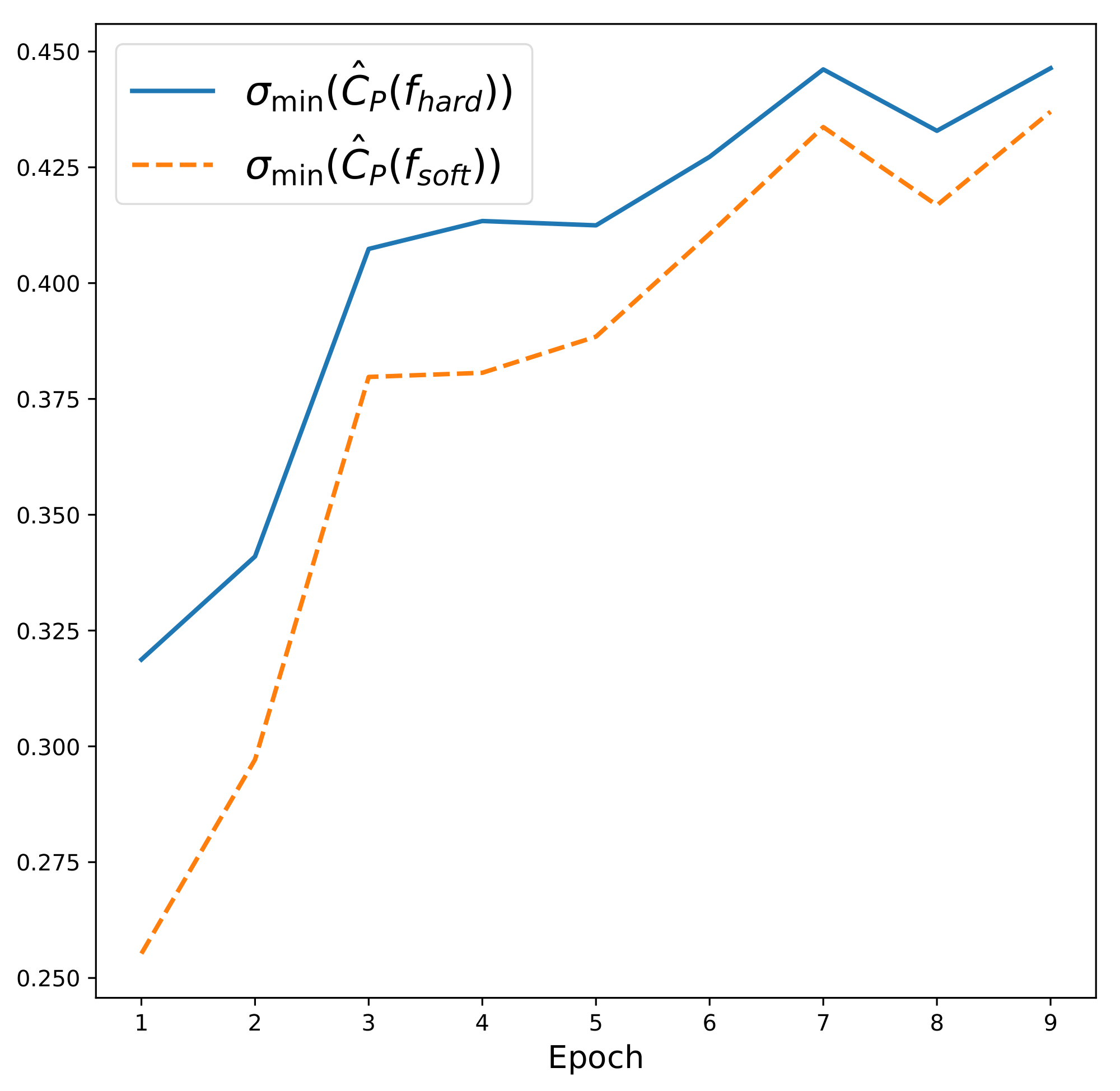
Our analysis assumes that $f$ is fixed and given, but in practice, often we need to train $f$ from the same data set. Given a number of choices, one may wonder which blackbox predictor $f$ should we prefer out of a collection of $\mathcal{F}$? Our theoretical results suggest a natural quantity: the smallest singular value of the confusion matrix, for choosing the blackbox predictors. Note that the smallest singular value is a quantity that can be estimated using only labeled data from the source domain. Therefore a practical heuristic to use is to the $f$ that maximizes the smallest singular value of the corresponding $\hat{C}_f$. Figure 8 plots the smallest singular value of the confusion matrices as the number of epochs of training $f$ gets larger. The model we use is the same multi-layer perceptron that we used for our experiments and the source distribution is one that we knocks off 80% of the fifth class. This is the same model and data set we used in Figure 1c. Referring to $\delta=0.8$ in Figure 1c, we see that the test power of $f$ that is trained for only one epoch is much lower than the $f$ that is trained for five epochs, and the gap in the smallest singular values is predicative of the fact at least qualitatively.
Is data splitting needed?
Recall that we train the model $f$ and estimate $\boldsymbol w$ using two independent splits of the labeled data set drawn from the same distribution. In practice, especially when $n$ is large, using the same data to train $f$ and to estimate $\boldsymbol w$ will be more data efficient. This comes at a price of a small bias. It is unclear how to quantify that bias but the data-reuse version could be useful in practice as a heuristic.
B. Proofs
We present the proofs of Lemma 1 and Proposition 2 in this Appendix.
Proof of Lemma 1: By the law of total probability
$ \begin{align*} &q(\hat{y} | y) = \sum_{y\in \mathcal{Y}} q(\hat{y} | \boldsymbol x, y) q(\boldsymbol x|y) = \sum_{y\in \mathcal{Y}} q(\hat{y} | \boldsymbol x, y) p(\boldsymbol x|y) \ &= \sum_{y\in \mathcal{Y}} p_{f}(\hat{y} | \boldsymbol x) p(\boldsymbol x|y) = \sum_{y\in \mathcal{Y}} p(\hat{y} | \boldsymbol x, y) p(\boldsymbol x|y) = p(\hat{y} | y). \end{align*} $
We applied A.1 to the second equality, and used the conditional independence $\hat{y}\perp!!!\perp y | x$ under $P$ and $Q$ together with $p(\hat{y} | \boldsymbol x)$ being determined by $f$, which is fixed.
Proof of Proposition 2: A.2 ensures that $\boldsymbol w<\infty$. By Assumption A.3, ${\mathbf C}{\hat{y}, y}$ is invertible. Let $\delta>0$ be its smallest singular value. We bound the probability that $\hat{\mathbf C}{\hat{y}, y}$ is not invertible:
$ \begin{align*} & \mathbb{P}(\hat{\mathbf C}{\hat{y}, y}\text{ is not invertible}) \leq \mathbb{P}(\sigma{\min}(\hat{\mathbf C}{\hat{y}, y}) < \delta/2) \ & \leq \mathbb{P}(|\hat{\mathbf C}{\hat{y}, y}- \mathbf C_{\hat{y}, y}|2 \geq \delta/2) \underset{\mathclap{\overset{\uparrow}{\text{pigeon hole}}}}{\leq} \mathbb{P}(|\hat{\mathbf C}{\hat{y}, y}- \mathbf C_{\hat{y}, y}|F \geq \frac{\delta}{2\sqrt{k}}) \ &\underset{\mathclap{\overset{\uparrow}{\text{pigeon hole}}}}{\leq} \mathbb{P}(\exists (i, j)\in[k]^2, \text{ s.t.} |[\hat{\mathbf C}{\hat{y}, y}] {i, j}- [\mathbf C{\hat{y}, y}] _{i, j}| \geq \frac{\delta}{2k^{1.5}}) \underset{\mathclap{\overset{\uparrow}{\text{Hoeffding}}}}{\leq} 2e^{-\frac{n\delta^2}{4k^3}}. \end{align*} $
By the convergence of geometric series $\sum_{n}\mathbb{P}(\hat{\mathbf C}_{\hat{y}, y} is not invertible) < +\infty$. This allows us to invoke the First Borel-Cantelli Lemma, which shows
$ \mathbb{P}(\hat{\mathbf C}_{\hat{y}, y}\text{ is not invertible} \text{ i.o.}) = 0.\tag{5} $
This ensures that as $n\rightarrow \infty$, $\hat{\mathbf C}{\hat{y}, y}$ is invertible almost surely. By the strong law of large numbers (SLLN), as $n\rightarrow \infty$ $\hat{\mathbf C}{\hat{y}, y}\overset{\text{a.s.}}{\longrightarrow} \mathbf C_{\hat{y}, y}$ and $\hat{\boldsymbol \nu}{y} \overset{\text{a.s.}}{\longrightarrow} \boldsymbol \nu{y}$. Similarly, as $m\rightarrow \infty$, $\hat{\boldsymbol \mu}{\hat{y}} \overset{\text{a.s.}}{\longrightarrow} \boldsymbol \mu{\hat{y}}$. Combining these with Equation 5 and applying the continuous mapping theorem with the fact that the inverse of an invertible matrix is a continuous mapping we get that
$ \hat{\boldsymbol w} = [\hat{\mathbf C}{\hat{y}, y}]^{-1} \hat{\boldsymbol \mu}{\hat{y}} \overset{\text{a.s.}}{\longrightarrow} \boldsymbol w, \text{ and } \hat{\boldsymbol \mu}_{y} = \mathrm{diag}(\hat{\boldsymbol \nu}y) \hat{\boldsymbol w} \overset{\text{a.s.}}{\longrightarrow} \boldsymbol \mu{y}. $
C. Concentration inequalities
########## {caption="Lemma: Hoeffding's inequality"}
Let $x_1, ..., x_n$ be independent random variables bounded by $[a_i, b_i]$. Then $\bar{x} = \frac{1}{n}\sum_{i=1}^n x_i$ obeys for any $t>0$
$ \mathbb{P}(\left|\bar{x} - \mathbb{E}[\bar{x}]\right|\geq t) \leq 2\exp\left(-\frac{2n^2t^2}{\sum_{i=1}^n(b_i-a_i)^2}\right). $
########## {caption="Lemma 4: Matrix Bernstein Inequality (rectangular case)"}
Let $\mathbf Z_1, ..., \mathbf Z_n$ be independent random matrices with dimension $d_1\times d_2$ and each satisfy
$ \mathbb{E} \mathbf Z_i = \mathbf 0\text{ and } | \mathbf Z_i| \leq R $
almost surely. Define the variance parameter
$ \sigma^2 - \max{ |\sum_i \mathbb{E}[\mathbf Z_i \mathbf Z_i^T]|, |\sum_i \mathbb{E}[\mathbf Z_i^T \mathbf Z_i]| }. $
Then for all $t\geq 0$,
$ \mathbb{P}\left(|\sum_i \mathbf Z_i| \geq t\right) \leq (d_1 + d_2) \cdot e^{\frac{-t^2}{\sigma^2 + Rt/3}}. $
References
[1] Schölkopf, B., Janzing, D., Peters, J., Sgouritsa, E., Zhang, K., & Mooij, J. (2012). On causal and anticausal learning. In International Coference on International Conference on Machine Learning (ICML-12), (pp. 459–466). Omnipress.
[2] Zhang, K., Schölkopf, B., Muandet, K., & Wang, Z. (2013). Domain adaptation under target and conditional shift. In International Conference on Machine Learning, (pp. 819–827).
[3] Chan, Y. S., & Ng, H. T. (2005). Word sense disambiguation with distribution estimation. In Proceedings of the 19th international joint conference on Artificial intelligence, (pp. 1010–1015). Morgan Kaufmann Publishers Inc.
[4] Storkey, A. (2009). When training and test sets are different: characterizing learning transfer. Dataset shift in machine learning.
[5] Gretton, A., Smola, A. J., Huang, J., Schmittfull, M., Borgwardt, K. M., & Schölkopf, B. (2009). Covariate shift by kernel mean matching. Journal of Machine Learning Research.
[6] Bishop, C. M. (1995). Neural networks for pattern recognition. Oxford university press.
[7] Elkan, C. (2001). The foundations of cost-sensitive learning. In IJCAI.
[8] Zadrozny, B. (2004). Learning and evaluating classifiers under sample selection bias. In Proceedings of the twenty-first international conference on Machine learning, (p. 114). ACM.
[9] Huang, J., Gretton, A., Borgwardt, K. M., Schölkopf, B., & Smola, A. J. (2007). Correcting sample selection bias by unlabeled data. In Advances in neural information processing systems.
[10] Sugiyama, M., Nakajima, S., Kashima, H., Buenau, P. V., & Kawanabe, M. (2008). Direct importance estimation with model selection and its application to covariate shift adaptation. In Advances in neural information processing systems.
[11] Shimodaira, H. (2000). Improving predictive inference under covariate shift by weighting the log-likelihood function. Journal of statistical planning and inference.
[12] Heckman, J. J. (1977). Sample selection bias as a specification error (with an application to the estimation of labor supply functions).
[13] Manski, C. F., & Lerman, S. R. (1977). The estimation of choice probabilities from choice based samples. Econometrica: Journal of the Econometric Society.
[14] Rosenbaum, P. R., & Rubin, D. B. (1983). The central role of the propensity score in observational studies for causal effects. Biometrika, 70(1), 41–55.
[15] Zhu, X., Gibson, B. R., Jun, K.-S., Rogers, T. T., Harrison, J., & Kalish, C. (2010). Cognitive models of test-item effects in human category learning. In ICML.
[16] Buck, A., Gart, J., et al. (1966). Comparison of a screening test and a reference test in epidemiologic studies. ii. a probabilistic model for the comparison of diagnostic tests. American Journal of Epidemiology.
[17] Forman, G. (2008). Quantifying counts and costs via classification. Data Mining and Knowledge Discovery.
[18] Saerens, M., Latinne, P., & Decaestecker, C. (2002). Adjusting the outputs of a classifier to new a priori probabilities: a simple procedure. Neural computation, 14(1), 21–41.
[19] Deng, J., Dong, W., Socher, R., Li, L.-J., Li, K., & Fei-Fei, L. (2009). Imagenet: A large-scale hierarchical image database. In CVPR.
[20] Zaremba, W., Gretton, A., & Blaschko, M. (2013). B-test: A non-parametric, low variance kernel two-sample test. In Advances in neural information processing systems, (pp. 755–763).
[21] Ramdas, A., Reddi, S. J., Póczos, B., Singh, A., & Wasserman, L. A. (2015). On the decreasing power of kernel and distance based nonparametric hypothesis tests in high dimensions. In AAAI, (pp. 3571–3577).
[22] Bickel, S., Brückner, M., & Scheffer, T. (2009). Discriminative learning under covariate shift. Journal of Machine Learning Research, 10(Sep), 2137–2155.
[23] Kang, J. D., & Schafer, J. L. (2007). Demystifying double robustness: A comparison of alternative strategies for estimating a population mean from incomplete data. Statistical science, 22(4), 523–539.
[24] Gretton, A., Borgwardt, K. M., Rasch, M. J., Schölkopf, B., & Smola, A. (2012). A kernel two-sample test. Journal of Machine Learning Research, 13(Mar), 723–773.