
Auto-Encoding Variational Bayes
Diederik P. Kingma
Machine Learning Group
Universiteit van Amsterdam[email protected]
Max Welling
Machine Learning Group
Universiteit van Amsterdam[email protected]
Abstract
How can we perform efficient inference and learning in directed probabilistic models, in the presence of continuous latent variables with intractable posterior distributions, and large datasets? We introduce a stochastic variational inference and learning algorithm that scales to large datasets and, under some mild differentiability conditions, even works in the intractable case. Our contributions are two-fold. First, we show that a reparameterization of the variational lower bound yields a lower bound estimator that can be straightforwardly optimized using standard stochastic gradient methods. Second, we show that for i.i.d. datasets with continuous latent variables per datapoint, posterior inference can be made especially efficient by fitting an approximate inference model (also called a recognition model) to the intractable posterior using the proposed lower bound estimator. Theoretical advantages are reflected in experimental results.
Executive Summary: In the field of machine learning, a key challenge arises when modeling complex data like images or faces using probabilistic models that include hidden, continuous variables—such as latent factors representing underlying patterns. These models often have "intractable" posteriors, meaning the math to infer hidden variables from observed data is too complex to compute directly, especially with large datasets. This limits efficient training and inference, hindering applications in generative tasks like creating realistic synthetic images or denoising noisy data. As data volumes grow in areas like computer vision, scalable methods are urgently needed to learn useful representations without prohibitive computation.
This paper aims to develop an efficient algorithm for inference and learning in such directed probabilistic models with continuous latent variables, even when exact computations are impossible. It specifically targets maximum likelihood estimation of model parameters and approximate posterior inference for latent variables, using independent and identically distributed datasets.
The authors propose a high-level approach based on variational Bayesian methods, which approximate intractable probabilities with simpler ones to create a lower bound on the data likelihood. They introduce a "reparameterization trick" to form a stochastic gradient variational Bayes (SGVB) estimator, which rewrites expectations over latent variables as differentiable functions of fixed noise, allowing optimization via standard stochastic gradient descent. For practical efficiency with large datasets, they extend this to the Auto-Encoding Variational Bayes (AEVB) algorithm, which jointly trains a "recognition model" (an approximate posterior, like a neural network encoder) alongside the generative model (a decoder). This uses minibatches of 100 data points and one sample per point, tested on standard datasets like MNIST handwritten digits (60,000 training images) and Frey Face faces (about 2,000 images), assuming Gaussian priors and neural network architectures with 100–500 hidden units. No heavy sampling like Markov chain Monte Carlo is needed per data point.
The core findings highlight AEVB's advantages. First, it converges 2–5 times faster than the wake-sleep algorithm and achieves 10–20% higher variational lower bounds on average across latent space dimensions from 2 to 200. Second, unlike prior methods, adding more latent variables (up to 200 dimensions) does not cause overfitting, thanks to built-in regularization from the KL divergence term, maintaining stable performance on test data. Third, AEVB yields marginal log-likelihoods about 5–10 nats higher than wake-sleep and outperforms Monte Carlo EM by converging in under 20 million samples for small sets (1,000 points) and scaling better for large ones (50,000 points), where EM becomes infeasible. Fourth, low-dimensional (2D) projections visualize meaningful manifolds, such as smooth interpolations between digit shapes in MNIST or facial expressions in Frey Faces. These results hold across experiments running in 20–40 minutes per million samples on standard hardware.
These findings imply that AEVB enables scalable, principled training of variational auto-encoders, bridging probabilistic modeling with auto-encoder architectures for better generative performance. It reduces risks of poor representations seen in unregularized auto-encoders by enforcing prior alignment, potentially cutting training times by half while improving data likelihood by 10–20%, which matters for downstream tasks like image synthesis, anomaly detection, or representation learning in safety-critical applications (e.g., medical imaging). Contrary to expectations from earlier work like wake-sleep, the method avoids dual-objective optimization pitfalls, delivering more reliable results without manual hyperparameter tuning for regularization.
To leverage these results, organizations should implement AEVB for training neural probabilistic models on image or sequential data, starting with Gaussian assumptions and neural encoders/decoders for quick pilots. The main option is using the lower-variance estimator (eq. 7 in the paper) for faster convergence, trading minimal added computation for stability; alternatives like full variational Bayes on parameters could be explored if parameter uncertainty is key. Further work is needed before broad deployment: validate on non-image data (e.g., text) and scale to deeper networks. Test via small-scale pilots on domain-specific datasets to confirm gains.
Limitations include reliance on continuous latent variables and differentiable reparameterizations (e.g., Gaussian families), which may not suit discrete data without extensions; high estimator variance could arise in non-standard distributions. Experiments are confined to toy datasets, so real-world scaling (e.g., millions of high-res images) requires more validation. Overall confidence is strong for the claimed efficiency and bounds, based on consistent empirical comparisons, but caution is advised for models outside tested assumptions like intractable non-Gaussian likelihoods.
1. Introduction
Section Summary: This section addresses the challenge of performing efficient approximate inference and learning in probabilistic models with continuous hidden variables or parameters that have hard-to-compute posterior distributions. It introduces the variational Bayesian method, which approximates the posterior but often struggles with the standard mean-field technique due to intractable calculations; to overcome this, the authors propose the Stochastic Gradient Variational Bayes (SGVB) estimator, a simple, differentiable tool that enables efficient optimization using common gradient-based methods for a wide range of such models. For datasets with independent data points and per-point continuous latents, they present the Auto-Encoding Variational Bayes (AEVB) algorithm, which trains a recognition model for fast inference via basic sampling, allowing efficient parameter learning without costly iterative methods, and supports tasks like denoising and visualization; when using a neural network for recognition, this leads to the variational auto-encoder.
How can we perform efficient approximate inference and learning with directed probabilistic models whose continuous latent variables and/or parameters have intractable posterior distributions? The variational Bayesian (VB) approach involves the optimization of an approximation to the intractable posterior. Unfortunately, the common mean-field approach requires analytical solutions of expectations w.r.t. the approximate posterior, which are also intractable in the general case. We show how a reparameterization of the variational lower bound yields a simple differentiable unbiased estimator of the lower bound; this SGVB (Stochastic Gradient Variational Bayes) estimator can be used for efficient approximate posterior inference in almost any model with continuous latent variables and/or parameters, and is straightforward to optimize using standard stochastic gradient ascent techniques.
For the case of an i.i.d. dataset and continuous latent variables per datapoint, we propose the Auto-Encoding VB (AEVB) algorithm. In the AEVB algorithm we make inference and learning especially efficient by using the SGVB estimator to optimize a recognition model that allows us to perform very efficient approximate posterior inference using simple ancestral sampling, which in turn allows us to efficiently learn the model parameters, without the need of expensive iterative inference schemes (such as MCMC) per datapoint. The learned approximate posterior inference model can also be used for a host of tasks such as recognition, denoising, representation and visualization purposes. When a neural network is used for the recognition model, we arrive at the variational auto-encoder.
2. Method
Section Summary: This section outlines a strategy for estimating parameters in directed graphical models that involve hidden continuous variables generating observed data, focusing on common scenarios with independent data samples where exact computations are infeasible. It addresses challenges like intractable integrals for likelihoods and posteriors, especially with large datasets that require efficient updates using small batches rather than slow sampling methods. The approach proposes approximate solutions for parameter estimation, inferring hidden variables from observations, and generating data distributions, using a jointly learned "recognition model" to approximate the hidden structure, akin to a probabilistic encoder for data representation.
The strategy in this section can be used to derive a lower bound estimator (a stochastic objective function) for a variety of directed graphical models with continuous latent variables. We will restrict ourselves here to the common case where we have an i.i.d. dataset with latent variables per datapoint, and where we like to perform maximum likelihood (ML) or maximum a posteriori (MAP) inference on the (global) parameters, and variational inference on the latent variables. It is, for example, straightforward to extend this scenario to the case where we also perform variational inference on the global parameters; that algorithm is put in the appendix, but experiments with that case are left to future work. Note that our method can be applied to online, non-stationary settings, e.g. streaming data, but here we assume a fixed dataset for simplicity.
2.1 Problem scenario
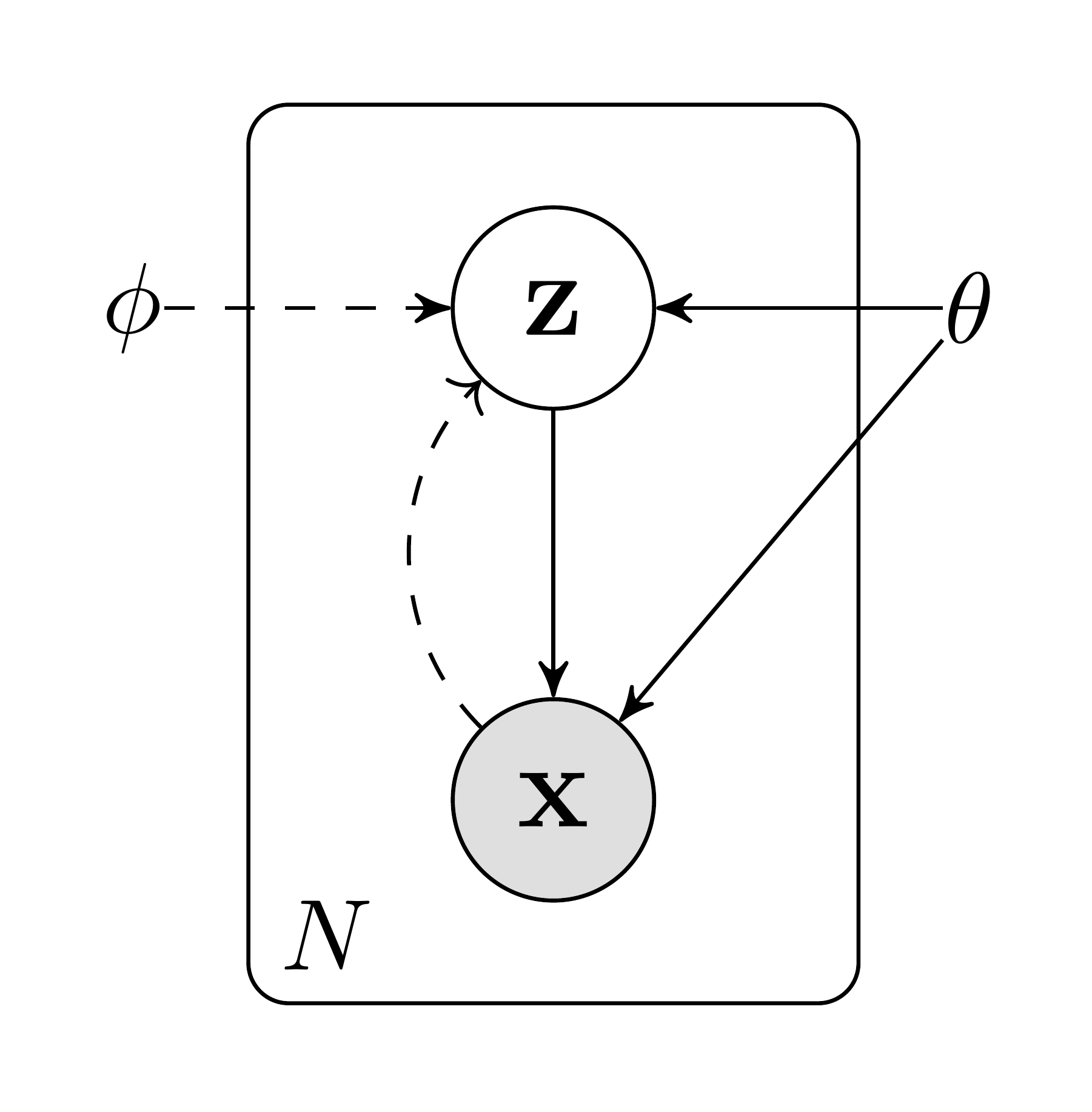
Let us consider some dataset $\mathbf{X} = {\mathbf{x}^{(i)}}{i=1}^N$ consisting of $N$ i.i.d. samples of some continuous or discrete variable $\mathbf{x}$. We assume that the data are generated by some random process, involving an unobserved continuous random variable $\mathbf{z}$. The process consists of two steps: (1) a value $\mathbf{z}^{(i)}$ is generated from some prior distribution $p{\boldsymbol{\theta}^*}(\mathbf{z})$; (2) a value $\mathbf{x}^{(i)}$ is generated from some conditional distribution $p_{\boldsymbol{\theta}^*}(\mathbf{x}| \mathbf{z})$. We assume that the prior $p_{\boldsymbol{\theta}^*}(\mathbf{z})$ and likelihood $p_{\boldsymbol{\theta}^*}(\mathbf{x}| \mathbf{z})$ come from parametric families of distributions $p_{\boldsymbol{\theta}}(\mathbf{z})$ and $p_{\boldsymbol{\theta}}(\mathbf{x}| \mathbf{z})$, and that their PDFs are differentiable almost everywhere w.r.t. both $\boldsymbol{\theta}$ and $\mathbf{z}$. Unfortunately, a lot of this process is hidden from our view: the true parameters $\boldsymbol{\theta}^*$ as well as the values of the latent variables $\mathbf{z}^{(i)}$ are unknown to us.
Very importantly, we do not make the common simplifying assumptions about the marginal or posterior probabilities. Conversely, we are here interested in a general algorithm that even works efficiently in the case of:
- Intractability: the case where the integral of the marginal likelihood $p_{\boldsymbol{\theta}}(\mathbf{x}) = \int p_{\boldsymbol{\theta}}(\mathbf{z}) p_{\boldsymbol{\theta}}(\mathbf{x}| \mathbf{z}) , d \mathbf{z}$ is intractable (so we cannot evaluate or differentiate the marginal likelihood), where the true posterior density $p_{\boldsymbol{\theta}}(\mathbf{z}| \mathbf{x}) = p_{\boldsymbol{\theta}}(\mathbf{x}| \mathbf{z})p_{\boldsymbol{\theta}}(\mathbf{z})/ p_{\boldsymbol{\theta}}(\mathbf{x})$ is intractable (so the EM algorithm cannot be used), and where the required integrals for any reasonable mean-field VB algorithm are also intractable. These intractabilities are quite common and appear in cases of moderately complicated likelihood functions $p_{\boldsymbol{\theta}}(\mathbf{x}| \mathbf{z})$, e.g. a neural network with a nonlinear hidden layer.
- A large dataset: we have so much data that batch optimization is too costly; we would like to make parameter updates using small minibatches or even single datapoints. Sampling-based solutions, e.g. Monte Carlo EM, would in general be too slow, since it involves a typically expensive sampling loop per datapoint.
We are interested in, and propose a solution to, three related problems in the above scenario:
- Efficient approximate ML or MAP estimation for the parameters $\boldsymbol{\theta}$. The parameters can be of interest themselves, e.g. if we are analyzing some natural process. They also allow us to mimic the hidden random process and generate artificial data that resembles the real data.
- Efficient approximate posterior inference of the latent variable $\mathbf{z}$ given an observed value $\mathbf{x}$ for a choice of parameters $\boldsymbol{\theta}$. This is useful for coding or data representation tasks.
- Efficient approximate marginal inference of the variable $\mathbf{x}$. This allows us to perform all kinds of inference tasks where a prior over $\mathbf{x}$ is required. Common applications in computer vision include image denoising, inpainting and super-resolution.
For the purpose of solving the above problems, let us introduce a recognition model $q_{\boldsymbol{\phi}}(\mathbf{z}| \mathbf{x})$: an approximation to the intractable true posterior $p_{\boldsymbol{\theta}}(\mathbf{z}| \mathbf{x})$. Note that in contrast with the approximate posterior in mean-field variational inference, it is not necessarily factorial and its parameters $\boldsymbol{\phi}$ are not computed from some closed-form expectation. Instead, we'll introduce a method for learning the recognition model parameters $\boldsymbol{\phi}$ jointly with the generative model parameters $\boldsymbol{\theta}$.
From a coding theory perspective, the unobserved variables $\mathbf{z}$ have an interpretation as a latent representation or code. In this paper we will therefore also refer to the recognition model $q_{\boldsymbol{\phi}}(\mathbf{z}| \mathbf{x})$ as a probabilistic encoder, since given a datapoint $\mathbf{x}$ it produces a distribution (e.g. a Gaussian) over the possible values of the code $\mathbf{z}$ from which the datapoint $\mathbf{x}$ could have been generated. In a similar vein we will refer to $p_{\boldsymbol{\theta}}(\mathbf{x}| \mathbf{z})$ as a probabilistic decoder, since given a code $\mathbf{z}$ it produces a distribution over the possible corresponding values of $\mathbf{x}$.
2.2 The variational bound
The marginal likelihood is composed of a sum over the marginal likelihoods of individual datapoints $\log p_{\boldsymbol{\theta}}(\mathbf{x}^{(1)}, \cdots, \mathbf{x}^{(N)}) = \sum_{i=1}^N \log p_{\boldsymbol{\theta}}(\mathbf{x}^{(i)})$, which can each be rewritten as:
$ \begin{align*} \log p_{\boldsymbol{\theta}}(\mathbf{x}^{(i)}) = D_{KL}(q_{\boldsymbol{\phi}}(\mathbf{z}| \mathbf{x}^{(i)})|| p_{\boldsymbol{\theta}}(\mathbf{z}| \mathbf{x}^{(i)})) + \mathcal{L}^{}(\boldsymbol{\theta}, \boldsymbol{\phi}; \mathbf{x}^{(i)}) \end{align*}\tag{1} $
The first RHS term is the KL divergence of the approximate from the true posterior. Since this KL-divergence is non-negative, the second RHS term $\mathcal{L}^{}(\boldsymbol{\theta}, \boldsymbol{\phi}; \mathbf{x}^{(i)})$ is called the (variational) lower bound on the marginal likelihood of datapoint $i$, and can be written as:
$ \begin{align*} \log p_{\boldsymbol{\theta}}(\mathbf{x}^{(i)}) \geq \mathcal{L}^{}(\boldsymbol{\theta}, \boldsymbol{\phi}; \mathbf{x}^{(i)}) &= \mathbb{E}{q{\boldsymbol{\phi}}(\mathbf{z}| \mathbf{x})}\left[- \log q_{\boldsymbol{\phi}}(\mathbf{z}| \mathbf{x}) + \log p_{\boldsymbol{\theta}}(\mathbf{x}, \mathbf{z})\right] \end{align*}\tag{2} $
which can also be written as:
$ \begin{align*} \mathcal{L}^{}(\boldsymbol{\theta}, \boldsymbol{\phi}; \mathbf{x}^{(i)}) = - D_{KL}(q_{\boldsymbol{\phi}}(\mathbf{z}| \mathbf{x}^{(i)}) || p_{\boldsymbol{\theta}}(\mathbf{z})) + \mathbb{E}{q{\boldsymbol{\phi}}(\mathbf{z}| \mathbf{x}^{(i)})}\left[\log p_{\boldsymbol{\theta}}(\mathbf{x}^{(i)} | \mathbf{z})\right] \end{align*}\tag{3} $
We want to differentiate and optimize the lower bound $\mathcal{L}^{}(\boldsymbol{\theta}, \boldsymbol{\phi}; \mathbf{x}^{(i)})$ w.r.t. both the variational parameters $\boldsymbol{\phi}$ and generative parameters $\boldsymbol{\theta}$. However, the gradient of the lower bound w.r.t. $\boldsymbol{\phi}$ is a bit problematic. The usual (naïve) Monte Carlo gradient estimator for this type of problem is: $\nabla_{\boldsymbol{\phi}} \mathbb{E}{q{\boldsymbol{\phi}}(\mathbf{z})}\left[f(\mathbf{z})\right] = \mathbb{E}{q{\boldsymbol{\phi}}(\mathbf{z})}\left[f(\mathbf{z}) \nabla_{q_{\boldsymbol{\phi}}(\mathbf{z})} \log q_{\boldsymbol{\phi}}(\mathbf{z}) \right] \simeq \frac{1}{L} \sum_{l=1}^L f(\mathbf{z}) \nabla_{q_{\boldsymbol{\phi}}(\mathbf{z}^{(l)})} \log q_{\boldsymbol{\phi}}(\mathbf{z}^{(l)})$ where $\mathbf{z}^{(l)} \sim q_{\boldsymbol{\phi}}(\mathbf{z}| \mathbf{x}^{(i)})$. This gradient estimator exhibits exhibits very high variance (see e.g. [1]) and is impractical for our purposes.
2.3 The SGVB estimator and AEVB algorithm
In this section we introduce a practical estimator of the lower bound and its derivatives w.r.t. the parameters. We assume an approximate posterior in the form $q_{\boldsymbol{\phi}}(\mathbf{z}| \mathbf{x})$, but please note that the technique can be applied to the case $q_{\boldsymbol{\phi}}(\mathbf{z})$, i.e. where we do not condition on $\mathbf{x}$, as well. The fully variational Bayesian method for inferring a posterior over the parameters is given in the appendix.
Under certain mild conditions outlined in Section 2.4 for a chosen approximate posterior $q_{\boldsymbol{\phi}}(\mathbf{z}| \mathbf{x})$ we can reparameterize the random variable $\widetilde{\mathbf{z}} \sim q_{\boldsymbol{\phi}}(\mathbf{z}| \mathbf{x})$ using a differentiable transformation $g_{\boldsymbol{\phi}}(\boldsymbol{\epsilon}, \mathbf{x})$ of an (auxiliary) noise variable $\boldsymbol{\epsilon}$:
$ \begin{align*} \widetilde{\mathbf{z}} = g_{\boldsymbol{\phi}}(\boldsymbol{\epsilon}, \mathbf{x}) \text{\quad with \quad} \boldsymbol{\epsilon} \sim p(\boldsymbol{\epsilon}) \end{align*}\tag{4} $
See Section 2.4 for general strategies for chosing such an approriate distribution $p(\boldsymbol{\epsilon})$ and function $g_{\boldsymbol{\phi}}(\boldsymbol{\epsilon}, \mathbf{x})$. We can now form Monte Carlo estimates of expectations of some function $f(\mathbf{z})$ w.r.t. $q_{\boldsymbol{\phi}}(\mathbf{z}| \mathbf{x})$ as follows:
$ \begin{align} \mathbb{E}{q{\boldsymbol{\phi}}(\mathbf{z}| \mathbf{x}^{(i)})}\left[f(\mathbf{z})\right] = \mathbb{E}{p(\boldsymbol{\epsilon})}\left[f(g{\boldsymbol{\phi}}(\boldsymbol{\epsilon}, \mathbf{x}^{(i)}))\right] &\simeq \frac{1}{L} \sum_{l=1}^L {f(g_{\boldsymbol{\phi}}(\boldsymbol{\epsilon}^{(l)}, \mathbf{x}^{(i)}))} \text{\quad where \quad} \boldsymbol{\epsilon}^{(l)} \sim p(\boldsymbol{\epsilon}) \end{align} $
We apply this technique to the variational lower bound (eq. 2), yielding our generic Stochastic Gradient Variational Bayes (SGVB) estimator $\widetilde{\mathcal{L}}^{A}(\boldsymbol{\theta}, \boldsymbol{\phi}; \mathbf{x}^{(i)}) \simeq \mathcal{L}^{}(\boldsymbol{\theta}, \boldsymbol{\phi}; \mathbf{x}^{(i)})$:
$ \begin{align*} \widetilde{\mathcal{L}}^{A}(\boldsymbol{\theta}, \boldsymbol{\phi}; \mathbf{x}^{(i)}) &= \frac{1}{L} \sum_{l=1}^L \log p_{\boldsymbol{\theta}}(\mathbf{x}^{(i)}, \mathbf{z}^{(i, l)}) - \log q_{\boldsymbol{\phi}}(\mathbf{z}^{(i, l)}| \mathbf{x}^{(i)}) \ \text{where \quad} \mathbf{z}^{(i, l)} &= g_{\boldsymbol{\phi}}(\boldsymbol{\epsilon}^{(i, l)}, \mathbf{x}^{(i)}) \text{\quad and \quad} \boldsymbol{\epsilon}^{(l)} \sim p(\boldsymbol{\epsilon}) \end{align*}\tag{5} $
Often, the KL-divergence $D_{KL}(q_{\boldsymbol{\phi}}(\mathbf{z}| \mathbf{x}^{(i)}) || p_{\boldsymbol{\theta}}(\mathbf{z}))$ of eq. 3 can be integrated analytically (see Appendix B), such that only the expected reconstruction error $\mathbb{E}{q{\boldsymbol{\phi}}(\mathbf{z}| \mathbf{x}^{(i)})}\left[\log p_{\boldsymbol{\theta}}(\mathbf{x}^{(i)} | \mathbf{z})\right]$ requires estimation by sampling. The KL-divergence term can then be interpreted as regularizing $\boldsymbol{\phi}$, encouraging the approximate posterior to be close to the prior $p_{\boldsymbol{\theta}}(\mathbf{z})$. This yields a second version of the SGVB estimator $\widetilde{\mathcal{L}}^{B}(\boldsymbol{\theta}, \boldsymbol{\phi}; \mathbf{x}^{(i)}) \simeq \mathcal{L}^{}(\boldsymbol{\theta}, \boldsymbol{\phi}; \mathbf{x}^{(i)})$, corresponding to eq. 3, which typically has less variance than the generic estimator:
$ \begin{align*} \widetilde{\mathcal{L}}^{B}(\boldsymbol{\theta}, \boldsymbol{\phi}; \mathbf{x}^{(i)}) &= - D_{KL}(q_{\boldsymbol{\phi}}(\mathbf{z}| \mathbf{x}^{(i)}) || p_{\boldsymbol{\theta}}(\mathbf{z}))
- \frac{1}{L} \sum_{l=1}^L (\log p_{\boldsymbol{\theta}}(\mathbf{x}^{(i)}| \mathbf{z}^{(i, l)})) \ \text{where \quad} \mathbf{z}^{(i, l)} &= g_{\boldsymbol{\phi}}(\boldsymbol{\epsilon}^{(i, l)}, \mathbf{x}^{(i)}) \text{\quad and \quad} \boldsymbol{\epsilon}^{(l)} \sim p(\boldsymbol{\epsilon}) \end{align*}\tag{6} $
Given multiple datapoints from a dataset $\mathbf{X}$ with $N$ datapoints, we can construct an estimator of the marginal likelihood lower bound of the full dataset, based on minibatches:
$ \begin{align*} \mathcal{L}^{}(\boldsymbol{\theta}, \boldsymbol{\phi}; \mathbf{X}) \simeq \widetilde{\mathcal{L}}^{M}(\boldsymbol{\theta}, \boldsymbol{\phi}; \mathbf{X}^M) = \frac{N}{M} \sum_{i=1}^M \widetilde{\mathcal{L}}^{}(\boldsymbol{\theta}, \boldsymbol{\phi}; \mathbf{x}^{(i)}) \end{align*}\tag{7} $
where the minibatch $\mathbf{X}^M = {\mathbf{x}^{(i)}}{i=1}^M$ is a randomly drawn sample of $M$ datapoints from the full dataset $\mathbf{X}$ with $N$ datapoints. In our experiments we found that the number of samples $L$ per datapoint can be set to $1$ as long as the minibatch size $M$ was large enough, e.g. $M=100$. Derivatives $\nabla{\boldsymbol{\theta}, \boldsymbol{\phi}} \widetilde{\mathcal{L}}(\boldsymbol{\theta}; \mathbf{X}^M)$ can be taken, and the resulting gradients can be used in conjunction with stochastic optimization methods such as SGD or Adagrad [2]. See Algorithm 1 for a basic approach to compute the stochastic gradients.
A connection with auto-encoders becomes clear when looking at the objective function given at eq. 6. The first term is (the KL divergence of the approximate posterior from the prior) acts as a regularizer, while the second term is a an expected negative reconstruction error. The function $g_{\boldsymbol{\phi}}(.)$ is chosen such that it maps a datapoint $\mathbf{x}^{(i)}$ and a random noise vector $\boldsymbol{\epsilon}^{(l)}$ to a sample from the approximate posterior for that datapoint: $\mathbf{z}^{(i, l)} = g_{\boldsymbol{\phi}}(\boldsymbol{\epsilon}^{(l)}, \mathbf{x}^{(i)})$ where $\mathbf{z}^{(i, l)} \sim q_{\boldsymbol{\phi}}(\mathbf{z}| \mathbf{x}^{(i)})$. Subsequently, the sample $\mathbf{z}^{(i, l)}$ is then input to function $\log p_{\boldsymbol{\theta}}(\mathbf{x}^{(i)}| \mathbf{z}^{(i, l)})$, which equals the probability density (or mass) of datapoint $\mathbf{x}^{(i)}$ under the generative model, given $\mathbf{z}^{(i, l)}$. This term is a negative reconstruction error in auto-encoder parlance.
$\boldsymbol{\theta}, \boldsymbol{\phi} \gets$ Initialize parameters
**repeat**
  $\mathbf{X}^M \gets $ Random minibatch of $M$ datapoints (drawn from full dataset)
  $\boldsymbol{\epsilon} \gets $ Random samples from noise distribution $p(\boldsymbol{\epsilon})$
  $\mathbf{g} \gets \nabla_{\boldsymbol{\theta}, \boldsymbol{\phi}} \widetilde{\mathcal{L}}^M(\boldsymbol{\theta}, \boldsymbol{\phi}; \mathbf{X}^M, \boldsymbol{\epsilon})$ (Gradients of minibatch estimator \eqref{eq:minibatchestimator})
  $\boldsymbol{\theta}, \boldsymbol{\phi} \gets $ Update parameters using gradients $\mathbf{g}$ (e.g. SGD or Adagrad ([2]))
**until** convergence of parameters $(\boldsymbol{\theta}, \boldsymbol{\phi})$
\\ **return** $\boldsymbol{\theta}, \boldsymbol{\phi}$
2.4 The reparameterization trick
In order to solve our problem we invoked an alternative method for generating samples from $q_{\boldsymbol{\phi}}(\mathbf{z}| \mathbf{x})$. The essential parameterization trick is quite simple. Let $\mathbf{z}$ be a continuous random variable, and $\mathbf{z} \sim q_{\boldsymbol{\phi}}(\mathbf{z}| \mathbf{x})$ be some conditional distribution. It is then often possible to express the random variable $\mathbf{z}$ as a deterministic variable $\mathbf{z} = g_{\boldsymbol{\phi}}(\boldsymbol{\epsilon}, \mathbf{x})$, where $\boldsymbol{\epsilon}$ is an auxiliary variable with independent marginal $p(\boldsymbol{\epsilon})$, and $g_{\boldsymbol{\phi}}(.)$ is some vector-valued function parameterized by $\boldsymbol{\phi}$.
This reparameterization is useful for our case since it can be used to rewrite an expectation w.r.t $q_{\boldsymbol{\phi}}(\mathbf{z}| \mathbf{x})$ such that the Monte Carlo estimate of the expectation is differentiable w.r.t. $\boldsymbol{\phi}$. A proof is as follows. Given the deterministic mapping $\mathbf{z} = g_{\boldsymbol{\phi}}(\boldsymbol{\epsilon}, \mathbf{x})$ we know that $q_{\boldsymbol{\phi}}(\mathbf{z}| \mathbf{x}) \prod_i d z_i = p(\boldsymbol{\epsilon}) \prod_i d \epsilon_i$. Therefore[^1], $\int q_{\boldsymbol{\phi}}(\mathbf{z}| \mathbf{x}) f(\mathbf{z}) , d \mathbf{z} = \int p(\boldsymbol{\epsilon}) f(\mathbf{z}) , d \boldsymbol{\epsilon} = \int p(\boldsymbol{\epsilon}) f(g_{\boldsymbol{\phi}}(\boldsymbol{\epsilon}, \mathbf{x})) , d \boldsymbol{\epsilon}$. It follows that a differentiable estimator can be constructed: $\int q_{\boldsymbol{\phi}}(\mathbf{z}| \mathbf{x}) f(\mathbf{z}) , d \mathbf{z} \simeq \frac{1}{L} \sum_{l=1}^L f(g_{\boldsymbol{\phi}}(\mathbf{x}, \boldsymbol{\epsilon}^{(l)}))$ where $\boldsymbol{\epsilon}^{(l)} \sim p(\boldsymbol{\epsilon})$. In Section 2.3 we applied this trick to obtain a differentiable estimator of the variational lower bound.
[^1]: Note that for infinitesimals we use the notational convention $d \mathbf{z} = \prod_i d z_i$
Take, for example, the univariate Gaussian case: let $z \sim p(z|x) = \mathcal{N}(\mu, \sigma^2)$. In this case, a valid reparameterization is $z = \mu + \sigma \epsilon$, where $\epsilon$ is an auxiliary noise variable $\epsilon \sim \mathcal{N}(0, 1)$. Therefore, $\mathbb{E}{\mathcal{N}(z; \mu, \sigma^2)}\left[f(z)\right] = \mathbb{E}{\mathcal{N}(\epsilon; 0, 1)}\left[f(\mu + \sigma \epsilon)\right] \simeq \frac{1}{L} \sum_{l=1}^L f(\mu + \sigma \epsilon^{(l)})$ where $\epsilon^{(l)} \sim \mathcal{N}(0, 1)$.
For which $q_{\boldsymbol{\phi}}(\mathbf{z}| \mathbf{x})$ can we choose such a differentiable transformation $g_{\boldsymbol{\phi}}(.)$ and auxiliary variable $\boldsymbol{\epsilon} \sim p(\boldsymbol{\epsilon})$? Three basic approaches are:
- Tractable inverse CDF. In this case, let $\boldsymbol{\epsilon} \sim \mathcal{U}(\mathbf{0}, \mathbf{I})$, and let $g_{\boldsymbol{\phi}}(\boldsymbol{\epsilon}, \mathbf{x})$ be the inverse CDF of $q_{\boldsymbol{\phi}}(\mathbf{z}| \mathbf{x})$. Examples: Exponential, Cauchy, Logistic, Rayleigh, Pareto, Weibull, Reciprocal, Gompertz, Gumbel and Erlang distributions.
- Analogous to the Gaussian example, for any "location-scale" family of distributions we can choose the standard distribution (with $\text{location} =0$, $\text{scale} =1$) as the auxiliary variable $\boldsymbol{\epsilon}$, and let $g(.)=\text{location}+\text{scale} \cdot \boldsymbol{\epsilon}$. Examples: Laplace, Elliptical, Student's t, Logistic, Uniform, Triangular and Gaussian distributions.
- Composition: It is often possible to express random variables as different transformations of auxiliary variables. Examples: Log-Normal (exponentiation of normally distributed variable), Gamma (a sum over exponentially distributed variables), Dirichlet (weighted sum of Gamma variates), Beta, Chi-Squared, and F distributions.
When all three approaches fail, good approximations to the inverse CDF exist requiring computations with time complexity comparable to the PDF (see e.g. [3] for some methods).
3. Example: Variational Auto-Encoder
Section Summary: This section describes a practical example of a variational auto-encoder, a type of neural network model that learns to generate data by compressing inputs into hidden variables and then reconstructing them. It uses a simple Gaussian distribution as the starting assumption for these hidden variables, with one neural network encoding input data into an approximate hidden representation and another decoding it back into the original form, handling either continuous or binary data. The model's parameters are trained together using a specialized algorithm that balances matching the hidden structure to a standard Gaussian while accurately rebuilding the data, making the complex underlying math workable through efficient calculations.
In this section we'll give an example where we use a neural network for the probabilistic encoder $q_{\boldsymbol{\phi}}(\mathbf{z}| \mathbf{x})$ (the approximation to the posterior of the generative model $p_{\boldsymbol{\theta}}(\mathbf{x}, \mathbf{z})$) and where the parameters $\boldsymbol{\phi}$ and $\boldsymbol{\theta}$ are optimized jointly with the AEVB algorithm.
Let the prior over the latent variables be the centered isotropic multivariate Gaussian $p_{\boldsymbol{\theta}}(\mathbf{z}) = \mathcal{N}(\mathbf{z}; \mathbf{0}, \mathbf{I})$. Note that in this case, the prior lacks parameters. We let $p_{\boldsymbol{\theta}}(\mathbf{x}| \mathbf{z})$ be a multivariate Gaussian (in case of real-valued data) or Bernoulli (in case of binary data) whose distribution parameters are computed from $\mathbf{z}$ with a MLP (a fully-connected neural network with a single hidden layer, see Appendix C). Note the true posterior $p_{\boldsymbol{\theta}}(\mathbf{z}| \mathbf{x})$ is in this case intractable. While there is much freedom in the form $q_{\boldsymbol{\phi}}(\mathbf{z}| \mathbf{x})$, we'll assume the true (but intractable) posterior takes on a approximate Gaussian form with an approximately diagonal covariance. In this case, we can let the variational approximate posterior be a multivariate Gaussian with a diagonal covariance structure[^2]:
[^2]: Note that this is just a (simplifying) choice, and not a limitation of our method.
$ \begin{align*} \log q_{\boldsymbol{\phi}}(\mathbf{z}| \mathbf{x}^{(i)}) &= \log \mathcal{N}(\mathbf{z}; \boldsymbol{\mu}^{(i)}, \boldsymbol{\sigma}^{2 (i)} \mathbf{I}) \end{align*}\tag{8} $
where the mean and s.d. of the approximate posterior, $\boldsymbol{\mu}^{(i)}$ and $\boldsymbol{\sigma}^{(i)}$, are outputs of the encoding MLP, i.e. nonlinear functions of datapoint $\mathbf{x}^{(i)}$ and the variational parameters $\boldsymbol{\phi}$ (see Appendix C).
As explained in Section 2.4, we sample from the posterior $\mathbf{z}^{(i, l)} \sim q_{\boldsymbol{\phi}}(\mathbf{z}| \mathbf{x}^{(i)})$ using $\mathbf{z}^{(i, l)} = g_{\boldsymbol{\phi}}(\mathbf{x}^{(i)}, \boldsymbol{\epsilon}^{(l)}) = \boldsymbol{\mu}^{(i)} + \boldsymbol{\sigma}^{(i)} \odot \boldsymbol{\epsilon}^{(l)}$ where $\boldsymbol{\epsilon}^{(l)} \sim \mathcal{N}(\mathbf{0}, \mathbf{I})$. With $\odot$ we signify an element-wise product. In this model both $p_{\boldsymbol{\theta}}(\mathbf{z})$ (the prior) and $q_{\boldsymbol{\phi}}(\mathbf{z}| \mathbf{x})$ are Gaussian; in this case, we can use the estimator of eq. 6 where the KL divergence can be computed and differentiated without estimation (see Appendix B). The resulting estimator for this model and datapoint $\mathbf{x}^{(i)}$ is:
$ \begin{align*} \mathcal{L}^{}(\boldsymbol{\theta}, \boldsymbol{\phi}; \mathbf{x}^{(i)}) &\simeq \frac{1}{2} \sum_{j=1}^J \left(1 + \log ((\sigma_j^{(i)})^2) - (\mu_j^{(i)})^2 - (\sigma_j^{(i)})^2 \right)
- \frac{1}{L} \sum_{l=1}^L \log p_{\boldsymbol{\theta}}(\mathbf{x}^{(i)}| \mathbf{z}^{(i, l)}) \ \text{where\quad} \mathbf{z}^{(i, l)} &= \boldsymbol{\mu}^{(i)} + \boldsymbol{\sigma}^{(i)} \odot \boldsymbol{\epsilon}^{(l)} \text{\quad and \quad} \boldsymbol{\epsilon}^{(l)} \sim \mathcal{N}(0, \mathbf{I}) \end{align*}\tag{9} $
As explained above and in Appendix C, the decoding term $\log p_{\boldsymbol{\theta}}(\mathbf{x}^{(i)}| \mathbf{z}^{(i, l)})$ is a Bernoulli or Gaussian MLP, depending on the type of data we are modelling.
4. Related work
Section Summary: This section reviews existing techniques for training models with hidden variables, highlighting the wake-sleep algorithm as the main alternative for online learning in continuous latent variable models, though it optimizes separate objectives without directly improving the model's overall likelihood and works for discrete variables too. It also covers advances in stochastic variational inference to lower estimation errors using tricks like reparameterization, and draws parallels between the authors' method and auto-encoders, which reconstruct data but often need extra tweaks for useful features, while their approach builds in natural regularization. Finally, it touches on related ideas in sparse coding, generative networks, and recent independent work linking auto-encoders to similar probabilistic learning for directed models, mostly limited to specific cases like binary variables.
The wake-sleep algorithm [4] is, to the best of our knowledge, the only other on-line learning method in the literature that is applicable to the same general class of continuous latent variable models. Like our method, the wake-sleep algorithm employs a recognition model that approximates the true posterior. A drawback of the wake-sleep algorithm is that it requires a concurrent optimization of two objective functions, which together do not correspond to optimization of (a bound of) the marginal likelihood. An advantage of wake-sleep is that it also applies to models with discrete latent variables. Wake-Sleep has the same computational complexity as AEVB per datapoint.
Stochastic variational inference [5] has recently received increasing interest. Recently, [1] introduced a control variate schemes to reduce the high variance of the naïve gradient estimator discussed in Section 2.1, and applied to exponential family approximations of the posterior. In [6] some general methods, i.e. a control variate scheme, were introduced for reducing the variance of the original gradient estimator. In [7], a similar reparameterization as in this paper was used in an efficient version of a stochastic variational inference algorithm for learning the natural parameters of exponential-family approximating distributions.
The AEVB algorithm exposes a connection between directed probabilistic models (trained with a variational objective) and auto-encoders. A connection between linear auto-encoders and a certain class of generative linear-Gaussian models has long been known. In [8] it was shown that PCA corresponds to the maximum-likelihood (ML) solution of a special case of the linear-Gaussian model with a prior $p(\mathbf{z}) = \mathcal{N}(0, \mathbf{I})$ and a conditional distribution $p(\mathbf{x}| \mathbf{z}) = \mathcal{N}(\mathbf{x}; \mathbf{W} \mathbf{z}, \epsilon \mathbf{I})$, specifically the case with infinitesimally small $\epsilon$.
In relevant recent work on autoencoders [9] it was shown that the training criterion of unregularized autoencoders corresponds to maximization of a lower bound (see the infomax principle [10]) of the mutual information between input $X$ and latent representation $Z$. Maximizing (w.r.t. parameters) of the mutual information is equivalent to maximizing the conditional entropy, which is lower bounded by the expected loglikelihood of the data under the autoencoding model [9], i.e. the negative reconstrution error. However, it is well known that this reconstruction criterion is in itself not sufficient for learning useful representations [11]. Regularization techniques have been proposed to make autoencoders learn useful representations, such as denoising, contractive and sparse autoencoder variants [11]. The SGVB objective contains a regularization term dictated by the variational bound (e.g. eq. 9), lacking the usual nuisance regularization hyperparameter required to learn useful representations. Related are also encoder-decoder architectures such as the predictive sparse decomposition (PSD) [12], from which we drew some inspiration. Also relevant are the recently introduced Generative Stochastic Networks [13] where noisy auto-encoders learn the transition operator of a Markov chain that samples from the data distribution. In [14] a recognition model was employed for efficient learning with Deep Boltzmann Machines. These methods are targeted at either unnormalized models (i.e. undirected models like Boltzmann machines) or limited to sparse coding models, in contrast to our proposed algorithm for learning a general class of directed probabilistic models.
The recently proposed DARN method [15], also learns a directed probabilistic model using an auto-encoding structure, however their method applies to binary latent variables. Even more recently, [16] also make the connection between auto-encoders, directed proabilistic models and stochastic variational inference using the reparameterization trick we describe in this paper. Their work was developed independently of ours and provides an additional perspective on AEVB.
5. Experiments
Section Summary: Researchers trained generative image models on the MNIST digit dataset and the Frey Face dataset, using neural networks as encoders and decoders to learn patterns in the data. They compared the performance of a method called AEVB against the wake-sleep algorithm and Monte Carlo EM by evaluating variational lower bounds and estimated marginal likelihoods, showing that AEVB converged effectively without overfitting even with extra latent variables. Additionally, they visualized high-dimensional data by projecting it into a low-dimensional space, revealing structured manifolds for the datasets.
We trained generative models of images from the MNIST and Frey Face datasets[^3] and compared learning algorithms in terms of the variational lower bound, and the estimated marginal likelihood.
[^3]: Available at [http://www.cs.nyu.edu/ roweis/data.html](http://www.cs.nyu.edu/ roweis/data.html)
The generative model (encoder) and variational approximation (decoder) from Section 3 were used, where the described encoder and decoder have an equal number of hidden units. Since the Frey Face data are continuous, we used a decoder with Gaussian outputs, identical to the encoder, except that the means were constrained to the interval $(0, 1)$ using a sigmoidal activation function at the decoder output. Note that with hidden units we refer to the hidden layer of the neural networks of the encoder and decoder.
Parameters are updated using stochastic gradient ascent where gradients are computed by differentiating the lower bound estimator $\nabla_{\boldsymbol{\theta}, \boldsymbol{\phi}} \mathcal{L}^{}(\boldsymbol{\theta}, \boldsymbol{\phi}; \mathbf{X})$ (see Algorithm 1), plus a small weight decay term corresponding to a prior $p(\boldsymbol{\theta}) = \mathcal{N}(0, \mathbf{I})$. Optimization of this objective is equivalent to approximate MAP estimation, where the likelihood gradient is approximated by the gradient of the lower bound.
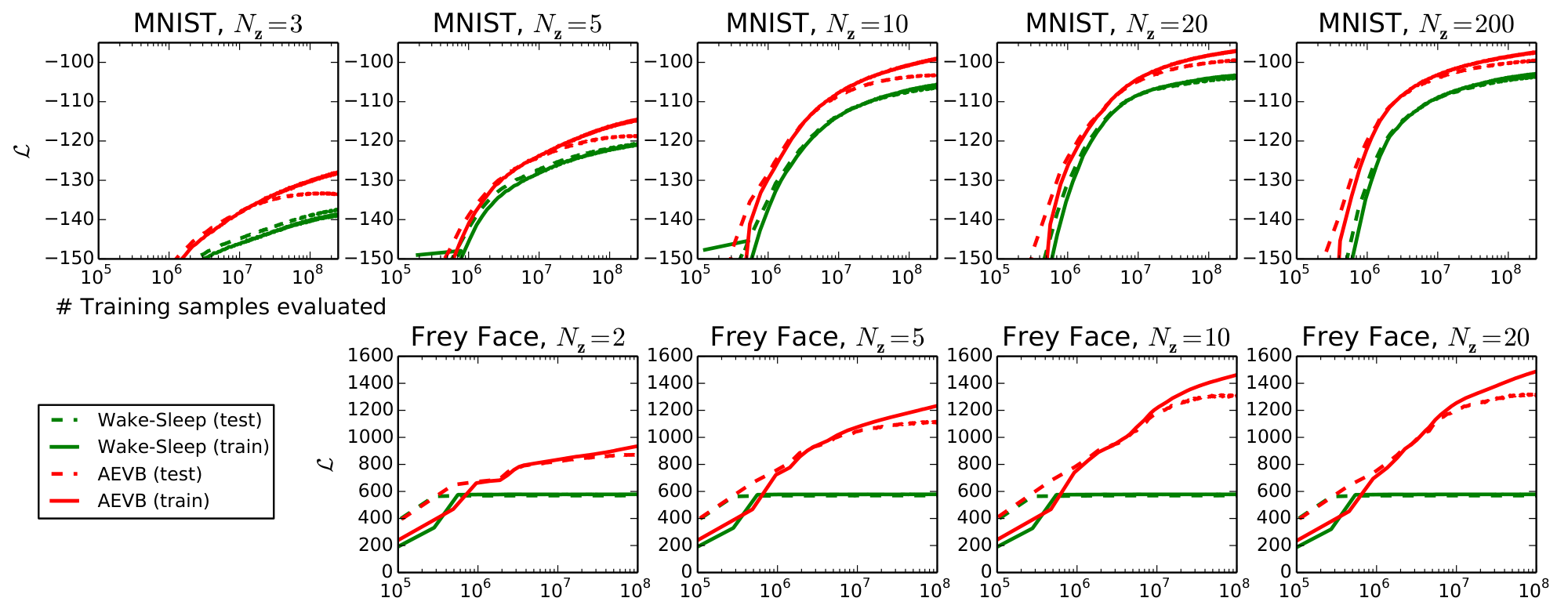
We compared performance of AEVB to the wake-sleep algorithm [4]. We employed the same encoder (also called recognition model) for the wake-sleep algorithm and the variational auto-encoder. All parameters, both variational and generative, were initialized by random sampling from $\mathcal{N}(0, 0.01)$, and were jointly stochastically optimized using the MAP criterion. Stepsizes were adapted with Adagrad [2]; the Adagrad global stepsize parameters were chosen from 0.01, 0.02, 0.1 based on performance on the training set in the first few iterations. Minibatches of size $M=100$ were used, with $L=1$ samples per datapoint.
Likelihood lower bound
We trained generative models (decoders) and corresponding encoders (a.k.a. recognition models) having $500$ hidden units in case of MNIST, and $200$ hidden units in case of the Frey Face dataset (to prevent overfitting, since it is a considerably smaller dataset). The chosen number of hidden units is based on prior literature on auto-encoders, and the relative performance of different algorithms was not very sensitive to these choices. Figure 2 shows the results when comparing the lower bounds. Interestingly, superfluous latent variables did not result in overfitting, which is explained by the regularizing nature of the variational bound.
Marginal likelihood
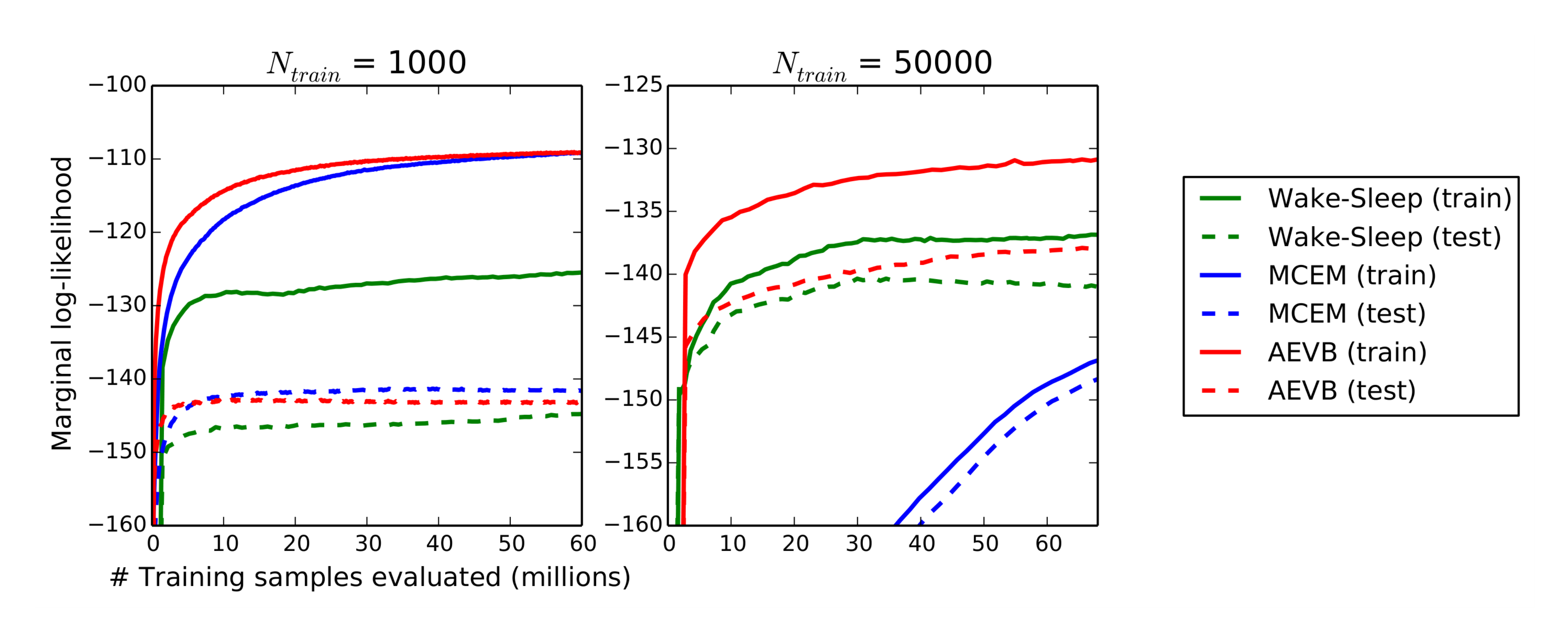
For very low-dimensional latent space it is possible to estimate the marginal likelihood of the learned generative models using an MCMC estimator. More information about the marginal likelihood estimator is available in the appendix. For the encoder and decoder we again used neural networks, this time with 100 hidden units, and 3 latent variables; for higher dimensional latent space the estimates became unreliable. Again, the MNIST dataset was used. The AEVB and Wake-Sleep methods were compared to Monte Carlo EM (MCEM) with a Hybrid Monte Carlo (HMC) [17] sampler; details are in the appendix. We compared the convergence speed for the three algorithms, for a small and large training set size. Results are in Figure 3.
Visualisation of high-dimensional data
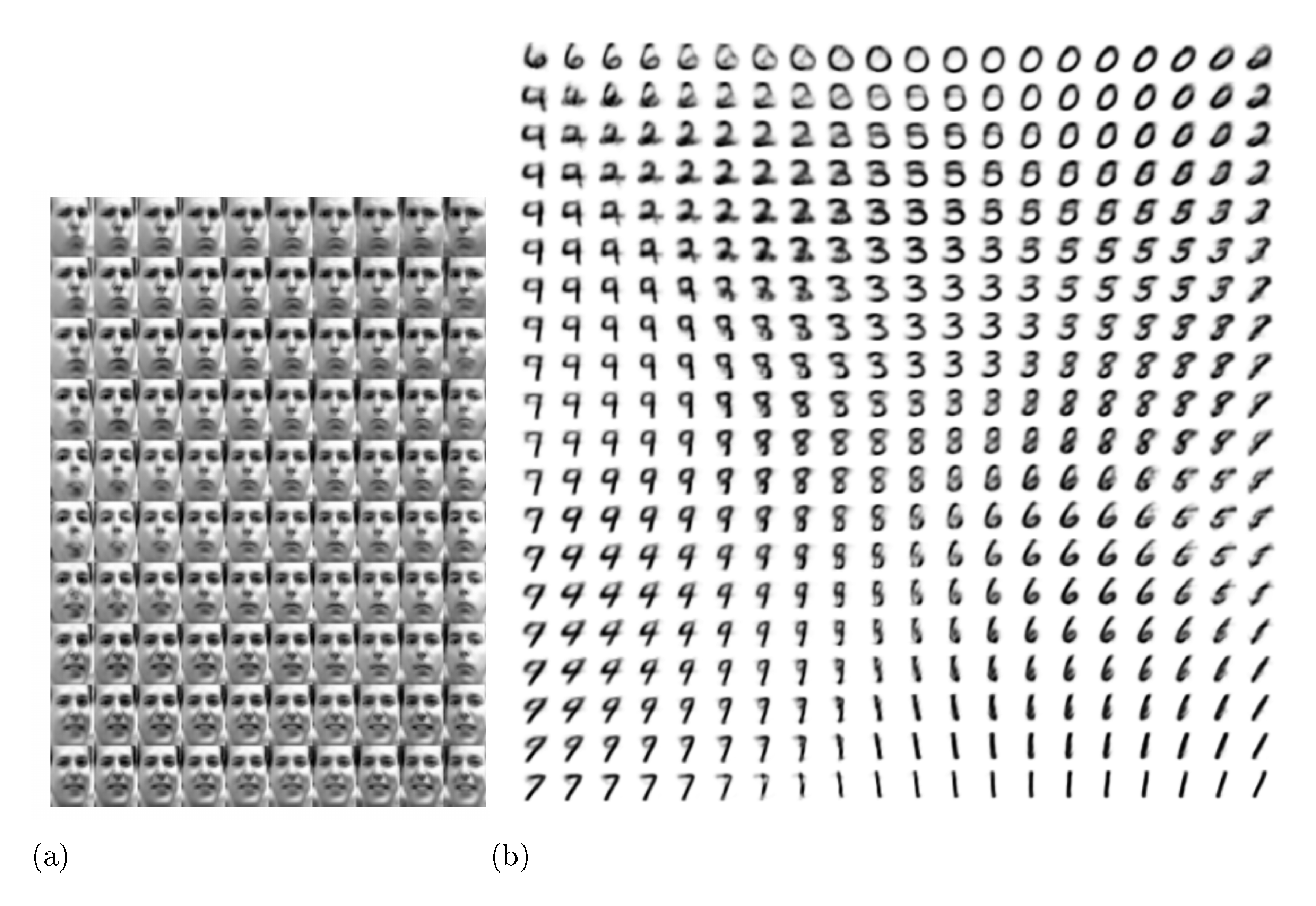
If we choose a low-dimensional latent space (e.g. 2D), we can use the learned encoders (recognition model) to project high-dimensional data to a low-dimensional manifold. See Appendix A for visualisations of the 2D latent manifolds for the MNIST and Frey Face datasets.
6. Conclusion
Section Summary: This conclusion introduces Stochastic Gradient VB (SGVB), a new tool for quickly estimating and refining approximations of hidden patterns in data with continuous underlying variables, which can be easily optimized using common machine learning techniques. It also presents Auto-Encoding VB (AEVB), a streamlined method for handling datasets where each data point has independent continuous hidden factors, by training a model to infer these factors efficiently with SGVB. The approach's benefits are backed by strong results from experiments.
We have introduced a novel estimator of the variational lower bound, Stochastic Gradient VB (SGVB), for efficient approximate inference with continuous latent variables. The proposed estimator can be straightforwardly differentiated and optimized using standard stochastic gradient methods. For the case of i.i.d. datasets and continuous latent variables per datapoint we introduce an efficient algorithm for efficient inference and learning, Auto-Encoding VB (AEVB), that learns an approximate inference model using the SGVB estimator. The theoretical advantages are reflected in experimental results.
7. Future work
Section Summary: The SGVB estimator and AEVB algorithm, which work well for various learning problems involving hidden continuous variables, offer many promising future applications. Researchers plan to explore building complex layered models using advanced neural networks for processing inputs and outputs, all trained together with AEVB. Other ideas include adapting these tools for sequences over time, like dynamic data patterns, applying them to broader system settings, and enhancing supervised learning to handle tricky variations in data noise.
Since the SGVB estimator and the AEVB algorithm can be applied to almost any inference and learning problem with continuous latent variables, there are plenty of future directions: (i) learning hierarchical generative architectures with deep neural networks (e.g. convolutional networks) used for the encoders and decoders, trained jointly with AEVB; (ii) time-series models (i.e. dynamic Bayesian networks); (iii) application of SGVB to the global parameters; (iv) supervised models with latent variables, useful for learning complicated noise distributions.
Appendix
Section Summary: This appendix provides visualizations of the latent spaces and generated samples from variational auto-encoder models trained on handwritten digit data, showing how hidden patterns map to visible outputs. It includes a mathematical breakdown of a key divergence measure for models assuming Gaussian distributions, along with details on using simple neural networks called multi-layer perceptrons to encode and decode data probabilistically, tailored for binary or continuous inputs. Finally, it outlines a sampling-based method to estimate the overall likelihood of data under these models, effective for low-dimensional spaces with enough samples.
A. Visualisations
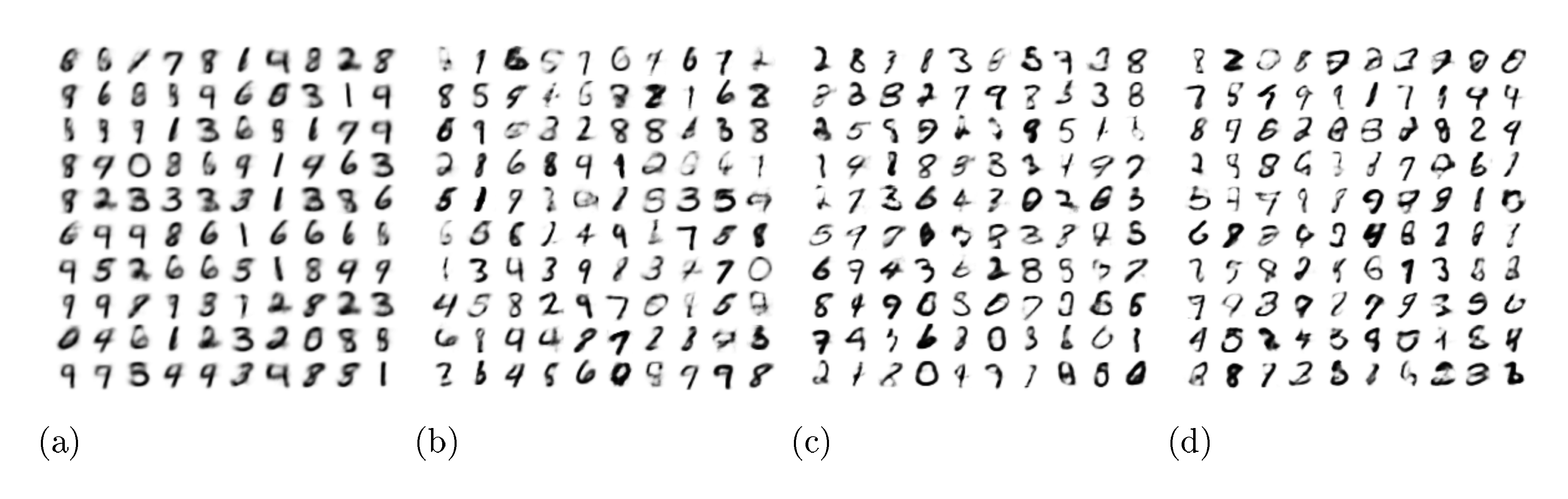
See Figure 4 and Figure 5 for visualisations of latent space and corresponding observed space of models learned with SGVB.
B. Solution of $- D_{KL}(q_{\boldsymbol{\phi}}(\mathbf{z}) || p_{\boldsymbol{\theta}}(\mathbf{z}))$, Gaussian case
The variational lower bound (the objective to be maximized) contains a KL term that can often be integrated analytically. Here we give the solution when both the prior $p_{\boldsymbol{\theta}}(\mathbf{z}) = \mathcal{N}(0, \mathbf{I})$ and the posterior approximation $q_{\boldsymbol{\phi}}(\mathbf{z}| \mathbf{x}^{(i)})$ are Gaussian. Let $J$ be the dimensionality of $\mathbf{z}$. Let $\boldsymbol{\mu}$ and $\boldsymbol{\sigma}$ denote the variational mean and s.d. evaluated at datapoint $i$, and let $\mu_j$ and $\sigma_j$ simply denote the $j$-th element of these vectors. Then:
$ \begin{align*} \int q_{\boldsymbol{\theta}}(\mathbf{z}) \log p(\mathbf{z}) , d \mathbf{z} &= \int \mathcal{N}(\mathbf{z}; \boldsymbol{\mu}, \boldsymbol{\sigma}^2) \log \mathcal{N}(\mathbf{z}; \mathbf{0}, \mathbf{I}) , d \mathbf{z} \ &= - \frac{J}{2} \log (2 \pi) - \frac{1}{2} \sum_{j=1}^J (\mu_j^2 + \sigma_j^2) \end{align*} $
And:
$ \begin{align*} \int q_{\boldsymbol{\theta}}(\mathbf{z}) \log q_{\boldsymbol{\theta}}(\mathbf{z}) , d \mathbf{z} &= \int \mathcal{N}(\mathbf{z}; \boldsymbol{\mu}, \boldsymbol{\sigma}^2) \log \mathcal{N}(\mathbf{z}; \boldsymbol{\mu}, \boldsymbol{\sigma}^2) , d \mathbf{z} \ &= - \frac{J}{2} \log (2 \pi) - \frac{1}{2} \sum_{j=1}^J (1 + \log \sigma^2_j) \end{align*} $
Therefore:
$ \begin{align*}
- D_{KL}((q_{\boldsymbol{\phi}}(\mathbf{z}) || p_{\boldsymbol{\theta}}(\mathbf{z})) &= \int q_{\boldsymbol{\theta}}(\mathbf{z}) \left(\log p_{\boldsymbol{\theta}}(\mathbf{z}) - \log q_{\boldsymbol{\theta}}(\mathbf{z})\right) , d \mathbf{z} \ &= \frac{1}{2} \sum_{j=1}^J \left(1 + \log ((\sigma_j)^2) - (\mu_j)^2 - (\sigma_j)^2 \right) \end{align*} $
When using a recognition model $q_{\boldsymbol{\phi}}(\mathbf{z}| \mathbf{x})$ then $\boldsymbol{\mu}$ and s.d. $\boldsymbol{\sigma}$ are simply functions of $\mathbf{x}$ and the variational parameters $\boldsymbol{\phi}$, as exemplified in the text.
C. MLP's as probabilistic encoders and decoders
In variational auto-encoders, neural networks are used as probabilistic encoders and decoders. There are many possible choices of encoders and decoders, depending on the type of data and model. In our example we used relatively simple neural networks, namely multi-layered perceptrons (MLPs). For the encoder we used a MLP with Gaussian output, while for the decoder we used MLPs with either Gaussian or Bernoulli outputs, depending on the type of data.
C.1 Bernoulli MLP as decoder
In this case let $p_{\boldsymbol{\theta}}(\mathbf{x}| \mathbf{z})$ be a multivariate Bernoulli whose probabilities are computed from $\mathbf{z}$ with a fully-connected neural network with a single hidden layer:
$ \begin{align*} \log p(\mathbf{x}| \mathbf{z}) &= \sum_{i=1}^D x_i \log y_i + (1-x_i) \cdot \log(1-y_i) \ \text{where, , , } \mathbf{y} &= f_\sigma(\mathbf{W}_2 \tanh(\mathbf{W}_1 \mathbf{z} + \mathbf{b}_1) + \mathbf{b}_2) \end{align*}\tag{10} $
where $f_\sigma(.)$ is the elementwise sigmoid activation function, and where $\boldsymbol{\theta} = {\mathbf{W}_1, \mathbf{W}_2, \mathbf{b}_1, \mathbf{b}_2}$ are the weights and biases of the MLP.
C.2 Gaussian MLP as encoder or decoder
In this case let encoder or decoder be a multivariate Gaussian with a diagonal covariance structure:
$ \begin{align*} \log p(\mathbf{x}| \mathbf{z}) &= \log \mathcal{N}(\mathbf{x}; \boldsymbol{\mu}, \boldsymbol{\sigma}^2 \mathbf{I}) \ \text{where, , , } \boldsymbol{\mu} &= \mathbf{W}_4 \mathbf{h} + \mathbf{b}_4 \ \log \boldsymbol{\sigma}^2 &= \mathbf{W}_5 \mathbf{h} + \mathbf{b}_5 \ \mathbf{h} &= \tanh(\mathbf{W}_3 \mathbf{z} + \mathbf{b}_3) \end{align*}\tag{11} $
where ${\mathbf{W}_3, \mathbf{W}_4, \mathbf{W}_5, \mathbf{b}_3, \mathbf{b}_4, \mathbf{b}5 }$ are the weights and biases of the MLP and part of $\boldsymbol{\theta}$ when used as decoder. Note that when this network is used as an encoder $q{\boldsymbol{\phi}}(\mathbf{z}| \mathbf{x})$, then $\mathbf{z}$ and $\mathbf{x}$ are swapped, and the weights and biases are variational parameters $\boldsymbol{\phi}$.
D. Marginal likelihood estimator
We derived the following marginal likelihood estimator that produces good estimates of the marginal likelihood as long as the dimensionality of the sampled space is low (less then 5 dimensions), and sufficient samples are taken. Let $p_{\boldsymbol{\theta}}(\mathbf{x}, \mathbf{z}) = p_{\boldsymbol{\theta}}(\mathbf{z}) p_{\boldsymbol{\theta}}(\mathbf{x}| \mathbf{z})$ be the generative model we are sampling from, and for a given datapoint $\mathbf{x}^{(i)}$ we would like to estimate the marginal likelihood $p_{\boldsymbol{\theta}}(\mathbf{x}^{(i)})$.
The estimation process consists of three stages:
- Sample $L$ values ${\mathbf{z}^{(l)}}$ from the posterior using gradient-based MCMC, e.g. Hybrid Monte Carlo, using $\nabla_{\mathbf{z}} \log p_{\boldsymbol{\theta}}(\mathbf{z}| \mathbf{x}) = \nabla_{\mathbf{z}} \log p_{\boldsymbol{\theta}}(\mathbf{z}) + \nabla_{\mathbf{z}} \log p_{\boldsymbol{\theta}}(\mathbf{x}| \mathbf{z})$.
- Fit a density estimator $q(\mathbf{z})$ to these samples ${\mathbf{z}^{(l)}}$.
- Again, sample $L$ new values from the posterior. Plug these samples, as well as the fitted $q(\mathbf{z})$, into the following estimator:
$ \begin{align*} p_{\boldsymbol{\theta}}(\mathbf{x}^{(i)}) \simeq \left(\frac{1}{L} \sum_{l=1}^L \frac{q(\mathbf{z}^{(l)})}{p_{\boldsymbol{\theta}}(\mathbf{z}) p_{\boldsymbol{\theta}}(\mathbf{x}^{(i)}| \mathbf{z}^{(l)})} \right)^{-1} \text{\quad where \quad} \mathbf{z}^{(l)} \sim p_{\boldsymbol{\theta}}(\mathbf{z}| \mathbf{x}^{(i)}) \end{align*} $
Derivation of the estimator:
$ \begin{align*} \frac{1}{p_{\boldsymbol{\theta}}(\mathbf{x}^{(i)})} &= \frac{\int q(\mathbf{z}) , d \mathbf{z}}{p_{\boldsymbol{\theta}}(\mathbf{x}^{(i)})} = \frac{\int q(\mathbf{z}) \frac{p_{\boldsymbol{\theta}}(\mathbf{x}^{(i)}, \mathbf{z}) }{p_{\boldsymbol{\theta}}(\mathbf{x}^{(i)}, \mathbf{z})} , d \mathbf{z}}{p_{\boldsymbol{\theta}}(\mathbf{x}^{(i)})} \ &= \int \frac{p_{\boldsymbol{\theta}}(\mathbf{x}^{(i)}, \mathbf{z})}{p_{\boldsymbol{\theta}}(\mathbf{x}^{(i)})} \frac{q(\mathbf{z})}{p_{\boldsymbol{\theta}}(\mathbf{x}^{(i)}, \mathbf{z})} , d \mathbf{z} \ &= \int p_{\boldsymbol{\theta}}(\mathbf{z}| \mathbf{x}^{(i)}) \frac{q(\mathbf{z})}{p_{\boldsymbol{\theta}}(\mathbf{x}^{(i)}, \mathbf{z})} , d \mathbf{z} \ &\simeq \frac{1}{L} \sum_{l=1}^L \frac{q(\mathbf{z}^{(l)})}{p_{\boldsymbol{\theta}}(\mathbf{z}) p_{\boldsymbol{\theta}}(\mathbf{x}^{(i)}| \mathbf{z}^{(l)})} \text{\quad where \quad} \mathbf{z}^{(l)} \sim p_{\boldsymbol{\theta}}(\mathbf{z}| \mathbf{x}^{(i)}) \end{align*} $
E. Monte Carlo EM
The Monte Carlo EM algorithm does not employ an encoder, instead it samples from the posterior of the latent variables using gradients of the posterior computed with $\nabla_{\mathbf{z}} \log p_{\boldsymbol{\theta}}(\mathbf{z}| \mathbf{x}) = \nabla_{\mathbf{z}} \log p_{\boldsymbol{\theta}}(\mathbf{z}) + \nabla_{\mathbf{z}} \log p_{\boldsymbol{\theta}}(\mathbf{x}| \mathbf{z})$. The Monte Carlo EM procedure consists of 10 HMC leapfrog steps with an automatically tuned stepsize such that the acceptance rate was 90%, followed by 5 weight updates steps using the acquired sample. For all algorithms the parameters were updated using the Adagrad stepsizes (with accompanying annealing schedule).
The marginal likelihood was estimated with the first 1000 datapoints from the train and test sets, for each datapoint sampling 50 values from the posterior of the latent variables using Hybrid Monte Carlo with 4 leapfrog steps.
F. Full VB
As written in the paper, it is possible to perform variational inference on both the parameters $\boldsymbol{\theta}$ and the latent variables $\mathbf{z}$, as opposed to just the latent variables as we did in the paper. Here, we'll derive our estimator for that case.
Let $p_{\boldsymbol{\alpha}}(\boldsymbol{\theta})$ be some hyperprior for the parameters introduced above, parameterized by $\boldsymbol{\alpha}$. The marginal likelihood can be written as:
$ \begin{align*} \log p_{\boldsymbol{\alpha}}(\mathbf{X}) = D_{KL}(q_{\boldsymbol{\phi}}(\boldsymbol{\theta})|| p_{\boldsymbol{\alpha}}(\boldsymbol{\theta}| \mathbf{X})) + \mathcal{L}(\boldsymbol{\phi}; \mathbf{X}) \end{align*}\tag{12} $
where the first RHS term denotes a KL divergence of the approximate from the true posterior, and where $\mathcal{L}(\boldsymbol{\phi}; \mathbf{X})$ denotes the variational lower bound to the marginal likelihood:
$ \begin{align*} \mathcal{L}(\boldsymbol{\phi}; \mathbf{X}) = \int q_{\boldsymbol{\phi}}(\boldsymbol{\theta}) \left(\log p_{\boldsymbol{\theta}}(\mathbf{X}) + \log p_{\boldsymbol{\alpha}}(\boldsymbol{\theta}) - \log q_{\boldsymbol{\phi}}(\boldsymbol{\theta}) \right) , d \boldsymbol{\theta} \end{align*}\tag{13} $
Note that this is a lower bound since the KL divergence is non-negative; the bound equals the true marginal when the approximate and true posteriors match exactly. The term $\log p_{\boldsymbol{\theta}}(\mathbf{X})$ is composed of a sum over the marginal likelihoods of individual datapoints $\log p_{\boldsymbol{\theta}}(\mathbf{X}) = \sum_{i=1}^N \log p_{\boldsymbol{\theta}}(\mathbf{x}^{(i)})$, which can each be rewritten as:
$ \begin{align*} \log p_{\boldsymbol{\theta}}(\mathbf{x}^{(i)}) = D_{KL}(q_{\boldsymbol{\phi}}(\mathbf{z}| \mathbf{x}^{(i)})|| p_{\boldsymbol{\theta}}(\mathbf{z}| \mathbf{x}^{(i)})) + \mathcal{L}(\boldsymbol{\theta}, \boldsymbol{\phi}; \mathbf{x}^{(i)}) \end{align*}\tag{14} $
where again the first RHS term is the KL divergence of the approximate from the true posterior, and $\mathcal{L}(\boldsymbol{\theta}, \boldsymbol{\phi}; \mathbf{x})$ is the variational lower bound of the marginal likelihood of datapoint $i$:
$ \begin{align*} \mathcal{L}(\boldsymbol{\theta}, \boldsymbol{\phi}; \mathbf{x}^{(i)}) &= \int q_{\boldsymbol{\phi}}(\mathbf{z}| \mathbf{x}) \left(\log p_{\boldsymbol{\theta}}(\mathbf{x}^{(i)} | \mathbf{z}) + \log p_{\boldsymbol{\theta}}(\mathbf{z}) - \log q_{\boldsymbol{\phi}}(\mathbf{z}| \mathbf{x})\right) , d \mathbf{z} \end{align*}\tag{15} $
The expectations on the RHS of eqs Equation 13 and 15 can obviously be written as a sum of three separate expectations, of which the second and third component can sometimes be analytically solved, e.g. when both $p_{\boldsymbol{\theta}}(\mathbf{x})$ and $q_{\boldsymbol{\phi}}(\mathbf{z}| \mathbf{x})$ are Gaussian. For generality we will here assume that each of these expectations is intractable.
Under certain mild conditions outlined in section (see paper) for chosen approximate posteriors $q_{\boldsymbol{\phi}}(\boldsymbol{\theta})$ and $q_{\boldsymbol{\phi}}(\mathbf{z}| \mathbf{x})$ we can reparameterize conditional samples $\widetilde{\mathbf{z}} \sim q_{\boldsymbol{\phi}}(\mathbf{z}| \mathbf{x})$ as
$ \begin{align*} \widetilde{\mathbf{z}} = g_{\boldsymbol{\phi}}(\boldsymbol{\epsilon}, \mathbf{x}) \text{\quad with \quad} \boldsymbol{\epsilon} \sim p(\boldsymbol{\epsilon}) \end{align*}\tag{16} $
where we choose a prior $p(\boldsymbol{\epsilon})$ and a function $g_{\boldsymbol{\phi}}(\boldsymbol{\epsilon}, \mathbf{x})$ such that the following holds:
$ \begin{align*} \mathcal{L}(\boldsymbol{\theta}, \boldsymbol{\phi}; \mathbf{x}^{(i)}) &= \int q_{\boldsymbol{\phi}}(\mathbf{z}| \mathbf{x}) \left(\log p_{\boldsymbol{\theta}}(\mathbf{x}^{(i)} | \mathbf{z}) + \log p_{\boldsymbol{\theta}}(\mathbf{z}) - \log q_{\boldsymbol{\phi}}(\mathbf{z}| \mathbf{x})\right) , d \mathbf{z} \ &= \int p(\boldsymbol{\epsilon}) \left(\log p_{\boldsymbol{\theta}}(\mathbf{x}^{(i)} | \mathbf{z}) + \log p_{\boldsymbol{\theta}}(\mathbf{z}) - \log q_{\boldsymbol{\phi}}(\mathbf{z}| \mathbf{x})\right) \bigg|{\mathbf{z}= g{\boldsymbol{\phi}}(\boldsymbol{\epsilon}, \mathbf{x}^{(i)})} , d \boldsymbol{\epsilon} \end{align*}\tag{17} $
The same can be done for the approximate posterior $q_{\boldsymbol{\phi}}(\boldsymbol{\theta})$:
$ \begin{align*} \widetilde{\boldsymbol{\theta}} = h_{\boldsymbol{\phi}}(\boldsymbol{\zeta}) \text{\quad with \quad} \boldsymbol{\zeta} \sim p(\boldsymbol{\zeta}) \end{align*}\tag{18} $
where we, similarly as above, choose a prior $p(\boldsymbol{\zeta})$ and a function $h_{\boldsymbol{\phi}}(\boldsymbol{\zeta})$ such that the following holds:
$ \begin{align*} \mathcal{L}(\boldsymbol{\phi}; \mathbf{X}) &= \int q_{\boldsymbol{\phi}}(\boldsymbol{\theta}) \left(\log p_{\boldsymbol{\theta}}(\mathbf{X}) + \log p_{\boldsymbol{\alpha}}(\boldsymbol{\theta}) - \log q_{\boldsymbol{\phi}}(\boldsymbol{\theta}) \right) , d \boldsymbol{\theta} \ &= \int p(\boldsymbol{\zeta}) \left(\log p_{\boldsymbol{\theta}}(\mathbf{X}) + \log p_{\boldsymbol{\alpha}}(\boldsymbol{\theta}) - \log q_{\boldsymbol{\phi}}(\boldsymbol{\theta}) \right) \bigg|{\boldsymbol{\theta}= h{\boldsymbol{\phi}}(\boldsymbol{\zeta})} , d \boldsymbol{\zeta} \end{align*}\tag{19} $
For notational conciseness we introduce a shorthand notation $f_{\boldsymbol{\phi}}(\mathbf{x}, \mathbf{z}, \boldsymbol{\theta})$:
$ \begin{align} f_{\boldsymbol{\phi}}(\mathbf{x}, \mathbf{z}, \boldsymbol{\theta}) = N \cdot (\log p_{\boldsymbol{\theta}}(\mathbf{x} | \mathbf{z}) + \log p_{\boldsymbol{\theta}}(\mathbf{z}) - \log q_{\boldsymbol{\phi}}(\mathbf{z}| \mathbf{x})) + \log p_{\boldsymbol{\alpha}}(\boldsymbol{\theta}) - \log q_{\boldsymbol{\phi}}(\boldsymbol{\theta}) \end{align}\tag{20} $
Using equations 19 and 17, the Monte Carlo estimate of the variational lower bound, given datapoint $\mathbf{x}^{(i)}$, is:
$ \begin{align*} \mathcal{L}(\boldsymbol{\phi}; \mathbf{X}) &\simeq \frac{1}{L} \sum_{l=1}^L f_{\boldsymbol{\phi}}(\mathbf{x}^{(l)}, g_{\boldsymbol{\phi}}(\boldsymbol{\epsilon}^{(l)}, \mathbf{x}^{(l)}), h_{\boldsymbol{\phi}}(\zeta^{(l)})) \end{align*}\tag{21} $
where $\boldsymbol{\epsilon}^{(l)} \sim p(\boldsymbol{\epsilon})$ and $\zeta^{(l)} \sim p(\boldsymbol{\zeta})$. The estimator only depends on samples from $p(\boldsymbol{\epsilon})$ and $p(\boldsymbol{\zeta})$ which are obviously not influenced by $\boldsymbol{\phi}$, therefore the estimator can be differentiated w.r.t. $\boldsymbol{\phi}$. The resulting stochastic gradients can be used in conjunction with stochastic optimization methods such as SGD or Adagrad [2]. See Algorithm 1 for a basic approach to computing stochastic gradients.
**Require:** $\boldsymbol{\phi}$ (Current value of variational parameters)
$\mathbf{g} \gets 0$
**for** $l$ is $1$ to $L$ **do**
  $\mathbf{x} \gets $ Random draw from dataset $\mathbf{X}$
  $\boldsymbol{\epsilon} \gets $ Random draw from prior $p(\boldsymbol{\epsilon})$
  $\boldsymbol{\zeta} \gets $ Random draw from prior $p(\boldsymbol{\zeta})$
  $\mathbf{g} \gets \mathbf{g} + \frac{1}L \nabla_{\boldsymbol{\phi}} f_{\boldsymbol{\phi}}(\mathbf{x}, g_{\boldsymbol{\phi}}(\boldsymbol{\epsilon}, \mathbf{x}), h_{\boldsymbol{\phi}}(\boldsymbol{\zeta}))$
**end for**
**return** $\mathbf{g}$
F.1 Example
Let the prior over the parameters and latent variables be the centered isotropic Gaussian $p_{\boldsymbol{\alpha}}(\boldsymbol{\theta}) = \mathcal{N}(\mathbf{z}; \mathbf{0}, \mathbf{I})$ and $p_{\boldsymbol{\theta}}(\mathbf{z}) = \mathcal{N}(\mathbf{z}; \mathbf{0}, \mathbf{I})$. Note that in this case, the prior lacks parameters. Let's also assume that the true posteriors are approximatily Gaussian with an approximately diagonal covariance. In this case, we can let the variational approximate posteriors be multivariate Gaussians with a diagonal covariance structure:
$ \begin{align*} \log q_{\boldsymbol{\phi}}(\boldsymbol{\theta}) &= \log \mathcal{N}(\boldsymbol{\theta}; \boldsymbol{\mu}{\boldsymbol{\theta}}, \boldsymbol{\sigma}{\boldsymbol{\theta}}^2 \mathbf{I}) \ \log q_{\boldsymbol{\phi}}(\mathbf{z}| \mathbf{x}) &= \log \mathcal{N}(\mathbf{z}; \boldsymbol{\mu}{\mathbf{z}}, \boldsymbol{\sigma}{\mathbf{z}}^2 \mathbf{I}) \end{align*}\tag{22} $
where $\boldsymbol{\mu}{\mathbf{z}}$ and $\boldsymbol{\sigma}{\mathbf{z}}$ are yet unspecified functions of $\mathbf{x}$. Since they are Gaussian, we can parameterize the variational approximate posteriors:
$ \begin{align*} q_{\boldsymbol{\phi}}(\boldsymbol{\theta}) &\text{\quad as \quad} \widetilde{\boldsymbol{\theta}} = \boldsymbol{\mu}{\boldsymbol{\theta}} + \boldsymbol{\sigma}{\boldsymbol{\theta}} \odot \boldsymbol{\zeta} &\text{\quad where \quad} \boldsymbol{\zeta} \sim \mathcal{N}(\mathbf{0}, \mathbf{I}) \ q_{\boldsymbol{\phi}}(\mathbf{z}| \mathbf{x}) &\text{\quad as \quad} \widetilde{\mathbf{z}} = \boldsymbol{\mu}{\mathbf{z}} + \boldsymbol{\sigma}{\mathbf{z}} \odot \boldsymbol{\epsilon} &\text{\quad where \quad} \boldsymbol{\epsilon} \sim \mathcal{N}(\mathbf{0}, \mathbf{I}) \end{align*} $
With $\odot$ we signify an element-wise product. These can be plugged into the lower bound defined above (eqs Equation 20 and 21).
In this case it is possible to construct an alternative estimator with a lower variance, since in this model $p_{\boldsymbol{\alpha}}(\boldsymbol{\theta})$, $p_{\boldsymbol{\theta}}(\mathbf{z})$, $q_{\boldsymbol{\phi}}(\boldsymbol{\theta})$ and $q_{\boldsymbol{\phi}}(\mathbf{z}| \mathbf{x})$ are Gaussian, and therefore four terms of $f_{\boldsymbol{\phi}}$ can be solved analytically. The resulting estimator is:
$ \begin{align*} \mathcal{L}(\boldsymbol{\phi}; \mathbf{X}) &\simeq \frac{1}{L} \sum_{l=1}^L N \cdot \left(\frac{1}{2} \sum_{j=1}^J \left(1 + \log ((\sigma_{\mathbf{z}, j}^{(l)})^2) - (\mu_{\mathbf{z}, j}^{(l)})^2 - (\sigma_{\mathbf{z}, j}^{(l)})^2 \right)
- \log p_{\boldsymbol{\theta}}(\mathbf{x}^{(i)}\mathbf{z}^{(i)}) \right) \ &+ \frac{1}{2} \sum_{j=1}^J \left(1 + \log ((\sigma_{\boldsymbol{\theta}, j}^{(l)})^2) - (\mu_{\boldsymbol{\theta}, j}^{(l)})^2 - (\sigma_{\boldsymbol{\theta}, j}^{(l)})^2 \right) \end{align*}\tag{23} $
$\mu_j^{(i)}$ and $\sigma_j^{(i)}$ simply denote the $j$-th element of vectors $\boldsymbol{\mu}^{(i)}$ and $\boldsymbol{\sigma}^{(i)}$.
References
[1] David M Blei, Michael I Jordan, and John W Paisley. Variational Bayesian inference with Stochastic Search. In Proceedings of the 29th International Conference on Machine Learning (ICML-12), pages 1367–1374, 2012.
[2] John Duchi, Elad Hazan, and Yoram Singer. Adaptive subgradient methods for online learning and stochastic optimization. Journal of Machine Learning Research, 12:2121–2159, 2010.
[3] Luc Devroye. Sample-based non-uniform random variate generation. In Proceedings of the 18th conference on Winter simulation, pages 260–265. ACM, 1986.
[4] Geoffrey E Hinton, Peter Dayan, Brendan J Frey, and Radford M Neal. The" wake-sleep" algorithm for unsupervised neural networks. SCIENCE, pages 1158–1158, 1995.
[5] Matthew D Hoffman, David M Blei, Chong Wang, and John Paisley. Stochastic variational inference. The Journal of Machine Learning Research, 14(1):1303–1347, 2013.
[6] Rajesh Ranganath, Sean Gerrish, and David M Blei. Black Box Variational Inference. arXiv preprint arXiv:1401.0118, 2013.
[7] Tim Salimans and David A Knowles. Fixed-form variational posterior approximation through stochastic linear regression. Bayesian Analysis, 8(4), 2013.
[8] Sam Roweis. EM algorithms for PCA and SPCA. Advances in neural information processing systems, pages 626–632, 1998.
[9] Pascal Vincent, Hugo Larochelle, Isabelle Lajoie, Yoshua Bengio, and Pierre-Antoine Manzagol. Stacked denoising autoencoders: Learning useful representations in a deep network with a local denoising criterion. The Journal of Machine Learning Research, 9999:3371–3408, 2010.
[10] Ralph Linsker. An application of the principle of maximum information preservation to linear systems. Morgan Kaufmann Publishers Inc., 1989.
[11] Yoshua Bengio, Aaron Courville, and Pascal Vincent. Representation learning: A review and new perspectives. 2013.
[12] Koray Kavukcuoglu, Marc'Aurelio Ranzato, and Yann LeCun. Fast inference in sparse coding algorithms with applications to object recognition. Technical Report CBLL-TR-2008-12-01, Computational and Biological Learning Lab, Courant Institute, NYU, 2008.
[13] Yoshua Bengio and Éric Thibodeau-Laufer. Deep generative stochastic networks trainable by backprop. arXiv preprint arXiv:1306.1091, 2013.
[14] Ruslan Salakhutdinov and Hugo Larochelle. Efficient learning of deep boltzmann machines. In International Conference on Artificial Intelligence and Statistics, pages 693–700, 2010.
[15] Karol Gregor, Andriy Mnih, and Daan Wierstra. Deep autoregressive networks. arXiv preprint arXiv:1310.8499, 2013.
[16] Danilo Jimenez Rezende, Shakir Mohamed, and Daan Wierstra. Stochastic back-propagation and variational inference in deep latent gaussian models. arXiv preprint arXiv:1401.4082, 2014.
[17] Simon Duane, Anthony D Kennedy, Brian J Pendleton, and Duncan Roweth. Hybrid monte carlo. Physics letters B, 195(2):216–222, 1987.