
SyncDreamer: Generating Multiview-Consistent Images from a Single-View Image
Yuan Liu$^{1,2*}$ Cheng Lin$^{2*}$ Zijiao Zeng$^{2}$ Xiaoxiao Long$^{1\dagger}$ Lingjie Liu$^{3}$
Taku Komura$^{1}$ Wenping Wang$^{4\dagger}$
$^{1}$ The university of Hong Kong $^{2}$ Tencent Games $^{3}$ University of Pennsylvania
$^{4}$ Texas A&M University
{yuanly, chlin, xxlong}@connect.hku.hk
[email protected]
[email protected]
[email protected]
$^{*}$ Equal contribution.
$^{\dagger}$ Corresponding Authors.
Abstract
Section Summary: This paper introduces SyncDreamer, a new type of AI model that creates consistent images from multiple angles based on just one starting image. Building on earlier models that could generate new views but often mismatched shapes or colors, SyncDreamer uses a synchronized process to link all views together from the start, ensuring they match up through a smart attention system aware of 3D structures. Tests show it produces highly reliable multi-angle images, making it ideal for tasks like creating 3D models from text or single pictures.
In this paper, we present a novel diffusion model called SyncDreamer that generates multiview-consistent images from a single-view image. Using pretrained large-scale 2D diffusion models, recent work Zero123 ([1]) demonstrates the ability to generate plausible novel views from a single-view image of an object. However, maintaining consistency in geometry and colors for the generated images remains a challenge. To address this issue, we propose a synchronized multiview diffusion model that models the joint probability distribution of multiview images, enabling the generation of multiview-consistent images in a single reverse process. SyncDreamer synchronizes the intermediate states of all the generated images at every step of the reverse process through a 3D-aware feature attention mechanism that correlates the corresponding features across different views. Experiments show that SyncDreamer generates images with high consistency across different views, thus making it well-suited for various 3D generation tasks such as novel-view-synthesis, text-to-3D, and image-to-3D. Project page: https://liuyuan-pal.github.io/SyncDreamer/.
Executive Summary: Generating consistent 3D models from a single 2D image is a longstanding challenge in computer vision and graphics. A single photo or drawing provides limited clues about an object's full shape, colors, and structure, making it hard to imagine or reconstruct other angles accurately. This problem matters now because advances in artificial intelligence, especially diffusion models that create realistic images, offer new ways to bridge 2D to 3D. Such tools could speed up content creation for industries like gaming, virtual reality, and product design, where turning quick sketches or photos into full 3D assets saves time and reduces manual effort.
This paper introduces SyncDreamer, a new diffusion-based system designed to generate multiple consistent images of an object from just one input image, supporting easier 3D reconstruction. It aims to demonstrate that this approach outperforms existing methods in producing views that align in geometry and appearance, without needing complex optimization steps.
The researchers built SyncDreamer by extending pretrained 2D image generation models, starting with Zero123 trained on over 800,000 3D objects from the Objaverse dataset. They created a synchronized process that generates up to 16 images at fixed angles around the object in one go, using a shared network that links features across views through a 3D-aware attention mechanism. This ensures the views "talk" to each other during generation, enforcing consistency. Training took about four days on high-end GPUs, and testing focused on 30 diverse objects from the Google Scanned Objects dataset, plus real-world examples like internet photos and game art.
Key results show SyncDreamer excels in both image quality and 3D accuracy. First, it produces more consistent novel views than baselines: on average, images scored a peak signal-to-noise ratio of 20.05, compared to 18.93 for Zero123 and 15.26 for RealFusion, with structural similarity at 0.798 versus 0.779. It also enabled structure-from-motion software to reconstruct 1,123 3D points per set of views, far more than Zero123's 95, indicating stronger geometric alignment. Second, for 3D reconstruction using simple neural surface methods, SyncDreamer achieved a Chamfer Distance of 0.0261—about 23% better than Zero123's 0.0339—and a volume overlap of 0.5421, up from 0.5035. Third, it handles diverse inputs like cartoons, sketches, and ink paintings, generating plausible 3D-consistent views where other methods fail or distort shapes. Fourth, unlike slower distillation techniques that take hours per object and yield one output, SyncDreamer runs in about 40 seconds for multiple plausible variants, allowing users to pick the best.
These findings mean SyncDreamer makes single-view 3D generation more reliable and efficient, cutting reconstruction time from hours to minutes while improving detail and smoothness on arbitrary objects. It reduces risks of inconsistent or low-quality results that plague prior methods, potentially lowering costs in design workflows by enabling quick iterations from photos or art. Surprisingly, it outperforms expectations from pretrained models by adding just a synchronization layer, highlighting how joint modeling boosts 3D awareness without vast new data.
Leaders should prioritize integrating SyncDreamer into tools for image-to-3D pipelines, especially for creative applications, as it simplifies downstream tasks like mesh creation without special tweaks. For next steps, test it in pilots for specific uses like AR prototyping, and explore hybrid versions with text prompts to expand from images alone. If scaling to production, consider trade-offs: generating fewer views (e.g., 8 instead of 16) halves runtime with minimal quality loss, but more views improve accuracy at higher compute cost.
Confidence in these results is high for everyday objects on standard benchmarks, backed by quantitative metrics and visuals outperforming baselines. However, caution applies to edge cases—generated views are fixed at specific angles, textures can lack fine details compared to single-view methods, and quality dips with very small or orthogonally drawn objects. Further work needs larger, cleaner datasets to address these gaps and enable flexible viewpoints.
1. Introduction
Section Summary: Humans can intuitively envision a three-dimensional object from just one image, but creating consistent multiple views from a single photo remains difficult for computers due to the limited depth information in a flat picture. While neural networks and diffusion models have advanced image generation, methods relying on large 3D datasets or adapting text-to-image tools often require excessive training time, fine-tuning, and struggle to capture an image's details accurately, leading to inconsistent or low-quality 3D results. This paper introduces SyncDreamer, a streamlined approach that uses synchronized diffusion processes to generate matching multiview images from any single-view input, enabling easy 3D reconstruction with standard tools, supporting diverse styles like sketches or paintings, and producing varied yet reliable outputs that outperform existing techniques.
Humans possess a remarkable ability to perceive 3D structures from a single image. When presented with an image of an object, humans can easily imagine the other views of the object. Despite great progress ([2, 3, 4, 5, 6]) brought by neural networks in computer vision or graphics fields for extracting 3D information from images, generating multiview-consistent images from a single-view image of an object is still a challenging problem due to the limited 3D information available in an image.
Recently, diffusion models ([7, 8]) have demonstrated huge success in 2D image generation, which unlocks new potential for 3D generation tasks. However, directly training a generalizable 3D diffusion model ([9, 10, 11, 12]) usually requires a large amount of 3D data while existing 3D datasets are insufficient for capture the complexity of arbitrary 3D shapes. Therefore, recent methods ([13, 14, 15, 16, 17]) resort to distilling pretrained text-to-image diffusion models for creating 3D models from texts, which shows impressive results on this text-to-3D task. Some works ([18, 19, 20, 21]) extend such a distillation process to train a neural radiance field ([5]) (NeRF) for the image-to-3D task. In order to utilize pretrained text-to-image models, these methods have to perform textual inversion ([22]) to find a suitable text description of the input image. However, the distillation process along with the textual inversion usually takes a long time to generate a single shape and requires tedious parameter tuning for satisfactory quality. Moreover, due to the abundance of specific details in an image, such as object category, appearance, and pose, it is challenging to accurately represent an image using a single word embedding, which results in a decrease in the quality of 3D shapes reconstructed by the distillation method.
Instead of distillation, some recent works ([23, 24, 25, 26, 27, 28, 29, 30, 31, 32]) apply 2D diffusion models to directly generate multiview images for the 3D reconstruction task. The key problem is how to maintain the multiview consistency when generating images of the same object. To improve the multiview consistency, these methods allow the diffusion model to condition on the input images ([26, 27, 23, 1, 28]), previously generated images ([30, 29]) or renderings from a neural field ([24]). Although some impressive results are achieved for specific object categories from ShapeNet ([33]) or Co3D ([34]), how to design a diffusion model to generate multiview-consistent images for arbitrary objects still remains unsolved.
![**Figure 1:** **SyncDreamer** is able to generate multiview-consistent images from a single-view input image of arbitrary objects. The generated multiview images can be used for mesh reconstruction by reconstruction methods like NeuS ([4]) without using SDS ([13]) loss.](https://ittowtnkqtyixxjxrhou.supabase.co/storage/v1/object/public/public-images/5mdu4zry/teaser.png)
In this paper, we propose a simple yet effective framework to generate multiview-consistent images for the single-view 3D reconstruction of arbitrary objects. The key idea is to extend the diffusion framework ([8]) to model the joint probability distribution of multiview images. We show that modeling the joint distribution can be achieved by introducing a synchronized multiview diffusion model. Specifically, for $N$ target views to be generated, we construct $N$ shared noise predictors respectively. The reverse diffusion process simultaneously generates $N$ images by $N$ corresponding noise predictors, where information across different images is shared among noise predictors by attention layers on every denoising step. Thus, we name our framework SyncDreamer which synchronizes intermediate states of all noise predictors on every step in the reverse process.
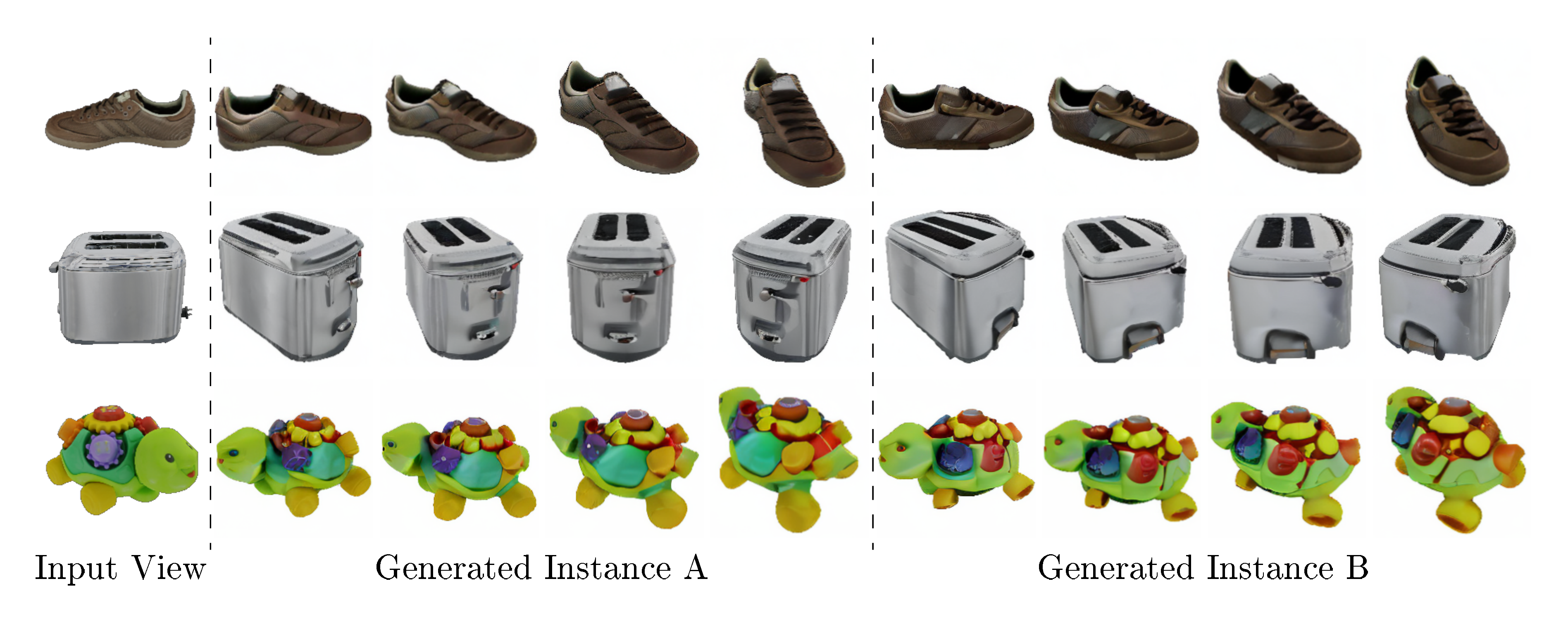
SyncDreamer has the following characteristics that make it a competitive tool for lifting 2D single-view images to 3D. First, SyncDreamer retains strong generalization ability by initializing its weights from the pretrained Zero123 ([1]) model which is finetuned from the Stable Diffusion model ([7]) on the Objaverse ([35]) dataset. Thus, SyncDreamer is able to reconstruct shapes from both photorealistic images and hand drawings as shown in Figure 1. Second, SyncDreamer makes the single-view reconstruction easier than the distillation methods. Because the generated images are consistent in both geometry and appearance, we can simply run a vanilla NeRF ([5]) or a vanilla NeuS ([4]) without using any special losses for reconstruction. Given the generated images, one can easily reckon the final reconstruction quality while it is hard for distillation methods to know the output reconstruction quality beforehand. Third, SyncDreamer maintains creativity and diversity when inferring 3D information, which enables generating multiple reasonable objects from a given image as shown in Figure 4. In comparison, previous distillation methods can only converge to one single shape.
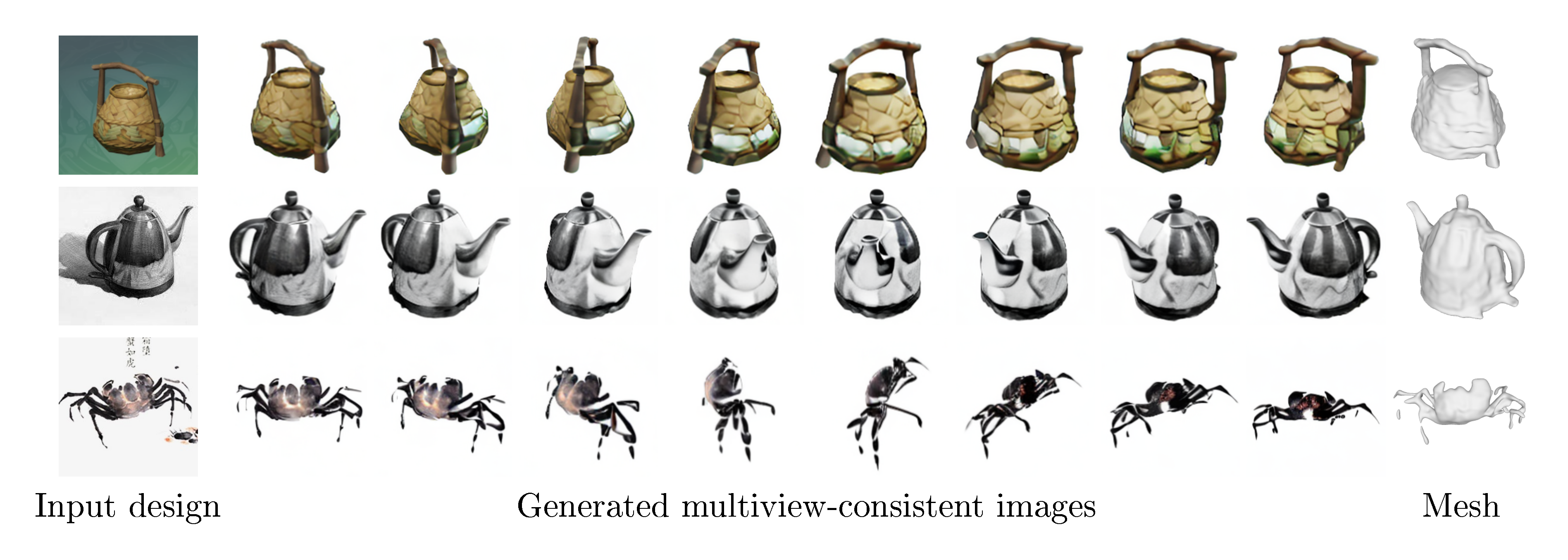
We quantitatively compare SyncDreamer with baseline methods on the Google Scanned Object ([36]) dataset. The results show that, in comparison with baseline methods, SyncDreamer is able to generate more consistent images and reconstruct better shapes from input single-view images. We further demonstrate that SyncDreamer supports various styles of 2D input like cartoons, sketches, ink paintings, and oil paintings for generating consistent views and reconstructing 3D shapes, which verifies the effectiveness of SyncDreamer in lifting 2D images to 3D.
2. Related Work
Section Summary: Diffusion models, which excel at generating 2D images by gradually adding and removing noise, have inspired efforts to create 3D content, though challenges like limited 3D data have led to lower quality results compared to images. Many approaches adapt these powerful 2D models for 3D tasks, such as distilling them to produce shapes from text or single images, or generating multiple views of an object for reconstruction, with the proposed SyncDreamer method synchronizing views through attention mechanisms for efficient object rebuilding without needing predefined geometry. Earlier single-view reconstruction techniques relied on regression, retrieval, or specialized neural networks for categories like faces, but they struggle to generalize to diverse, everyday objects.
2.1 Diffusion models
Diffusion models ([8, 7, 37]) have shown impressive results on 2D image generation. Concurrent work MVDiffusion ([38]) also adopts the multiview diffusion formulation to synthesize textures or panoramas with known geometry. We propose similar formulations in SyncDreamer but with unknown geometry. MultiDiffusion ([39]) and SyncDiffusion ([40]) correlate multiple diffusion models for different regions of a 2D image. Many recent works ([11, 10, 12, 41, 42, 9, 43, 44, 45, 46, 47, 48, 49, 50, 51, 52, 53]) try to repeat the success of diffusion models on the 3D generation task. However, the scarcity of 3D data makes it difficult to directly train diffusion models on 3D and the resulting generation quality is still much worse and less generalizable than the counterpart image generation models, though some works ([46, 49, 45]) are trying to only use 2D images for training 3D diffusion models.
2.2 Using 2D diffusion models for 3D
Instead of directly learning a 3D diffusion model, many works resort to using high-quality 2D diffusion models ([7, 54]) for 3D tasks. Pioneer works DreamFusion ([13]) and SJC ([14]) propose to distill a 2D text-to-image generation model to generate 3D shapes from texts. Follow-up works ([17, 15, 55, 56, 16, 57, 58, 59, 60, 61, 62, 63]) improve such text-to-3D distillation methods in various aspects. Many works ([18, 19, 64, 20, 21, 65]) also apply such a distillation pipeline in the single-view reconstruction task. Though some impressive results are achieved, these methods usually require a long time for textual inversion ([66]) and NeRF optimization and they do not guarantee to get satisfactory results.
Other works ([23, 24, 25, 26, 27, 29, 28, 30, 67, 68, 38, 32, 69, 70]) directly apply the 2D diffusion models to generate multiview images for 3D reconstruction. ([27, 28]) are conditioned on the input image by attention layers for novel-view synthesis in indoor scenes. Our method also uses attention layers but is intended for object reconstruction. ([32, 31]) resort to estimated depth maps to warp and inpaint for novel-view image generation, which strongly relies on the performance of the external single-view depth estimator. Two concurrent works ([29, 30]) generate new images in an autoregressive render-and-generate manner, which demonstrates good performances on specific object categories or scenes. In comparison, SyncDreamer is targeted to reconstruct arbitrary objects and generates all images in one reverse process. The concurrent work Viewset Diffusion ([68]) shares a similar idea to generate a set of images. The differences between SyncDreamer and Viewset Diffusion are that SyncDreamer does not require predicting a radiance field like Viewset Diffusion but only uses attention to synchronize the states among views and SyncDreamer fixes the viewpoints of generated views for better convergence. Another concurrent work MVDream ([71]) also proposes multiview generation for the text-to-3D task while our work aims to reconstruct shapes from single-view images.
2.3 Other single-view reconstruction methods
Single-view reconstruction is a challenging ill-posed problem. Before the prosperity of generative models used in 3D reconstruction, there are many works ([72, 73, 74, 75, 76]) that reconstruct 3D shapes from single-view images by regression ([75]) or retrieval ([72]), which have difficulty in generalizing to new categories. Recent NeRF-GAN methods ([77, 78, 79, 80, 81, 82]) learn to generate NeRFs for specific categories like human or cat faces. These NeRF-GANs achieve impressive results on single-view image reconstruction but fail to generalize to arbitrary objects. Although some recent works also attempt to generalize NeRF-GAN to ImageNet ([83, 84]), training NeRF-GANs for arbitrary objects is still challenging.
3. Method
Section Summary: The method aims to create consistent images of an object from multiple fixed angles based on a single input view, assuming the object sits at the center of a unit cube. It builds on diffusion models, which work by gradually adding noise to images in a forward process and then training a model to reverse this by predicting and removing noise step by step. To ensure the generated views match up seamlessly, the approach extends this to a joint multiview diffusion process, where noise removal for each view takes into account the noisy states of all views simultaneously.
Given an input view $\mathbf{y}$ of an object, our target is to generate multiview images of the object. We assume that the object is located at the origin and is normalized inside a cube of length 1. The target images are generated on $N$ fixed viewpoints looking at the object with azimuths evenly ranging from $0^{\circ}$ to $360^{\circ}$ and elevations of $30^{\circ}$. To improve the multiview consistency of generated images, we formulate this generation process as a multiview diffusion model. In the following, we begin with a review of diffusion models ([85, 8]).
3.1 Diffusion
Diffusion models ([85, 8]) aim to learn a probability model $ p_\theta(\mathbf{x}0)=\int p\theta (\mathbf{x}{0:T})d\mathbf{x}{1:T}$ where $\mathbf{x}0$ is the data and $\mathbf{x}{1:T}:=\mathbf{x}_1, ..., \mathbf{x}_T$ are latent variables. The joint distribution is characterized by a Markov Chain (reverse process)
$ p_\theta(\mathbf{x}{0:T})=p(\mathbf{x}T) \prod{t=1}^T p\theta(\mathbf{x}_{t-1}|\mathbf{x}_t),\tag{1} $
where $p(\mathbf{x}T)=\mathcal{N}(\mathbf{x}T; \mathbf{0}, \mathbf{I})$ and $p\theta(\mathbf{x}{t-1}|\mathbf{x}t)=\mathcal{N}(\mathbf{x}{t-1};\mathbf{\mu}\theta(\mathbf{x}t, t), \sigma^2_t \mathbf{I})$. $\mathbf{\mu}\theta(\mathbf{x}t, t)$ is a trainable component while the variance $\sigma^2_t$ is untrained time-dependent constants ([8]). The target is to learn the $\mathbf{\mu}\theta$ for the generation. To learn $\mathbf{\mu}\theta$, a Markov chain called forward process is constructed as
$ q(\mathbf{x}_{1:T}|\mathbf{x}0)=\prod{t=1}^{T} q(\mathbf{x}t|\mathbf{x}{t-1}),\tag{2} $
where $q(\mathbf{x}t|\mathbf{x}{t-1})=\mathcal{N}(\mathbf{x}t;\sqrt{1-\beta_t} \mathbf{x}{t-1}, \beta_t \mathbf{I})$ and $\beta_t$ are all constants. DDPM ([8]) shows that by defining
$ \mathbf{\mu}_\theta(\mathbf{x}_t, t)=\frac{1}{\sqrt{\alpha_t}}\left(\mathbf{x}_t - \frac{\beta_t}{\sqrt{1-\bar{\alpha}t}} \mathbf{\epsilon}\theta (\mathbf{x}_t, t)\right),\tag{3} $
where $\alpha_t$ and $\bar{\alpha}t$ are constants derived from $\beta_t$ and $\mathbf{\epsilon}\theta$ is a noise predictor, we can learn $\mathbf{\epsilon}_\theta$ by
$ \ell=\mathbb{E}_{t, \mathbf{x}0, \mathbf{\epsilon}}\left[|\mathbf{\epsilon} - \mathbf{\epsilon}\theta (\sqrt{\bar{\alpha}_t} \mathbf{x}_0+\sqrt{1-\bar{\alpha}_t}\mathbf{\epsilon}, t)|_2\right], $
where $\mathbf{\epsilon}$ is a random variable sampled from $\mathcal{N}(\mathbf{0}, \mathbf{I})$.
![**Figure 2:** The pipeline of a synchronized multiview noise predictor to denoise the target view $\mathbf{x}^{(n)}_t$ for one step. First, a spatial feature volume is constructed from all the noisy target views $\mathbf{x}^{(1:N)}_t$. Then, we construct a view frustum feature volume for $\mathbf{x}^{(n)}_t$ by interpolating the features of spatial feature volume. The input view $\mathbf{y}$, current target view $\mathbf{x}^{(n)}_t$ and viewpoint difference $\Delta\mathbf{v}^{(n)}$ are fed into the backbone UNet initialized from Zero123 ([1]). On the intermediate feature maps of the UNet, new depth-wise attention layers are applied to extract features from the view frustum feature volume. Finally, the output of the UNet is used to denoise $\mathbf{x}^{(n)}_t$ to obtain $\mathbf{x}^{(n)}_{t-1}$.](https://ittowtnkqtyixxjxrhou.supabase.co/storage/v1/object/public/public-images/5mdu4zry/pipeline.png)
3.2 Multiview diffusion
Applying the vanilla DDPM model to generate novel-view images separately would lead to difficulty in maintaining multiview consistency across different views. To address this problem, we formulate the generation process as a multiview diffusion model that correlates the generation of each view. Let us denote the $N$ images that we want to generate on the predefined viewpoints as ${\mathbf{x}^{(1)}_0, ..., \mathbf{x}^{(N)}0}$ where suffix $0$ means the time step $0$. We want to learn the joint distribution of all these views $p\theta({\mathbf{x}^{(1:N)}0}|\mathbf{y}):=p\theta(\mathbf{x}^{(1)}_0, ..., \mathbf{x}^{(N)}_0|\mathbf{y})$. In the following discussion, all the probability functions are conditioned on the input view $\mathbf{y}$ so we omit $\mathbf{y}$ for simplicity.
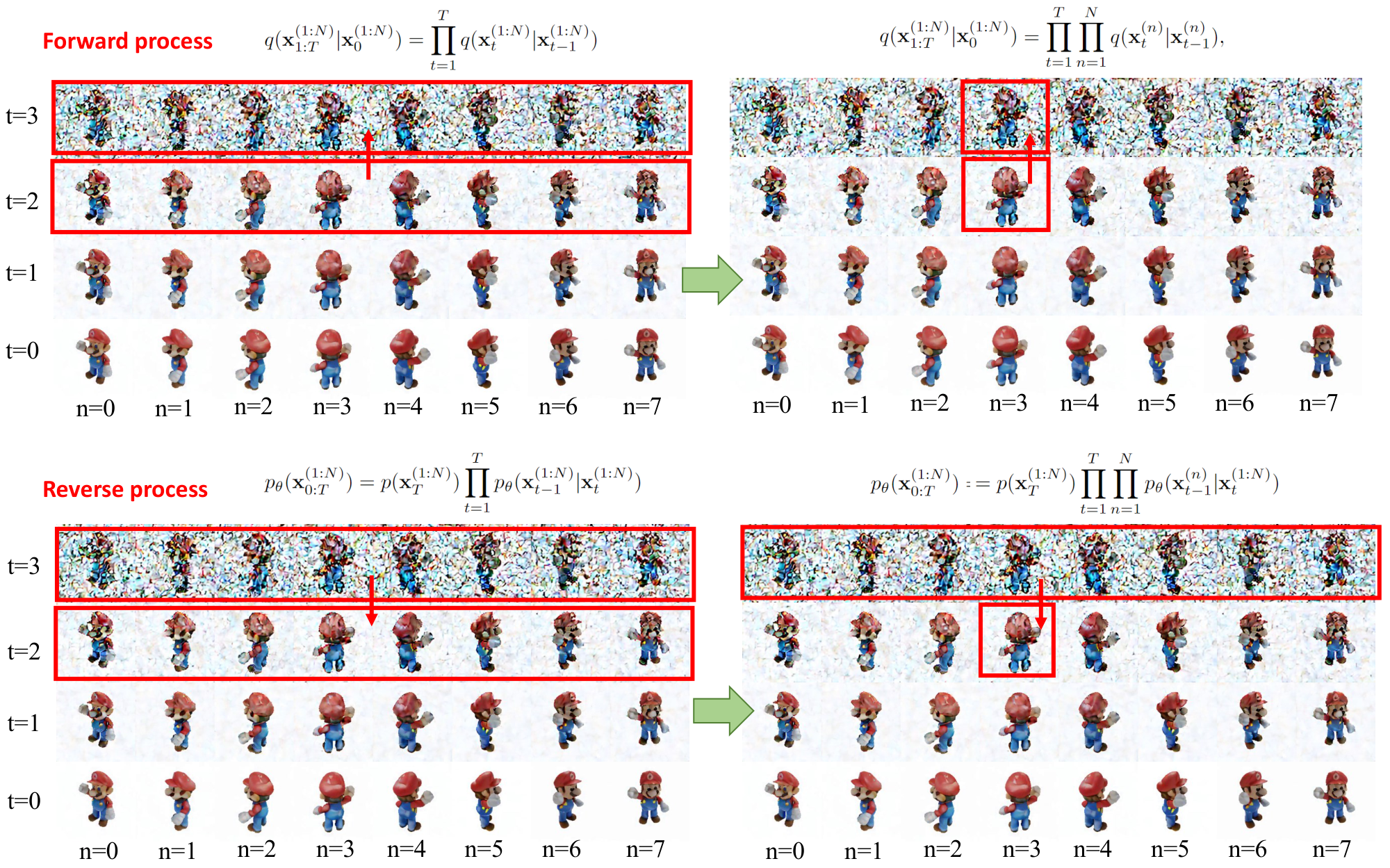
The forward process of the multiview diffusion model is a direct extension of the vanilla DDPM in Equation 2, where noises are added to every view independently by
$ q(\mathbf{x}^{(1:N)}{1:T}|\mathbf{x}0^{(1:N)}) = \prod{t=1}^T q(\mathbf{x}^{(1:N)}t|\mathbf{x}^{(1:N)}{t-1}) =\prod{t=1}^T \prod_{n=1}^N q(\mathbf{x}^{(n)}t|\mathbf{x}^{(n)}{t-1}),\tag{4} $
where $q(\mathbf{x}^{(n)}t|\mathbf{x}^{(n)}{t-1})=\mathcal{N}(\mathbf{x}^{(n)}t;\sqrt{1-\beta_t} \mathbf{x}^{(n)}{t-1}, \beta_t \mathbf{I})$. Similarly, following Equation 1, the reverse process is constructed as
$ p_\theta(\mathbf{x}{0:T}^{(1:N)}) =p(\mathbf{x}^{(1:N)}T) \prod{t=1}^{T} p\theta(\mathbf{x}^{(1:N)}{t-1}|\mathbf{x}^{(1:N)}{t}) =p(\mathbf{x}^{(1:N)}T) \prod{t=1}^{T} \prod_{n=1}^{N} p_\theta(\mathbf{x}^{(n)}{t-1}|\mathbf{x}^{(1:N)}{t}),\tag{6} $
where $p_\theta(\mathbf{x}^{(n)}{t-1}|\mathbf{x}^{(1:N)}t)=\mathcal{N}(\mathbf{x}^{(n)}{t-1};\mathbf{\mu}^{(n)}\theta(\mathbf{x}^{(1:N)}t, t), \sigma^2_t \mathbf{I})$. Note that the second equation in Equation 6 holds because we assume a diagonal variance matrix. However, the mean $\mathbf{\mu}^{(n)}\theta$ of $n$-th view $\mathbf{x}_{t-1}^{(n)}$ depends on the states of all the views $\mathbf{x}^{(1:N)}t$. Similar to Eq. 3, we define $\mathbf{\mu}^{(n)}\theta$ and the loss by
$ \mathbf{\mu}^{(n)}_\theta(\mathbf{x}^{(1:N)}_t, t)=\frac{1}{\sqrt{\alpha_t}}\left(\mathbf{x}^{(n)}_t - \frac{\beta_t}{\sqrt{1-\bar{\alpha}t}} \mathbf{\epsilon}^{(n)}\theta (\mathbf{x}^{(1:N)}_t, t)\right). $
$ \ell = \mathbb{E}_{t, \mathbf{x}^{(1:N)}0, n, \mathbf{\epsilon}^{(1:N)}} \left[|\mathbf{\epsilon}^{(n)} - \mathbf{\epsilon}^{(n)}\theta (\mathbf{x}^{(1:N)}_t, t)|_2\right], $
where $\mathbf{\epsilon}^{(1:N)}$ is the standard Gaussian noise of size $N\times H\times W$ added to all $N$ views, $\mathbf{\epsilon}^{(n)}$ is the noise added to the $n$-th view, and $\mathbf{\epsilon}^{(n)}_\theta$ is the noise predictor on the $n$-th view.
Training procedure. In one training step, we first obtain $N$ images $\mathbf{x}^{(1:N)}0$ of the same object from the dataset. Then, we sample a timestep $t$ and the noise $\epsilon^{(1:N)}$ which is added to all the images $\mathbf{x}^{(1:N)}0$ to obtain $\mathbf{x}^{(1:N)}{t}$. After that, we randomly select a view $n$ and apply the corresponding noise predictor $\mathbf{\epsilon}^{(n)}\theta$ on the selected view to predict the noise. Finally, the L2 distance between the sampled noise $\mathbf{\epsilon}^{(n)}$ and the predicted noise is computed as the loss for the training.
Synchronized $N$-view noise predictor. The proposed multiview diffusion model can be regarded as $N$ synchronized noise predictors ${\mathbf{\epsilon}^{(n)}\theta|n=1, ..., N }$. On each time step $t$, each noise predictor $\mathbf{\epsilon}^{(n)}$ is in charge of predicting noise on its corresponding view $\mathbf{x}^{(n)}{t}$ to get $\mathbf{x}^{(n)}{t-1}$. Meanwhile, these noise predictors are synchronized because, on every denoising step, every noise predictor exchanges information with each other by correlating the states $\mathbf{x}^{(1:N)}{t}$ of all the other views. In practical implementation, we use a shared UNet for all $N$ noise predictors and put the viewpoint difference between the input view and the $n$-th target view $\Delta\mathbf{v}^{(n)}$, and the states $\mathbf{x}^{(1:N)}t$ of all views as conditions to this shared noise predictor, i.e., $\mathbf{\epsilon}^{(n)}\theta(\mathbf{x}^{(1:N)}t, t)=\mathbf{\epsilon}\theta(\mathbf{x}^{(n)}_t;t, \Delta\mathbf{v}^{(n)}, \mathbf{x}^{(1:N)}_t)$. The detailed computation of the viewpoint difference can be found in the supplementary material.
3.3 3D-aware feature attention for denoising
In this section, we discuss how to implement the synchronized noise predictor $\mathbf{\epsilon}_\theta(\mathbf{x}^{(n)}_t;t, \Delta\mathbf{v}^{(n)}, \mathbf{x}^{(1:N)}_t, \mathbf{y})$ by correlating the multiview features using a 3D-aware attention scheme. The overview is shown in Figure 2.
Backbone UNet. Similar to previous works ([8, 7]), our noise predictor $\mathbf{\epsilon}_\theta$ contains a UNet which takes a noisy image as input and then denoises the image. To ensure the generalization ability, we initialize the UNet from the pretrained weights of Zero123 ([1]) which is a generalizable model with the ability to generate novel-view images from a given image of an object. Zero123 concatenates the input view with the noisy target view as the input to UNet. Then, to encode the viewpoint difference $\Delta\mathbf{v}^{(n)}$ in UNet, Zero123 reuses the text attention layers of Stable Diffusion to process the concatenation of $\Delta\mathbf{v}^{(n)}$ and the CLIP feature ([86]) of the input image. We follow the same design as Zero123 and empirically freeze the UNet and the text attention layers when training SyncDreamer. Experiments to verify these choices are presented in Sec. 4.4.
3D-aware feature attention. The remaining problem is how to correlate the states $\mathbf{x}{t}^{(1:N)}$ of all the target views for the denoising of the current noisy target view $\mathbf{x}{t}^{(n)}$. To enforce consistency among multiple generated views, it is desirable for the network to perceive the corresponding features in 3D space when generating the current image. To achieve this, we first construct a 3D volume with $V^3$ vertices and then project the vertices onto all the target views to obtain the features. The features from each target view are extracted by convolution layers and are concatenated to form a spatial feature volume. Next, a 3D CNN is applied to the feature volume to capture and process spatial relationships. In order to denoise $n$-th target view, we construct a view frustum that is pixel-wise aligned with this view, whose features are obtained by interpolating the features from the spatial volume. Finally, on every intermediate feature map of the current view in the UNet, we apply a new depth-wise attention layer to extract features from the pixel-wise aligned view-frustum feature volume along the depth dimension. The depth-wise attention is similar to the epipolar attention layers in [87, 26, 27, 28] as discussed in the supplementary material.
Discussion. There are two primary design considerations in this 3D-aware feature attention UNet. First, the spatial volume is constructed from all the target views and all the target views share the same spatial volume for denoising, which implies a global constraint that all target views are looking at the same object. Second, the added new attention layers only conduct attention along the depth dimension, which enforces a local epipolar line constraint that the feature for a specific location should be consistent with the corresponding features on the epipolar lines of other views.
4. Experiments
Section Summary: The experiments evaluate the method's performance on generating consistent new views of objects from a single image and reconstructing 3D shapes from those images, using the Google Scanned Object dataset with 30 diverse items, alongside some internet photos. Compared to baselines like Zero123 and RealFusion, the approach excels in novel-view synthesis by producing more visually appealing and geometrically consistent images, as measured by metrics like image quality scores and the number of reconstructible 3D points. For 3D reconstruction, it achieves the highest accuracy in shape matching and overlap with real objects, outperforming others that often result in incomplete, rough, or inconsistent models.
4.1 Experiment protocol
Evaluation dataset. Following ([1, 66]), we adopt the Google Scanned Object ([36]) dataset as the evaluation dataset. To demonstrate the generalization ability to arbitrary objects, we randomly chose 30 objects ranging from daily objects to animals. For each object, we render an image with a size of 256 $\times$ 256 as the input view. We additionally evaluate some images collected from the Internet and the Wiki of Genshin Impact. More results are included in the supplementary materials.
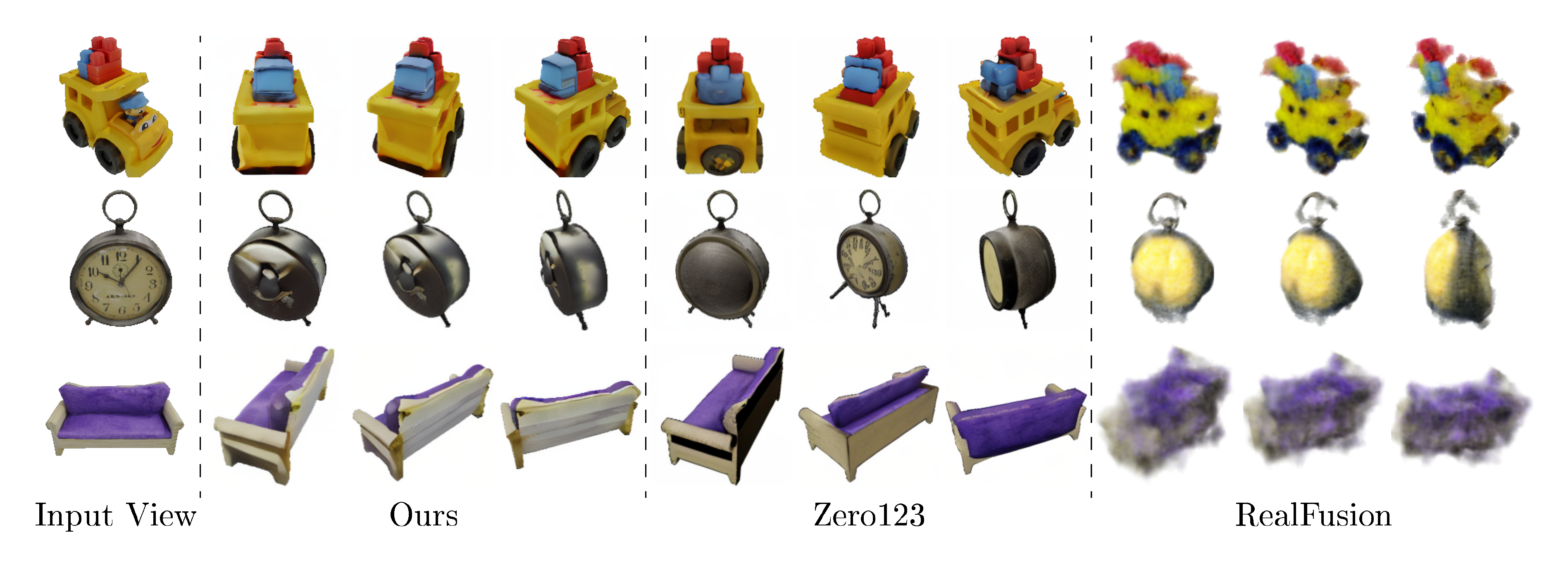
Baselines. We adopt Zero123 ([1]), RealFusion ([19]), Magic123 ([64]), One-2-3-45 ([66]), Point-E ([11]) and Shap-E ([10]) as baseline methods. Given an input image of an object, Zero123 ([1]) is able to generate novel-view images of the same object from different viewpoints. Zero123 can also be incorporated with the SDS loss ([13]) for 3D reconstruction. We adopt the implementation of ThreeStudio ([88]) for reconstruction with Zero123, which includes many optimization strategies to achieve better reconstruction quality than the original Zero123 implementation. RealFusion ([19]) is based on Stable Diffusion ([7]) and the SDS loss for single-view reconstruction. Magic123 ([64]) combines Zero123 ([1]) with RealFusion ([19]) to further improve the reconstruction quality. One-2-3-45 ([66]) directly regresses SDFs from the output images of Zero123 and we use the official hugging face online demo ([89]) to produce the results. Point-E ([11]) and Shap-E ([10]) are 3D generative models trained on a large internal OpenAI 3D dataset, both of which are able to convert a single-view image into a point cloud or a shape encoded in an MLP. For Point-E, we convert the generated point clouds to SDFs for shape reconstruction using the official models.
Metrics. We mainly focus on two tasks, novel view synthesis (NVS) and single view 3D reconstruction (SVR). On the NVS task, we adopt the commonly used metrics, i.e., PSNR, SSIM ([90]) and LPIPS ([91]). To further demonstrate the multiview consistency of the generated images, we also run the MVS algorithm COLMAP ([92]) on the generated images and report the reconstructed point number. Because MVS algorithms rely on multiview consistency to find correspondences to reconstruct 3D points, more consistent images would lead to more reconstructed points. On the SVR task, we report the commonly used Chamfer Distances (CD) and Volume IoU between ground-truth shapes and reconstructed shapes. Since the shapes generated by Point-E ([11]) and Shap-E ([10]) are defined in a different canonical coordinate system, we manually align the generated shapes of these two methods to the ground-truth shapes before computing these metrics. Considering randomness in the generation, we report the min, max, and average metrics on 8 objects in the supplementary material.
4.2 Consistent novel-view synthesis
:Table 1: The quantitative comparison in novel view synthesis. We report PSNR, SSIM, LPIPS and reconstructed point numbers by COLMAP on the GSO dataset.
| Method | PSNR $\uparrow$ | SSIM $\uparrow$ | LPIPS $\downarrow$ | #Points $\uparrow$ |
|---|---|---|---|---|
| Realfusion | 15.26 | 0.722 | 0.283 | 4010 |
| Zero123 | 18.93 | 0.779 | 0.166 | 95 |
| Ours | 20.05 | 0.798 | 0.146 | 1123 |
For this task, the quantitative results are shown in Table 1 and the qualitative results are shown in Figure 3. By applying a NeRF model to distill the Stable Diffusion model ([13, 7]), RealFusion ([19]) shows strong multiview consistency producing more reconstructed points but is unable to produce visually plausible images as shown in Figure 3. Zero123 ([1]) produces visually plausible images but the generated images are not multiview-consistent. Our method is able to generate images that not only are semantically consistent with the input image but also maintain multiview consistency in colors and geometry. Meanwhile, for the same input image, Our method can generate different plausible instances using different random seeds as shown in Figure 4.
4.3 Single view reconstruction
:Table 2: Quantitative comparison with baseline methods. We report Chamfer Distance and Volume IoU on the GSO dataset.
| Method | Chamfer Dist. $\downarrow$ | Volume IoU $\uparrow$ |
|---|---|---|
| Realfusion | 0.0819 | 0.2741 |
| Magic123 | 0.0516 | 0.4528 |
| One-2-3-45 | 0.0629 | 0.4086 |
| Point-E | 0.0426 | 0.2875 |
| Shap-E | 0.0436 | 0.3584 |
| Zero123 | 0.0339 | 0.5035 |
| Ours | 0.0261 | 0.5421 |
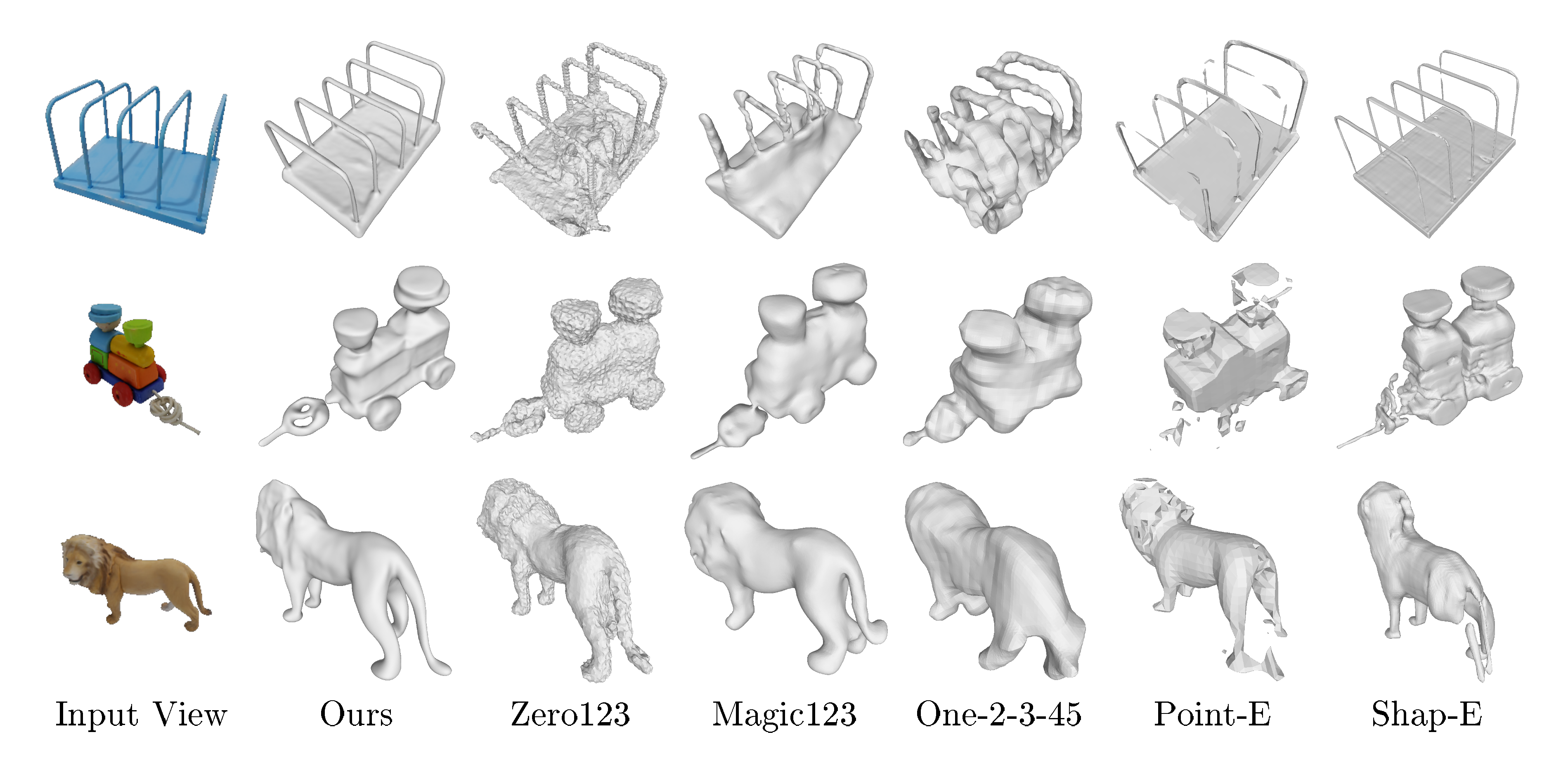
We show the quantitative results in Table 2 and the qualitative comparison in Figure 5. Point-E ([11]) and Shap-E ([10]) tend to produce incompleted meshes. Directly distilling Zero123 ([1]) generates shapes that are coarsely aligned with the input image, but the reconstructed surfaces are rough and not consistent with input images in detailed parts. Magic123 ([64]) produces much smoother meshes but heavily relies on the estimated depth values on the input view, which may lead to incorrect results when the depth estimator is not robust. One-2-3-45 ([66]) reconstructs meshes from the multiview-inconsistent outputs of Zero123, which is able to capture the general geometry but also loses details. In comparison, our method achieves the best reconstruction quality with smooth surfaces and detailed geometry.
4.4 Discussions
In this section, we further conduct a set of experiments to evaluate the effectiveness of our designs.
Generalization ability. To show the generalization ability, we evaluate SyncDreamer with 2D designs or hand drawings like sketches, cartoons, and traditional Chinese ink paintings, which are usually created manually by artists and exhibit differences in lighting effects and color space from real-world images. The results are shown in Figure 6. Despite the significant differences in lighting and shadow effects between these images and the real-world images, our algorithm is still able to perceive their reasonable 3D geometry and produce multiview-consistent images.
Without 3D-aware feature attention. To show how the proposed 3D-aware feature attention improves multiview consistency, we discard the 3D-aware attention module in SyncDreamer and train this model on the same training set. This actually corresponds to finetuning a Zero123 model with fixed viewpoints. As we can see in Figure 7, such a model still cannot produce images with strong consistency, which demonstrates the necessity of the 3D-aware attention module in generating multiview-consistent images.
Initializing from Stable Diffusion instead of Zero123 ([1]). An alternative strategy is to initialize our model from Stable Diffusion ([7]). However, the results shown in Figure 7 indicate that initializing from Stable Diffusion exhibits a worse generalization ability than from Zero123. Based on our observations, we find that the batch size plays an important role in enhancing the stability and efficacy of learning 3D priors from a diverse dataset like Objaverse. However, due to limited GPU memories, our batch size is 192 which is smaller than the 1536 used by Zero123. Finetuning on Zero123 enables SyncDreamer to utilize the 3D priors of Zero123.
Training UNet. During the training of SyncDreamer, another feasible solution is to not freeze the UNet and the related layers initialized from Zero123 but further finetune them together with the volume condition module. As shown in Figure 7, the model without freezing these layers tends to predict the input object as a thin plate, especially when the input images are 2D hand drawings. We speculate that this phenomenon is caused by overfitting, likely due to the numerous thin-plate objects within the Objaverse dataset and the fixed viewpoints employed during our training process.
![**Figure 7:** Ablation studies to verify the designs of our method. "SyncDreamer" means our full model. "W/O 3D Attn" means discarding the 3D-aware attention module in SyncDreamer, which actually results in a Zero123 ([1]) finetuned on fixed viewpoints on the Objaverse ([35]) dataset. "Init SD" means initialize the SyncDreamer noise predictor from Stable Diffusion instead of Zero123. "Train UNet" means we train the UNet instead of freezing it.](https://ittowtnkqtyixxjxrhou.supabase.co/storage/v1/object/public/public-images/5mdu4zry/complex_fig_3bef28e19dba.png)
Runtime. SyncDreamer uses about 40s to sample 64 images (4 instances) with 50 DDIM ([93]) sampling steps on a 40G A100 GPU. Our runtime is slightly longer than Zero123 because we need to construct the spatial feature volume on every step.
5. Conclusion
Section Summary: This paper introduces SyncDreamer, a tool that creates consistent images from multiple angles based on just one input image. It works by using a synchronized process to model how these different views relate to each other, building on an existing system called Zero123 and adding a new module to handle connections between views. Tests show that SyncDreamer quickly produces high-quality, consistent multi-angle images that outperform other methods and adapt well to various image styles.
In this paper, we present SyncDreamer to generate multiview-consistent images from a single-view image. SyncDreamer adopts a synchronized multiview diffusion to model the joint probability distribution of multiview images, which thus improves the multiview consistency. We design a novel architecture that uses the Zero123 as the backbone and a new volume condition module to model cross-view dependency. Extensive experiments demonstrate that SyncDreamer not only efficiently generates multiview images with strong consistency, but also achieves improved reconstruction quality compared to the baseline methods with excellent generalization to various input styles.
6. Acknowledgement
Section Summary: This research received funding from the Innovation and Technology Commission of the Hong Kong Special Administrative Region Government through its InnoHK initiative, as well as from the Hong Kong Research Grants Council under reference T45-205/21-N. The authors express gratitude to Zhiyang Dou, Peng Wang, and Jiepeng Wang from AnySyn3D for their helpful discussions. The work also relied on computing resources provided by the Tencent Taiji platform.
This research is sponsored by the Innovation and Technology Commission of the HKSAR Government under the InnoHK initiative and Ref. T45-205/21-N of Hong Kong RGC. We sincerely thank Zhiyang Dou, Peng Wang, and Jiepeng Wang from AnySyn3D for discussions. This work is based on the computation resources from Tencent Taiji platform.
A Appendix
Section Summary: SyncDreamer is trained on a large dataset of 3D objects using specific settings like 16 viewpoints and custom volume sizes to generate consistent images from different angles, which can then be turned into 3D models via tools like NeuS for surface reconstruction. The method extends to creating 3D shapes directly from text descriptions by first generating images with models like Stable Diffusion, offering users flexibility in selecting the best ones. While effective, it has limitations such as fixed viewpoints leading to blurry novel views, inconsistent generation quality affected by object size and perspective, and simpler textures, with future improvements suggested like using larger datasets and handling orthogonal projections; depth-wise attention layers are crucial for maintaining high-quality, consistent results across views.
A.1 Implementation details
We train SyncDreamer on the Objaverse ([35]) dataset which contains about 800k objects. We set the viewpoint number $N=16$. The spatial volume has the size of $32^3$ and the view-frustum volume has the size of $32\times 32 \times 48$. We sample 48 depth planes for the view-frustum volume because the view may look into the volume from the diagonal direction. We chose these sizes because the latent feature map size of an image of $256\times 256$ in the Stable Diffusion [7] $32\times 32$. The elevation of the target views is set to 30$^\circ$ and the azimuth evenly distributes in $[0^\circ, 360^\circ]$. Besides these target views, we also render 16 random views as input views on each object for training, which have the same azimuths but random elevations. We always assume that the azimuth of both the input view and the first target view is 0$^\circ$. We train the SyncDreamer for 80k steps ($\sim$ 4 days) with 8 40G A100 GPUs using a total batch size of 192. The learning rate is annealed from 5e-4 to 1e-5. The viewpoint difference is computed from the difference between the target view and the input view on their elevations and azimuths. Since we need an elevation of the input view to compute the viewpoint difference $\Delta\mathbf{v}^{(n)}$, we use the rendering elevation in training while we roughly estimate an elevation angle as input in inference. Note that baseline methods RealFusion ([19]), Zero123 ([1]), and Magic123 ([64]) all require an estimated elevation angle as input in test time. It is also possible to adopt the elevation estimator in [66] to estimate the elevation angle of the input image. To obtain surface meshes, we predict the foreground masks of the generated images using CarveKit^1. Then, we train the vanilla NeuS ([4]) for 2k steps to reconstruct the shape, which costs about 10 mins. On each step, we sample 4096 rays and sample 128 points on each ray for training. Both the mask loss and the rendering loss are applied in training NeuS. The reconstruction process can be further sped up by faster reconstruction methods ([94, 95, 96]) or generalizable SDF predictors ([97, 66]) with priors.
A.2 Text-to-image-to-3D
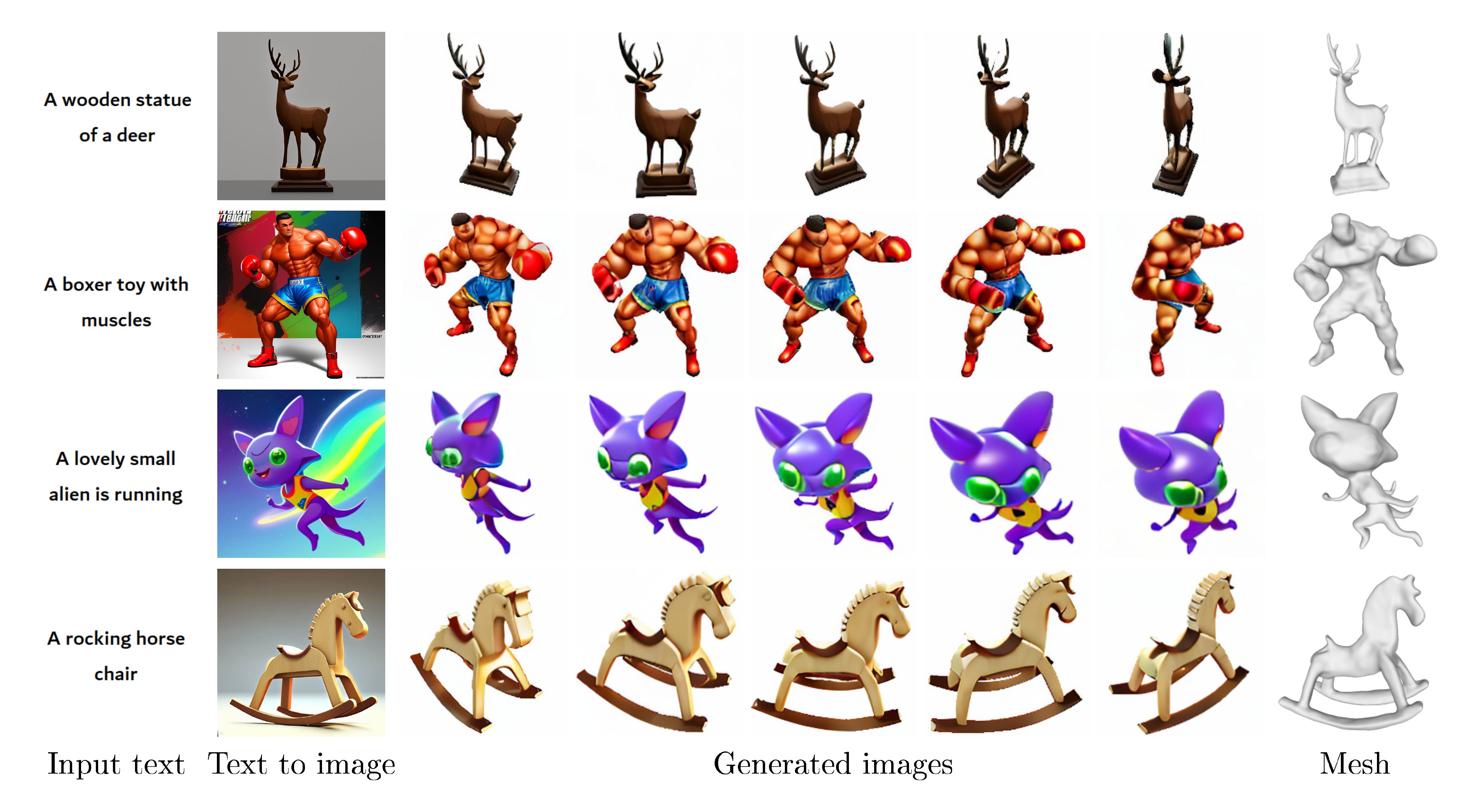
By incorporating text2image models like Stable Diffusion ([7]) or Imagen ([54]), SyncDreamer enables generating 3D models from text. Examples are shown in Figure 8. Compared with existing text-to-3D distillation, our method gives more flexibility because users can generate multiple images with their text2image models and select the desirable one to feed to SyncDreamer for 3D reconstruction.
A.3 Limitations and future works
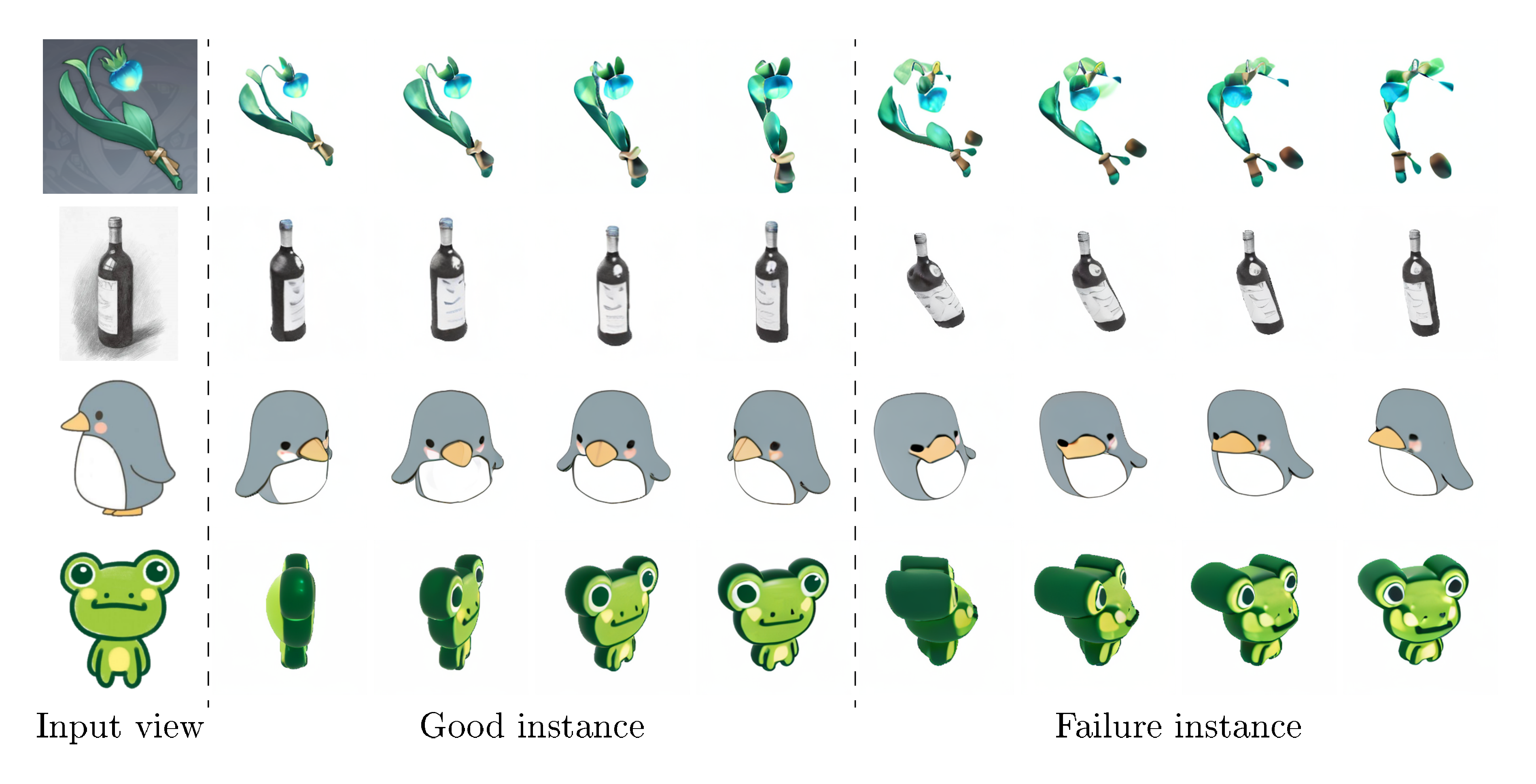
Though SyncDreamer shows promising performances in generating multiview-consistent images for 3D reconstruction, there are still limitations that the current framework does not fully address. First, the generated images of SyncDreamer have fixed viewpoints, which limits some of its application scope when requiring images of other viewpoints. A possible alternative is to use the trained NeuS to render novel-view images, which achieves reasonable but a little bit blurry results as shown in Figure 13. Second, the generated images are not always plausible and we may need to generate multiple instances with different seeds and select a desirable instance for 3D reconstruction as shown in Figure 9. Especially, we notice that the generation quality is sensitive to the foreground object size in the image. The reason is that changing the foreground object size corresponds to adjusting the perspective patterns of the input camera and affects how the model perceives the geometry of the object. The training images of SyncDreamer have a predefined intrinsic matrix and all are captured at a predefined distance to the constructed volume, which makes the model adapt to a fixed perspective pattern. To further increase the quality, we may need to use a larger object dataset like Objaverse-XL ([98]) and manually clean the dataset to exclude some uncommon shapes like complex scene representation, textureless 3D models, and point clouds. Third, the current implementation of SyncDreamer assumes a perspective image as input but many 2D designs are drawn with orthogonal projections, which would lead to unnatural distortion of the reconstructed geometry. Applying orthogonal projection in the volume construction of SyncDreamer would alleviate this problem. Meanwhile, we notice that generated textures are sometimes less detailed than the Zero123. The reason is that the multiview generation is more challenging, which not only needs to be consistent with the input image but also needs to be consistent with all other generated views. Thus, the model may tend to generate large texture blocks with less detail, since it could more easily maintain multiview consistency.
A.4 Discussion on depth-wise attention layers
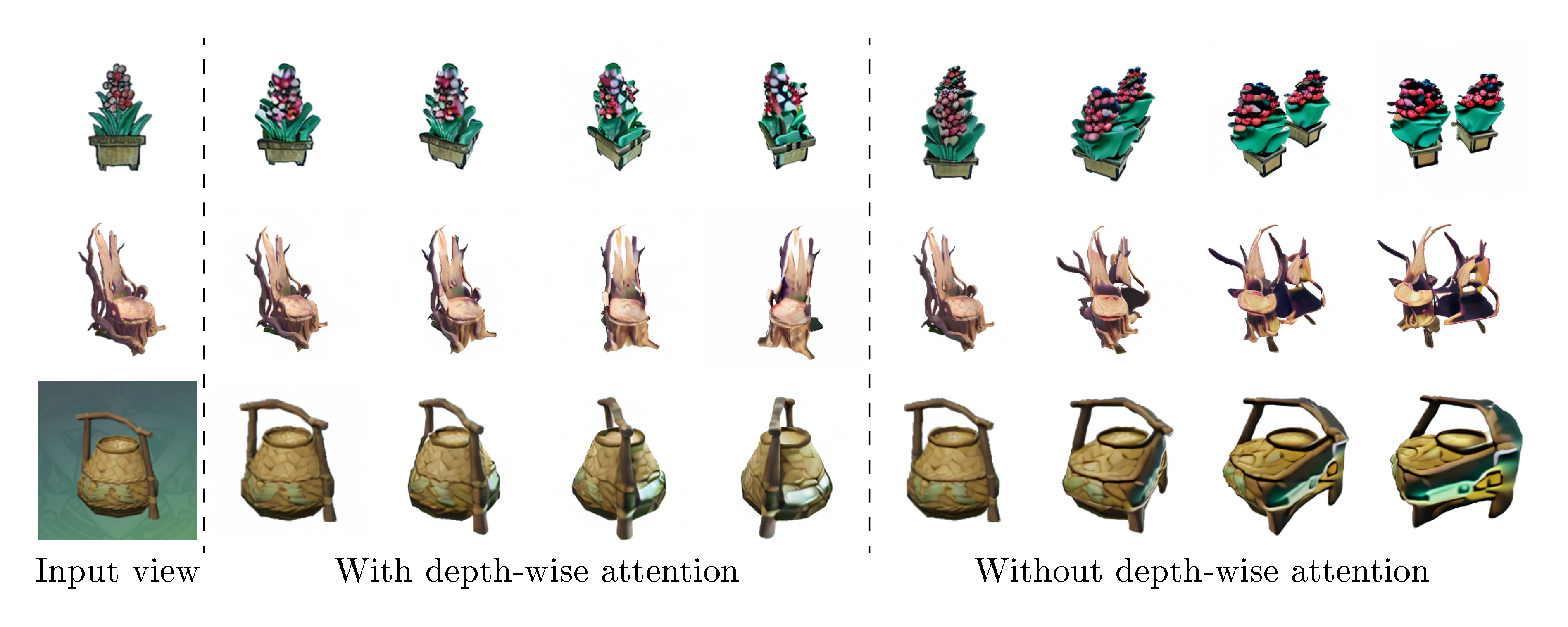
We find that the depth-wise attention layers are important for generating high-quality multiview-consistent images. To show that, we design an alternative model that directly treats the view-frustum feature volume $H\times W\times D\times F$ as a 2D feature map $H\times W \times (D\times F)$. Then, we apply 2D convolutional layers to extract features on it and then add them to the intermediate feature maps of UNet. We find that the model without depth-wise attention layers produces degenerated images with undesirable shape distortions as shown in Figure 10.
A.5 Generating image on other viewpoints
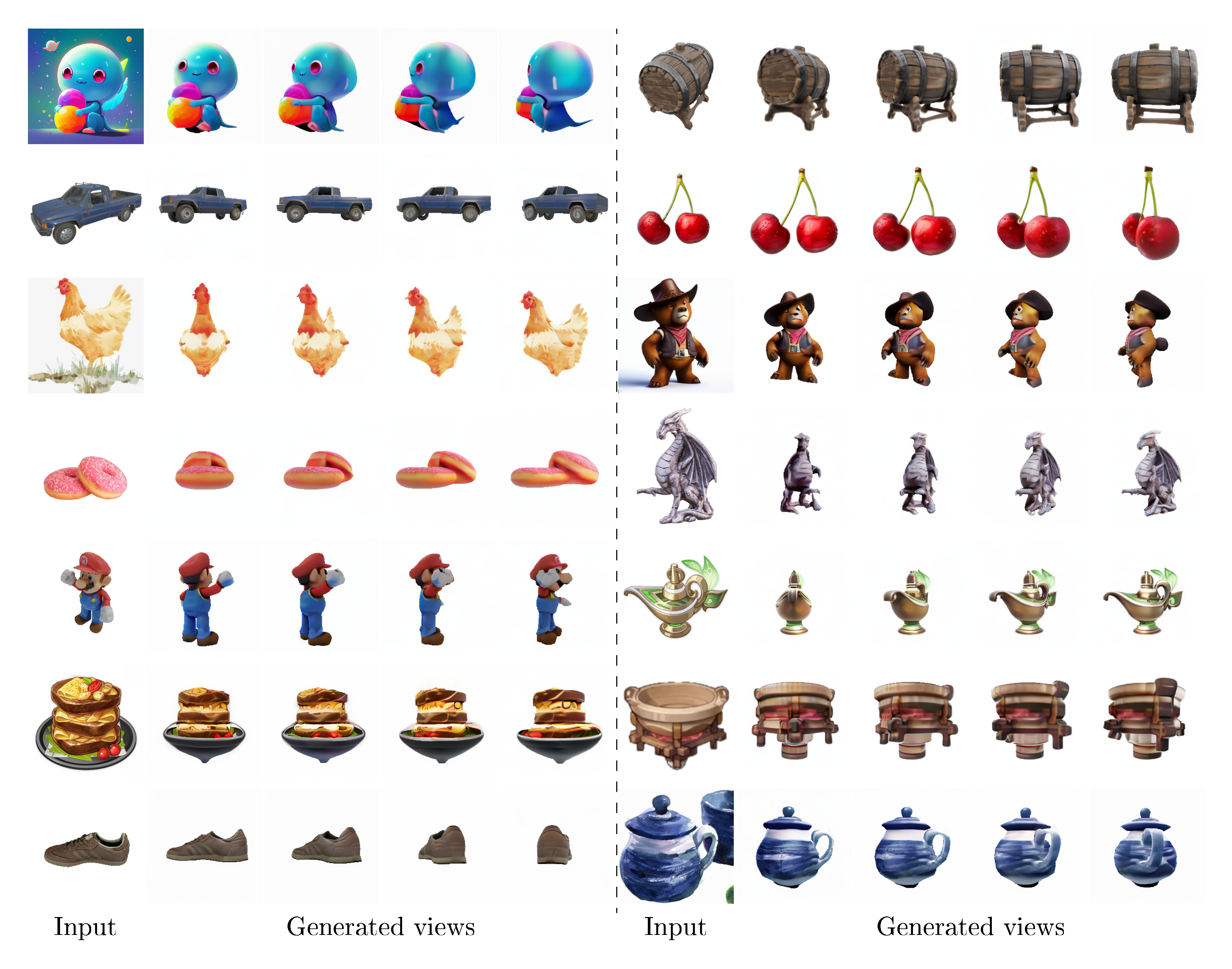
To show the ability of SyncDreamer to generate images of different viewpoints, we train a new SyncDreamer model but with different 16 viewpoints. The new viewpoints all have elevations of 0$^\circ$ and azimuth evenly distributed in the range [0$^\circ$, 360$^\circ$]. The generated images of this new model are shown in Figure 11.
A.6 Iterative generation
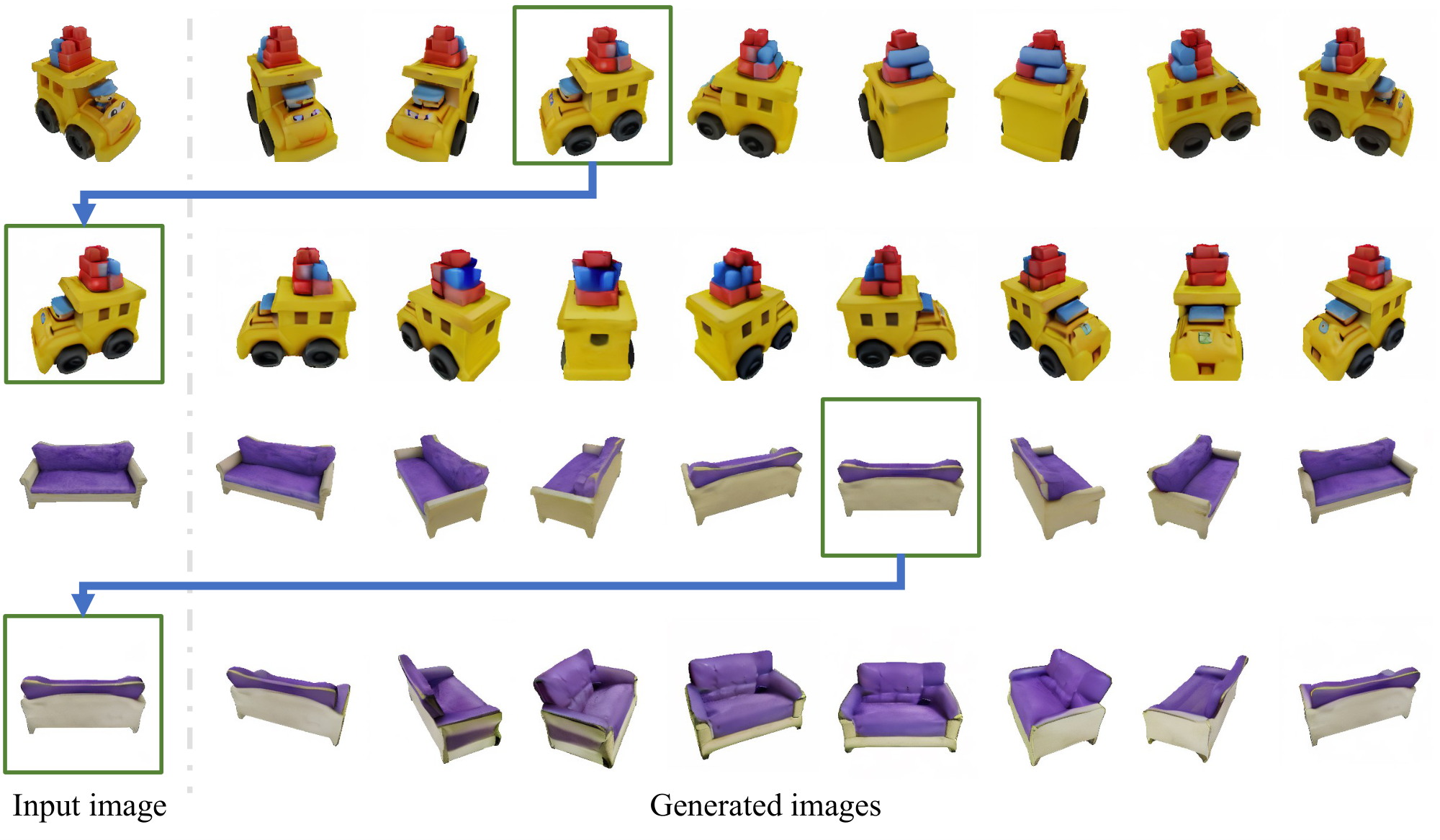
It is also possible to re-generate novel view images from one of the generated images of SyncDreamer. Two examples are shown in Figure 12. In the figure, row 1 shows the generated images of SyncDreamer and row 2 shows the re-generated images of SyncDreamer using one of first-row images as its input image. Though the regenerated images are still plausible, they reasonably differ from the original input view
A.7 Novel-view renderings of NeuS
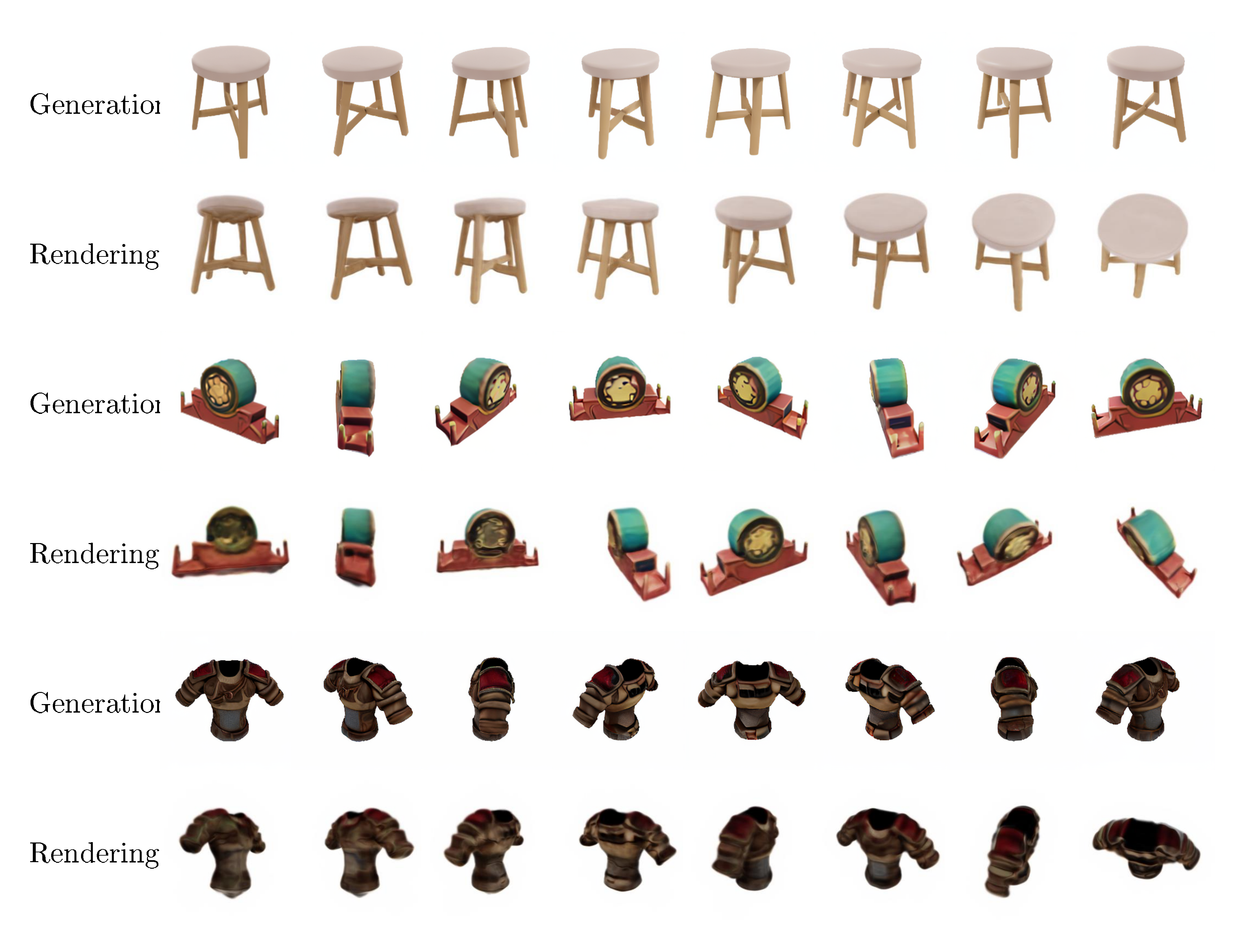
Though SyncDreamer can only generate images on fixed viewpoints, we can render novel-view images from arbitrary viewpoints using the NeuS model trained on the output of SyncDreamer, as shown in Figure 13. However, since only 16 images are generated to train the NeuS model, the renderings from NeuS are more blurry than the generated images of SyncDreamer.
A.8 Fewer generated views for NeuS training
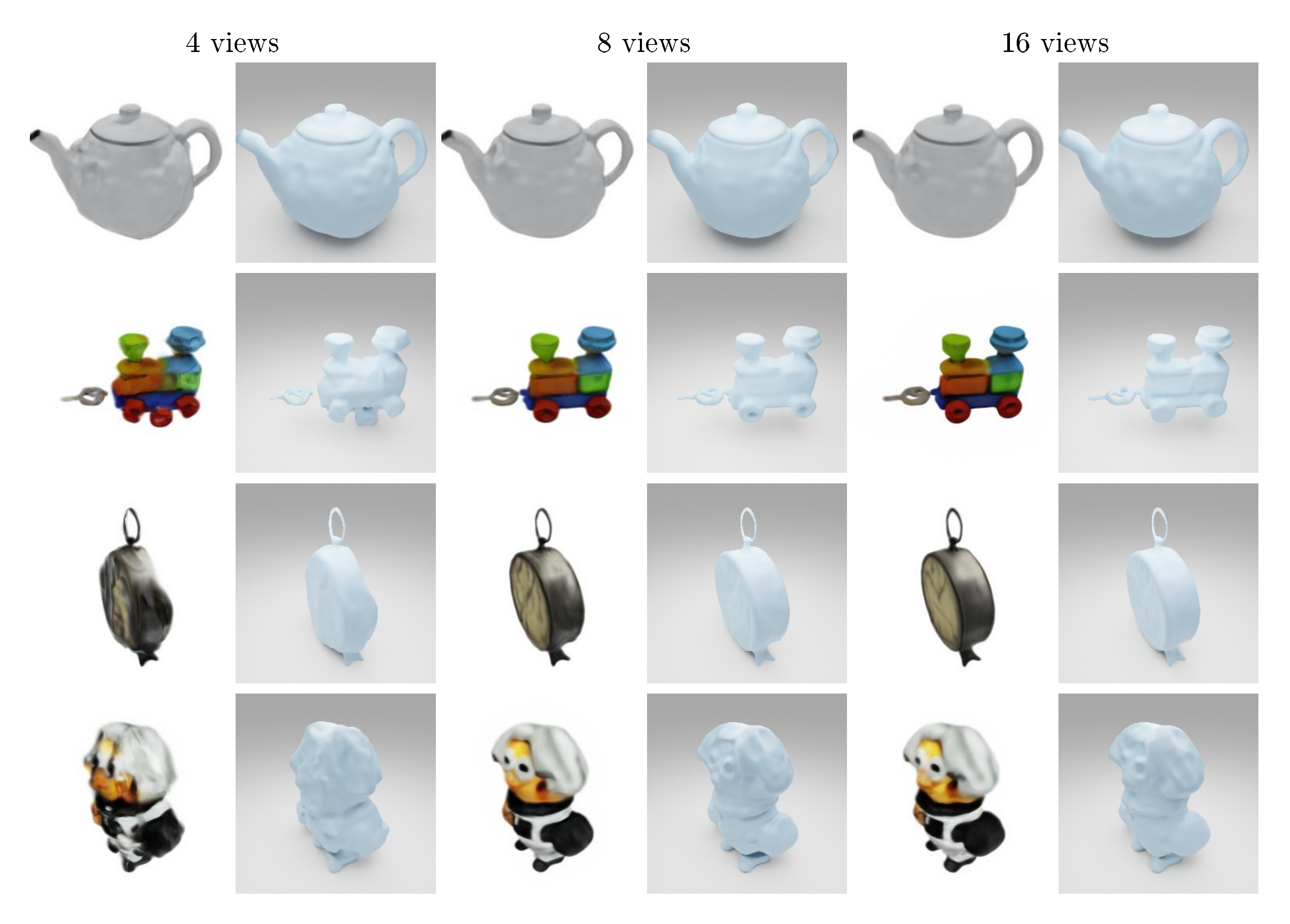
The NeuS reconstruction process can be accomplished with fewer views, as demonstrated in Figure 14. Decreasing the number of views from 16 to 8 does not have a significant impact on the overall reconstruction quality. However, utilizing only 4 views results in a steep decline in both surface reconstruction and novel-view-synthesis quality. Consequently, it is possible to train a more efficient version of SyncDreamer to generate 8 views for the NeuS reconstruction without compromising the quality too much.
A.9 Faster reconstruction with hash-grid-based NeuS
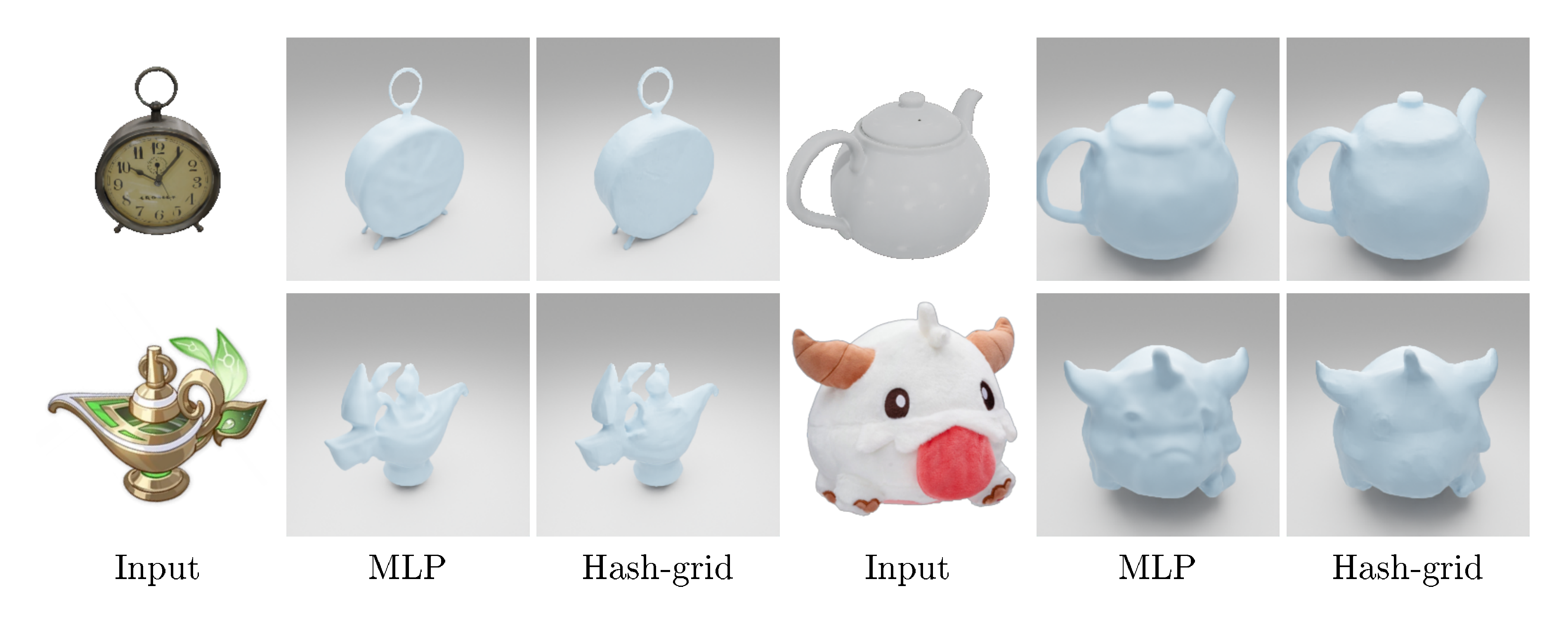
It is possible to use a hash-grid-based NeuS to improve the reconstruction efficiency. Some qualitative reconstruction results are shown in Figure 15. The hash-grid-based method takes about 3 minutes which is less than half the time of the vanilla MLP-based NeuS (10min). Since hash-grid-based SDF usually produces more noisy surfaces than MLP-based SDF, we add additional smoothness losses on the normals computed from the has-grid-based SDF.
A.10 Metrics using different generation seeds
Due to the randomness in the generation process, the computed metrics may differ if we use different seeds for generation. To show this, we randomly sample 4 instances from the same input image of 8 objects from the GSO dataset and compute the corresponding PSNR, SSIM, LPIPS, Chamfer Distance, and Volume IOU as reported in Table 3.
\begin{tabular}{cccccccccc}
  \toprule
  & & Mario & S.Bus1 & S.Bus2 & Shoe & S.Cups & Sofa & Hat & Turtle \\
  \midrule
  \multirow{3}{*}{PSNR $\uparrow$}
  & Min & 18.25 & 20.52 & 16.39 & 21.38 & 23.43 & 18.97 & 20.87 & 15.83 \\
  & Max & 18.74 & 20.70 & 16.67 & 21.70 & 24.48 & 19.53 & 21.08 & 16.33\\
  & Avg. & 18.48 & 20.63 & 16.48 & 21.48 & 23.99 & 19.26 & 20.96 & 16.03 \\
  \midrule
  \multirow{3}{*}{SSIM $\uparrow$}
  & Min & 0.811 & 0.851 & 0.687 & 0.862 & 0.899 & 0.809 & 0.797 & 0.749 \\
  & Max & 0.816 & 0.855 & 0.690 & 0.866 & 0.913 & 0.816 & 0.801 & 0.754\\
  & Avg. & 0.813 & 0.853 & 0.688 & 0.864 & 0.906 & 0.812 & 0.799 & 0.751 \\
  \midrule
  \multirow{3}{*}{LPIPS $\downarrow$}
  & Min & 0.129 & 0.104 & 0.222 & 0.081 & 0.055 & 0.154 & 0.134 & 0.209 \\
  & Max & 0.135 & 0.108 & 0.229 & 0.084 & 0.087 & 0.157 & 0.136 & 0.223\\
  & Avg. & 0.133 & 0.105 & 0.226 & 0.082 & 0.071 & 0.156 & 0.135 & 0.218 \\
  \midrule
  \multirow{3}{*}{CD $\downarrow$}
  & Min & 0.0139 & 0.0076 & 0.0217 & 0.0167 & 0.0079 & 0.0237 & 0.0464 & 0.0225 \\
  & Max & 0.0194 & 0.0100 & 0.0236 & 0.0184 & 0.0138 & 0.0449 & 0.0511 & 0.0377\\
  & Avg. & 0.0167 & 0.0087 & 0.0227 & 0.0172 & 0.0110 & 0.0312 & 0.0490 & 0.0301 \\
  \midrule
  \multirow{3}{*}{Vol. IOU $\uparrow$}
  & Min & 0.6604 & 0.8284 & 0.5247 & 0.4383 & 0.5966 & 0.3905 & 0.2614 & 0.6313 \\
  & Max & 0.7336 & 0.8335 & 0.5731 & 0.4826 & 0.6873 & 0.5205 & 0.2919 & 0.7471\\
  & Avg. & 0.6889 & 0.8309 & 0.5578 & 0.4575 & 0.6427 & 0.4729 & 0.2705 & 0.6864 \\

  \bottomrule
  \end{tabular}
A.11 Discussion on other attention mechanism
There are several attention mechanisms similar to our depth-wise attention layers. MVDiffusion [38] utilizes a correspondence-aware attention layer based on the known geometry. In SyncDreamer, the geometry is unknown so we cannot build such one-to-one correspondence for attention. An alternative way is the epipolar attention layer in [87, 26, 27, 28] which constructs an epipolar line on every image and applies attention along the epipolar line. Epipolar line attention constructs epipolar lines on every image and applies attention along epipolar lines. Our depth-wise attention is very similar to epipolar line attention. If we project a 3D point in the view frustum onto a neighboring view, we get a 2D sample point on the epipolar line. We notice that in epipolar line attention, we still need to maintain a new tensor of size $H\times W \times D$ containing the epipolar features. This would cost as large GPU memory as our volume-based attention. A concurrent work MVDream ([71]) applies attention layers on all feature maps from multiview images, which also achieves promising results. However, applying such an attention layer to all the feature maps of 16 images in our setting costs unaffordable GPU memory in training. Finding a suitable network design for multiview-consistent image generation would still be an interesting and challenging problem for future work.
A.12 Diagram on multiview diffusion
We provide a diagram in Figure 16 to visualize the derivation of the proposed multiview diffusion in Sec. 3.2 in the main paper.
References
Section Summary: This references section compiles a bibliography of over 30 recent academic papers and preprints on cutting-edge AI techniques for generating and reconstructing 3D objects and scenes. The works span topics like creating detailed 3D models from single images or text descriptions, synthesizing new viewpoints of objects using neural networks, and applying diffusion models—AI systems that build images or shapes step by step—to improve realism and efficiency in visual computing. Published mostly between 2018 and 2023 in major conferences such as CVPR, ICCV, and NeurIPS, these studies build on foundational ideas like neural radiance fields to push the boundaries of digital creation.
[1] Ruoshi Liu, Rundi Wu, Basile Van Hoorick, Pavel Tokmakov, Sergey Zakharov, and Carl Vondrick. Zero-1-to-3: Zero-shot one image to 3d object. In ICCV, 2023b.
[2] Yao Yao, Zixin Luo, Shiwei Li, Tian Fang, and Long Quan. Mvsnet: Depth inference for unstructured multi-view stereo. In ECCV, 2018.
[3] Ayush Tewari, Ohad Fried, Justus Thies, Vincent Sitzmann, Stephen Lombardi, Kalyan Sunkavalli, Ricardo Martin-Brualla, Tomas Simon, Jason Saragih, Matthias Nießner, et al. State of the art on neural rendering. In Computer Graphics Forum, 2020.
[4] Peng Wang, Lingjie Liu, Yuan Liu, Christian Theobalt, Taku Komura, and Wenping Wang. Neus: Learning neural implicit surfaces by volume rendering for multi-view reconstruction. In NeurIPS, 2021.
[5] Ben Mildenhall, Pratul P Srinivasan, Matthew Tancik, Jonathan T Barron, Ravi Ramamoorthi, and Ren Ng. Nerf: Representing scenes as neural radiance fields for view synthesis. In ECCV, 2020.
[6] Yiheng Xie, Towaki Takikawa, Shunsuke Saito, Or Litany, Shiqin Yan, Numair Khan, Federico Tombari, James Tompkin, Vincent Sitzmann, and Srinath Sridhar. Neural fields in visual computing and beyond. In Computer Graphics Forum, 2022.
[7] Robin Rombach, Andreas Blattmann, Dominik Lorenz, Patrick Esser, and Björn Ommer. High-resolution image synthesis with latent diffusion models. In CVPR, 2022.
[8] Jonathan Ho, Ajay Jain, and Pieter Abbeel. Denoising diffusion probabilistic models. In NeurIPS, 2020.
[9] Tengfei Wang, Bo Zhang, Ting Zhang, Shuyang Gu, Jianmin Bao, Tadas Baltrusaitis, Jingjing Shen, Dong Chen, Fang Wen, Qifeng Chen, et al. Rodin: A generative model for sculpting 3d digital avatars using diffusion. In CVPR, 2023b.
[10] Heewoo Jun and Alex Nichol. Shap-e: Generating conditional 3d implicit functions. arXiv preprint arXiv:2305.02463, 2023.
[11] Alex Nichol, Heewoo Jun, Prafulla Dhariwal, Pamela Mishkin, and Mark Chen. Point-e: A system for generating 3d point clouds from complex prompts. arXiv preprint arXiv:2212.08751, 2022.
[12] Norman Müller, Yawar Siddiqui, Lorenzo Porzi, Samuel Rota Bulo, Peter Kontschieder, and Matthias Nießner. Diffrf: Rendering-guided 3d radiance field diffusion. In CVPR, 2023.
[13] Ben Poole, Ajay Jain, Jonathan T Barron, and Ben Mildenhall. Dreamfusion: Text-to-3d using 2d diffusion. In ICLR, 2023.
[14] Haochen Wang, Xiaodan Du, Jiahao Li, Raymond A Yeh, and Greg Shakhnarovich. Score jacobian chaining: Lifting pretrained 2d diffusion models for 3d generation. In CVPR, 2023a.
[15] Zhengyi Wang, Cheng Lu, Yikai Wang, Fan Bao, Chongxuan Li, Hang Su, and Jun Zhu. Prolificdreamer: High-fidelity and diverse text-to-3d generation with variational score distillation. arXiv preprint arXiv:2305.16213, 2023d.
[16] Chen-Hsuan Lin, Jun Gao, Luming Tang, Towaki Takikawa, Xiaohui Zeng, Xun Huang, Karsten Kreis, Sanja Fidler, Ming-Yu Liu, and Tsung-Yi Lin. Magic3d: High-resolution text-to-3d content creation. In CVPR, 2023.
[17] Rui Chen, Yongwei Chen, Ningxin Jiao, and Kui Jia. Fantasia3d: Disentangling geometry and appearance for high-quality text-to-3d content creation. arXiv preprint arXiv:2303.13873, 2023b.
[18] Junshu Tang, Tengfei Wang, Bo Zhang, Ting Zhang, Ran Yi, Lizhuang Ma, and Dong Chen. Make-it-3d: High-fidelity 3d creation from a single image with diffusion prior. In ICCV, 2023a.
[19] Luke Melas-Kyriazi, Iro Laina, Christian Rupprecht, and Andrea Vedaldi. Realfusion: 360deg reconstruction of any object from a single image. In CVPR, 2023.
[20] Dejia Xu, Yifan Jiang, Peihao Wang, Zhiwen Fan, Yi Wang, and Zhangyang Wang. Neurallift-360: Lifting an in-the-wild 2d photo to a 3d object with 360 views. arXiv e-prints, pp. arXiv–2211, 2022.
[21] Amit Raj, Srinivas Kaza, Ben Poole, Michael Niemeyer, Nataniel Ruiz, Ben Mildenhall, Shiran Zada, Kfir Aberman, Michael Rubinstein, Jonathan Barron, et al. Dreambooth3d: Subject-driven text-to-3d generation. arXiv preprint arXiv:2303.13508, 2023.
[22] Rinon Gal, Yuval Alaluf, Yuval Atzmon, Or Patashnik, Amit H Bermano, Gal Chechik, and Daniel Cohen-Or. An image is worth one word: Personalizing text-to-image generation using textual inversion. arXiv preprint arXiv:2208.01618, 2022.
[23] Daniel Watson, William Chan, Ricardo Martin-Brualla, Jonathan Ho, Andrea Tagliasacchi, and Mohammad Norouzi. Novel view synthesis with diffusion models. arXiv preprint arXiv:2210.04628, 2022.
[24] Jiatao Gu, Alex Trevithick, Kai-En Lin, Joshua M Susskind, Christian Theobalt, Lingjie Liu, and Ravi Ramamoorthi. Nerfdiff: Single-image view synthesis with nerf-guided distillation from 3d-aware diffusion. In ICML, 2023b.
[25] Congyue Deng, Chiyu Jiang, Charles R Qi, Xinchen Yan, Yin Zhou, Leonidas Guibas, Dragomir Anguelov, et al. Nerdi: Single-view nerf synthesis with language-guided diffusion as general image priors. In CVPR, 2023a.
[26] Zhizhuo Zhou and Shubham Tulsiani. Sparsefusion: Distilling view-conditioned diffusion for 3d reconstruction. In CVPR, 2023.
[27] Hung-Yu Tseng, Qinbo Li, Changil Kim, Suhib Alsisan, Jia-Bin Huang, and Johannes Kopf. Consistent view synthesis with pose-guided diffusion models. In CVPR, 2023.
[28] Jason J. Yu, Fereshteh Forghani, Konstantinos G. Derpanis, and Marcus A. Brubaker. Long-term photometric consistent novel view synthesis with diffusion models. In ICCV, 2023b.
[29] Eric R Chan, Koki Nagano, Matthew A Chan, Alexander W Bergman, Jeong Joon Park, Axel Levy, Miika Aittala, Shalini De Mello, Tero Karras, and Gordon Wetzstein. Generative novel view synthesis with 3d-aware diffusion models. In ICCV, 2023.
[30] Ayush Tewari, Tianwei Yin, George Cazenavette, Semon Rezchikov, Joshua B Tenenbaum, Frédo Durand, William T Freeman, and Vincent Sitzmann. Diffusion with forward models: Solving stochastic inverse problems without direct supervision. arXiv preprint arXiv:2306.11719, 2023.
[31] Jingbo Zhang, Xiaoyu Li, Ziyu Wan, Can Wang, and Jing Liao. Text2nerf: Text-driven 3d scene generation with neural radiance fields. arXiv preprint arXiv:2305.11588, 2023b.
[32] Jianfeng Xiang, Jiaolong Yang, Binbin Huang, and Xin Tong. 3d-aware image generation using 2d diffusion models. arXiv preprint arXiv:2303.17905, 2023.
[33] Angel X Chang, Thomas Funkhouser, Leonidas Guibas, Pat Hanrahan, Qixing Huang, Zimo Li, Silvio Savarese, Manolis Savva, Shuran Song, Hao Su, et al. Shapenet: An information-rich 3d model repository. arXiv preprint arXiv:1512.03012, 2015.
[34] Jeremy Reizenstein, Roman Shapovalov, Philipp Henzler, Luca Sbordone, Patrick Labatut, and David Novotny. Common objects in 3d: Large-scale learning and evaluation of real-life 3d category reconstruction. In CVPR, 2021.
[35] Matt Deitke, Dustin Schwenk, Jordi Salvador, Luca Weihs, Oscar Michel, Eli VanderBilt, Ludwig Schmidt, Kiana Ehsani, Aniruddha Kembhavi, and Ali Farhadi. Objaverse: A universe of annotated 3d objects. In CVPR, 2023b.
[36] Laura Downs, Anthony Francis, Nate Koenig, Brandon Kinman, Ryan Hickman, Krista Reymann, Thomas B McHugh, and Vincent Vanhoucke. Google scanned objects: A high-quality dataset of 3d scanned household items. In ICRA, 2022.
[37] Florinel-Alin Croitoru, Vlad Hondru, Radu Tudor Ionescu, and Mubarak Shah. Diffusion models in vision: A survey. T-PAMI, 2023.
[38] Shitao Tang, Fuyang Zhang, Jiacheng Chen, Peng Wang, and Yasutaka Furukawa. Mvdiffusion: Enabling holistic multi-view image generation with correspondence-aware diffusion. arXiv preprint arXiv:2307.01097, 2023b.
[39] Omer Bar-Tal, Lior Yariv, Yaron Lipman, and Tali Dekel. Multidiffusion: Fusing diffusion paths for controlled image generation. arXiv preprint arXiv:2302.08113, 2023.
[40] Yuseung Lee, Kunho Kim, Hyunjin Kim, and Minhyuk Sung. Syncdiffusion: Coherent montage via synchronized joint diffusions. arXiv preprint arXiv:2306.05178, 2023.
[41] Biao Zhang, Jiapeng Tang, Matthias Niessner, and Peter Wonka. 3dshape2vecset: A 3d shape representation for neural fields and generative diffusion models. In SIGGRAPH, 2023a.
[42] Zhen Liu, Yao Feng, Michael J Black, Derek Nowrouzezahrai, Liam Paull, and Weiyang Liu. Meshdiffusion: Score-based generative 3d mesh modeling. In ICLR, 2023d.
[43] Anchit Gupta, Wenhan Xiong, Yixin Nie, Ian Jones, and Barlas Oğuz. 3dgen: Triplane latent diffusion for textured mesh generation. arXiv preprint arXiv:2303.05371, 2023.
[44] Yen-Chi Cheng, Hsin-Ying Lee, Sergey Tulyakov, Alexander G Schwing, and Liang-Yan Gui. Sdfusion: Multimodal 3d shape completion, reconstruction, and generation. In CVPR, 2023.
[45] Animesh Karnewar, Andrea Vedaldi, David Novotny, and Niloy J Mitra. Holodiffusion: Training a 3d diffusion model using 2d images. In CVPR, 2023b.
[46] Titas Anciukevičius, Zexiang Xu, Matthew Fisher, Paul Henderson, Hakan Bilen, Niloy J Mitra, and Paul Guerrero. Renderdiffusion: Image diffusion for 3d reconstruction, inpainting and generation. In CVPR, 2023.
[47] Xiaohui Zeng, Arash Vahdat, Francis Williams, Zan Gojcic, Or Litany, Sanja Fidler, and Karsten Kreis. Lion: Latent point diffusion models for 3d shape generation. In NeurIPS, 2022.
[48] Ziya Erkoç, Fangchang Ma, Qi Shan, Matthias Nießner, and Angela Dai. Hyperdiffusion: Generating implicit neural fields with weight-space diffusion. arXiv preprint arXiv:2303.17015, 2023.
[49] Hansheng Chen, Jiatao Gu, Anpei Chen, Wei Tian, Zhuowen Tu, Lingjie Liu, and Hao Su. Single-stage diffusion nerf: A unified approach to 3d generation and reconstruction. In ICCV, 2023a.
[50] Seung Wook Kim, Bradley Brown, Kangxue Yin, Karsten Kreis, Katja Schwarz, Daiqing Li, Robin Rombach, Antonio Torralba, and Sanja Fidler. Neuralfield-ldm: Scene generation with hierarchical latent diffusion models. In CVPR, 2023.
[51] Evangelos Ntavelis, Aliaksandr Siarohin, Kyle Olszewski, Chaoyang Wang, Luc Van Gool, and Sergey Tulyakov. Autodecoding latent 3d diffusion models. arXiv preprint arXiv:2307.05445, 2023.
[52] Jiatao Gu, Qingzhe Gao, Shuangfei Zhai, Baoquan Chen, Lingjie Liu, and Josh Susskind. Learning controllable 3d diffusion models from single-view images. arXiv preprint arXiv:2304.06700, 2023a.
[53] Animesh Karnewar, Niloy J Mitra, Andrea Vedaldi, and David Novotny. Holofusion: Towards photo-realistic 3d generative modeling. In ICCV, 2023a.
[54] Chitwan Saharia, William Chan, Saurabh Saxena, Lala Li, Jay Whang, Emily L Denton, Kamyar Ghasemipour, Raphael Gontijo Lopes, Burcu Karagol Ayan, Tim Salimans, et al. Photorealistic text-to-image diffusion models with deep language understanding. NeurIPS, 2022.
[55] Hoigi Seo, Hayeon Kim, Gwanghyun Kim, and Se Young Chun. Ditto-nerf: Diffusion-based iterative text to omni-directional 3d model. arXiv preprint arXiv:2304.02827, 2023a.
[56] Chaohui Yu, Qiang Zhou, Jingliang Li, Zhe Zhang, Zhibin Wang, and Fan Wang. Points-to-3d: Bridging the gap between sparse points and shape-controllable text-to-3d generation. arXiv preprint arXiv:2307.13908, 2023a.
[57] Junyoung Seo, Wooseok Jang, Min-Seop Kwak, Jaehoon Ko, Hyeonsu Kim, Junho Kim, Jin-Hwa Kim, Jiyoung Lee, and Seungryong Kim. Let 2d diffusion model know 3d-consistency for robust text-to-3d generation. arXiv preprint arXiv:2303.07937, 2023b.
[58] Christina Tsalicoglou, Fabian Manhardt, Alessio Tonioni, Michael Niemeyer, and Federico Tombari. Textmesh: Generation of realistic 3d meshes from text prompts. arXiv preprint arXiv:2304.12439, 2023.
[59] Joseph Zhu and Peiye Zhuang. Hifa: High-fidelity text-to-3d with advanced diffusion guidance. arXiv preprint arXiv:2305.18766, 2023.
[60] Yukun Huang, Jianan Wang, Yukai Shi, Xianbiao Qi, Zheng-Jun Zha, and Lei Zhang. Dreamtime: An improved optimization strategy for text-to-3d content creation. arXiv preprint arXiv:2306.12422, 2023.
[61] Mohammadreza Armandpour, Huangjie Zheng, Ali Sadeghian, Amir Sadeghian, and Mingyuan Zhou. Re-imagine the negative prompt algorithm: Transform 2d diffusion into 3d, alleviate janus problem and beyond. arXiv preprint arXiv:2304.04968, 2023.
[62] Jinbo Wu, Xiaobo Gao, Xing Liu, Zhengyang Shen, Chen Zhao, Haocheng Feng, Jingtuo Liu, and Errui Ding. Hd-fusion: Detailed text-to-3d generation leveraging multiple noise estimation. arXiv preprint arXiv:2307.16183, 2023.
[63] Yiwen Chen, Chi Zhang, Xiaofeng Yang, Zhongang Cai, Gang Yu, Lei Yang, and Guosheng Lin. It3d: Improved text-to-3d generation with explicit view synthesis. arXiv preprint arXiv:2308.11473, 2023c.
[64] Guocheng Qian, Jinjie Mai, Abdullah Hamdi, Jian Ren, Aliaksandr Siarohin, Bing Li, Hsin-Ying Lee, Ivan Skorokhodov, Peter Wonka, Sergey Tulyakov, et al. Magic123: One image to high-quality 3d object generation using both 2d and 3d diffusion priors. arXiv preprint arXiv:2306.17843, 2023.
[65] Qiuhong Shen, Xingyi Yang, and Xinchao Wang. Anything-3d: Towards single-view anything reconstruction in the wild. arXiv preprint arXiv:2304.10261, 2023.
[66] Minghua Liu, Chao Xu, Haian Jin, Linghao Chen, Zexiang Xu, and Hao Su. One-2-3-45: Any single image to 3d mesh in 45 seconds without per-shape optimization. arXiv preprint arXiv:2306.16928, 2023a.
[67] Paul Yoo, Jiaxian Guo, Yutaka Matsuo, and Shixiang Shane Gu. Dreamsparse: Escaping from plato's cave with 2d frozen diffusion model given sparse views. CoRR, 2023.
[68] Stanislaw Szymanowicz, Christian Rupprecht, and Andrea Vedaldi. Viewset diffusion:(0-) image-conditioned 3d generative models from 2d data. arXiv preprint arXiv:2306.07881, 2023.
[69] Xinhang Liu, Shiu-hong Kao, Jiaben Chen, Yu-Wing Tai, and Chi-Keung Tang. Deceptive-nerf: Enhancing nerf reconstruction using pseudo-observations from diffusion models. arXiv preprint arXiv:2305.15171, 2023c.
[70] Jiabao Lei, Jiapeng Tang, and Kui Jia. Generative scene synthesis via incremental view inpainting using rgbd diffusion models. In CVPR, 2022.
[71] Yichun Shi, Peng Wang, Jianglong Ye, Mai Long, Kejie Li, and Xiao Yang. Mvdream: Multi-view diffusion for 3d generation. arXiv preprint arXiv:2308.16512, 2023.
[72] Maxim Tatarchenko, Stephan R Richter, René Ranftl, Zhuwen Li, Vladlen Koltun, and Thomas Brox. What do single-view 3d reconstruction networks learn? In CVPR, 2019.
[73] Kui Fu, Jiansheng Peng, Qiwen He, and Hanxiao Zhang. Single image 3d object reconstruction based on deep learning: A review. Multimedia Tools and Applications, 80:463–498, 2021.
[74] Hiroharu Kato and Tatsuya Harada. Learning view priors for single-view 3d reconstruction. In CVPR, 2019.
[75] Xueting Li, Sifei Liu, Kihwan Kim, Shalini De Mello, Varun Jampani, Ming-Hsuan Yang, and Jan Kautz. Self-supervised single-view 3d reconstruction via semantic consistency. In ECCV, 2020.
[76] George Fahim, Khalid Amin, and Sameh Zarif. Single-view 3d reconstruction: A survey of deep learning methods. Computers & Graphics, 94:164–190, 2021.
[77] Michael Niemeyer and Andreas Geiger. Giraffe: Representing scenes as compositional generative neural feature fields. In CVPR, 2021.
[78] Eric R Chan, Connor Z Lin, Matthew A Chan, Koki Nagano, Boxiao Pan, Shalini De Mello, Orazio Gallo, Leonidas J Guibas, Jonathan Tremblay, Sameh Khamis, et al. Efficient geometry-aware 3d generative adversarial networks. In CVPR, 2022.
[79] Jiatao Gu, Lingjie Liu, Peng Wang, and Christian Theobalt. Stylenerf: A style-based 3d-aware generator for high-resolution image synthesis. In ICLR, 2021.
[80] Katja Schwarz, Yiyi Liao, Michael Niemeyer, and Andreas Geiger. Graf: Generative radiance fields for 3d-aware image synthesis. NeurIPS, 2020.
[81] Jun Gao, Tianchang Shen, Zian Wang, Wenzheng Chen, Kangxue Yin, Daiqing Li, Or Litany, Zan Gojcic, and Sanja Fidler. Get3d: A generative model of high quality 3d textured shapes learned from images. NeurIPS, 2022.
[82] Kangle Deng, Gengshan Yang, Deva Ramanan, and Jun-Yan Zhu. 3d-aware conditional image synthesis. In CVPR, 2023b.
[83] Ivan Skorokhodov, Aliaksandr Siarohin, Yinghao Xu, Jian Ren, Hsin-Ying Lee, Peter Wonka, and Sergey Tulyakov. 3d generation on imagenet. arXiv preprint arXiv:2303.01416, 2023.
[84] Kyle Sargent, Jing Yu Koh, Han Zhang, Huiwen Chang, Charles Herrmann, Pratul Srinivasan, Jiajun Wu, and Deqing Sun. Vq3d: Learning a 3d-aware generative model on imagenet. arXiv preprint arXiv:2302.06833, 2023.
[85] Jascha Sohl-Dickstein, Eric Weiss, Niru Maheswaranathan, and Surya Ganguli. Deep unsupervised learning using nonequilibrium thermodynamics. In ICML, 2015.
[86] Alec Radford, Jong Wook Kim, Chris Hallacy, Aditya Ramesh, Gabriel Goh, Sandhini Agarwal, Girish Sastry, Amanda Askell, Pamela Mishkin, Jack Clark, et al. Learning transferable visual models from natural language supervision. In ICML, 2021.
[87] Mohammed Suhail, Carlos Esteves, Leonid Sigal, and Ameesh Makadia. Generalizable patch-based neural rendering. In ECCV, 2022.
[88] Yuan-Chen Guo, Ying-Tian Liu, Ruizhi Shao, Christian Laforte, Vikram Voleti, Guan Luo, Chia-Hao Chen, Zi-Xin Zou, Chen Wang, Yan-Pei Cao, and Song-Hai Zhang. threestudio: A unified framework for 3d content generation. https://github.com/threestudio-project/threestudio, 2023.
[89] Hugging Face. One-2-3-45. https://huggingface.co/spaces/One-2-3-45/One-2-3-45, 2023.
[90] Zhou Wang, Alan C Bovik, Hamid R Sheikh, and Eero P Simoncelli. Image quality assessment: from error visibility to structural similarity. TIP, 2004.
[91] Richard Zhang, Phillip Isola, Alexei A Efros, Eli Shechtman, and Oliver Wang. The unreasonable effectiveness of deep features as a perceptual metric. In CVPR, 2018.
[92] Johannes Lutz Schönberger, Enliang Zheng, Marc Pollefeys, and Jan-Michael Frahm. Pixelwise view selection for unstructured multi-view stereo. In ECCV, 2016.
[93] Jiaming Song, Chenlin Meng, and Stefano Ermon. Denoising diffusion implicit models. arXiv preprint arXiv:2010.02502, 2020.
[94] Yiming Wang, Qin Han, Marc Habermann, Kostas Daniilidis, Christian Theobalt, and Lingjie Liu. Neus2: Fast learning of neural implicit surfaces for multi-view reconstruction. In ICCV, 2023c.
[95] Yuan-Chen Guo. Instant neural surface reconstruction, 2022. https://github.com/bennyguo/instant-nsr-pl.
[96] Tong Wu, Jiaqi Wang, Xingang Pan, Xudong Xu, Christian Theobalt, Ziwei Liu, and Dahua Lin. Voxurf: Voxel-based efficient and accurate neural surface reconstruction. arXiv preprint arXiv:2208.12697, 2022.
[97] Xiaoxiao Long, Cheng Lin, Peng Wang, Taku Komura, and Wenping Wang. Sparseneus: Fast generalizable neural surface reconstruction from sparse views. In ECCV, 2022.
[98] Matt Deitke, Ruoshi Liu, Matthew Wallingford, Huong Ngo, Oscar Michel, Aditya Kusupati, Alan Fan, Christian Laforte, Vikram Voleti, Samir Yitzhak Gadre, et al. Objaverse-xl: A universe of 10m+ 3d objects. arXiv preprint arXiv:2307.05663, 2023a.